
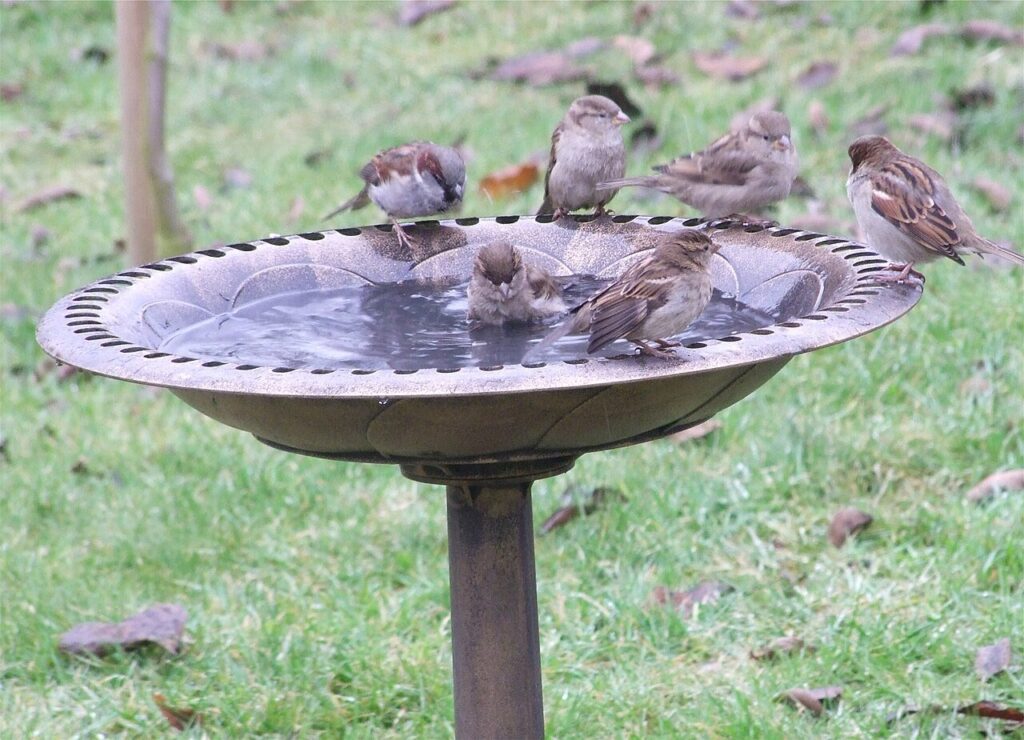
Apple cider vinegar in a bird bath is one of the most-searched bird bath tips on the internet, and it half works. Vinegar is an excellent bird bath cleaner. Vinegar added to the water the birds drink does very little, and the amounts people recommend are too small to matter either way. This page gives the straight answer, the routine that actually keeps algae down, and replies to the questions readers have left here over the past five years.
The short answer
As a cleaner: yes. A 50/50 mix of vinegar and water, a stiff brush, and a good rinse is the best weekly cleaning there is. It dissolves the mineral scale that algae anchors to, it kills most of what’s growing, and it leaves no residue. Apple cider and plain white vinegar work identically; white is cheaper.
In the water: not really. The usual advice is a teaspoon of apple cider vinegar per gallon. That’s a dilution of about 1 to 750, which changes the water’s acidity by almost nothing, and algae grows happily at that level. It won’t hurt the birds at that strength either. It just doesn’t do much. Adding enough vinegar to actually suppress algae (a cup or more per gallon) would make water birds won’t drink. So use vinegar to scrub, not to dose.
What actually keeps algae down
Algae needs three things: sunlight, still water, and nutrients (bird droppings, fallen seed, leaves). Take away any one and growth slows to a crawl. Take away two and a weekly scrub keeps it invisible.
Change the water every two or three days. This is the whole answer for most people. Algae takes about a week to establish; water that’s dumped and refilled twice a week never gets there. It also stops mosquitoes, which need the same week of still water. Tip the bath, swipe the bowl with your hand, refill. Thirty seconds.
Shade. A bath in dappled shade grows algae at a fraction of the rate of one in full sun, and the water stays cool enough that birds use it in July. Shade also matters for the birds’ safety; see the bird bath guide for placement.
Copper. Copper ions are mildly biostatic. A pure copper disc dropped in the bowl stretches the time between scrubs from a few days to a week or more. A few pre-1982 pennies do the same thing on a smaller scale; modern pennies are zinc with a copper wash and do nothing. Copper at these levels is harmless to birds.
Moving water. Algae struggles in water that circulates. A dripper, a small pump, or a solar fountain keeps the surface moving and draws more birds besides.
Weekly scrub. Whatever else you do, once a week: dump, scrub with the vinegar mix and a stiff utility brush kept for the purpose, rinse until it doesn’t smell, refill. Once a month, use a 10 percent bleach solution instead, rinse thoroughly, and let it dry in the sun before refilling; that kills the bacteria vinegar misses and matters most in summer when finch eye disease spreads at dirty water.
What not to put in the water
No bleach, no algaecide, no pond treatments, no dish soap, no essential oils, and no “a little bit” of any of them. Birds drink the water. Everything on that list either sickens them directly or strips the oils from their feathers so they can’t stay warm or fly well. Larvicide tablets sold for ponds are for ponds. If the algae is winning, the answer is more frequent water changes, not an additive.
Reader questions
Will apple cider vinegar on cotton balls keep squirrels off my feeder? No. Squirrels dislike the smell for about a day and then ignore it, and rain removes it anyway. What works is a pole baffle and placement; see how to keep squirrels out of bird feeders.
I’ve used white vinegar for months and it cut the algae, but in triple-digit heat the water still turned. That matches what we’d expect: the scrubbing is doing the work, and in extreme heat algae grows faster than a weekly scrub can keep up with. In a heat wave, change the water daily and move the bath into shade. A copper disc helps here more than anywhere.
Will the vinegar mix keep bees off my fountain? No, and you don’t want it to. Bees need water and will keep coming. Give them their own: a shallow dish of water with pebbles or corks to land on, ten feet from the bath, and most of them switch to it within a week.
There’s algae growing on the outside of our fountain. How do we clean it? Drain it, scrub the surface with the 50/50 vinegar mix and a brush, rinse hard, and let it dry in the sun for a few hours. For stone or concrete with deep staining, a paste of baking soda and water on the spot for twenty minutes, then scrub. Skip pressure washers on concrete; they open the pores and the algae comes back faster.
The article says to put the bath in shade but also to add a solar fountain. Which is it? Both, and you’re right that it reads as a contradiction. Buy a fountain with the solar panel on a cord, put the bath in the shade, and put the panel six feet away in the sun. The all-in-one floating fountains are the ones that don’t work in a shaded bath.
Is there a bird disease going around that means I should take my feeders and bath down? Periodically, yes. State wildlife agencies issue take-down advisories during outbreaks (finch eye disease, salmonellosis, and in 2021 a still-unexplained songbird illness in the mid-Atlantic). When your state says take them down, take them down for the period they ask, clean everything with the bleach solution, and put them back. Between advisories, the weekly scrub and monthly bleach are the protection.
Bottom line
Use vinegar to clean the bath, not to treat the water. Change the water twice a week, keep the bath in shade, drop a copper disc in it, and scrub weekly. That routine takes about five minutes a week and the algae never gets a foothold. Everything else on this page is a refinement.
Related: The ultimate bird bath guide · Why you should keep your bird bath clean · Essential rules for attracting birds
Huh! I never heard of this nifty trick for keeping algae out of bird baths. Yet another cool use for apple cider vinegar. Thanks for sharing!
Hrllo. Do you know anything about the bird disease here in the northeast causing crusting of the eyes and neurological systems. NJ Division of Fish and Wildlife is encouraging people to take down bird feeder and baths. Is there any natural treatment alternatives I can use instead. I have kept things clean. Thank you
A very useful method. Copper is also helpful in controlling the presence of bacteria in bird baths. I find that throwing in a few pennies helps keep the birdbath clean.
Hi Scarlett, so we have a big bubble or fountain in our bird sanctuary in our front yard. The birds love it and our bathing in it and drinking the water. We found growing algae on the outside and we wiped off the fountain and then I guess the algae water went into the water source and the water became green. So I cleaned out the water from the fountain and now it’s clear again. I’m looking at algicide‘s online and most of them are toxic to pets and animals but there are a few that say that they are not toxic to pets and animals, only to fish. I also found your post about Apple cider vinegar. What do you think about using the store purchased safe for animals algicide? If I use the Apple cider vinegar technique, when do I know to replace more Apple cider vinegar to compensate for the water Evaporation?
I’ve been using this method using white vinegar for 6 months now and have noticed 2 results. First it definitely cuts down on the green algae growth. Second, with the recent triple digit temperatures here in Southern California, there has been a relatively quick build up of clear, slimey goo clogging the solar fountain filter and coating the surfaces of the plastic bird bath (in as little as 1 day). Perhaps the birds themselves have provided the goo as they cool off in the heat. Even so, the growth of green algae has been greatly slowed.
Maybe you should switch to apple cider vinegar and see if the clear goo clears up?
If I add the Apple cider/water formula to my beautiful water fountain will it also deter the bees hoarding the water fountain? The bees are the problem. I don’t see a hive very close but there are hives on adjacent properties. I love feeding the birds and tending my garden. The bees have really increased this year with the summer heat in SoCal. I won’t harm the bees but what can I do?
-Chris in La Tuna Cyn.
Thank you for the apple cider suggestion. I would like to point out, however, that your post includes an interesting contradiction — one that I was aware of before, but baffled how to resolve (at least inexpensively). I have a solar powered fountain placed in my bird bath to prevent mosquito larvae. But to work, at least part of the time the birdbath must be in the sun! This, as you correctly point out, encourages algae and makes the water hot. In fact, to mitigate this, I freeze a small block of ice and add it to the bath most afternoons.
Any inexpensive suggestions?
I have heard that squirrels do not like apple cider vinegar. It smell and that you can put it on cotton balls on your birdfeeders to prevent squirrels from eating all your seeds. Has anyone tried this and do you know if it’s true?
Yes, apple cider vinegar can deter squirrels. Soak cotton balls in ACV and place them around the bird feeder. Refresh the vinegar regularly. Results may vary. Consider other deterrents like squirrel-proof feeders or spicy bird seed.