
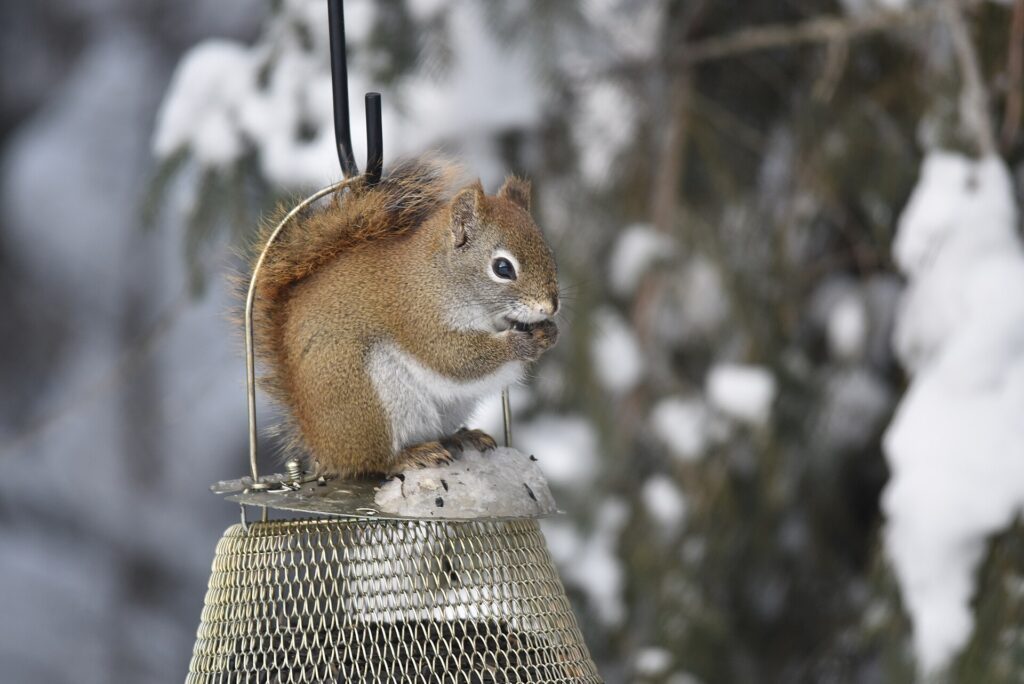
Squirrels will beat almost any single defense. They can jump five feet straight up, ten feet sideways, drop nine feet from a branch onto a feeder, chew through plastic, and remember every yard where the effort paid off. What they can’t beat is the combination that follows: the right feeder, a baffle, and a pole placed where nothing gives them a running start. This guide covers what works, in the order to try it, and the popular fixes that don’t.
Spark Lark is reader-supported. As an Amazon Associate we earn from qualifying purchases made through links on this page, at no extra cost to you.

The short version
- Best squirrel-proof feeder: Squirrel Buster Plus. Weight-activated shroud closes the ports under a squirrel.
- Best value feeder: Squirrel Buster Standard. Same mechanism, smaller capacity.
- The one that flings them: Droll Yankees Flipper. A motorized perch that spins when a squirrel’s weight lands on it.
- Cheapest fix that works: a pole baffle on a heavy-duty shepherd’s hook, placed by the 5-7-9 rule below.
- Change the menu: safflower seed or hot pepper seed. Birds eat both; squirrels won’t.
Step 1: The 5-7-9 rule
Before you buy anything, move the feeder. A gray squirrel can jump about five feet up from the ground, about seven feet sideways from a fence, deck rail, or tree trunk, and will drop about nine feet onto a feeder from a branch above. So the feeder needs to hang at least five feet off the ground, at least seven feet from anything a squirrel can climb (that includes the house), and with nothing overhead within nine feet. Most yards have one spot that qualifies, usually out in the open lawn, and most people have their feeder somewhere else because it looks nicer. Placement alone stops about half of squirrel problems. Everything below assumes you’ve done it.
Step 2: A pole and a baffle
Hang the feeder from a tall shepherd’s hook with a multi-prong base, then put a stovepipe or cone baffle on the pole at four to five feet. The squirrel climbs the pole, hits the inside of the baffle, and can’t get around it. That’s it. This is the setup every bird-supply store recommends first, it doesn’t cost much, and it protects every feeder on that pole, including the cheap ones. Two things make it fail: a baffle mounted too low (a squirrel just jumps over it from the ground) or a pole placed inside the 7-foot jump zone.
Step 3: A feeder that shuts them out
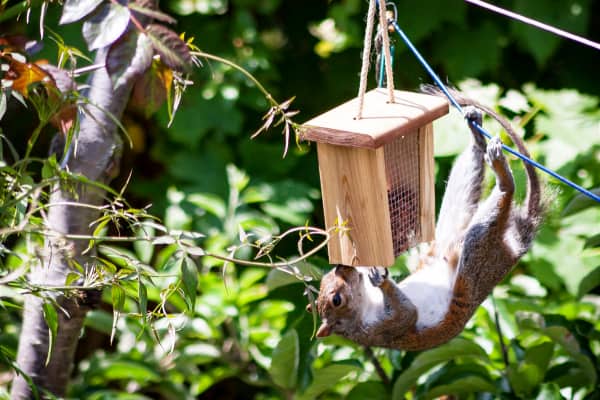
If you can’t meet the 5-7-9 rule (small yard, deck only, trees everywhere), the feeder itself has to do the work. Two designs actually hold up.
Weight-activated: Squirrel Buster
The Squirrel Buster Plus hangs from a spring. Birds are light enough that nothing happens; a squirrel’s weight pulls an outer shroud down over the feeding ports and the food is gone. It has a cardinal ring so cardinals can feed, holds five pounds of seed, and comes apart without tools for cleaning. It is not a grackle fix, though: Brome’s own page says it “will NOT deter Grackles, Starlings.” It’s one of the most recommended feeders in the category. The Squirrel Buster Standard is the same mechanism at 1.3 pounds capacity, and the right choice for a second feeder or a smaller yard.
Motorized: Droll Yankees Flipper
The Yankee Flipper has a battery-powered perch ring. A bird’s weight does nothing; a squirrel’s weight starts the motor and the ring spins, and the squirrel goes flying. It is the most entertaining thing you can put in a yard and it works. Downsides: you recharge the battery every few weeks, it’s pricey, and the motor is the weak point. Buy it because you want the show; buy the Squirrel Buster because you want it to be over.
Caged feeders
A tube feeder inside a wire cage with openings too small for a squirrel. They work for small birds and shut out squirrels and big birds alike, which is a feature if grackles and jays are also a problem. Cardinals can’t use them. Any caged tube feeder from a real brand works; the cheap ones on Amazon have cage openings big enough for a young squirrel, so check the spacing (1.5 inches is right).

Step 4: Serve food they don’t want
Two kinds of seed feed birds and bore squirrels. Safflower is a small white seed that cardinals, chickadees, titmice, house finches, doves, and nuthatches eat readily and squirrels (and grackles, and starlings) mostly ignore because of its bitter shell. Switch a feeder to straight safflower and the squirrels usually give up within a week; the birds take a few days to adjust.
Hot pepper seed is sunflower and nuts coated in capsaicin. Birds can’t taste heat at all; mammals can, and one mouthful sends a squirrel elsewhere. It works well and it’s the only option that protects a feeder you can’t move. It costs about twice as much as plain seed, and you wash your hands after filling. Wild Delight Sizzle N’ Heat is the standard. Don’t mix your own cayenne into seed; it’s cheaper but the powder blows into birds’ eyes and doesn’t coat evenly.
Step 5: Feed the squirrels somewhere else
This sounds like surrender and it’s actually strategy. A cheap platform on the far side of the yard with a scoop of dried corn or the cheapest seed you can buy keeps the squirrels busy where you don’t mind them and out of the feeder you care about. It works best combined with a baffle on the bird feeder, so the squirrels have an easy option and a hard one and pick the easy one.

What doesn’t work, and what hurts
Greasing the pole. Vaseline, cooking oil, and WD-40 all mat a squirrel’s fur so it can’t insulate, and in winter that can kill it. Birds that brush the pole get the same problem. A baffle does the job without the harm.
Mothballs. Naphthalene is a pesticide, it’s illegal to use outdoors in most states, it poisons pets and birds, and squirrels don’t care about it anyway.
Ultrasonic repellers. No controlled test has ever shown them to keep squirrels away from anything, and yard squirrels habituate to noise in days.
Coffee grounds, hair, predator urine, cayenne on the ground. Wash away in the first rain, and squirrels learn fast that nothing is behind the smell.
A Slinky on the pole. Funny, and it stops some squirrels for a while. A baffle stops all of them permanently.
Fishing line between branches. The old trick of hanging a feeder mid-span on monofilament fails because squirrels walk the line, and because the branches are within nine feet overhead anyway.
Our bird feeder pole guide compares complete setups, from a simple hook and baffle to a four-arm feeding station, plus raccoon baffles.
If your feeder sits on a pole or post, a baffle is the piece that stops climbing squirrels. Our squirrel baffle guide explains which kind to buy and where to mount it.
Common questions
Do squirrels scare birds away? Not permanently, but a squirrel sitting on a feeder keeps birds off it for as long as it’s there, and a feeder that’s occupied by squirrels half the day is effectively half a feeder. The bigger cost is seed: a pair of gray squirrels can empty a five-pound feeder in two days.
Will squirrels chew through a feeder? Plastic and thin wood, yes, especially the ports and the lid. If you’ve had one chewed, replace it with metal ports or an all-metal feeder; the Squirrel Buster line is chew-proof metal.
Do squirrels eat suet? Enthusiastically. Hot pepper suet cakes work the same way hot pepper seed does, and an upside-down suet feeder (birds cling from below, squirrels can’t) helps too.
Can squirrels get into a hummingbird feeder? They’ll drink nectar if they can reach it and will chew the ports. Hang it by the 5-7-9 rule or on a baffled pole like anything else.
What about chipmunks and raccoons? The same baffle handles chipmunks. Raccoons are heavier and smarter; bring feeders in at night for a week if one has found them, and use a larger stovepipe baffle rather than a cone.
Is it legal to trap and relocate squirrels? In many states it isn’t without a permit, relocated squirrels usually die, and the vacancy is filled within days. It doesn’t work and it isn’t worth the trouble.
Putting it together
Most yards are solved with the basic version: tall pole, baffle at four feet, placed by the 5-7-9 rule, safflower in the feeder for the first month. If that’s impossible because of the yard, the Squirrel Buster Plus on any hook you like ends the argument for good. Add a squirrel feeder across the yard if you want to watch them anyway, and put a window feeder on the glass; that’s the one place they can’t reach at all. For the rest of what makes a feeder work, see our guides to window feeders, winter feeder birds by region, and keeping grackles off feeders.
Squirrels are not the only ground raiders. If the seed is disappearing overnight, see will skunks eat bird seed.
Follow @sparklarkbirding for daily backyard birding tips →
Squirrels are pretty cute, but they’re pretty naughty. They come to my bird seed tray in search of food, and sometimes they even destroy the food tray. So, how to stop squirrels from eating bird seed?