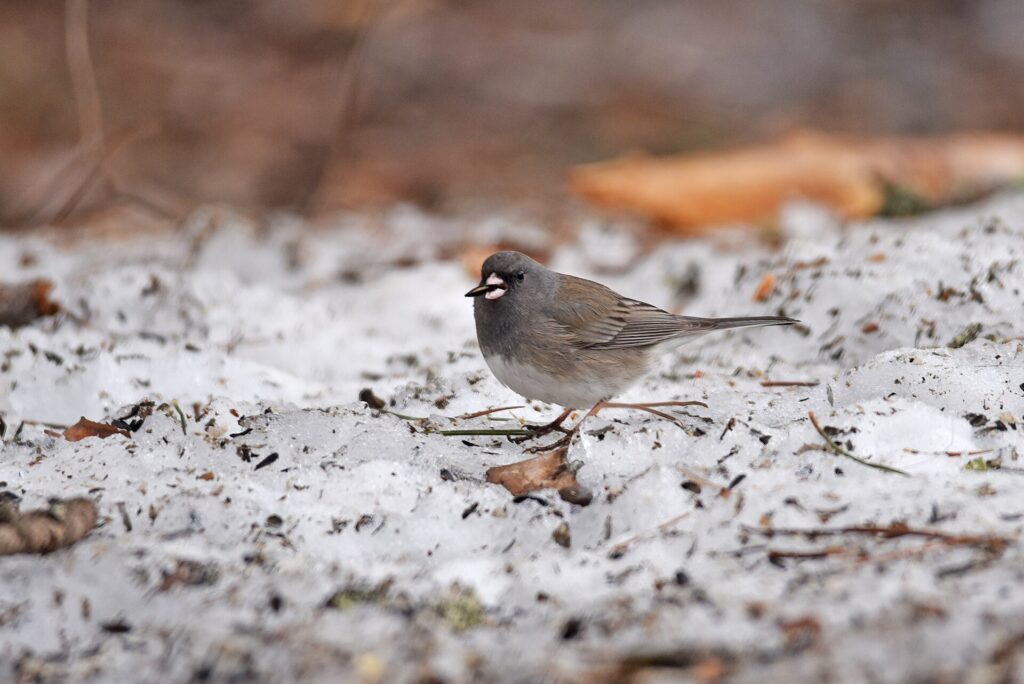
To help birds in a snowstorm, fill your feeders before the snow starts, keep high-fat food like black-oil sunflower seed and suet within reach while it falls, and clear or pack down the snow afterward so ground-feeding birds can find seed. Backyard birds are built for cold. What they struggle with is getting enough food when snow and ice bury it. A full, reachable feeder is the single most useful thing you can offer, and shelter and open water come next. Below is a step-by-step plan for before, during and after the storm, plus a free printable checklist to keep by the back door.
Free printable: the snowstorm bird checklist
We put the whole plan on one sheet: what to do the day before a storm, while the snow is falling, and once it stops. Tap or click the image to open the full-size version and print it. It’s free, with no signup.
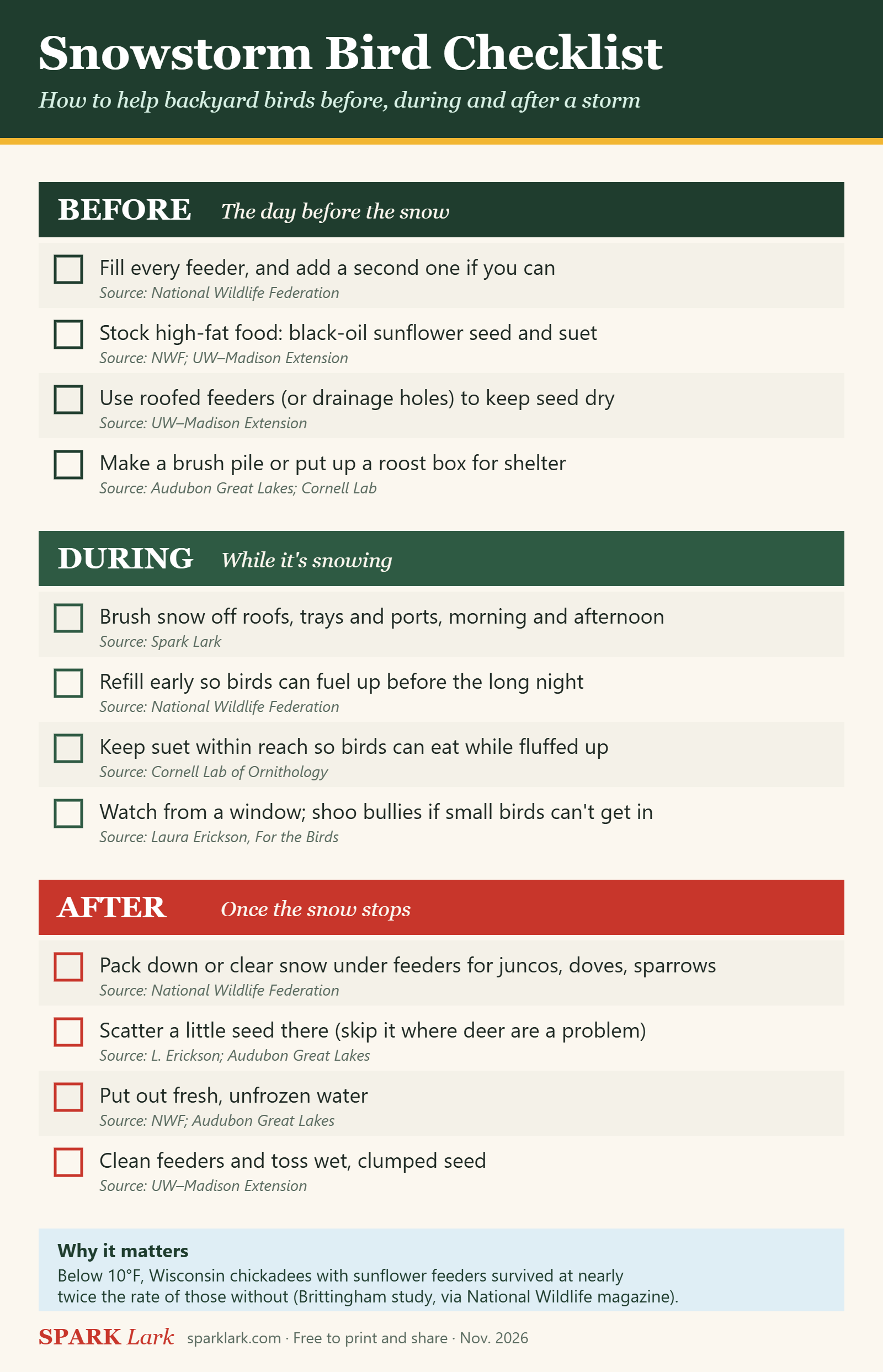
Source and method: Spark Lark checklist compiled Nov. 12, 2026 from the Cornell Lab of Ornithology’s All About Birds (“What do small birds do in a storm?” and “How birds survive the cold”); Audubon (“Gimme Shelter: How Do Birds Survive a Snow Storm?”, Jan. 2016; “How Do Birds Cope With the Cold Winter?”, Jan. 2024); Audubon Great Lakes (“Winter Bird Feeding 101”, Feb. 2024); the National Wildlife Federation (“Ten Simple Tips for Successful Winter Bird Feeding”); University of Wisconsin–Madison Extension (“Five Tips for Winter Bird Feeding”); and Laura Erickson’s For the Birds (“Ice Storm”, 2003). Each line on the sheet names its source.
Why a snowstorm is hard on backyard birds
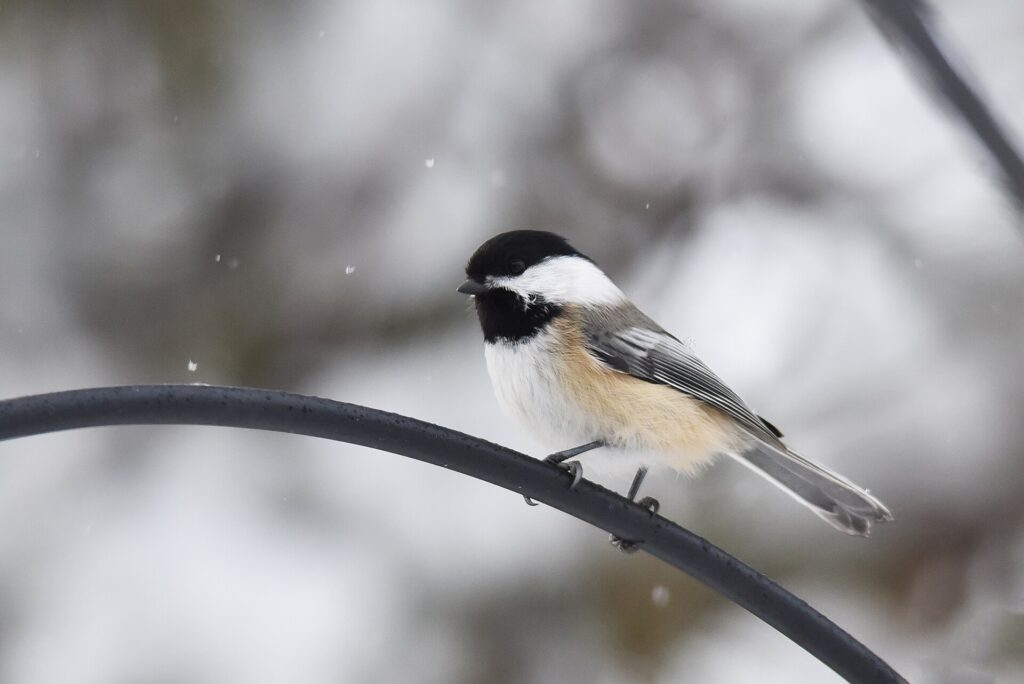
Cold by itself is not usually the problem. Audubon quotes Kenn Kaufman saying birds can handle extreme cold “as long as they get enough to eat.” Feathers trap warm air, and birds fluff up to add more insulated air pockets. Their legs and feet have counter-current circulation, which limits heat lost through bare skin. Our guide to how birds survive winter covers the full toolkit.
The trouble is fuel. Small birds burn through their reserves overnight and have to refill every day. In National Wildlife magazine, George Harrison described research on Alaska chickadees that gain at least 10 percent of their body weight in a day of feeding and burn that fat overnight shivering to stay warm. Audubon notes that fat can make up more than 10 percent of a small bird’s winter body weight. A storm that covers seeds and berries, or glazes branches with ice, cuts into the time they have to refuel.
That is where feeders matter most. In a Wisconsin study of 576 black-capped chickadees over three winters, Margaret Brittingham found that in harsh weather below 10°F, the survival rate of chickadees with access to sunflower feeders was nearly double that of birds without them (as reported by Harrison in National Wildlife). In milder weather the difference was much smaller, which is why the days around a storm are the ones that count.
Before the storm: get ready the day before
Birds often seem to know a storm is coming. Audubon’s Emily Silber writes that birds tend to forage more, and crowd feeders, when air pressure drops ahead of bad weather. Use the same window to get your yard ready.
Fill every feeder, and add one if you can
The National Wildlife Federation’s first winter tip is to use large feeders or several of them, because ample food matters most during snow and ice storms. Top everything off the day before. If you only have one feeder, a second one in a different style spreads out the crowd; UW–Madison Extension specialist Jamie Nack recommends several feeder types to cut down on competition.
Stock high-fat food
Fat packs more energy per gram than carbohydrates or protein, so the NWF suggests adding fatty foods in winter. Black-oil sunflower seed is the all-purpose choice: UW–Madison Extension notes it is high in fat with thin shells small birds can crack. Add suet for woodpeckers, nuthatches and chickadees. The Cornell Lab suggests placing suet where birds can feed while staying fluffed up. See what to feed birds in winter for a fuller menu, and when to put out suet if you haven’t started yet.
Choose feeders that keep seed dry
Wet seed clumps, freezes and molds. UW–Madison Extension recommends feeders with a roof or drainage holes, and a covered hopper or a tube with a dome over it will keep working through a long snowfall better than an open tray. Our checklist for preparing bird feeders for winter walks through the rest of the setup.
Put out shelter
Audubon Great Lakes recommends brush piles and nest boxes as storm shelter, since nest boxes double as winter roosting boxes. The Cornell Lab notes that bluebirds, chickadees, titmice, nuthatches and small woodpeckers may use a roost box, and that more than a dozen birds sometimes pile into a single box to save heat. Dense evergreens such as spruce and juniper also give much better cover than bare branches, Audubon says. If you have pruned branches or an old Christmas tree, a loose pile near your feeders gives sparrows and juncos somewhere to duck in. For boxes built for winter use, see our guide to birdhouses and roosting boxes.
During the storm: keep food reachable
You don’t need to stand in a blizzard. Two or three quick checks a day are enough, ideally in the morning, when birds are refueling after a cold night, and again in the afternoon.
- Brush off snow. Knock the snow off feeder roofs and trays, and clear the ports so seed can flow.
- Refill early. The NWF stresses keeping feeders full so birds can build up calories for long, cold nights.
- Keep suet out. Fat is the most energy-dense food you can offer, and Audubon Great Lakes lists woodpeckers, nuthatches, titmice and chickadees among suet’s regulars.
- Watch from inside. Birds use feeders hardest in bad weather. Audubon’s Gabrielle Saleh counted cardinals, juncos, bluebirds, woodpeckers and waxwings from her window over three days of a 2023 Texas winter storm.
If big birds are crowding out small ones, Laura Erickson found during a 2003 ice storm that briefly opening a window sent grackles off while smaller birds, like chickadees, were less bothered. A hawk can also show up where birds gather; our page on a hawk at your bird feeder explains what to do.
After the storm: clear the ground and fix the water
Once the snow stops, birds that feed on the ground have the hardest time. Snow buries fallen seed under the feeder, and ice can lock in everything else.
Pack down or clear a feeding patch
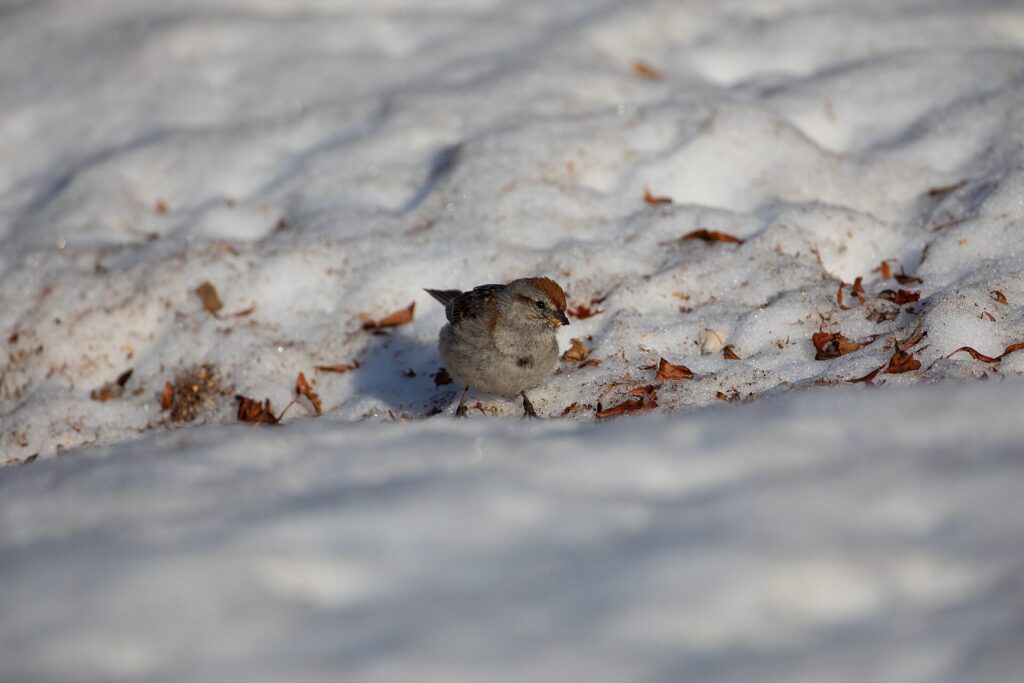
The NWF recommends packing down the snow under your feeders so ground feeders such as juncos, doves and sparrows can reach seed. After an April ice storm, Laura Erickson refilled her feeders and scattered seed on the ground for juncos as soon as she could, and Fox Sparrows in her yard built to about 30 by the next afternoon. Kaufman told Audubon that after one big Ohio snow, American Tree Sparrows at his feeder went from one to more than 70. A small cleared or tamped-down patch near cover is enough.
One caution: Audubon Great Lakes advises against putting seed directly on the ground, because it gathers large numbers of birds and draws deer and other animals. If deer or other visitors are a concern where you live, skip the scattering and just pack the snow under your feeders, where spilled seed already lands. Meet the regulars you’ll be feeding in our guides to dark-eyed juncos and common winter sparrows.
Offer open water
Birds can dehydrate even when they’re surrounded by snow and ice, the NWF notes. Set out a shallow pan of fresh water on milder days, or use a heated bird bath. Audubon Great Lakes suggests a sturdy bath in a sunny spot and fresh water every other day if possible. Our guide on how to keep a bird bath from freezing covers heaters and simple tricks.
Clean up once the weather settles
Storms crowd birds together and soak seed, and dirty feeders can spread disease. UW–Madison Extension recommends cleaning with a 10 percent non-chlorinated bleach solution whenever wet, moldy seed or droppings build up. Audubon Great Lakes suggests every one to two weeks, with a 9-to-1 water-to-bleach mix. Toss clumped seed from the bottom of tubes and trays. Our feeder cleaning guide has the step-by-step.
Quick reference: before, during and after
| When | What to do | Why |
|---|---|---|
| Day before | Fill every feeder; add a second feeder if you can | Ample food matters most in snow and ice storms (NWF) |
| Day before | Stock black-oil sunflower and suet | Fat gives the most energy per gram (NWF) |
| Day before | Use roofed feeders; set out a brush pile or roost box | Dry seed; shelter from wind (UW Extension, Audubon Great Lakes) |
| During | Brush snow off feeders 2–3 times a day; refill early | Snow blocks the ports; full feeders help birds build calories for the night (NWF) |
| During | Keep suet within reach | Birds can feed while staying fluffed up (Cornell Lab) |
| After | Pack down or clear a patch; scatter a little seed | Juncos, doves and sparrows feed on the ground (NWF, Erickson) |
| After | Offer open water | Birds can dehydrate in snow and ice (NWF) |
| After | Clean feeders, toss wet seed | Crowding and damp seed spread disease (UW Extension) |
Common questions
Should I stop feeding birds if I’ll be away during a storm?
Try not to stop suddenly in the middle of winter. UW–Madison Extension notes that birds come to depend on feeders for part of their diet, and the NWF suggests asking a neighbor or friend to refill your feeders if you travel.
Will birds freeze to death in a snowstorm?
Most backyard birds handle cold well if they can eat. Chickadees and kinglets can even lower their body temperature at night to save energy, according to the Cornell Lab. Harrison wrote that black-capped chickadees can drop about 12 to 15°F below their normal daytime temperature of about 108°F, which saves almost 25 percent of their hourly energy use at freezing temperatures. The risk rises when snow and ice keep them from refueling, which is why food matters more than anything else you can do.
Where do birds go during a blizzard?
Into the thickest cover they can find. The Cornell Lab says cavity-roosting birds like chickadees and woodpeckers shelter in tree holes and roost boxes, while songbirds such as cardinals and sparrows perch on thick branches close to the trunk on the sheltered side of the tree. Their feet lock around the branch automatically, so they can sleep without falling off.
Is it OK to put feeders closer to the house in a storm?
Yes, as long as you think about windows. UW–Madison Extension recommends placing feeders either within 3 feet of a window or more than 30 feet away to prevent collisions, and about 10 feet from shrubs so cats can’t ambush birds. More on that in why birds crash into windows.
What can I do with all the birds I’m seeing?
Count them. Storm days are some of the busiest at feeders, and our free Project FeederWatch tally sheet makes it easy to log who shows up.
Bottom line
Birds don’t need you to keep them warm. They need help getting enough food while snow and ice cover their natural food. Fill feeders with black-oil sunflower and suet before the storm, brush them off and refill early while it snows, then clear a patch on the ground and put out water once it stops. Add a brush pile or roost box, and your yard becomes one of the best places in the neighborhood to ride out the weather.