Birds survive the winter with a stack of tricks rather than one big one: they eat a huge share of their body weight every day, fluff their feathers into an insulating coat, keep their legs and feet cold on purpose, and spend long nights tucked into tree holes, dense evergreens, snowbanks or a pile of their own kind. A few small birds even let their body temperature drop at night to save fuel. The chart below shows which of these tricks are documented for nine birds you might see this winter, and the rest of this guide explains how each one works and what you can do in your yard to help.
Chart: the winter survival tricks of 9 backyard birds
We built this chart from the sources listed under it. Each check mark is a behavior that a source we read documents for that bird. An empty circle does not mean the bird never does it; it means our sources didn’t cover it for that species.
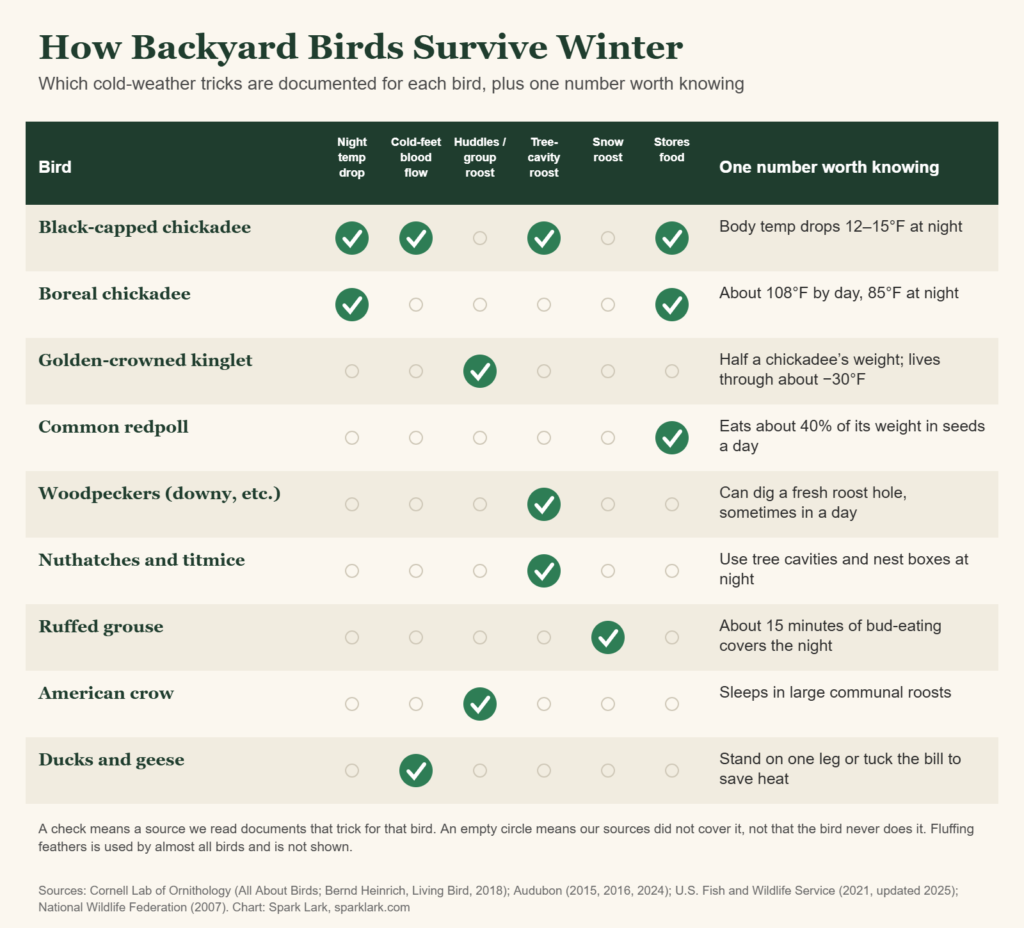
Source and method: Spark Lark chart compiled Oct. 2026 from the Cornell Lab of Ornithology (All About Birds Black-capped Chickadee page; Bernd Heinrich, “How Do Birds Survive the Winter?”, Living Bird, Dec. 2018), Audubon (BirdNote on the Boreal Chickadee, 2015; Common Redpoll, 2016; “How Do Birds Cope With Cold Winter Weather?”, 2024), the U.S. Fish and Wildlife Service (“How do birds keep warm in the winter?”, 2021, updated 2025) and National Wildlife (“How Chickadees Weather Winter”, 2007). Numbers are rounded as the sources give them.
The short answer: calories in, heat kept in
Writing for the Cornell Lab’s Living Bird magazine, biologist Bernd Heinrich sums up the winter plan of most birds as taking in as many calories as they can while spending as few as they can. Everything else on this page is a variation on that theme. A bird that stays north for the winter has to do two things at once: find enough food in short, cold days, and hold on to the heat that food makes through long, cold nights.
For small birds, food is usually the harder part. Heinrich notes that for chickadees, food is the more critical factor for getting through the winter.
1. They eat a startling amount every day
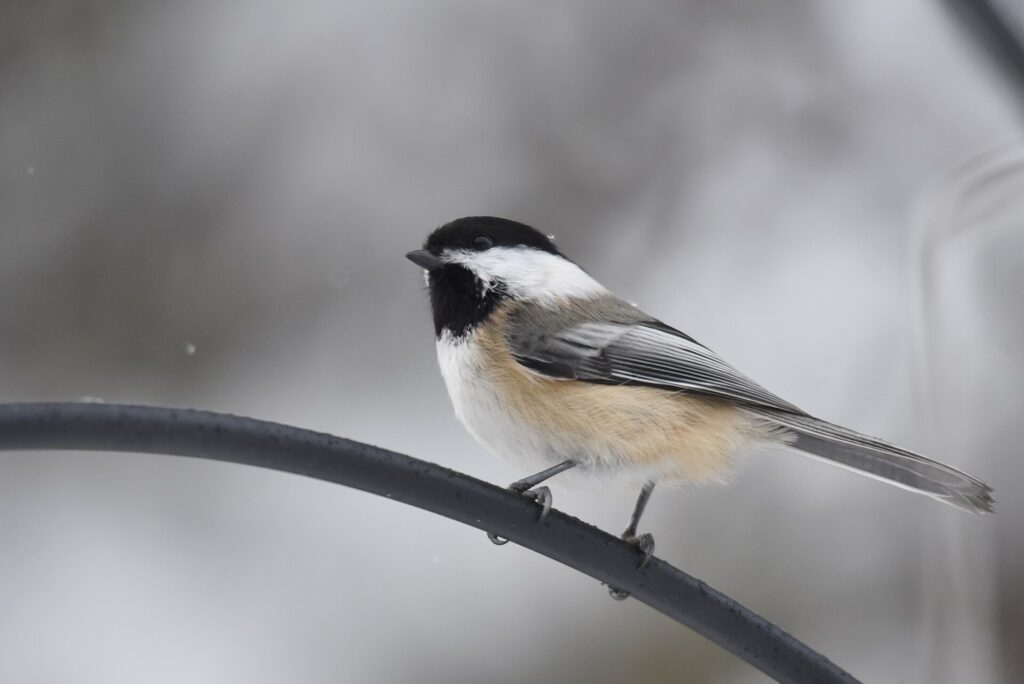
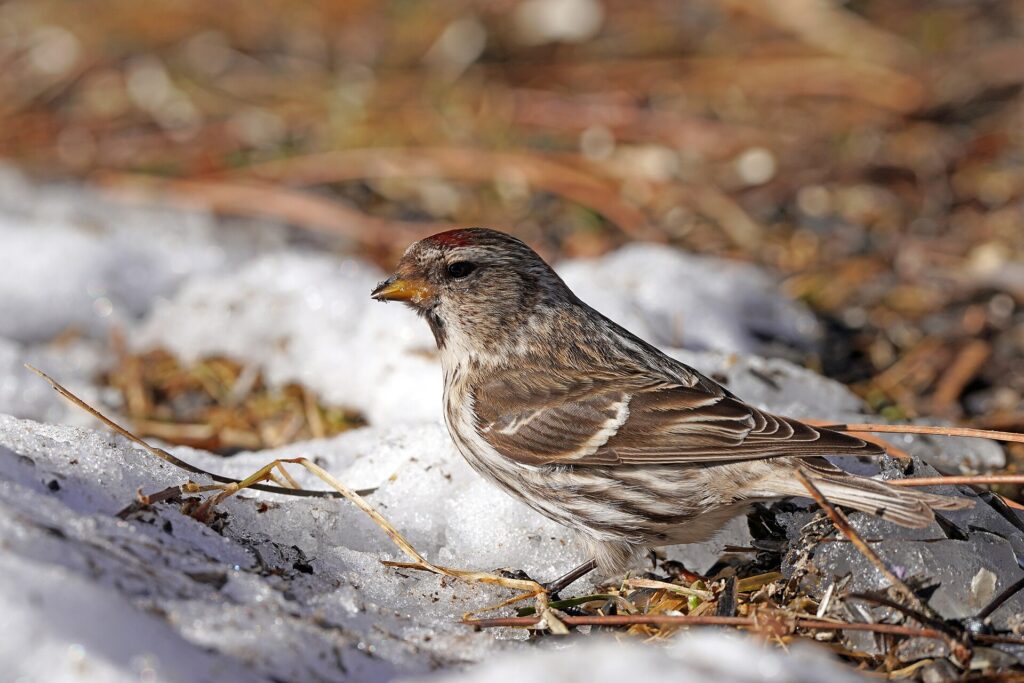
Small birds burn energy fast, so winter is one long refueling job. According to the U.S. Fish and Wildlife Service, a black-capped chickadee weighs less than half an ounce and eats more than 35% of its body weight every day. The common redpoll, a little finch from the far north, eats about 40% of its body weight in seeds daily, according to Audubon.
Much of that food goes into fat, which is both fuel and insulation. Audubon notes that for small birds like chickadees and finches, fat can be more than 10% of their winter body weight. In Alaska, National Wildlife reported that chickadees put on an extra 10% or more of their body weight each day to make it through nights that last about 18 hours.
Want to see who is fueling up in your yard? Our free backyard bird ID chart by color (no signup) covers the usual winter feeder crowd, and our guide to what to feed birds in winter lists the high-fat foods that do the most good.
2. They store food for later
Some birds don’t just eat; they save. Chickadees hide seeds and other food in many separate spots, and the Cornell Lab says a chickadee can remember thousands of hiding places. Audubon puts the upper end at up to 80,000 seeds stored by a single chickadee. The U.S. Fish and Wildlife Service adds that the chickadee’s hippocampus, the part of the brain tied to spatial memory, grows larger in the fall, right when all that hiding begins.
The boreal chickadee of the northern forests caches insects and spruce seeds in bark crevices and under lichen in summer, according to BirdNote on Audubon. Redpolls take a different approach: they carry seeds in an expanded part of the esophagus, a built-in storage pouch, and feed heavily on birch and alder seeds that stay on the trees through winter. Ravens, Heinrich notes, cache surplus food too.
3. They fluff up and keep their feathers in top shape
A puffed-up bird on a cold morning isn’t fat or sick; it’s wearing a down jacket. Audubon explains that fluffing creates hundreds of air pockets between the feathers, and that trapped air holds body heat in. The boreal chickadee grows a fresh, heavier coat each fall, with feathers denser than most birds’, according to BirdNote.
Insulation only works if the feathers are clean and dry, so preening is winter maintenance. The U.S. Fish and Wildlife Service notes that many birds spread oil from a gland near the base of the tail to weatherproof their feathers, while egrets, herons and mourning doves make a fine powder that does a similar job. That is also why a clean, unfrozen water source helps in winter; our guide on how to keep a bird bath from freezing covers the options.
4. They keep their legs and feet cold on purpose
Bare legs and feet would leak heat fast, so birds don’t keep them warm. Heinrich writes that chickadees hold their legs and feet near freezing, about 30°F, using countercurrent blood flow: warm blood heading down the leg passes right next to cold blood coming back up, so the heat moves back into the body instead of out through the toes. Waterfowl use the same countercurrent heat exchange, according to the U.S. Fish and Wildlife Service, and their scaled legs and feet lose less heat.
Bird feet are mostly bone and tendon with very little muscle, Audubon notes, so there is little tissue to keep warm in the first place. Behavior helps too: ducks, geese, gulls, pelicans and swans stand on one leg or sit down to cover their feet, and Canada geese tuck their bills under their back feathers, per the U.S. Fish and Wildlife Service. Smaller birds often just crouch, Audubon notes.
5. Some let their body temperature drop at night
The more a bird’s body temperature differs from the air, the faster it loses heat. So some small birds narrow the gap. National Wildlife reported that chickadees lower their body temperature about 12 to 15°F below their normal daytime temperature of about 108°F, which at freezing saves almost 25% of the energy they would burn each hour. The colder the night, the more they save.
The boreal chickadee goes further. BirdNote, published by Audubon, reports that it drops from about 108°F to just 85°F at night, which helps it hold on to its fat until morning. This is a controlled nightly chill, not hibernation: by daybreak the bird warms up again and goes back to feeding.
6. They pick their bedrooms carefully
Where a bird spends the night can matter as much as what it ate that day. Different birds solve it in different ways:
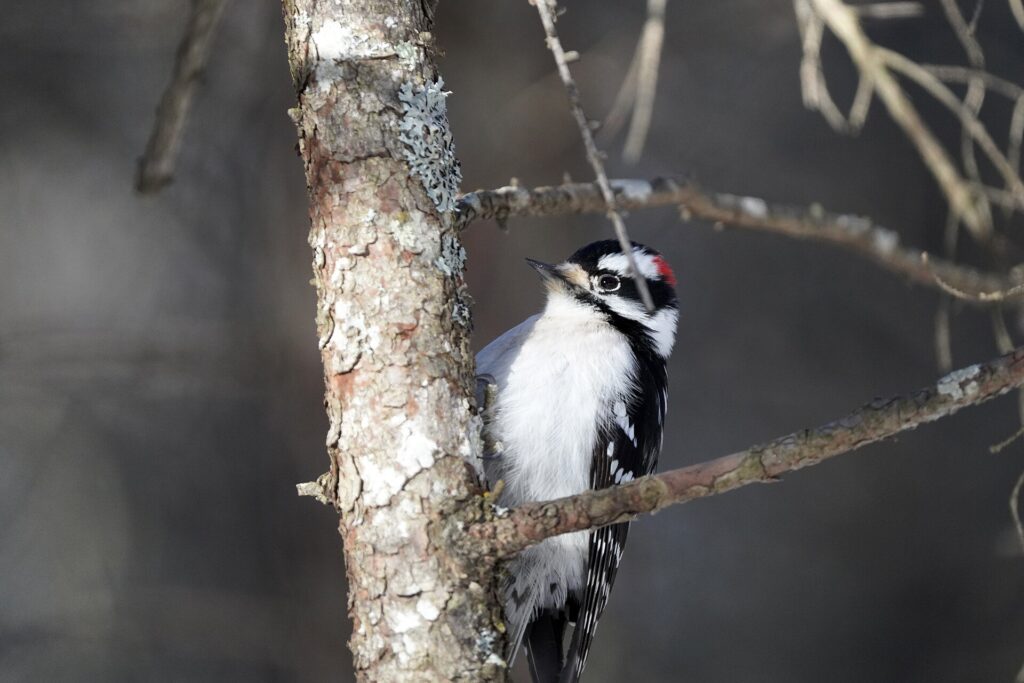
- Tree cavities and nest boxes. Nuthatches, titmice and downy woodpeckers shelter in tree cavities and nest boxes, according to the U.S. Fish and Wildlife Service. The Cornell Lab notes that chickadees almost always sleep in their own individual cavities, even when temperatures are far below zero. Woodpeckers can dig a fresh roost hole, often within about 6 feet of the ground and sometimes in a single day, Heinrich writes.
- Dense cover. Audubon says denser trees and shrubs suit small birds like titmice and juncos, and that tree crooks and buildings also block the wind. The U.S. Fish and Wildlife Service also suggests evergreens as winter cover.
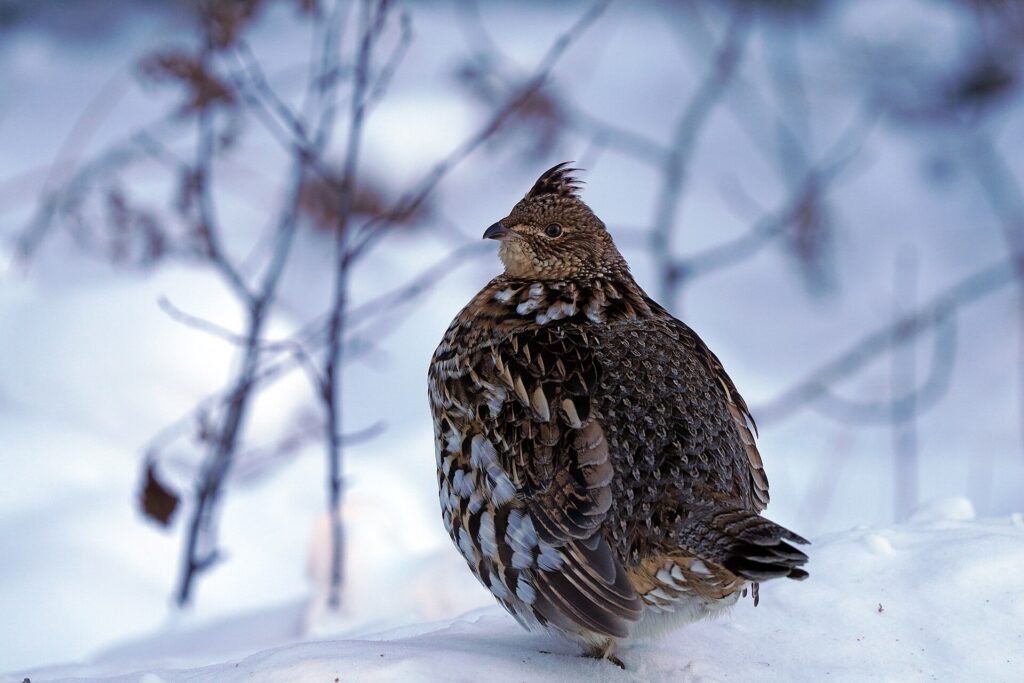
- Under the snow. Ruffed grouse spend much of the winter day under the snow, which insulates them and may also hide them from predators, according to Heinrich. They can fill up on tree buds in about 15 minutes, enough to cover their overnight needs.
A roosting box is one of the few ways you can add shelter to a yard quickly. Our guide to the best birdhouses and winter roosting boxes explains what makes a box work for winter nights.
7. They huddle together
Sharing body heat works for birds just like it does for people. Golden-crowned kinglets weigh about half as much as a chickadee and still survive temperatures near −30°F; Heinrich found that they spend the night pressed together in a tight group on a twig rather than in a sheltered hole. Tree swallows huddle in shrubs, vines and evergreens, and American crows and ring-billed gulls flock together, according to the U.S. Fish and Wildlife Service.
Crows and ravens take it further with large communal roosts. Heinrich notes those roosts also help the birds share information about where food is and spread out the risk from predators.
How tough are they? A few winter numbers
| Bird | Winter number | Source |
|---|---|---|
| Common redpoll | Under 15 grams, yet survives temperatures nearly 100 degrees below freezing | U.S. Fish and Wildlife Service |
| Common redpoll | Eats about 40% of its body weight in seeds a day | Audubon |
| Black-capped chickadee | Less than half an ounce; eats more than 35% of its body weight a day | U.S. Fish and Wildlife Service |
| Black-capped chickadee | Drops body temperature 12–15°F at night, saving almost 25% of hourly energy at freezing | National Wildlife |
| Black-capped chickadee | Can store up to 80,000 seeds | Audubon |
| Boreal chickadee | About 108°F by day, about 85°F at night | BirdNote / Audubon |
| Golden-crowned kinglet | About half a chickadee’s weight; survives temperatures near −30°F | Cornell Lab (Heinrich) |
| Ruffed grouse | About 15 minutes of feeding on buds covers its overnight needs | Cornell Lab (Heinrich) |
Do feeders really help birds survive the winter?
There is good evidence that they can, especially in hard weather. National Wildlife described a study that followed 576 black-capped chickadees over three Wisconsin winters in the 1980s. In harsh weather, below 10°F, survival nearly doubled for chickadees that ate sunflower seeds at feeders.
The U.S. Fish and Wildlife Service lists several simple ways to help:
- Offer high-energy food: suet, peanuts and black oil sunflower seeds. Our suet feeder guide covers feeders that work for woodpeckers, nuthatches and chickadees.
- Keep clean water open. A heated bird bath helps; see our guide to the best heated bird baths.
- Add shelter: roosting boxes, dead trees left standing where they’re safe, and evergreens.
- Plant native trees and shrubs that hold fruit into winter, which feed birds such as cedar waxwings.
If you want to put those feeder visits to use, the Cornell Lab’s Project FeederWatch season starts Nov. 1; our free FeederWatch tally sheet (no signup) makes counting easy.
FAQ
Why don’t birds’ feet freeze?
Their feet are mostly bone and tendon, and countercurrent blood flow keeps them cold but above freezing. Heinrich puts a chickadee’s feet at about 30°F in winter, which cuts the heat they lose.
Why do birds look fat in winter?
Mostly they’re fluffed up. Raised feathers trap air that holds body heat. Small birds also carry more fat in winter, which Audubon says can be more than 10% of their body weight.
Where do birds sleep in winter?
It depends on the bird: chickadees, nuthatches, titmice and woodpeckers use tree cavities and nest boxes; juncos and other small birds tuck into dense shrubs and evergreens; kinglets huddle on a twig; ruffed grouse burrow under snow; crows gather in large roosts.
Which birds stay for the winter?
It varies a lot by region. Our winter backyard birds by region guide covers the common ones, and the dark-eyed junco is a good example of a bird that shows up in many yards only in winter.
Bottom line
Birds get through winter by eating a lot, storing food, fluffing their feathers, keeping their feet cold, choosing sheltered roosts, huddling and, in some small species, letting their body temperature drop overnight. You can’t change the weather, but high-energy food, open water and a little shelter make each of those strategies easier, and a study of Wisconsin chickadees suggests feeders can make a real difference when the weather turns harsh.