When people ask what it means when you see a cardinal, they usually mean the popular belief that a cardinal is a visit from someone who has died. That idea is folklore, a modern saying that sits alongside much older cardinal stories, and there is no scientific evidence that birds carry messages. The biology has its own answer: you see cardinals because they stay in the same place all year, the males stay bright red all winter, they come readily to feeders, and over the past century they have spread far north. Below we cover the beliefs as cultural history, the real biology behind each one, and a chart of where cardinals have become more common since 1966.
The short version
- The folklore: Cardinals are widely seen as messengers or visits from loved ones. A Cherokee story recorded in 1900 says the redbird is “the daughter of the Sun.”
- The name: The bird was named for the red robes of Roman Catholic cardinals.
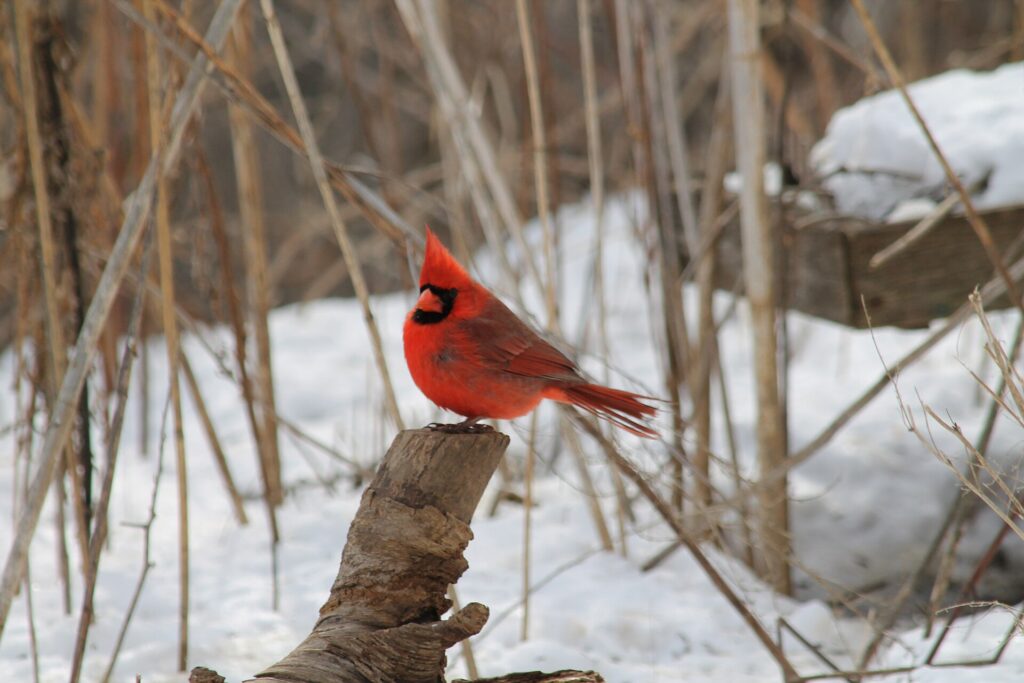
- The biology: Cardinals don’t migrate and don’t molt into dull winter feathers, so a red male against snow is hard to miss.
- The trend: Cardinals have pushed north for about a century. On U.S. Breeding Bird Survey routes they went from rare to common in parts of New England and more than doubled in New York, Michigan and Wisconsin.
Why more people see cardinals than ever: they moved north
One reason cardinals feel so meaningful to so many people is simply that more people live near them now. Audubon notes the northern cardinal’s U.S. range was once mostly southern and that it began spreading north in the early 1900s. A 1960 report cited by The Nature Conservancy says cardinals first nested in southern Connecticut around 1943 and in eastern Massachusetts in 1958. Researchers point to a mix of causes: shrubby suburbs and woodland edges, milder winters, and backyard feeders full of sunflower seed.
We wanted to see that spread in numbers, so we pulled the Northern Cardinal rows from the U.S. Geological Survey’s newest Breeding Bird Survey release and charted every state with enough data.
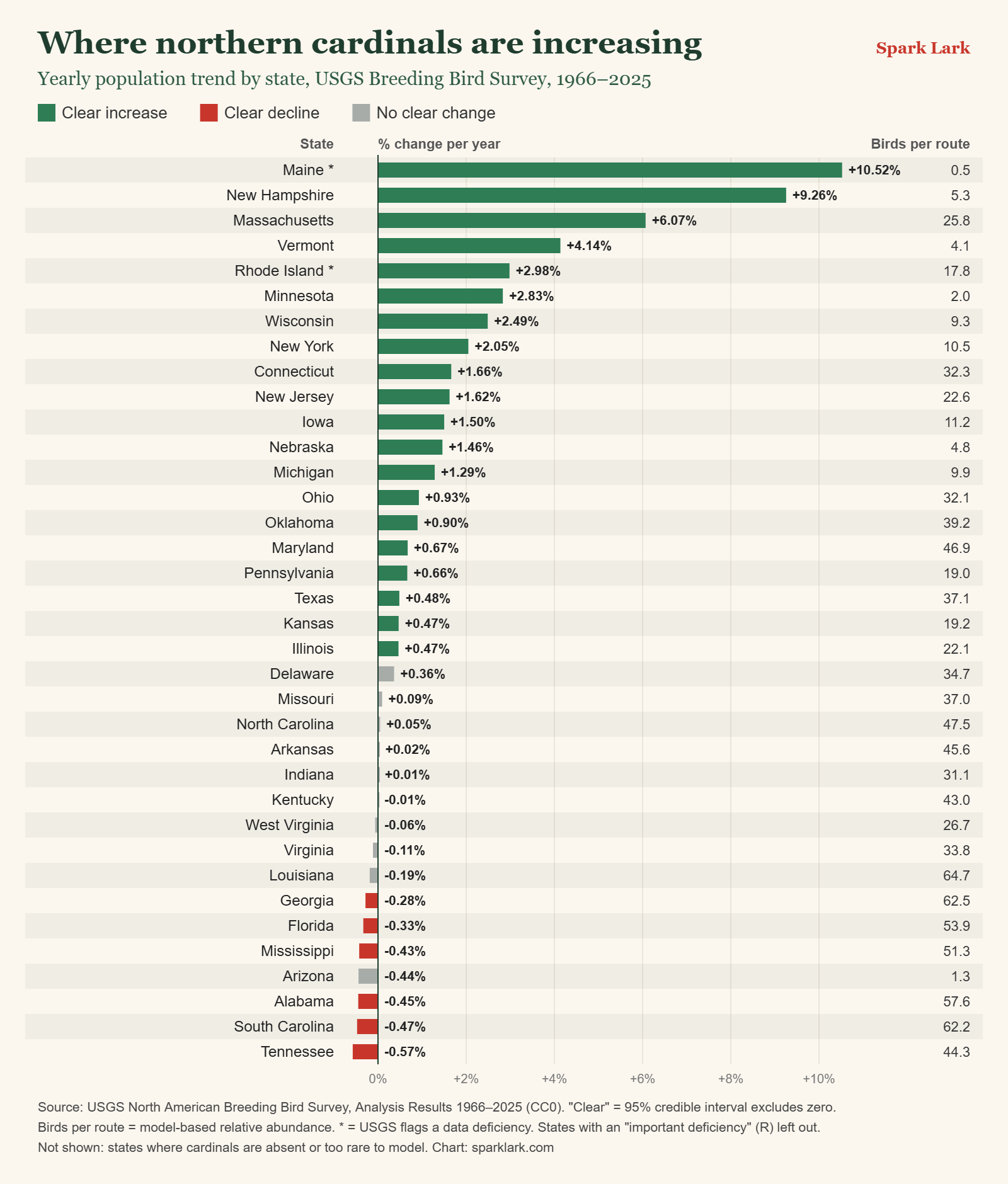
The pattern is clear. The biggest gains are in New England and the upper Midwest, where cardinals were scarce in the 1960s. Across much of the Southeast, where cardinals have always been common, survey counts are flat or slightly down. Southern routes still count far more cardinals per route than northern ones; the North is catching up, not taking over.
| State | Trend per year | Change since 1966** | Birds per route (2025 model) |
|---|---|---|---|
| Maine | +10.5% | rare to common* | 0.5 |
| New Hampshire | +9.3% | rare to common | 5.3 |
| Massachusetts | +6.1% | rare to common | 25.8 |
| Vermont | +4.1% | rare to common | 4.1 |
| Minnesota | +2.8% | +405% | 2.0 |
| Wisconsin | +2.5% | +326% | 9.3 |
| New York | +2.0% | +231% | 10.5 |
| Michigan | +1.3% | +113% | 9.9 |
| Ohio | +0.9% | +72% | 32.1 |
| Pennsylvania | +0.7% | +48% | 19.0 |
| Texas | +0.5% | +32% | 37.1 |
| North Carolina | +0.05% | about the same | 47.5 |
| Virginia | −0.1% | about the same | 33.8 |
| Georgia | −0.3% | −15% | 62.5 |
| Florida | −0.3% | −18% | 53.9 |
| Alabama | −0.4% | −23% | 57.6 |
| Tennessee | −0.6% | −29% | 44.3 |
| United States overall | +0.1% | +8% | 28.6 |
Source and method: USGS, The North American Breeding Bird Survey, Analysis Results 1966–2025 (Hostetler, Sauer, Hines, Ziolkowski, Lutmerding and Skalos; public domain, CC0). “Trend per year” is the USGS estimate of average yearly change in birds per route. Green means the 95% credible interval is entirely above zero, red entirely below. **Change since 1966 is our calculation: (1 + yearly trend)years − 1. Where that number tops 500%, we write “rare to common,” because the starting count was tiny. *USGS flags Maine’s estimate for a data deficiency. These are June roadside counts of breeding birds, not winter feeder counts.
The “visitor from heaven” belief
The best-known cardinal belief today is that a cardinal in your yard is a loved one stopping by. You’ll find the line “cardinals appear when angels are near” on sympathy cards and social media posts, and many people share stories of a cardinal showing up on a hard day. We could not find a documented origin for that exact saying; it reads as modern popular culture rather than an old proverb.
It’s easy to see why the bird fits the role. A cardinal is bright, familiar and present in every season, including the gray months when little else is blooming or singing. Treating a cardinal as a reminder of someone is a personal choice, and many people find it comforting. What the science can say is narrower: cardinals are not rare visitors. If you have one around, it most likely lives nearby and will be back.
Cardinals in Cherokee storytelling
Two older cardinal stories come from the Cherokee, collected by ethnologist James Mooney and published in 1900 in Myths of the Cherokee (Bureau of American Ethnology). The redbird appears in both.
- “The Daughter of the Sun.” A group of men try to bring the Sun’s daughter back from the land of the dead in a closed box. When they lift the lid a crack on the way home, something flutters out and a redbird calls from the bushes. The story ends: “So we know the Redbird is the daughter of the Sun.” It also explains why the dead cannot be brought back.
- “How the Redbird Got His Color.” A small brown bird frees a wolf whose eyes a raccoon had sealed shut. In thanks, the wolf leads him to a rock streaked with red paint, and the bird paints himself and has been a redbird ever since.
Mooney’s versions were written down by an outsider more than a century ago, so they are one record of Cherokee tradition, not the whole of it. They are notable because they tie the redbird to the sun, to the dead and to a gift for a kindness, themes that echo in how people talk about cardinals today.
How the cardinal got its name
According to Audubon, the name comes from the bright red plumage, which resembled the robes and caps of Roman Catholic cardinals. The scientific name is Cardinalis cardinalis. Older regional names include redbird, Virginia redbird and Virginia nightingale. The word “Northern” was added in 1983 to set it apart from other cardinal species farther south. A group of cardinals is sometimes called a “college,” “conclave” or “Vatican,” a nod to the same church theme.
From cage bird to state bird
Cardinals were prized for their color and song in the 1700s and 1800s. Thomas Jefferson’s Monticello notes that thousands were trapped and kept as pets, many shipped as far as Europe, and that Jefferson himself tried to get one through James Madison in 1788. The 1918 Migratory Bird Treaty Act made trapping and keeping them illegal.
Today the northern cardinal is the state bird of seven states, per the Cornell Lab of Ornithology: Illinois, Indiana, Kentucky, North Carolina, Ohio, Virginia and West Virginia.
Why the cardinal became the Christmas card bird
A column from Georgia’s Wildlife Resources Division calls the cardinal the bird found on more Christmas cards than any other and traces the link to its color: red like a cardinal’s robe and Santa’s suit, set off by the red and green of holiday decorations. The column also points out the irony that cardinals don’t live in Europe or the Holy Land. The tie is still going strong; the U.S. Postal Service’s 2025 holiday stamps include a design of northern cardinals on a mistletoe branch.
The real biology: why cardinals stand out in winter
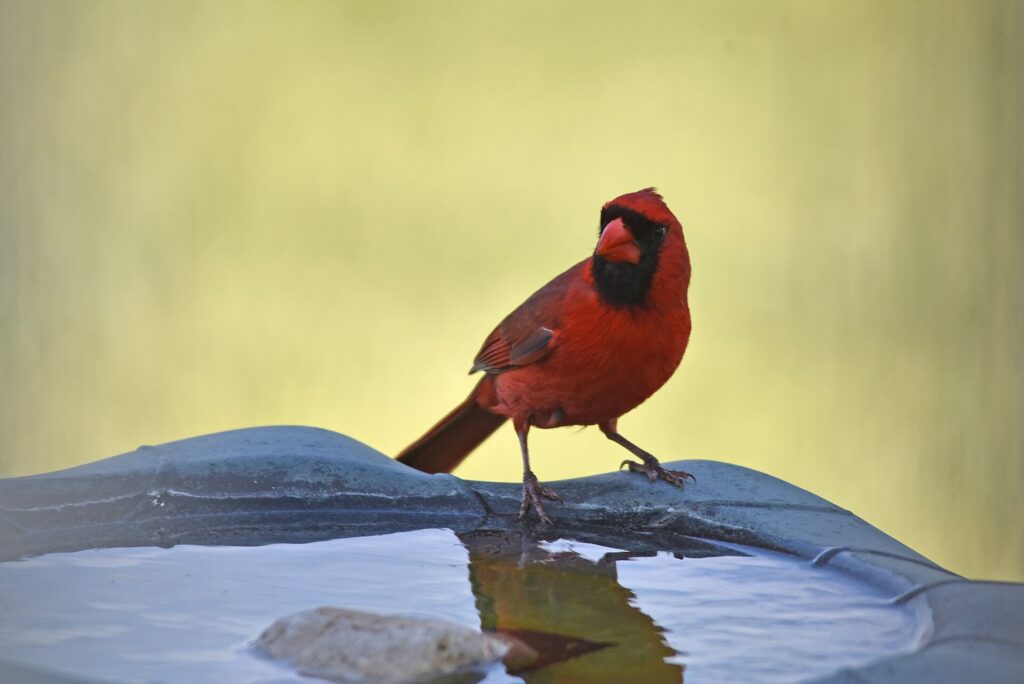
Most of what makes cardinals feel like a “sign” is how visible they are in winter. The Cornell Lab sums it up: cardinals don’t migrate and don’t molt into a dull plumage. Several facts work together:
- They stay put. Audubon lists the northern cardinal as a permanent resident throughout its range. The cardinal you see in January may well be one you saw in June.
- The red comes from food. Cardinals get carotenoid pigments from fruits such as wild grapes, sumac and honeysuckle. Maine Audubon notes they molt once a year, usually in August or September, so the red they grow then carries them through winter.
- They flock in winter. Cornell says cardinals form fall and winter flocks of a dozen to several dozen birds, which is why a snowy yard can suddenly hold many of them.
- They love feeders. Cornell notes they eat a lot of birdseed, especially black oil sunflower seed, so they are regulars at backyard feeders.
What it means when you see a cardinal: folklore vs. biology
Here are the most common cardinal moments people ask about, with the folk meaning side by side with what is actually going on.
| What you saw | What folklore says | What biology says |
|---|---|---|
| A cardinal shows up soon after someone dies | Many people read it as a visit or a sign from the person they lost. | Cardinals stay in the same area all year and come readily to feeders, so they are often the first bright bird people notice when they spend time outside or at a window. |
| A cardinal keeps hitting or pecking your window | Some take it as a message. | Both males and females attack their own reflection while defending a territory in spring and early summer. It usually fades in a few weeks. |
| You see a pair together in winter | A symbol of lasting love. | Cardinal pairs may stay together through winter, though up to 20% split up by the next season. |
| A dozen or more cardinals at once | Abundance, good fortune. | Cardinals gather in fall and winter flocks of a dozen to several dozen birds. |
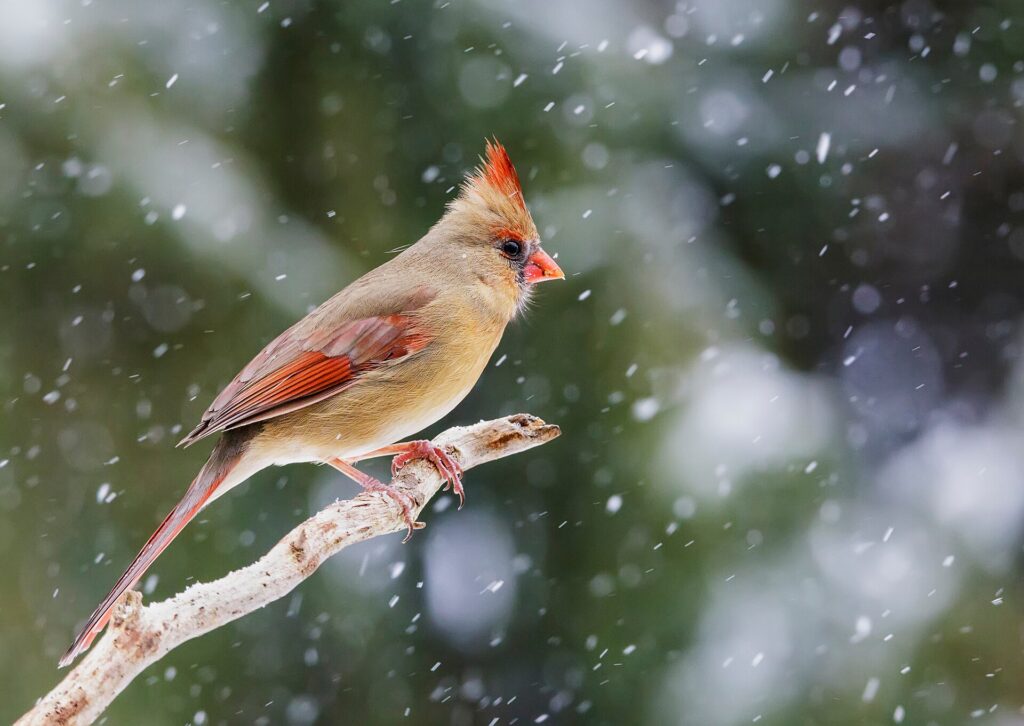
| A cardinal singing from a nest | — | That is probably the female. Female cardinals sing, which is unusual for North American songbirds. |
| A yellow cardinal | Extra-rare luck. | A genetic mutation that keeps the bird from turning yellow pigments red. Audubon puts it at about one in a million birds. |
If a cardinal is hitting your glass, a screen or an outside decal breaks the reflection. Our guide to why birds crash into windows covers the fixes that work. To tell a female cardinal from similar tan birds, our free, no-signup backyard bird ID chart by color helps, and types of cardinals covers the cardinal’s relatives.
How to see more cardinals in your yard
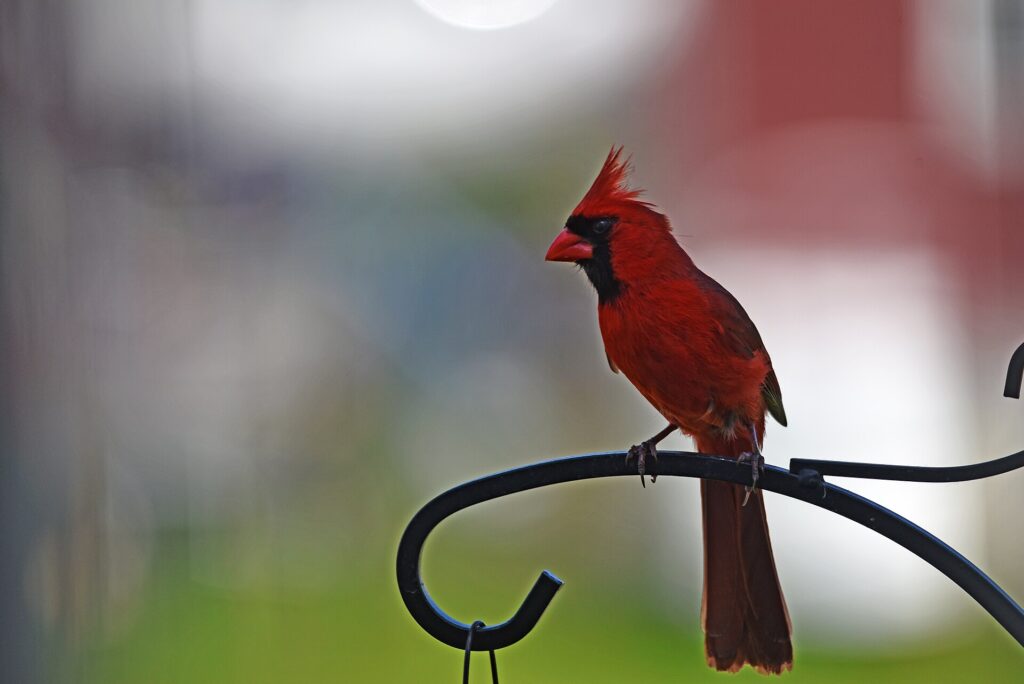
Cornell describes cardinal habitat as dense shrubby areas: forest edges, hedgerows and backyards. Give them cover and seed and they tend to stay.
- Offer black oil sunflower seed on a feeder with a sturdy perch or tray. See our picks for the best bird feeders for cardinals, plus hopper feeders and platform feeders.
- Keep shrubs or a brush pile within a short flight of the feeder for shelter.
- Plant or keep fruiting shrubs, the carotenoid sources behind that red. Our list of what to feed birds in winter covers the rest of the menu.
- Keep a bird bath open in winter, when natural water freezes.
Cardinal FAQ
Is seeing a cardinal good luck?
In folklore, many people say so. There is no evidence that a bird brings luck, but seeing one does tell you there is good cover and food nearby.
Do cardinals mate for life?
Not always. Pairs may stay together through winter, but Cornell notes up to 20% of pairs split up by the next season.
Do cardinals migrate?
No. Cardinals are year-round residents, which is why they are such a familiar winter bird.
What does it mean when a female cardinal visits?
Whatever meaning you give it, she is worth noticing: female cardinals sing, often from the nest. She is brownish with a crest and warm red accents.
Are cardinals declining?
Not overall. Audubon calls the species widespread and abundant, and U.S. survey counts rose slightly from 1966 to 2025. In several Southeastern states, including Florida, the trend is a small decline.
Bottom line
What it means when you see a cardinal depends on who you ask. For many people, it’s a moment of connection with someone they miss, and in Cherokee storytelling the redbird is the daughter of the Sun. Biologically, it means a resident bird that keeps its red all winter, thrives around shrubby yards and feeders, and is more widespread across the northern U.S. than it was a few decades ago. Both can be true at the same time. For more on bird beliefs and the science behind them, read what happens when a blue jay loses its mate and what a white pigeon symbolizes.