
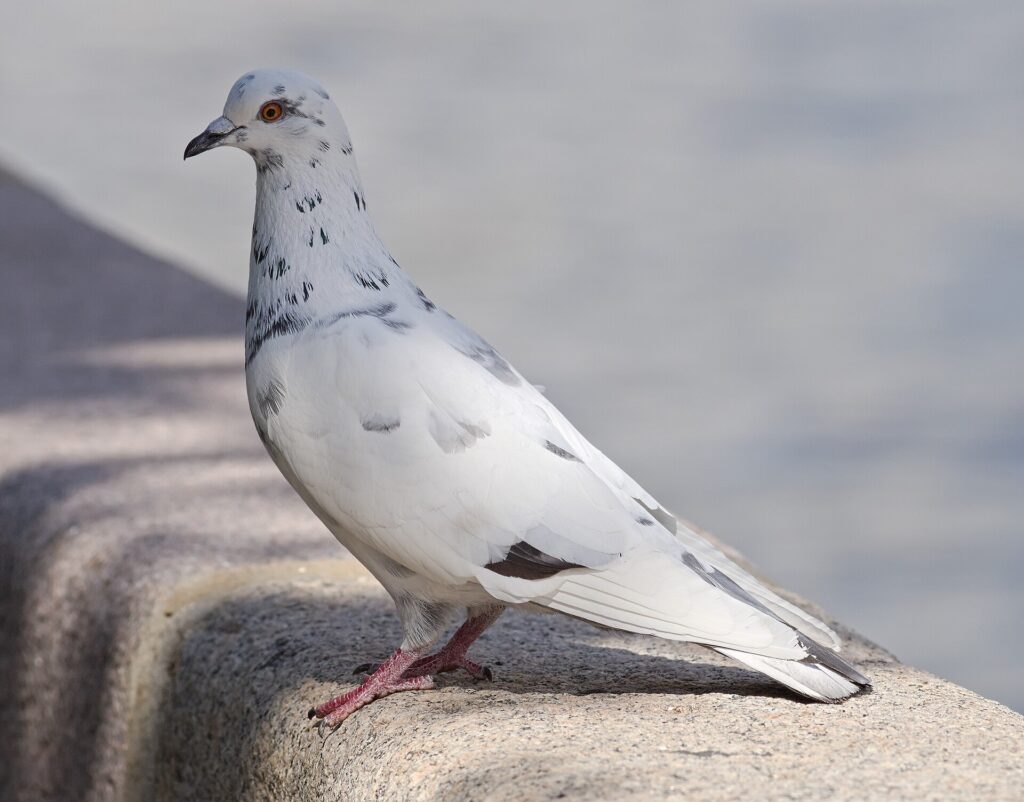
A white pigeon is widely read as a sign of peace, hope, purity, and new beginnings. In Judaism and Christianity that meaning traces to Noah’s dove returning with an olive leaf and to the Holy Spirit descending “like a dove” at the baptism of Jesus, and in the modern world it was cemented by Picasso’s 1949 peace poster. Biologically, though, the white bird in your yard is almost always a domestic Rock Pigeon (Columba livia) bred to be white, often a lost racing bird or a “release dove” from a wedding or funeral.
What does a white pigeon symbolize in religion and culture?
Doves and pigeons are the same bird family, and historically nobody drew a sharp line between them, so “white dove” symbolism is white pigeon symbolism. Here is what the major traditions actually say.
- Judaism. In Genesis 8:11, the dove Noah sends out returns with an olive leaf, showing the floodwaters have receded. It became a sign of life after catastrophe, and Midrashic texts later use the dove as an image for the people of Israel.
- Christianity. Matthew 3:16 and Luke 3:22 describe the Spirit of God descending like a dove at Jesus’ baptism, which is why the Holy Spirit appears as a white dove in church art worldwide. Early Christians carved Noah’s dove and olive branch on tombs beside the word “peace.”
- Islam. A traditional account of the Prophet Muhammad’s flight to the cave of Thawr holds that a pair of pigeons nested at the entrance, persuading pursuers the cave was undisturbed.
- Ancient Near East and Greece. Doves were the bird of Inanna-Ishtar in Mesopotamia and later of Aphrodite and Venus, tying them to love as well as peace.
- The modern peace movement. Picasso’s lithograph La Colombe, drawn in January 1949, was chosen for the poster of the Paris Peace Congress that spring and became the emblem of the World Peace Council. The model was a fancy pigeon given to him by Henri Matisse.
You’ll also see confident claims online about white pigeons in Hindu, Chinese, or Native American traditions. They vary from site to site and rarely cite a source, so we’ve left them out rather than repeat them.
Why are white doves released at weddings and funerals?
Because of everything above. A pair of white birds lifting off together reads as love, peace, and a soul set free. Doves were released at the 1896 Olympics and were an official part of the opening ceremony from 1920 until 1988, when birds landed on the torch in Seoul and burned. The Vatican stopped its January peace releases after 2015 when the birds failed to fly off and were attacked by gulls in front of the crowd. Both stories point to the same fact: white “doves” are domestic birds, and the outdoors is not their habitat.
Released birds often don’t survive, for two reasons. First, ceremony birds are often “chosen for their color and small size, not for their homing abilities or flight speed.” A well-trained white homing pigeon released by a reputable company has a fair chance of getting home; an untrained one, or one released at dusk or in rain, often does not. Second, cheap do-it-yourself releases use white Ringneck doves from pet stores. These birds have no homing instinct. They fly a short distance, land, and wait to be fed, and within days they starve or are taken by a hawk or cat.
If you want birds at an event, hire a company that belongs to a professional dove-release association, confirm the birds are banded homing pigeons, and skip releases in bad weather or near sunset. Or choose an alternative, such as bubbles, that carries the same meaning with no casualties. For wild birds that are genuinely white and black, see our post on black birds with white wings.
What kind of bird is a white pigeon, really?
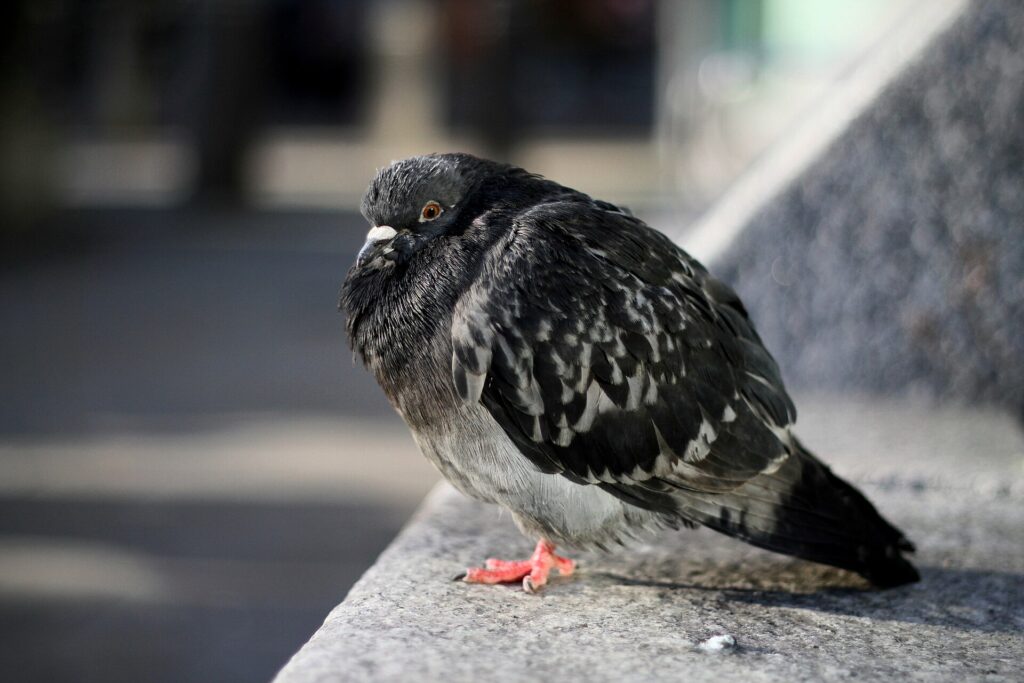
Nearly every all-white pigeon in North America is a Rock Pigeon, the same species as the gray city pigeon. The Cornell Lab notes that Mesopotamian tablets and Egyptian hieroglyphs suggest pigeons were “domesticated more than 5,000 years ago,” and thousands of years of breeding produced the color range you see in any downtown flock: blue-gray with two black wing bars, checkered, rusty red, pied, and “nearly all white.” Rock Pigeons arrived in North America from Europe in the early 1600s, so every pigeon here descends from domestic stock.
A pure-white bird usually falls into one of three groups:
- A white homing or racing pigeon. Bred white for ceremonies or kept by hobbyists, these birds carry a numbered leg band and were raised in a loft. This is the most common “white dove” at events.
- A white or mostly white feral pigeon. White genes persist in city flocks, so you’ll occasionally see an unbanded white bird in with the gray ones.
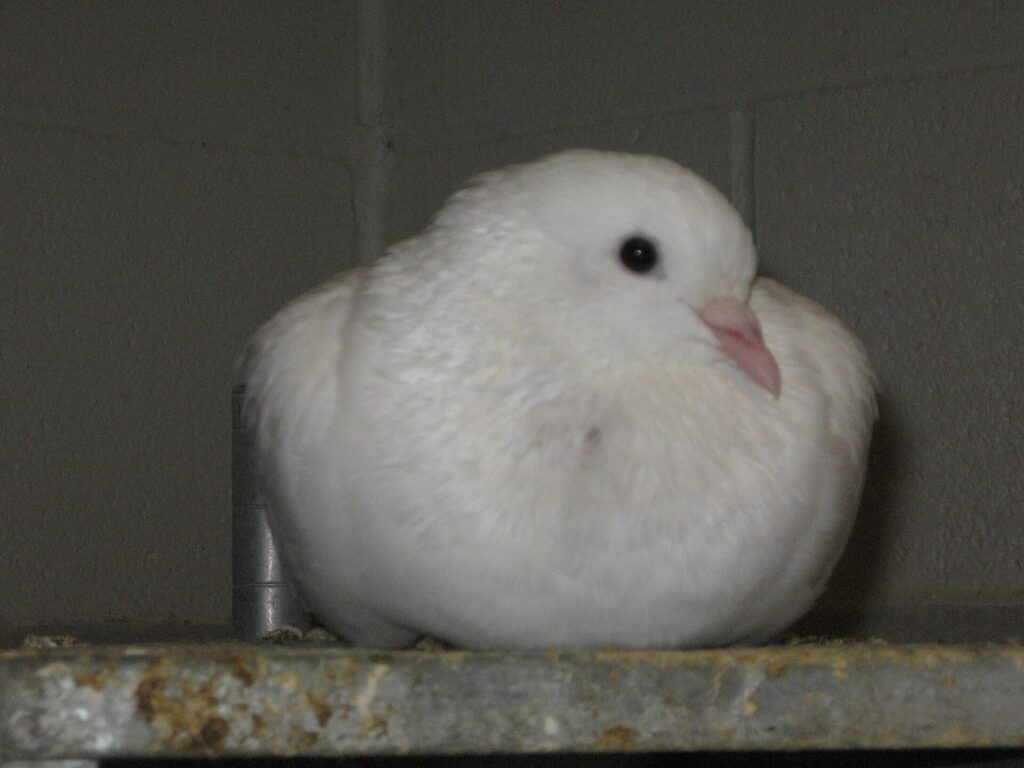
- A white Ringneck (Barbary) dove. A smaller, slimmer domestic dove, Streptopelia risoria, sold in pet stores and used in magic acts. They have no homing instinct and cannot live outdoors.
True albino pigeons, with pink eyes, are rare; most white pigeons have normal dark or orange eyes because their color comes from ordinary domestic genes. If you’re curious about the reputation pigeons carry, our post on whether pigeons are dirty birds separates the myths from the facts.
White pigeon vs. white dove: how to tell them apart
Size and shape do most of the work. Cornell describes the Rock Pigeon as “larger and plumper than a Mourning Dove,” with a small head and short legs. A Ringneck dove is noticeably smaller and slimmer than a pigeon, with a longer tail and, on colored birds, a black half-collar on the back of the neck. Use this table to narrow down what you saw.
| White bird you saw | Likely species | Clues |
|---|---|---|
| Stocky white bird, pigeon-sized, numbered leg band | Domestic Rock Pigeon (homing/racing or release bird) | Band with letters like AU, IF, or NPA; approaches people; may be exhausted |
| Stocky white or mostly white bird flying with gray pigeons, no band | Feral Rock Pigeon, white color form | Same size and flight as the flock; often has a few gray or dark feathers |
| Small, slim white dove, very tame, won’t fly far | Ringneck (Barbary) dove, white “Java” form | Smaller and slimmer than a pigeon; soft coo; sits and waits to be fed |
| Pale tan bird with a black neck crescent and square tail | Eurasian Collared-Dove | Not truly white; “chalky light brown to gray-buff”; common wild bird across the U.S. |
| White or pink-eyed bird of any species | Albino or leucistic individual | Rare; check eye color and overall shape to identify the underlying species |
Voice helps too. Rock Pigeons give a rolling, throaty coo, while Ringneck doves have a softer, higher call. Our guide to identifying birds by their songs and calls covers how to learn these differences.
Why is a white pigeon in my yard?
Wild pigeons don’t land on a porch railing and stare at you. A white bird that does is very likely a domestic bird in trouble:
- A lost racing pigeon. Racing birds are released hundreds of miles from home. Weather, hawks, and exhaustion knock some off course.
- A release bird that didn’t make it home. Ceremony doves are supposed to fly back to their loft. Some get lost, especially if released late in the day, in bad weather, or without training.
- An escaped or abandoned pet. Ringneck doves and fancy pigeons get loose or are let go by owners who don’t realize they can’t survive.
The quickest test: look at the legs. The American Racing Pigeon Union puts it plainly: “If the bird has no band at all, it is a wild pigeon.” A banded bird belongs to someone.
What to do if you find a white pigeon with a leg band
Racing bands follow a standard format, for example AU 24 ABC 1234. The first group is the organization (AU is the American Racing Pigeon Union; IF is the International Federation; CU is the Canadian union; NPA is the National Pigeon Association). The second is the hatch year, the third is the club’s letter code, and the last is the bird’s serial number. Some bands carry the owner’s phone number.
- Offer water in a shallow dish and some food such as wild bird seed or cracked corn. Keep the bird somewhere quiet, away from cats and dogs.
- Write down the full band code. Go to pigeon.org (the ARPU site) and use the band list to match the club letters, then contact that club’s secretary. The ARPU asks you to notify its office if you get no response within 24 hours; non-AU bands have their own contacts listed on the same page.
- If the bird is simply tired and uninjured, a day or two of rest and food is often enough. Erie Bird Observatory notes that “most homing pigeons are more than capable of finding their way home” once rested. Release it in the morning, in an open area.
- If it’s injured, or unbanded and clearly unable to survive outdoors, contact a wildlife rehabilitator, humane society, or pigeon rescue group instead.
Never attach a note to a bird’s leg with a rubber band; it can cut off circulation. Helping a banded bird home is a memorable project for kids and a natural way to get kids interested in birdwatching.
Frequently asked questions
Is seeing a white pigeon good luck?
In the Jewish, Christian, and modern peace traditions the white dove stands for peace, hope, and reconciliation, so most people take a sighting as a positive sign. In practical terms, a white pigeon in your yard most often means a lost domestic bird that could use a dish of water.
Are white pigeons and white doves the same bird?
Usually yes. Ceremony “white doves” are white Rock Pigeons, the same species as the gray city pigeon. The exception is the smaller white Ringneck dove, a different species sold as a pet.
Can a white pigeon find its way home on its own?
A healthy homing pigeon can. Cornell notes pigeons can navigate by sensing the earth’s magnetic field, and may also use sound and smell. A Ringneck dove cannot, and an exhausted or injured homing pigeon needs rest first. Cornell reports feral pigeons average only about 2.4 years while a domestic homing pigeon has lived 31, so getting a lost bird home matters.
Bottom line
A white pigeon symbolizes peace, hope, and renewal across Judaism, Christianity, and the modern peace movement, with roots that run back to Noah’s dove and forward to Picasso’s poster. The bird itself is almost always a domestic Rock Pigeon bred white, and if it’s sitting in your yard it probably needs help getting home. Check the leg for a band, offer water and seed, and look up the code at the American Racing Pigeon Union.