Most of the birds in a yard are heard before they’re seen, and in May, when the leaves are out, most of them are only heard. Learning a dozen songs turns a walk from “there’s a bird in there” into “that’s a red-eyed vireo, and it’s been going for twenty minutes.” It’s easier than it sounds, because you don’t have to learn songs the way you learn a language. You learn them the way you learn a friend’s voice on the phone: a few at a time, by listening to the same ones over and over.
Songs and calls
A song is the long, patterned sound a bird makes to claim a territory and attract a mate. Mostly males, mostly spring and early summer, mostly dawn, usually from a perch. A call is everything else: the short chip, tsee, or chatter used to keep in contact, warn of a hawk, beg for food, or scold a cat, given by both sexes all year. Songs are what you learn first, because they’re loud, repeated and seasonal. Calls come later and take longer.
The method that works
Use Merlin. The Cornell Lab’s free Merlin app listens through your phone and names the birds singing around you in real time, with the song highlighted as it plays. It’s astonishingly good, and it’s the fastest way anyone has ever learned birdsong: stand outside at 7 a.m. in May with it running for a week and you’ll know your yard. It makes mistakes on mimics and on distant birds, so treat it as a tutor, not an oracle.
Learn ten, not a hundred. Start with the birds that sing in your yard, in the order you hear them. Ten songs cover most of what you’ll hear in a suburb in any state. Add five a spring after that.
Use the mnemonics. Birders have written words to the songs for a century, and they stick. Some of the classics are below.
Look at the singer. When you hear something new, find it with binoculars and watch it sing. The song attaches to the picture, and you’ll have both next time. Our binoculars guide covers the pair to use.
Listen for the shape. Rising or falling? Buzzy or clear? A trill, a whistle, or phrases? How many parts? Two seconds of that narrows it to a handful of species before you even know the song.
One of the most confusing backyard sounds is a hawk scream that turns out to be a blue jay. Here’s why hawks screech, and how to tell the real thing from the mimic.
Twelve songs worth learning first
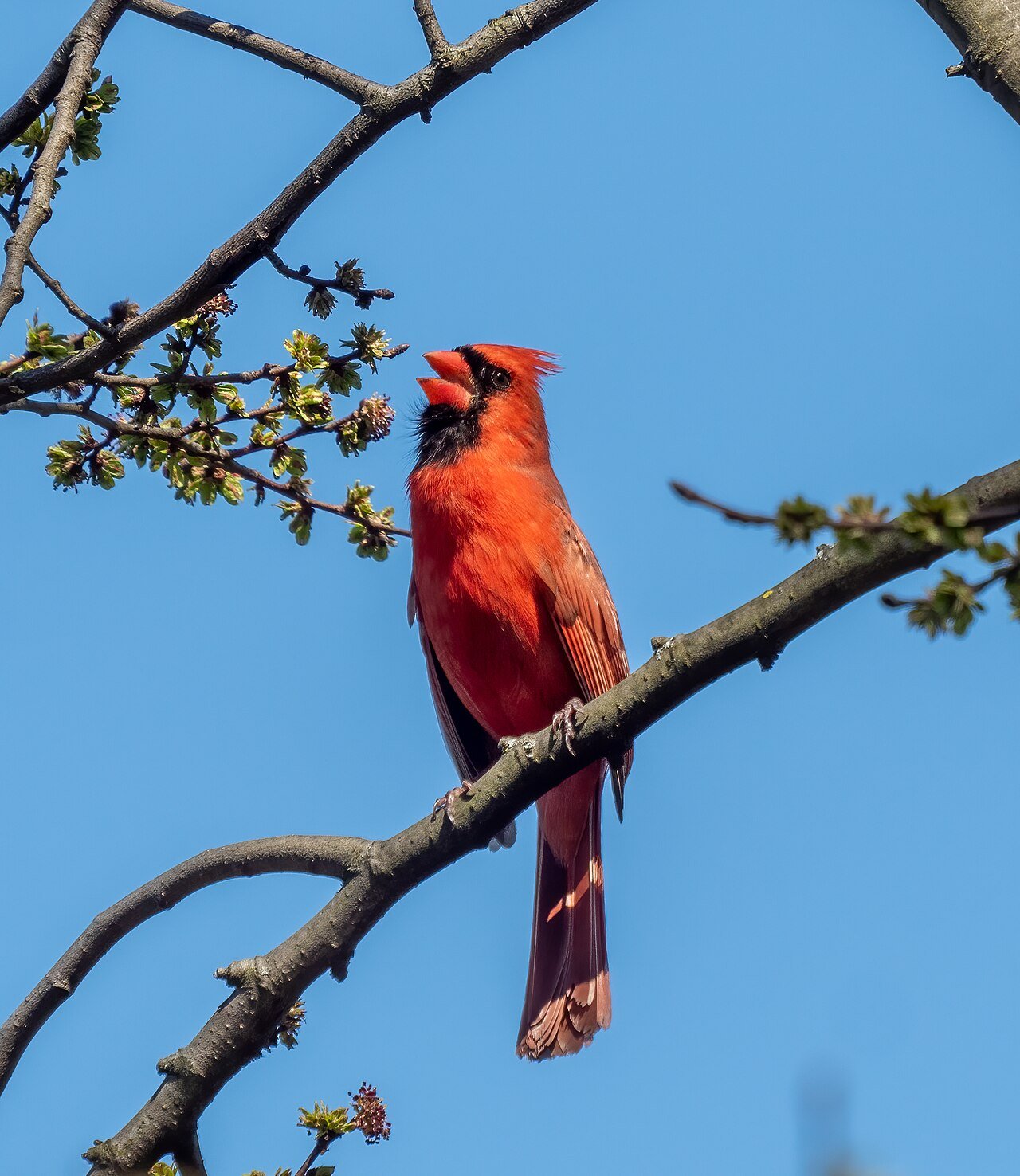
- Northern cardinal: loud, clear, slurred whistles: “cheer, cheer, cheer” or “birdy birdy birdy.” Everywhere but the Northwest. Females sing too.
- American robin: a long, rolling, cheerful series of short phrases, “cheerily, cheer up, cheerio,” often the first song before dawn.
- Song sparrow: three or four clear notes, then a jumble and a trill: “Madge, Madge, Madge, put on your tea kettle-ettle-ettle.”
- Carolina wren: a loud, ringing “teakettle, teakettle, teakettle,” far bigger than the bird. The South and East, year-round.
- Black-capped and Carolina chickadee: a clear, whistled “fee-bee” (two notes, north) or “fee-bee-fee-bay” (four, south). The “chick-a-dee-dee-dee” is the call.
- Tufted titmouse: “peter, peter, peter,” fast and whistled.
- Mourning dove: the soft, sad “coo-OO, oo, oo, oo” that people mistake for an owl.
- Red-winged blackbird: “conk-la-REE,” with the last note a buzz. Any marsh or wet ditch in the country.
- House finch: a long, fast, jumbled warble that usually ends in a buzzy, slurred note. In every town.
- American goldfinch: a bright, rambling twitter, and the “po-ta-to-chip” call given in flight.
- Northern mockingbird: everyone else’s song, each phrase repeated three to six times, often all night in spring. The South and most of the West.
- Red-eyed vireo: short, robin-like phrases with pauses, “here I am, where are you,” for hours from the canopy. The most-heard, least-seen bird in the eastern woods in June.
Regional additions
West of the Rockies, add the spotted towhee’s buzzy trill, the Bewick’s wren, and the western meadowlark’s flute. In the Southwest, the curve-billed thrasher’s sharp “whit-wheet” and the cactus wren’s engine-turning rattle. In the North Woods, the white-throated sparrow’s “Old Sam Peabody, Peabody, Peabody” and the hermit thrush, which is the one song everyone agrees is the most beautiful on the continent. Merlin will tell you which of these are in range.
Some birds are easier to learn by call than by sight. The great crested flycatcher is one: you will often hear its loud, rising “wheep” long before you see it. Our great crested flycatcher guide covers the call, the range and the nest box it uses.
A book, if you want one
Apps do the identifying; a book does the explaining. The Sibley Guide to Birds East and West describe every song in words alongside the paintings, and the descriptions are unusually good. For the theory of how songs work and why, the free All About Birds site from Cornell has recordings of every species with the sonograms.
Related: Woodpecker drumming explained · Backyard birding for beginners · The best binoculars under $200
Some of the most distinctive sounds are not songs at all; see woodpecker drumming explained and the great crested flycatcher, whose loud rising call is a summer giveaway.