Spark Lark is reader-supported. As an Amazon Associate we earn from qualifying purchases, at no extra cost to you. How we choose products.
That rapid, hollow rattle from the trees in March isn’t a woodpecker looking for food. It’s a woodpecker talking. Drumming is the woodpecker’s song: a burst of 10 to 30 strikes in about a second, on the loudest surface the bird can find, repeated every minute or so from a favorite perch. It says “this is my territory” and “I’m available,” the same two things a cardinal says by singing. Here’s how to tell drumming from feeding, which woodpecker is doing it, and what to do when the loudest surface in the neighborhood turns out to be your gutter.
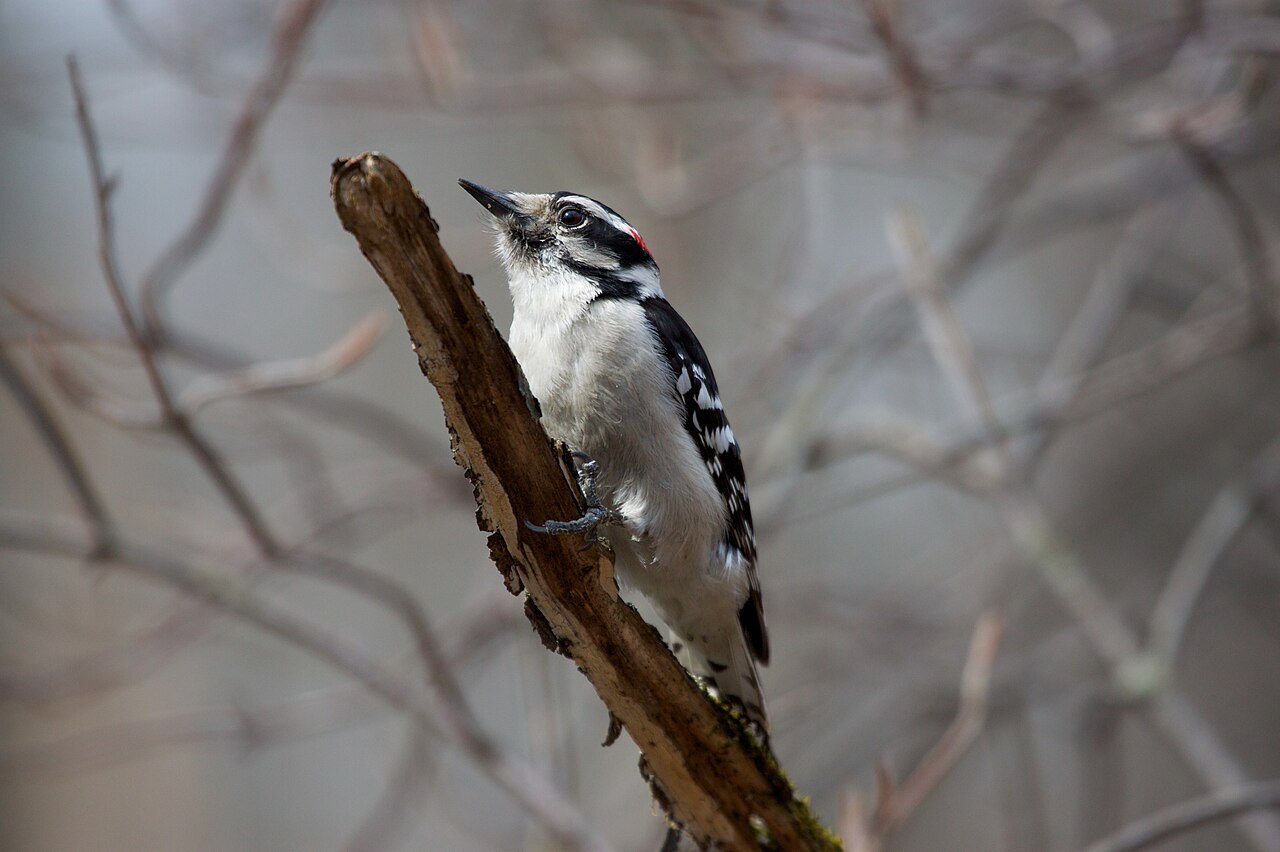
Drumming, drilling, and tapping are three different things
Drumming is fast, even, and loud, and it doesn’t leave a hole. The bird picks a resonant dead limb, a hollow trunk, a utility pole, a metal chimney cap, and hammers it in a steady roll, then stops and listens. It happens mostly from late winter through spring, mostly in the morning, and both sexes do it. Drilling for food is slower and irregular: a few taps, a pause, a few more, with wood chips falling, and it happens year-round. Excavating a nest cavity is the slow, deep, methodical version, in April and May, with a growing pile of chips below. If it’s fast and rhythmic and there’s no hole, it’s communication.
Who’s drumming
You can get surprisingly close to an ID from the drum alone, because each species has a tempo. Across the U.S.:
- Downy woodpecker: a short, fairly slow roll, about a second, evenly spaced. The most common drummer in suburbs everywhere.
- Hairy woodpecker: faster and longer than the downy, so fast the strikes blur together.
- Red-bellied woodpecker: a slow, short roll, often just half a second, with a lower pitch. The Southeast and Midwest.
- Northern flicker: a long, loud, even roll, often on metal. The flicker is the one on your chimney.
- Pileated woodpecker: a deep, slow roll that speeds up and trails off at the end, carrying half a mile through the woods. Unmistakable once you’ve heard it.
- Yellow-bellied sapsucker (and the western sapsuckers): an irregular, stuttering drum, like Morse code with a bad key. The one drum that isn’t even.
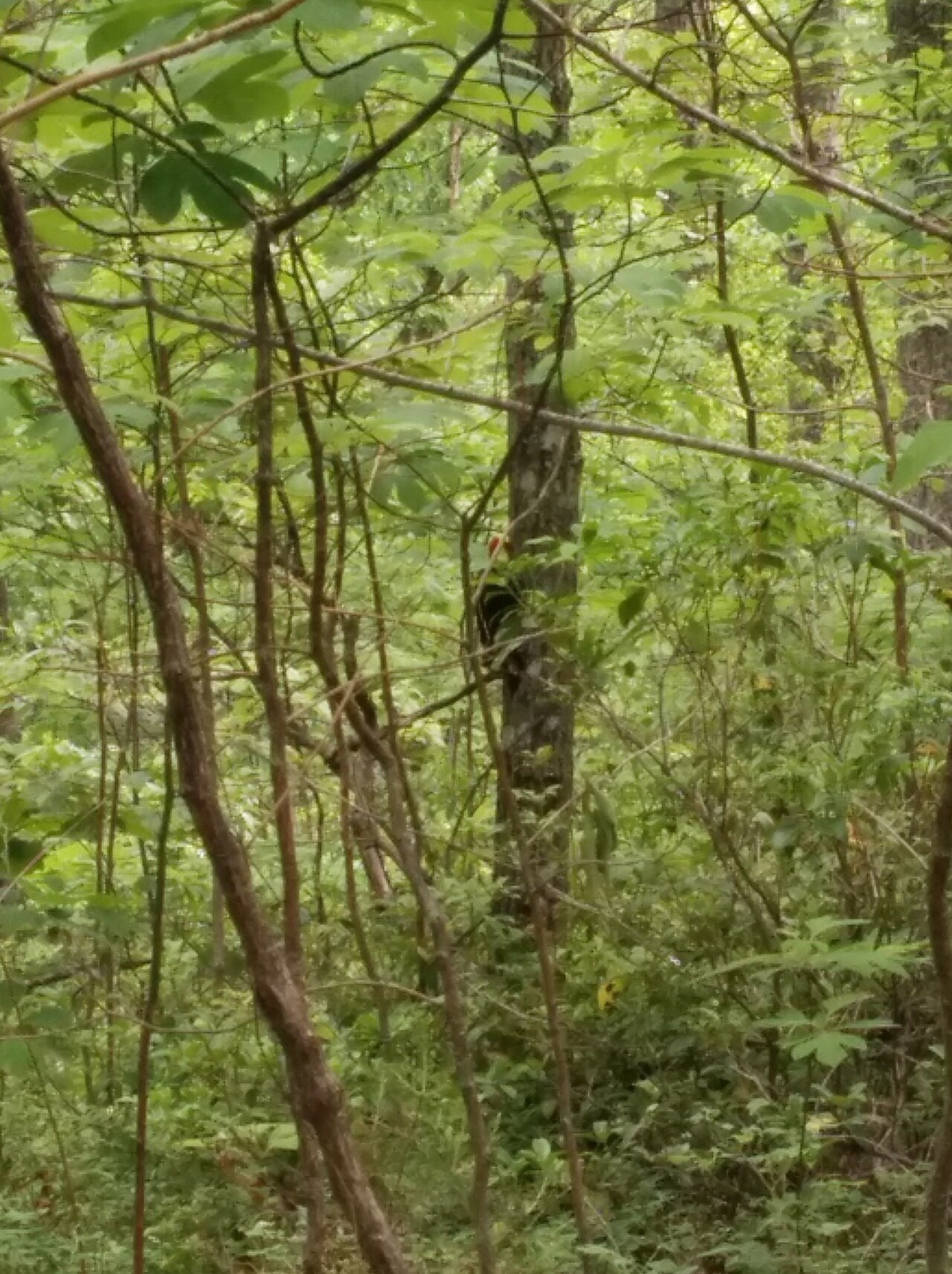
The free Merlin app from the Cornell Lab will identify most of these from a recording on your phone; hold it up during the next roll. Our songs and calls guide covers the method.
Why they don’t get concussions
A woodpecker hits wood at up to 20 times a second and decelerates at more than a thousand g each strike. For decades the explanation was a spongy skull that absorbs shock; recent work suggests the opposite, that the skull is stiff and the brain simply small and light enough that the forces stay below the damage threshold, like a hammer that doesn’t dent itself. Either way, the bill, skull and neck muscles are built for it, and a drummer shows no sign of harm after thousands of rolls a season.
When the drum is your house
Metal gutters, chimney caps, vent covers, satellite dishes and the flashing on a roof are the loudest things in a suburban yard, which makes them irresistible in March. This is annoying and harmless; drumming leaves no holes. It stops by itself when territories are settled, usually by May. To end it sooner, take away the resonance: a strip of foam or a towel taped over the spot for a couple of weeks, or hang something that moves in the wind (mylar tape, an old CD) at the drumming site. Don’t bother with plastic owls.
Holes in the siding are a different problem. A woodpecker drilling cedar or stained wood is either after carpenter bee or beetle larvae in it, in which case you have an insect problem, or excavating a roost hole in fall, usually high under an eave. Fill the holes, hang reflective tape or netting on that wall, and give the bird a better option: a suet feeder on the far side of the yard pulls most of the attention. Our suet feeder guide covers which one; the tail-prop feeder is the one built for the bigger woodpeckers that do the most damage. Woodpeckers are protected under federal law, so trapping or harming them isn’t an option, and it isn’t necessary.
How to get more of it
Leave a dead limb or a dead tree standing if it isn’t a hazard; it’s a drumming post, a feeding site and a nest cavity in one. Put out suet from October to April, and unsalted peanuts in a mesh feeder. And in March, go outside early, stand still, and count the rolls per minute; a downy on a good limb will drum twenty times before it moves.
Related: The best suet feeders · Identifying birds by song · Winter backyard birds by region