Yes, wild turkeys can fly. They take off in short, fast bursts, and every evening they fly up into trees to sleep. That surprises a lot of people, because the turkey on the Thanksgiving table can’t fly at all. The two are the same species, but decades of breeding have made the farm bird a very different animal. Here are the wild turkey facts people search for most this time of year: how fast they fly and run, where they sleep, what the red and blue skin on their heads is called, the five kinds of wild turkey in the U.S., and how close the species came to disappearing.
Chart: wild turkey vs. the Thanksgiving turkey
We built this chart from the Cornell Lab of Ornithology’s wild turkey pages, the U.S. Fish and Wildlife Service and a Popular Science report on farm turkeys. The weight bars are drawn to scale. Tap or click the chart to open the full-size version. It’s free to print and share.
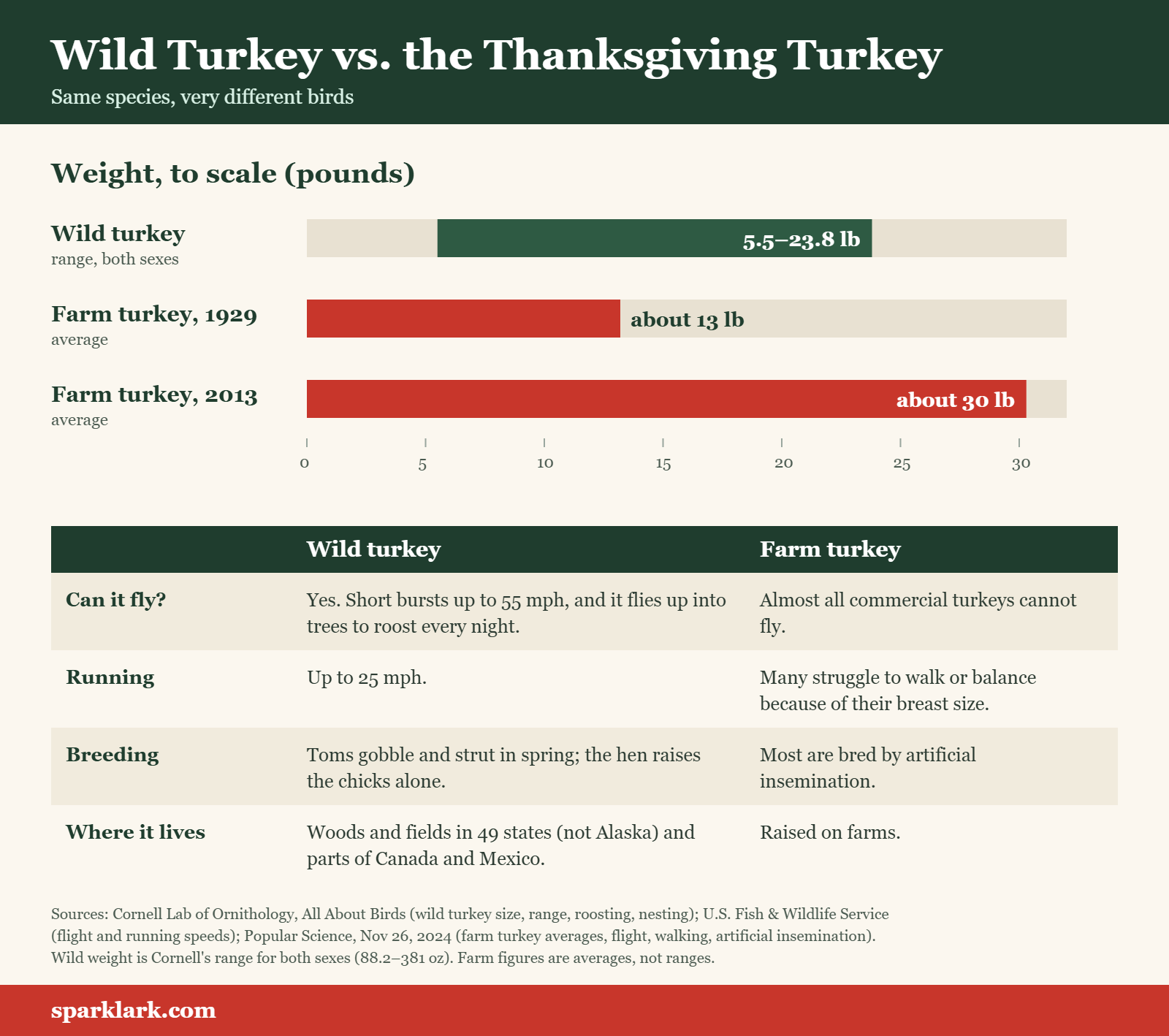
Source and method: the wild turkey weight range is Cornell’s figure for both sexes (88.2 to 381 ounces, or about 5.5 to 23.8 pounds). The farm turkey bars are average weights for 1929 and 2013 as reported by Popular Science; they are averages, not ranges, so the biggest farm birds weigh far more. Read Nov. 15, 2026.
The short version
- Wild turkeys fly. The U.S. Fish and Wildlife Service says they can fly briefly at up to 55 mph. Farm turkeys almost all can’t.
- They sleep in trees. At sundown they fly into low limbs, then hop up branch by branch to a high roost.
- They run fast. Up to 25 mph, according to the Fish and Wildlife Service.
- They’re big. 43 to 45 inches long with a wingspan of up to about 57 inches, per Cornell.
- They nearly vanished. U.S. numbers may have fallen to about 30,000 by 1940. Today the National Wild Turkey Federation puts the U.S. population at about 6.5 million.
- Five kinds live in the U.S.: Eastern, Osceola (Florida), Rio Grande, Merriam’s and Gould’s.
Can wild turkeys fly?
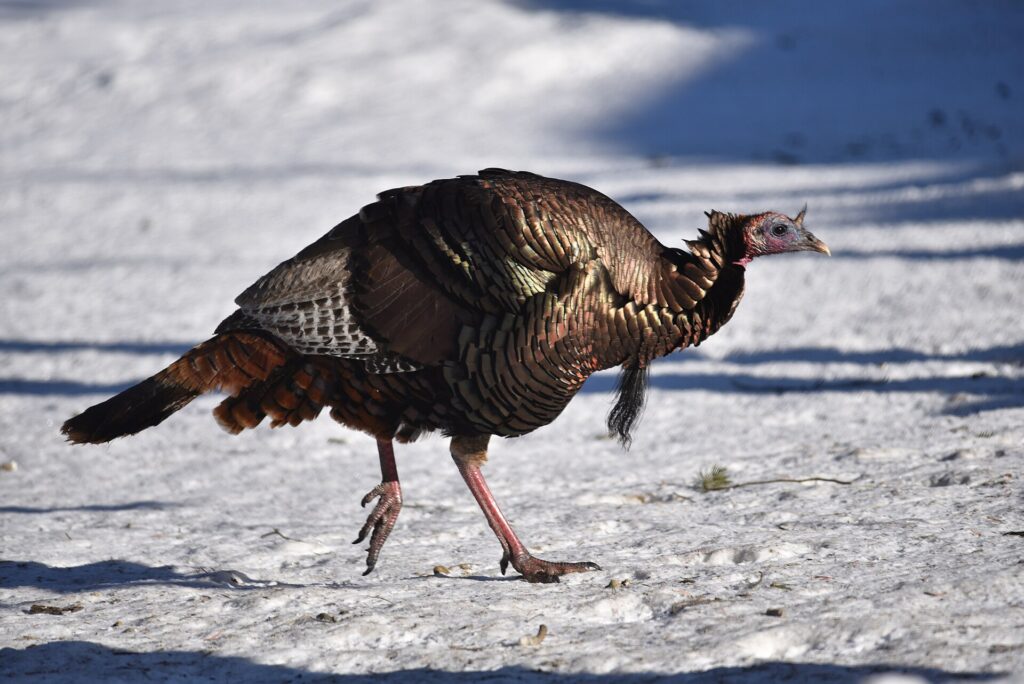
Yes, and fast. The U.S. Fish and Wildlife Service says wild turkeys can fly briefly at speeds up to 55 mph. Popular Science describes those flights as short bursts of about 100 yards. Cornell says turkeys live in the same area year-round, so they don’t need long flights. Flying is mostly for escaping danger and getting up to a roost.
Cornell’s ID page says turkeys take off “with a flurry of loud, labored wingbeats.” When something threatens a flock, Cornell notes, females tend to fly while males tend to run. Mostly, though, turkeys walk. A flock can cover a lot of ground on foot while scratching through leaves for food.
Why can’t farm turkeys fly?
Farm turkeys have been bred for size, mostly for breast meat. Popular Science reports that the average farm turkey went from about 13.2 pounds in 1929 to about 30.3 pounds in 2013. Almost all commercial turkeys can’t fly, many struggle to walk or balance, and most can’t mate on their own, so they’re bred by artificial insemination. A wild turkey is lean and long-legged by comparison.
Where do wild turkeys sleep?
In trees. Cornell’s life history page says that at sundown turkeys fly into the lower limbs of trees and then move up from limb to limb to a high roost spot. They usually roost in flocks, but sometimes alone. If you live near woods, dusk is a good time to watch for them heading up, and Cornell says you may see a group “flying high into their treetop roosts at the end of the day.”
Sleeping off the ground keeps them away from most of the animals that hunt them. Cornell lists coyotes, bobcats, raccoons, mountain lions, golden eagles, great horned owls and people as predators of adult turkeys.
How fast can a wild turkey run?
Up to 25 mph, according to the Fish and Wildlife Service. Cornell adds one more surprise: when they need to, turkeys can swim by tucking their wings in, spreading their tails and kicking.
How big is a wild turkey?
Cornell lists wild turkeys at 43.3 to 45.3 inches long, 5.5 to 23.8 pounds (88.2 to 381 ounces) and a 49.2 to 56.7 inch wingspan, measured across both sexes. Cornell calls them one of the largest and heaviest birds in North America, about twice the size and four times as heavy as a ring-necked pheasant. Females are dark brown overall with darker barring.
Up close, the feathers have a bronze-green shine, the wings are barred with white, and the tail feathers are tipped with rust or white. The Fish and Wildlife Service says an adult turkey has 5,000 to 6,000 feathers.
What’s the red thing on a turkey’s head?
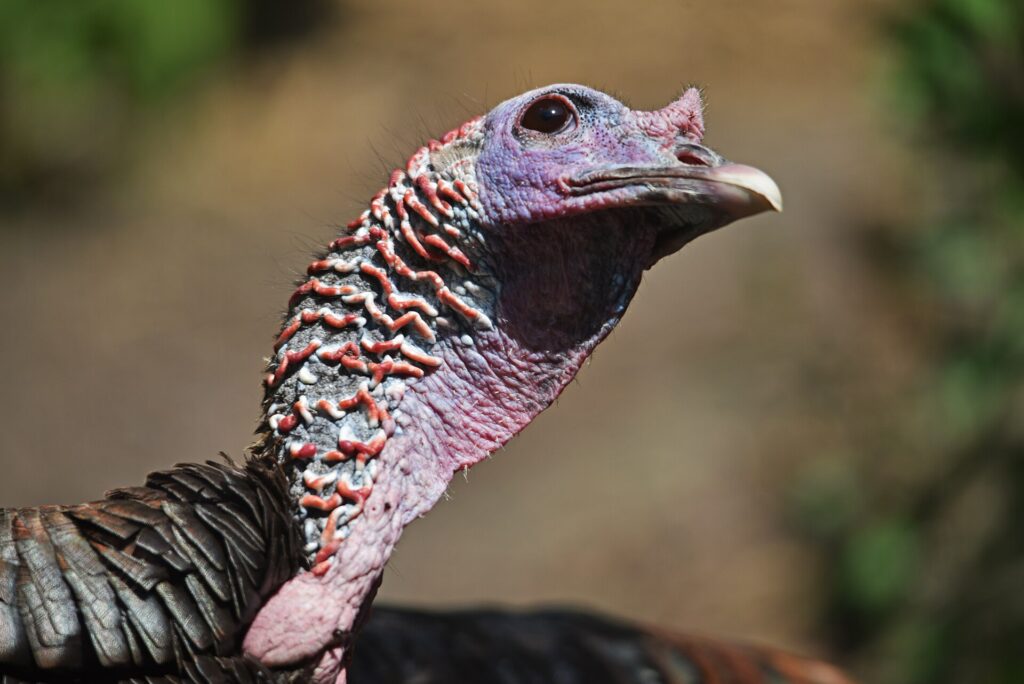
A turkey’s head and neck are bare skin, and Cornell says the color can change from red to blue to gray. The parts have names. The Fish and Wildlife Service, in the caption for its own close-up photo, explains:
- Snood: the fleshy, horn-like piece between the eyes. It’s usually short, but when a male struts it fills with blood and hangs down past the bill. Hens have one too, but it’s shorter.
- Caruncles: the bumpy growths on the head and neck.
- Wattle: the flap of skin under the chin.
Gobbling, strutting and family life
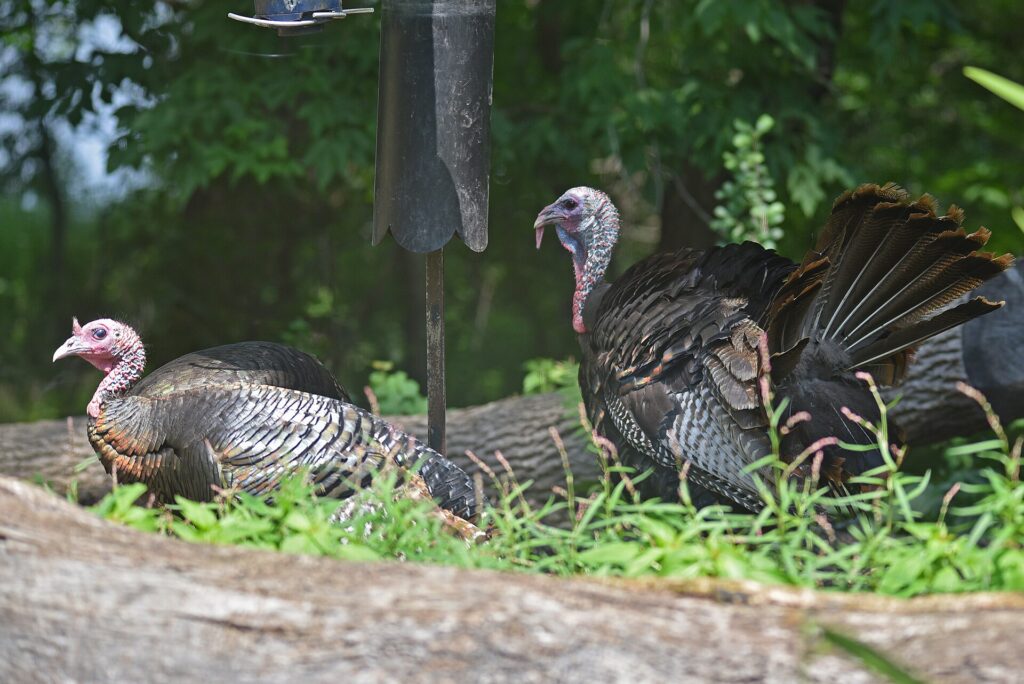
In early spring, males gather in clearings to show off. Cornell describes them puffing up their body feathers, fanning their tails, lowering their wings and strutting slowly while making soft hums and “chump” sounds that aren’t vocal. Then there’s the gobble. Males gobble to attract females and warn other males, and the Fish and Wildlife Service says a gobble can be heard up to a mile away.
After mating, the male’s job is done. Cornell says males provide no parental care. The hen scratches a shallow dip in dead leaves on the ground, often at the base of a tree or under brush, and lays 4 to 17 eggs. They hatch after 25 to 31 days, and the chicks, called poults, can leave the nest within a day of hatching.
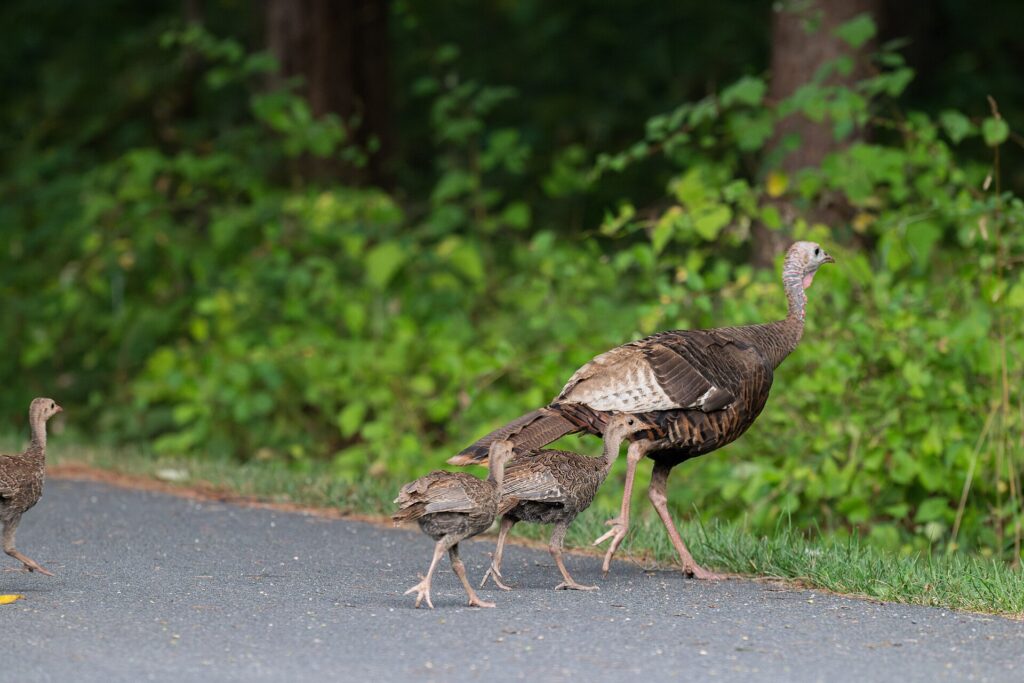
The poults follow their mother, who feeds them for a few days until they find food on their own. Families then band together with other hens and their broods. By winter those flocks can get big. Cornell says winter groups sometimes top 200 turkeys.
What do wild turkeys eat?
Mostly plants. Cornell’s life history page says that in fall, winter and early spring turkeys scratch the forest floor for acorns, beech nuts, pecans, hickory nuts, wild black cherries, ash seeds and other seeds and berries. When deep snow covers the ground, they switch to hemlock buds, evergreen ferns, club mosses and burdock. In late spring and summer they strip seeds from grasses and sedges and add salamanders, snails, beetles and other insects. The Fish and Wildlife Service notes that young poults eat a lot of insects and start favoring plants at around four weeks old.
Cornell says turkeys favor forests with nut trees such as oak, hickory and beech. If you’re planting for birds, our guide to a bird-friendly garden is a good place to start.
The five wild turkey subspecies in the U.S.
The National Wild Turkey Federation recognizes five subspecies in the U.S. You can often tell them apart by the color of the tips of the tail feathers.
| Subspecies | Where it lives | Tail-feather tips | Notes |
|---|---|---|---|
| Eastern | Most widespread; east of the Mississippi River, in 38 states and parts of Canada | Chestnut brown | Most abundant subspecies; strongest gobbles and longest beards |
| Osceola (Florida) | Florida only | Dark brown | Mostly black wings with thin white bars; about 100,000 birds |
| Rio Grande | Texas, Oklahoma, Kansas and other western states, plus Mexico | Tan | Equal black and white barring on the wings |
| Merriam’s | Mountains of the West, centered on the Rockies | Snow white | More white on the wings; weakest gobbles |
| Gould’s | Arizona, New Mexico and northern Mexico | Light colored | Long legs; few in number |
Source: National Wild Turkey Federation, “Know Your Wild Turkey Subspecies”. Cornell also notes that Rocky Mountain turkeys tend to have whitish tail tips while other populations have rusty or chestnut tips.
There’s also a second turkey species, the ocellated turkey of Mexico’s Yucatán Peninsula, northern Belize and northern Guatemala. The federation describes it as having iridescent, rainbow-like feathers and no beard. It doesn’t live in the U.S.
How the wild turkey came back
Hunting and habitat loss in the 1800s and early 1900s wiped turkeys out of large parts of their range. The Fish and Wildlife Service says the U.S. population may have dropped to about 30,000 birds by 1940. Cornell’s account says one subspecies disappeared from New England in the mid-1800s.
The first fix didn’t work. People released farm turkeys into the wild, and those birds didn’t survive. What worked, starting in the 1940s, was catching wild turkeys and moving them to good habitat in other areas. Cornell says no other game bird has responded so well to the efforts of wildlife managers. Wild turkeys now live in every state except Alaska, including Hawaii, where they were introduced, and parts of southern Canada. The National Wild Turkey Federation puts today’s U.S. population at about 6.5 million, and Partners in Flight estimates the global breeding population at 6.9 million. Cornell rates the species as low conservation concern.
Did Ben Franklin want the turkey as the national bird?
Not exactly. On Jan. 26, 1784, Franklin wrote a letter to his daughter, Sarah Bache, poking fun at the bald eagle. He called the eagle “a Bird of bad moral Character” and said the turkey was “a much more respectable Bird.” You can read the full letter at the National Archives’ Founders Online. But Smithsonian magazine points out that Franklin never proposed the turkey for the Great Seal; the design he did suggest had no birds at all. For more on bald eagles, read our story on Jackie, the Big Bear eagle.
Where the turkey’s name came from
Cornell says native people in Mexico domesticated turkeys centuries before European explorers brought some home in the early 1500s. The bird caught on in Europe, and English colonists later brought domesticated turkeys back across the Atlantic. The English name may come from shipping routes that passed through the country of Turkey on the way to European markets, Cornell says. The wild turkey and the Muscovy duck are the only two domesticated birds native to the Americas.
Do wild turkeys come to backyards?
They can, especially in yards near woods. Cornell’s backyard tips say planting nut-bearing or berry trees can attract them. Some people scatter birdseed or corn on the lawn for turkeys, but Cornell warns that this can also draw rodents and other unwanted visitors. If turkeys already visit, early morning is the best time to look. Cornell says flocks are often out foraging in clearings, along field edges and on roadsides then.
Turkeys in the yard are a fun one to add to a family checklist this time of year. Our free backyard bird bingo cards and backyard bird life list are both ready to print.
Wild turkey FAQ
Can wild turkeys fly?
Yes. They fly in short bursts at up to 55 mph, according to the U.S. Fish and Wildlife Service, and they fly up into trees to roost at night. Farm turkeys mostly can’t fly because they’ve been bred to be so heavy.
Are wild turkeys and farm turkeys the same species?
Yes. Both are Meleagris gallopavo. Cornell explains that farm turkeys come from birds people in Mexico domesticated centuries ago. Breeding since then has made farm birds much heavier, and most can no longer fly or mate on their own.
How much does a wild turkey weigh?
Cornell gives a range of about 5.5 to 23.8 pounds across both sexes.
Where do turkeys go at night?
Up into trees. At sundown they fly into low limbs and work their way up to a high roost, usually in a flock.
How far away can you hear a turkey gobble?
Up to a mile, according to the U.S. Fish and Wildlife Service.
Do female turkeys gobble?
Cornell describes gobbling as something courting males do to attract females and warn rival males.
Bottom line
The wild turkey is a fast, tree-roosting bird that flies at up to 55 mph and runs at up to 25. It nearly disappeared from the U.S. a century ago and is now back in every state but Alaska. The farm turkey on your table is the same species, bred over generations into a much heavier bird that can’t fly. If you live near oak woods, watch the treetops at dusk this week. You may catch a flock heading up to bed.