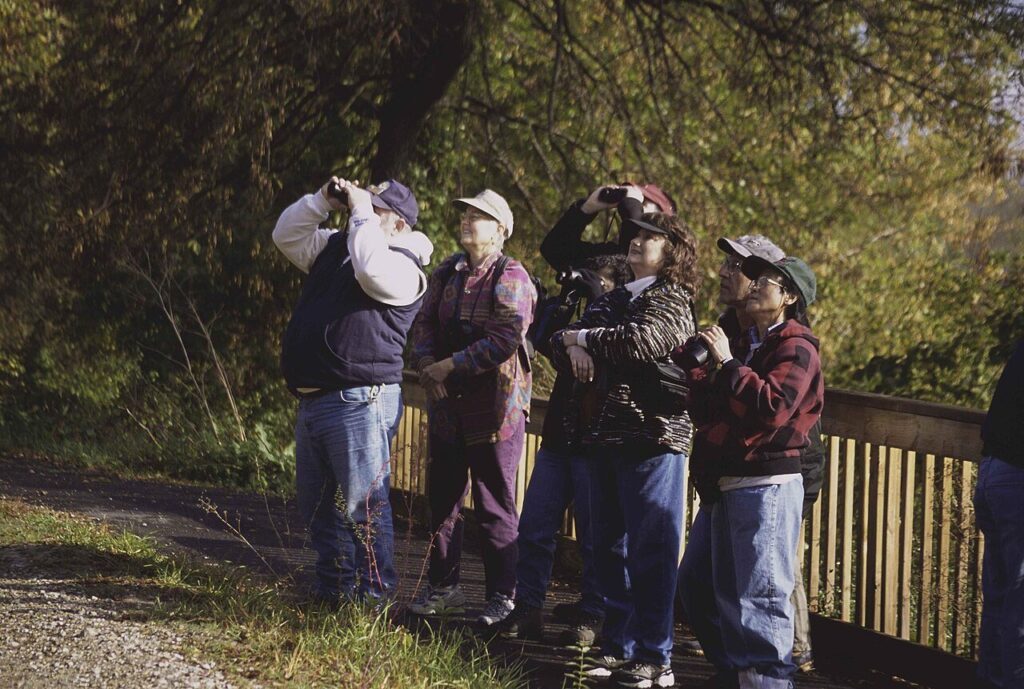
Two hundred dollars is the line where birding binoculars stop being a compromise. Below about $90 you get plastic lenses, fogging and a picture that’s soft at the edges; above $300 you’re paying for the last ten percent of sharpness and a nicer name on the barrel. In between, three or four pairs have become the standard recommendation of birding clubs, bird stores and the people who lead walks, and they’re all here. Every pick is waterproof, fog-proof and covered by a warranty that will outlast your interest in the hobby.
The short answer is a Vortex Crossfire HD or a Celestron Nature DX in 8×42. The rest of this explains why, and who should buy something else.
Spark Lark is reader-supported. As an Amazon Associate we earn from qualifying purchases made through links on this page, at no extra cost to you.
The short version
- Best overall: Vortex Crossfire HD 8×42. The best glass under $150, and Vortex’s no-questions lifetime warranty.
- Best for feeder watching: Celestron Nature DX 8×42. Close focus of 6.5 feet, the club-loaner pair.
- Best under $100: Celestron Outland X 8×42. Real waterproof glass at the price floor.
- Best from a camera brand: Nikon Prostaff P3 8×42. Nikon coatings, lightest of the full-size pairs.
- If you want 10x: Bushnell Engage X 10×42 or the Vortex Triumph HD 10×42. Read the 8x vs 10x section first.
The numbers, in two minutes
8×42 vs 10×42. The first number is magnification, the second is the diameter of the front lenses in millimeters. For birds, 8x is the right answer for most people: the image is steadier in the hand, the field of view is wider so you can find a bird in a tree, the close focus is shorter so the feeder is sharp, and the exit pupil is bigger so it’s brighter at dusk. 10x gets you closer to a hawk on a far snag and worse at everything else, especially hand shake. Buy 10x if you bird open country (shorebirds, raptors, the Plains) or already know you want it; buy 8x otherwise.
42 mm vs 32 mm. 42 is full size: brighter, heavier (a pound and a half), the standard. 32 is compact: lighter, dimmer at dawn, fine for travel. Under $200, the 42s are the better buy because the glass is where the money goes and a bigger lens forgives cheaper glass.
What “HD” and “ED” mean. Extra-low-dispersion glass, which cuts the purple fringing around a dark bird against a bright sky. The Crossfire HD and Nature DX have it; the Outland X doesn’t, and that’s the visible difference between the Outland X and the other two.
Things to ignore: “high powered,” anything over 10x, zoom binoculars, “night vision” claims, and any pair under $60 that lists 42 mm lenses and a phone adapter. Those are the $30 pairs with a $60 price tag.
The binoculars
1. Vortex Crossfire HD 8×42 — best overall
8×42 · HD glass · 6-ft close focus · 23 oz · VIP lifetime warranty
Vortex took the coatings and the HD glass from its pricier Diamondback and put them in a slightly heavier body, and the result is the sharpest, most contrasty image under $150. The field of view is wide, the focus wheel is smooth and fast, and it comes with a real case and a harness. Then there’s the warranty: Vortex replaces or repairs the binoculars for life, no receipt, no matter what happened to them, including a grandchild dropping them in a creek. That warranty is worth $40 by itself, and the glass would be worth the price without it.
Downside: at 23 ounces it’s the heaviest pair here, and the eyecups are a little stiff. If you wear glasses, check that the eye relief (17 mm) works for you; it does for most.
2. Celestron Nature DX 8×42 — best for feeder watching
8×42 · ED glass · 6.5-ft close focus · 22 oz · lifetime warranty
The Nature DX is the pair Audubon chapters and bird stores hand to beginners, and it’s earned it: bright, sharp in the center, a close focus that makes the feeder ten feet from the window look like a photograph, and no pattern of failures in owner reviews. The image is a hair softer at the very edges than the Vortex, which you won’t notice on a bird. It’s the friendlier pair to hold, with softer eyecups and a lighter body.
Downside: the warranty is Celestron’s lifetime limited, which covers defects but not accidents. Fine for most people; the Vortex is the pair for the person who breaks things.
3. Celestron Outland X 8×42 — best under $100
8×42 · 13-ft close focus · 22 oz · waterproof
The floor for glass you’ll keep. Multi-coated lenses, a sealed and nitrogen-purged body so it won’t fog, decent eye relief, and a picture that’s clearly better than anything at $60. It’s the pair for a second car, a kid who’s earned real binoculars, or a first try before spending more.
Downside: no ED glass, so a dark bird against the sky shows a purple edge, and the close focus is 13 feet, which is too far for a window feeder. Spend more for the Nature DX if the feeder is the main event.
4. Nikon Prostaff P3 8×42 — the camera-brand pick
8×42 · 9.8-ft close focus · 20 oz · waterproof
Nikon’s entry birding pair, with the company’s multilayer coatings and the lightest full-size body on this list. The image is bright and neutral, the build is Nikon-solid, and at 20 ounces it’s the pair you’ll actually carry on a walk. Slots between the Outland and the Crossfire in price and in glass.
Downside: no ED glass, and a nearly ten-foot close focus. Better on the trail than at the window.
5. Bushnell Engage X 10×42 — if you want 10x
10×42 · IPX7 waterproof · 22 oz
For the birder who’s read the 8x vs 10x section and still wants 10x: hawks over a field, shorebirds on a flat, a lake you scan from the porch. The Engage X has fully multi-coated lenses, a locking diopter (so your setting doesn’t drift), and a build that’s rated for immersion. The Vortex Triumph HD 10×42 is the budget 10x with the same Vortex warranty.
Downside: it’s 10x. Narrower view, more shake, dimmer at dusk, and a close focus too long for the feeder.
Side by side
| Binoculars | Spec | ED/HD glass | Close focus | Weight | Warranty |
|---|---|---|---|---|---|
| Vortex Crossfire HD | 8×42 | Yes | 6 ft | 23 oz | Lifetime, unconditional |
| Celestron Nature DX | 8×42 | Yes | 6.5 ft | 22 oz | Lifetime limited |
| Celestron Outland X | 8×42 | No | 13 ft | 22 oz | Lifetime limited |
| Nikon Prostaff P3 | 8×42 | No | 9.8 ft | 20 oz | Limited |
| Bushnell Engage X | 10×42 | No | — | 22 oz | Lifetime |
| Vortex Triumph HD | 10×42 | Yes | — | — | Lifetime, unconditional |
Setting them up
Three things most people never do. Set the diopter: the small ring on the right eyepiece corrects for the difference between your eyes. Cover the right lens, focus on something with the center wheel, then cover the left lens and turn the diopter until the same thing is sharp. Do it once and leave it. Eyecups: twisted out if you don’t wear glasses, in if you do; wrong setting means a black ring around the image. Find the bird without the binoculars first: lock your eyes on it, raise the glass to your eyes without looking down, and it’ll be in the field. Practice on a feeder for a week and it becomes automatic. Our beginner’s guide covers what to buy alongside them.
Ready to spend more? Our best binoculars under $500 compares seven step-up pairs, from the Vortex Diamondback HD to the Zeiss Terra ED and Nikon Monarch M7.
Binoculars are the classic bird-lover gift; for more ideas at every price, see our 25 best gifts for bird lovers.
Bottom line
Buy the Vortex Crossfire HD 8×42 if you want the best glass and a warranty that covers anything. Buy the Celestron Nature DX 8×42 if the feeder outside the window is the main event. Buy the Outland X if $100 is the ceiling. Skip 10x unless you know why you want it, and skip anything cheaper than the Outland. Any of the three will still be on the windowsill in fifteen years.
Related: Backyard birding for beginners · Getting kids into birdwatching · Winter backyard birds by region