The great crested flycatcher is the loudest bird most people have never seen. Its rising “wheeep!” carries across a suburban neighborhood all summer from the top of the tallest oak, and the bird itself, a robin-sized flycatcher with a lemon-yellow belly and a rusty tail, stays up in the canopy where only a patient look finds it. It’s also one of the few flycatchers that will nest in a box in your yard. This guide covers how to identify it, where and when to expect it, and how to bring a pair in.
Identification
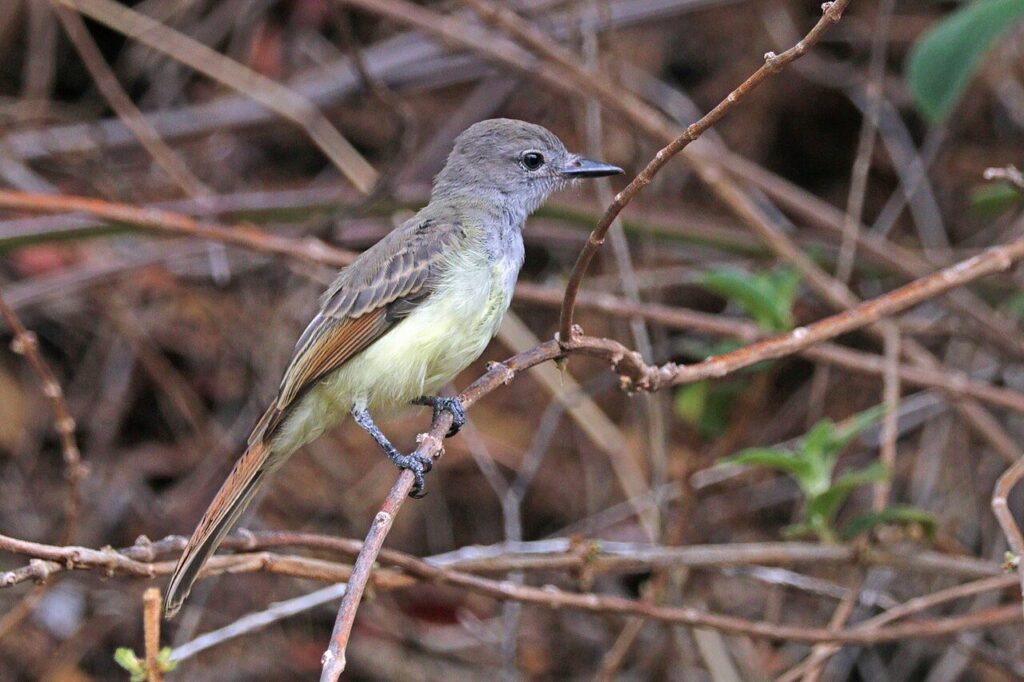
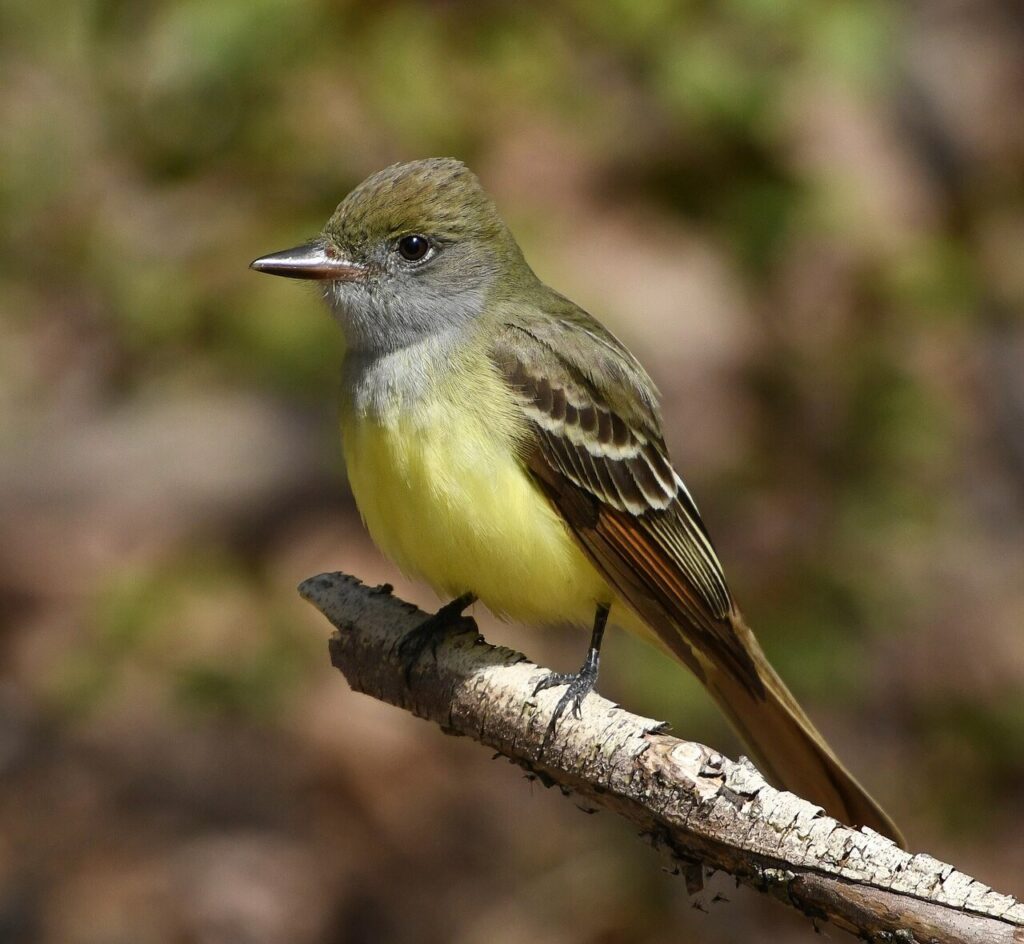
About eight inches long, bigger than a phoebe and slimmer than a robin. Olive-brown above, pale gray throat and upper chest, bright yellow belly, and warm rufous in the wings and especially the tail, which shows well when the bird flies. The crest is a bushy peaked crown rather than a cardinal-style point; it’s raised when the bird is alert. Heavy bill with a hooked tip. Sexes look alike. The birds it’s confused with: eastern kingbird (gray and white, no yellow, white tail tip), eastern phoebe (smaller, no yellow, pumps its tail), and in Florida and Texas the brown-crested and ash-throated flycatchers (paler yellow, larger or smaller bills; range and voice separate them).
Voice
You will hear it long before you see it. The main call is a loud, rising, whistled “wheeep!” repeated at intervals, and a rolling “prrrreet.” Learn the wheep and you’ll find that most wooded neighborhoods east of the Rockies have a pair. The Merlin app’s sound ID picks it up from a phone recording on the first try.
Range and season
A summer bird of the eastern two-thirds of the U.S. and southern Canada, from Texas and Florida north to the Dakotas and Maine. Arrives late April in the South and mid-May in the North, nests June, and leaves in September for Central America and southern Florida, where a few winter. Habitat is open deciduous woods, wooded suburbs, orchards, parks, and the edge of any yard with big trees. It’s a canopy bird, so look up.
What it eats
Insects, taken in flight or plucked from leaves: beetles, cicadas, grasshoppers, moths, dragonflies, and caterpillars. Late in summer it adds berries and small fruit. It will not come to a seed feeder. What it will come to is a yard full of insects, which means no lawn insecticide, some untidy edges, and native trees (oaks host more caterpillar species than any other tree in North America, and a flycatcher pair raising four chicks needs thousands of them). It occasionally visits a bird bath, especially a dripper, in a dry August.
The nest, and the snakeskin
Great crested flycatchers are cavity nesters, the only eastern flycatcher that is. They use old woodpecker holes, natural hollows, and nest boxes, and they line the nest with an odd assortment: fur, feathers, cellophane, onion skins, and famously a shed snakeskin, which is in most nests and is thought to deter predators. Four to six eggs, one brood a year. The pair defends the tree loudly.
Attracting a pair with a nest box
This is the one thing you can actively do. The box needs to be bigger than a bluebird box: a floor of about 6 by 6 inches, 8 to 10 inches deep, with an entrance hole of 1.75 to 2 inches (a bluebird box’s 1.5-inch hole is too small). Mount it 10 to 20 feet up on a tree trunk or pole at the edge of the woods or under a large tree, facing an open area, by mid-April. Put an inch of wood chips in the bottom. Most boxes sold as “flycatcher” or “screech-owl” boxes are the right size; a cedar box with a metal predator guard is worth the extra few dollars because raccoons and starlings both want the same hole. Starlings are the main competitor; if one moves in, clear it out (starlings are unprotected) and try again. Expect a season or two before a pair finds it.
Where to look
Stand in the yard at 7 a.m. in June and listen for the wheep. Follow it to the tallest tree. Watch the outer branches for a bird that sits upright, sallies out a few feet to snap an insect, and returns. Binoculars help; the yellow belly is hard to see from below without them. Then check the same tree every morning; a pair uses the same perches all summer.
Bottom line
A common, loud, colorful bird that most yards east of the Rockies already have and most people have never noticed. Learn the call, look up, and hang a box with a two-inch hole by April. That’s the whole plan.
Related: Small gray bird with a white belly: 8 it could be · Identify birds by their songs · Create a bird-friendly garden