A flock of grackles can empty a feeder in an afternoon and keep every chickadee and finch in the neighborhood away while they do it. Red-winged blackbirds, cowbirds, and starlings do the same thing in smaller numbers. They aren’t villains, they’re just big, social, and fond of cheap seed, and that’s the whole solution: change the food, change the feeder, and they leave on their own. Here’s what works, in the order to try it, and what to skip.
Spark Lark is reader-supported. As an Amazon Associate we earn from qualifying purchases made through links on this page, at no extra cost to you.
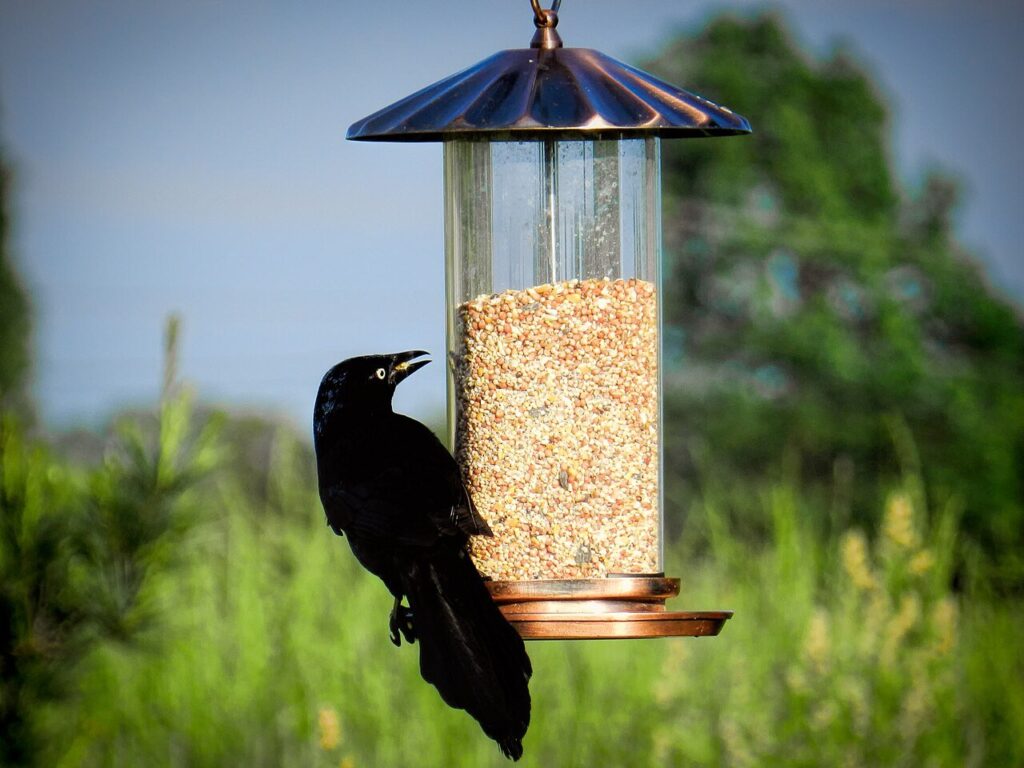
The short version
- Change the seed first: safflower or striped sunflower. Songbirds eat both; grackles and blackbirds mostly won’t bother.
- Best feeder fix: a feeder with weight-set perches, like the Woodlink Absolute II, on its light setting.
- Simplest feeder fix: a caged feeder, like the Audubon Caged Screen Feeder, that only small birds fit through.
- For suet: an upside-down suet feeder. Woodpeckers and chickadees feed hanging; grackles and starlings can’t.
- Stop doing: mixed seed, ground feeding, and platform feeders while the flock is around.
Not sure whether you have grackles, red-winged blackbirds, starlings or cowbirds? Our guide to telling grackles, blackbirds and starlings apart sorts them out in about ten seconds. And if you want to know why these birds go for the tray and the cheap mix but skip safflower, see what grackles eat, and if a flock showed up overnight, why grackles flock in fall and how long they stay. If the flock is a problem beyond the feeder, on the lawn, the roof or in a roost tree, see the law, roosts and nests below.
Know which bird you have
Common grackle: larger than a robin, glossy black with a purple-blue head that shines in sun, a long keel-shaped tail, and a pale yellow eye. Travels in flocks, walks rather than hops, and is the one that shows up forty at a time in spring and fall migration. Red-winged blackbird: smaller, the male jet black with red-and-yellow shoulder patches, the female streaky brown like a big sparrow. Comes to feeders mostly in late winter and spring. Brown-headed cowbird: stocky, the male glossy black with a chocolate head. European starling: not a blackbird at all, but the same behavior: short tail, yellow bill in spring, speckled in winter, and the one that will strip a suet cake by noon. Everything below works on all four.
Step 1: Switch the seed
This solves it more often than anything else. Blackbirds and grackles have soft, straight bills built for insects and grain. They love millet, cracked corn, milo, and the cheap mixes made of them, and they’ll happily eat black-oil sunflower because the shell is thin. They struggle with two seeds that the birds you want handle easily.
Safflower is a white seed with a bitter, hard shell. Cardinals, chickadees, titmice, house finches, nuthatches, and doves eat it without complaint; grackles, starlings, and most blackbirds try it once and leave. Squirrels dislike it too. Striped sunflower has a shell thick enough that only birds with strong cracking bills (cardinals, jays, grosbeaks, chickadees working at it) get in; grackles give up. Fill every feeder with one or the other for two weeks and the flock usually moves on. Expect a slower week from the songbirds while they adjust.
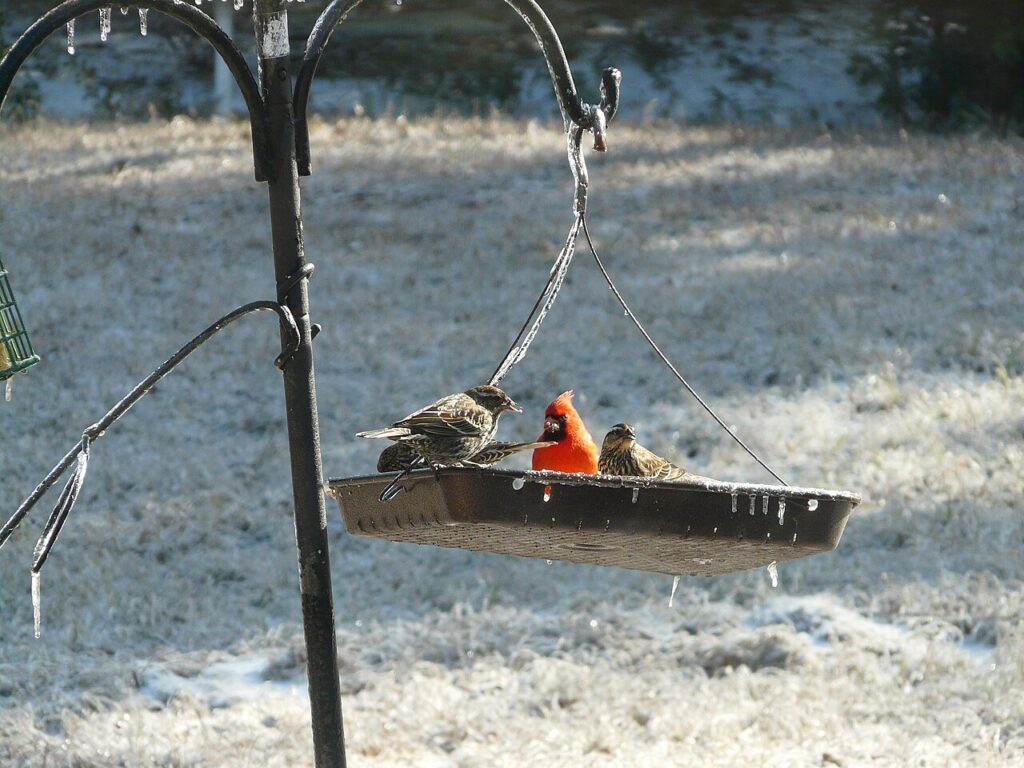
Step 2: Change the feeder
Grackles need something to stand on. Take that away and they can’t feed no matter what’s inside.
Weight-activated
The Woodlink Absolute II has two counterbalance perches that Woodlink says adjust to three positions, “to allow light, medium or heavy birds on the perch,” and “the wrong bird or squirrel closes access to seed.” Grackles weigh 2.6 to 5.0 ounces, according to the Cornell Lab, far more than a chickadee or finch, so the light setting is the one to try. One feeder you may see recommended for this is not a fix: Brome’s own page for the Squirrel Buster Plus says it “will NOT deter Grackles, Starlings.” It’s a strong squirrel feeder, not a grackle feeder.
Caged
A tube feeder inside a wire cage with 1.5-inch openings admits chickadees, finches, nuthatches, titmice, and small woodpeckers and shuts out everything grackle-sized. It also keeps cardinals out, which is the trade-off. The Audubon Caged Screen Feeder is a ready-made example; Woodlink says its metal grid cage keeps adult squirrels and larger birds out.
Tube feeders without trays
Any tube feeder with short perches and no seed tray on the bottom is hard for a grackle to use. If yours has a tray, take it off. Cheap fix, partial result.
For suet: feed upside down
Starlings and grackles will hang on a standard suet cage and eat the cake in a morning. An upside-down suet feeder puts the cake under a roof so the only way to reach it is clinging from below, which woodpeckers, nuthatches, chickadees, and wrens do naturally and blackbirds can’t. Skip hot-pepper suet for this job: birds don’t react to capsaicin the way mammals do, so pepper keeps squirrels off the cake but won’t stop starlings. Our starling guide covers the feeders that do.
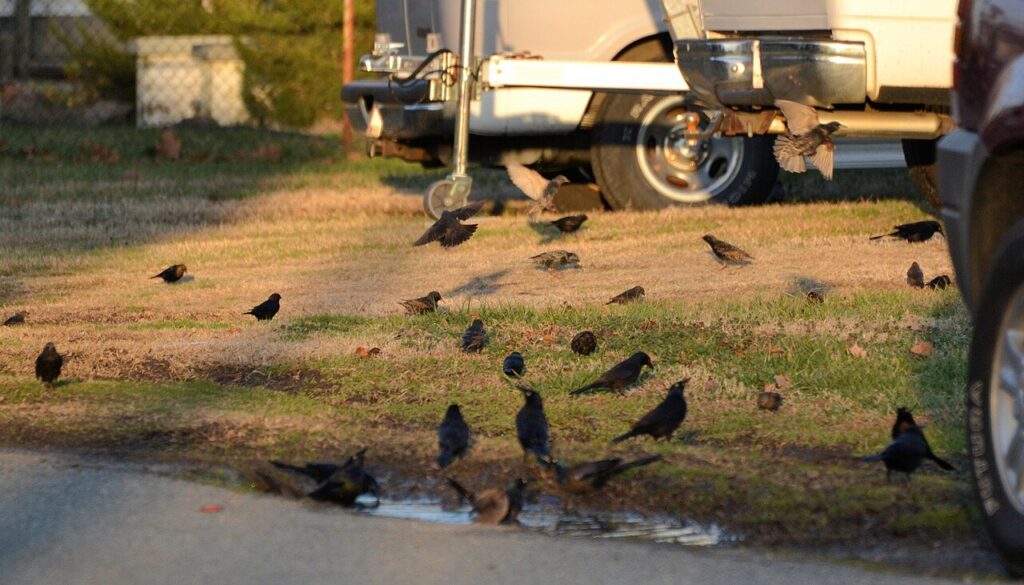
Pigeons crowding the feeder too? The same fixes work on them. Here’s the full answer to are pigeons dirty birds? and how to keep them off feeders.
Step 3: Stop the ground buffet
Grackles and blackbirds prefer to feed on the ground, and a feeder that spills seed is feeding them under it all day. Stop ground feeding entirely while the flock is around, rake up hulls under the feeders, put a seed tray under tube feeders to catch what falls (yes, that’s the tray you removed from the feeder itself; move it to the pole), and take down any platform or tray feeder for a few weeks. If you keep a platform for cardinals, fill it with safflower only.
Step 4: Wait them out
Most grackle and blackbird problems are seasonal. The big flocks are migrants moving through in March–April and again in September–November, and they stay two or three weeks in any one yard. In nesting season the same birds split into pairs and mostly eat insects. If you switch the seed and pull the trays when the flock arrives, you’re usually back to normal before you’d have finished installing anything more elaborate. Starlings are the exception; they stay all year, and the upside-down suet feeder and caged feeder are permanent fixtures where starlings are thick.
Beyond the feeder: the law, roosts and nests
If grackles are a problem in your whole yard, not just at the feeder, these three things matter most.
Are grackles protected?
Yes. All three grackles are native birds covered by the Migratory Bird Treaty Act, which, as the U.S. Fish and Wildlife Service puts it, prohibits “the take (including killing, capturing, selling, trading, and transport)” of protected birds without authorization.
There is a narrow federal exception. A depredation order (50 CFR 21.150) lets people control blackbirds, cowbirds, crows, magpies and grackles without a permit when the birds are seriously damaging crops or livestock feed, causing a health hazard or property damage, or threatening endangered species. Even then, the rule requires trying nonlethal methods first each year, using nontoxic shot, following state and local law, and filing an annual report with the Fish and Wildlife Service. That’s a tool for farms and damage cases, not for a yard where grackles are loud and eat the birdseed. Everything in this article is nonlethal.
Nests are protected too. The Fish and Wildlife Service says it is illegal to destroy a nest that has eggs or chicks in it, or young birds still dependent on it. More on that in the nesting section below.
Break up a roost in your trees
The noisiest grackle problem isn’t the feeder. It’s the evening roost: dozens or hundreds of birds piling into the same trees at dusk. Cornell describes great-tailed grackle roosts as “raucous flocks” packing neighborhood trees, and says common grackles in winter roost in communal flocks with other blackbirds that can number in the millions.
University of Missouri Extension’s guide to blackbird roosts lays out a method that works for homeowners:
- Start early. Begin two to three hours before dark, or as soon as the birds start settling in.
- Use sharp noise, not steady noise. The guide says “sharp, loud noises are more effective than loud, sustained sounds.” Banging pots or trash can lids, beating a metal tub, or slapping two boards together all count.
- Keep at it. Plan on at least four evenings in a row. An established roost can take up to a week before the birds give up on it.
- Make the trees less attractive. The same guide recommends removing understory shrubs and brush and discouraging interlocking branches between trees. A thinned-out stand gives the flock less cover.
The extension guide also mentions pyrotechnic noisemakers and recorded distress calls. Check your city’s rules on noise and fireworks, and talk to your neighbors, before trying either. A roost that moves one yard over just becomes your neighbor’s problem. For big roosts in town, Missouri’s Department of Conservation recommends a community effort: plan in spring or early summer, get any permits needed, use at least three people, and expect three to five or more evenings in a row.
Why bother? Besides the noise, droppings pile up under a big roost. University of Missouri Extension notes that accumulated droppings can grow the fungus that causes histoplasmosis in people and animals. That’s a good reason to move a roost early rather than wait out a whole season.
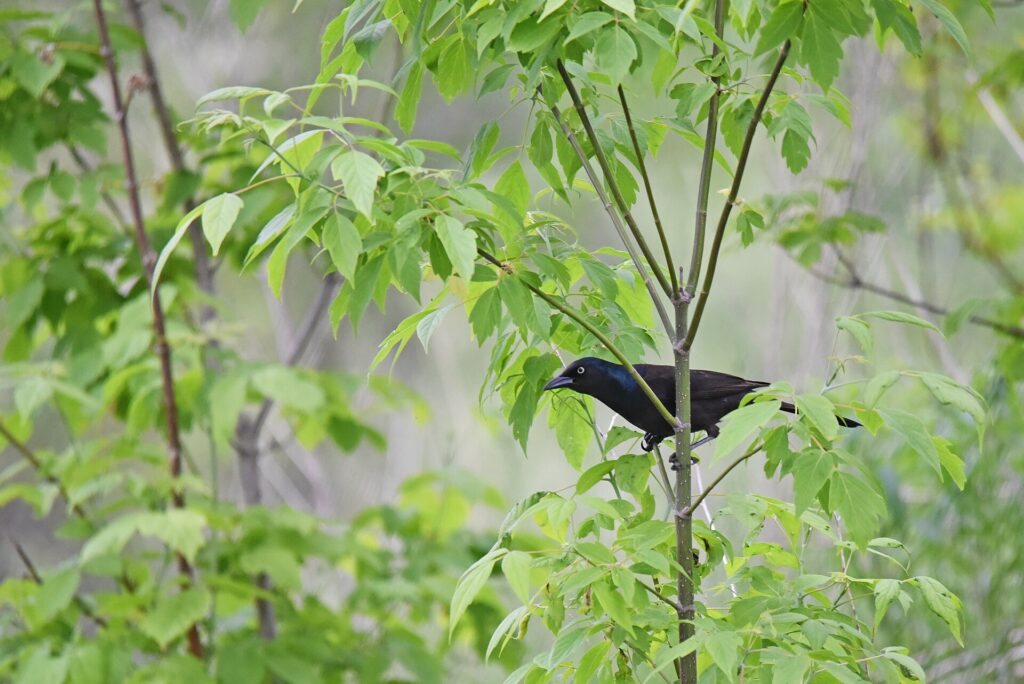
Stop nesting before it starts
If grackles nest in your yard, you’ll have them from spring into summer. Common grackles usually nest high in conifers, and they sometimes nest in loose colonies of up to 200 pairs, according to Cornell. Great-tailed grackle nests can be more than 60 feet up in trees, or in marsh plants or on buildings where trees are scarce. Boat-tailed grackles mostly nest low in marsh grasses near the coast.
The Fish and Wildlife Service’s advice on problem nests comes down to timing: deal with a nest while it’s being built. A nest with no eggs or birds in it can be removed without a permit under federal law, but a nest with eggs or chicks is protected. The Service notes that state laws may be stricter, so check with your state wildlife agency. Its guidance also points to April through July as the season to watch.
- From April on, watch dense evergreens and trees near water, where Cornell says common grackles often nest.
- Pull down a nest under construction right away, while it’s still empty.
- If you find eggs or chicks, leave the nest alone. It won’t be long: Cornell lists an incubation period of 11 to 15 days and a nestling period of 10 to 17 days for the common grackle.
- Thinning dense trees and brush, which the Missouri extension guide recommends against roosts, also leaves fewer hidden nest sites.
What doesn’t work
Mylar strips, shiny balloons, fake owls. Grackles are among the smartest birds at a feeder. They notice a fake owl for about a day. Ultrasonic repellers. No evidence, and birds barely hear the frequencies anyway. Shooting or poisoning. Grackles, red-winged blackbirds, and cowbirds are protected under the Migratory Bird Treaty Act; harming them is a federal offense. Starlings aren’t protected, but poison put out for them kills everything else too. Taking the feeders down for a day. A flock that found your yard comes back the next morning. Two weeks of safflower is what actually resets them.
Common questions
Will grackles hurt the smaller birds? They bully them off the feeder and occasionally kill nestlings, but at a feeder the harm is mostly lost seed and displaced songbirds. The songbirds come straight back once the flock moves on.
Do grackles eat suet? Yes, and starlings more so. The upside-down feeder is the fix.
Can I just feed the grackles somewhere else? You can, with cracked corn on the ground at the far side of the yard, and it takes pressure off the main feeder. It also makes the flock stay longer. Better for squirrels than for grackles.
Why are there suddenly hundreds of blackbirds in my yard? A migrating or winter-roosting flock found a food source. Pull the trays, switch to safflower, and stop ground feeding; they’ll be gone in days.
Shopping for a feeder that does this for you? Our guide to the best starling-proof and grackle-proof bird feeders compares six that use weight, cages or upside-down suet.
Bottom line
Safflower in every feeder, trays off, ground feeding stopped, for two weeks. If that’s not enough, or starlings are the problem, a weight-set feeder like the Woodlink Absolute II on its light setting, or a caged feeder, plus an upside-down suet feeder, make the feeders much harder for them to use. Same principles as keeping squirrels off feeders: take away the seed they want and the perch they need, and the problem solves itself.
Related: How to keep squirrels out of bird feeders · Winter backyard birds by region · The best window bird feeders