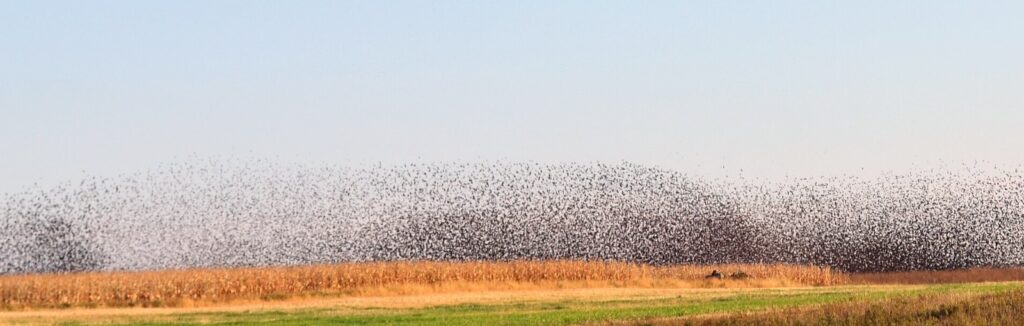
Grackles gather in huge flocks in fall for the same reasons most blackbirds do: there is safety in numbers, a big group finds food faster than a lone bird, and a shared roost is a warmer, better-defended place to spend a long night. The flocks start building as soon as nesting ends in late summer, peak in October and November, and roll south through the country in waves. How long they stay depends on where you live. In the northern half of the U.S. a flock is usually passing through and gone within days. From the mid-Atlantic and lower Midwest south, the same flock may be your neighbor until March.
The short version
- Why: protection from hawks, better luck finding food, warmth and shelter at a shared roost, and staging for migration.
- When: flocks form in August, build through September, and are biggest in October and November.
- How big: a typical roost holds a few thousand birds; the largest run to hundreds of thousands, and mixed winter roosts in the South and Midwest have reached the millions.
- Who’s in it: grackles plus red-winged blackbirds, brown-headed cowbirds and European starlings.
- How long at your feeder: days in the North, where they’re migrating through; all winter in the South, where they settle.
When the flocks form
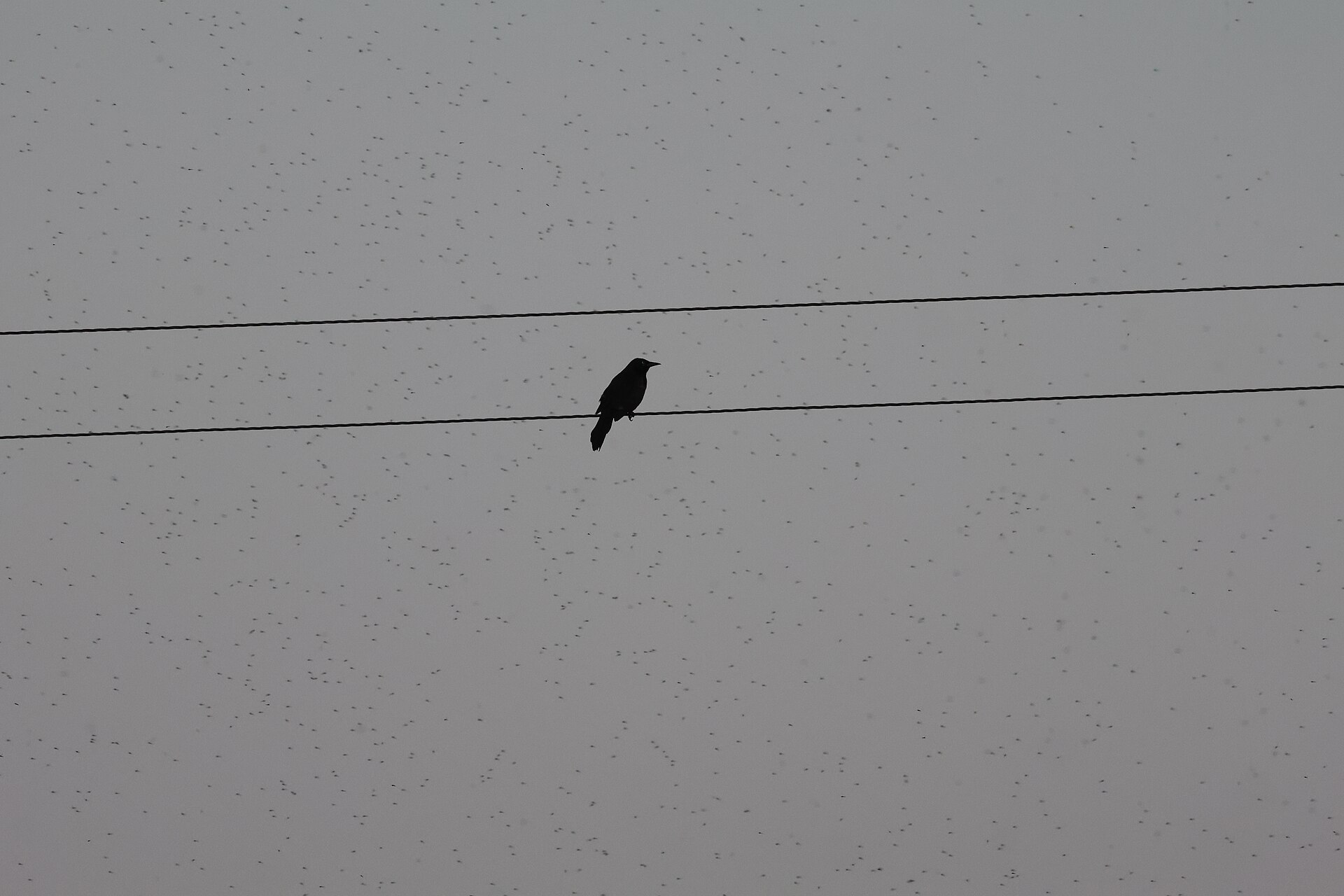
Common grackles nest in loose colonies, often a dozen or more pairs in the same stand of conifers, so they are never far from company. Once the young fledge in June and July, the family groups drift together into bigger and bigger bands. By August you can see a hundred at a time working a lawn or a harvested field. Through September those bands merge with red-winged blackbirds coming off the marshes, cowbirds, and starlings, and the evening flights to a shared roost begin.
New Hampshire Audubon, which tracks the state’s roosts, reports that they are “largest in October and November,” when a big one can top 100,000 birds, though about 3,000 is a more typical high count. That is the pattern across the northern states: the flocks peak in mid-fall, then thin out as birds move south.
Common grackles are what Cornell’s All About Birds calls a “resident or short-distance migrant.” Birds from Canada, the far-northern states and the Great Plains winter in the central and southern U.S. Birds already living in the mid-Atlantic, the Southeast and the lower Mississippi Valley mostly stay put and are joined by the northerners. That is why a Tennessee or Arkansas yard sees the biggest flocks of the year in December, while a Minnesota yard sees them in October and then nothing until March.
Why they gather: four reasons
1. Safety from hawks. A Cooper’s hawk or a sharp-shinned hawk hunts by surprise, and surprise is hard to pull off against ten thousand pairs of eyes. The Missouri Department of Conservation puts it plainly: it is “harder for a hawk to pick off a single bird” in a crowd of thousands. A lone grackle on a wire is a target; a grackle in the middle of a swirling flock is a lottery ticket. The tight, twisting flight you see when a flock lifts off together is the same principle in the air. Predators struggle to lock onto one bird in a moving mass.
2. Finding food. In summer, a grackle can feed itself on insects in a single yard. In fall and winter, the food is patchy: a harvested cornfield here, a stand of oaks dropping acorns there, a feeder tray somewhere else. A flock covers far more ground than a single bird, and when one group finds a field full of waste grain, the rest follow. The Missouri Department of Conservation notes that roosting blackbirds “may fly as far as 20 miles to feed” during the day. That commute only pays off if you know where you’re going, and a flock carries that knowledge in numbers.
3. A warm, sheltered night. Grackles roost high, in trees or on power lines, and in fall they crowd into the densest cover they can find. Summer and early-fall roosts are in leafy deciduous trees; as leaves drop and the cold sets in, the roosts shift to conifers, cattail marshes and, in cities, the sides of buildings, all of which cut the wind. Thousands of bodies packed into a stand of pines hold heat that a bird alone on a bare branch would lose.
4. Staging for migration. Mass Audubon describes fall grackles gathering “into large flocks before migration at communal roosts.” The roost is where the northbound-in-spring, southbound-in-fall movement gets organized. Birds put on fat, wait for good weather, and leave together. That is why a northern roost can hold 20,000 birds one week in October and be nearly empty the next.
What a roost looks like
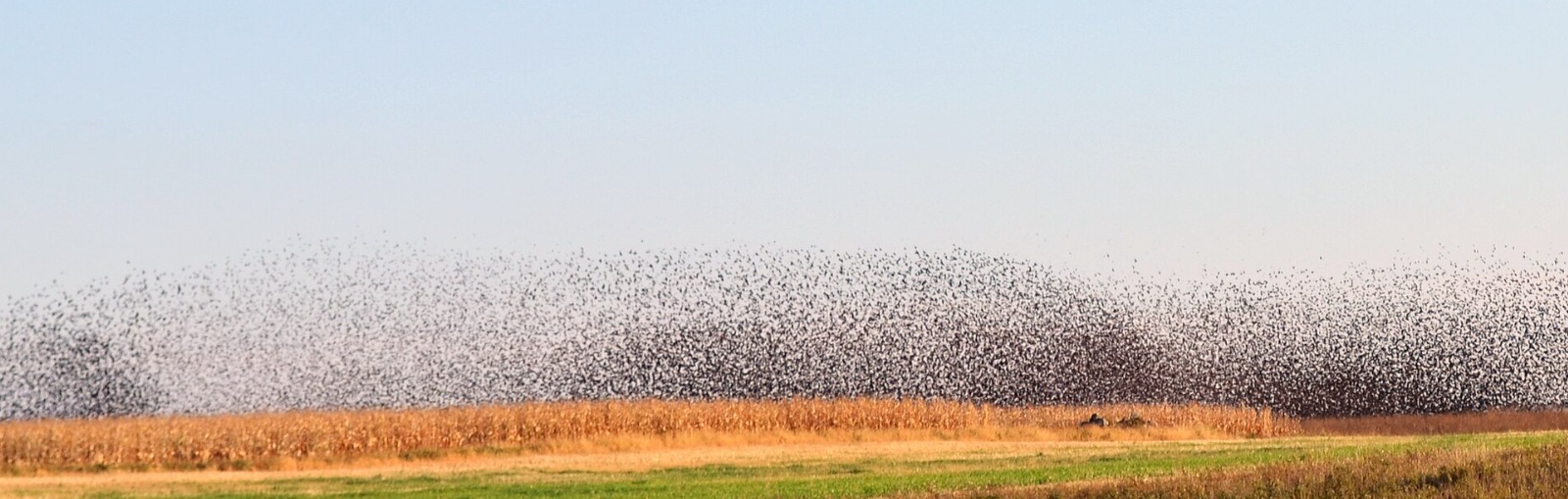
If you want to see one, go out at dusk or dawn, when the birds are arriving or leaving. In the last hour of daylight, lines of blackbirds stream across the sky from every direction toward one patch of woods, marsh or city park. They circle, pour into the trees, and the noise builds until it sounds like a stadium. At first light the process runs in reverse, with the flock breaking into smaller groups that fan out to feed.
Almost every fall and winter roost is a mixed one. A flock counted by Columbia Audubon in Missouri was about 75 percent common grackles, 20 percent red-winged blackbirds and 5 percent European starlings, and cowbirds and rusty blackbirds turn up in smaller numbers. The largest of these gatherings are hard to believe. Audubon reports roosts of up to a million birds, and Missouri birders have estimated 5 million at Eagle Bluffs in December 2011 and about 10 million in Audrain County in January 2019. Christmas Bird Count volunteers once tallied roosts in the tens of millions.
That last number points at something worth knowing. According to Audubon’s analysis of Christmas Bird Count data, common grackles have been declining about 3 percent a year, roughly a 78 percent drop since 1970, and Breeding Bird Survey data show at least a 50 percent decline over the past half century. Cornell lists the species as a “Common Bird in Steep Decline.” The flock that empties your feeder is a fraction of what your parents would have seen.
How long will they stay at my feeder?
It depends on whether your yard is a rest stop or a destination.
Northern states (New England, the upper Midwest, the northern Plains): flocks in September and October are migrating. A group finds your feeder, strips it, and moves on within a day or a few days. Once the flock’s roost breaks up and heads south, usually by mid-November, you will see very few grackles until they return in March. A single feeder is not worth fighting over. Take the tray in for a week, or switch to safflower, and wait them out.
Mid-Atlantic, Ohio Valley, lower Midwest: some birds stay all winter, joined by northern arrivals. Flocks are around from October through February, but they cover a lot of ground each day, so a given yard may be hit hard for a few days and then skipped for a week. The pattern repeats through the winter.
Southeast, Gulf Coast, Texas, lower Mississippi Valley: this is where the big roosts spend the winter. Expect grackles daily from November to March, and expect the numbers to peak in the coldest weeks. Here you need a feeder setup that grackles can’t use, not a plan to outlast them. Our guide to getting rid of grackles and keeping blackbirds away from feeders covers the full approach, and our starling-proof and grackle-proof feeder picks list caged and weight-set feeders that keep birds that size off the seed.
One more factor: what the flock is eating. In fall, harvested cornfields, oak stands and cattle feedlots draw far more birds than any feeder. If your yard sits between a roost and a food source, you get the overflow. If it sits near neither, a flock may never find you. For what actually draws them in, see what grackles eat.
Is it grackles, or something else?
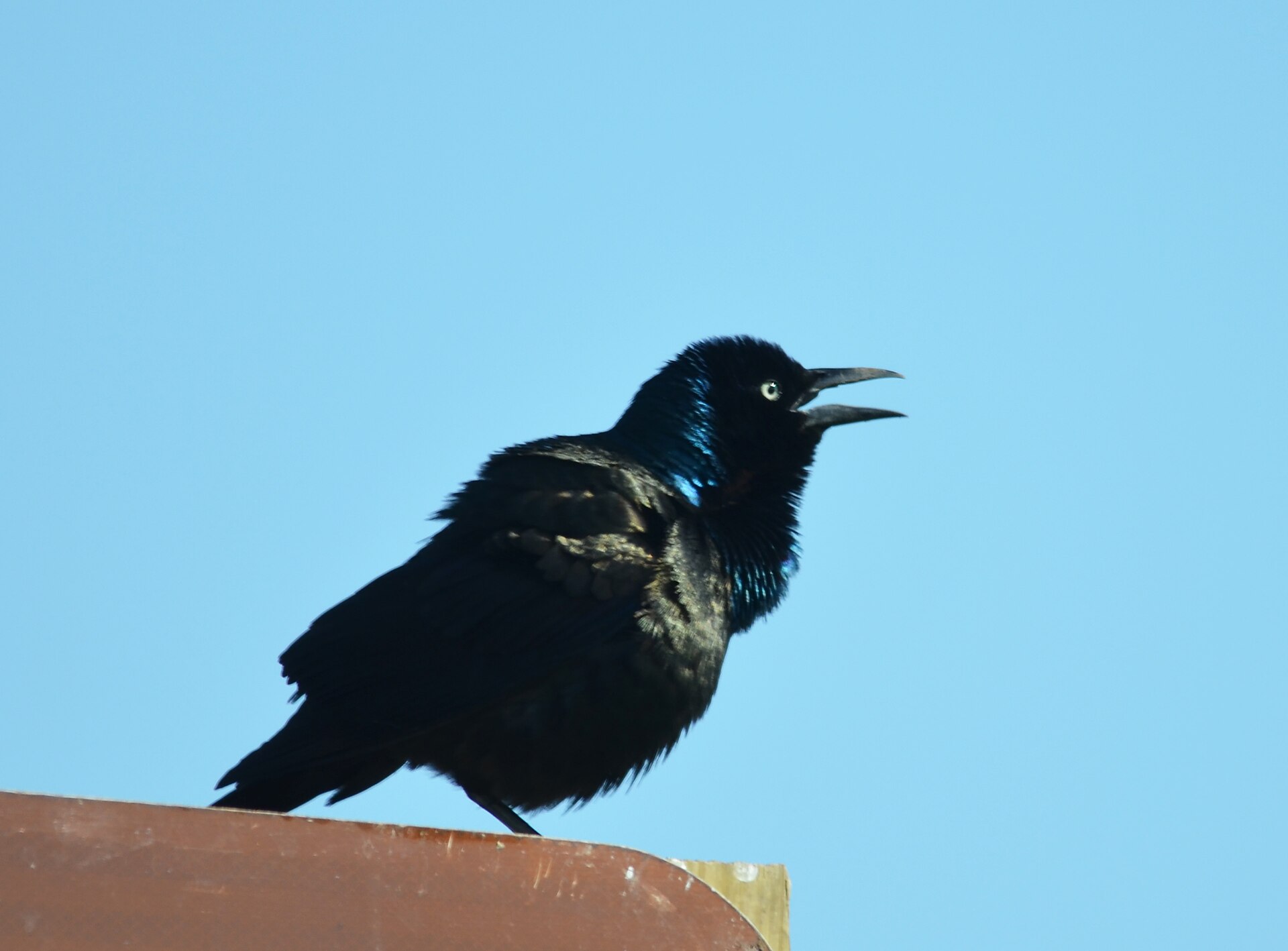
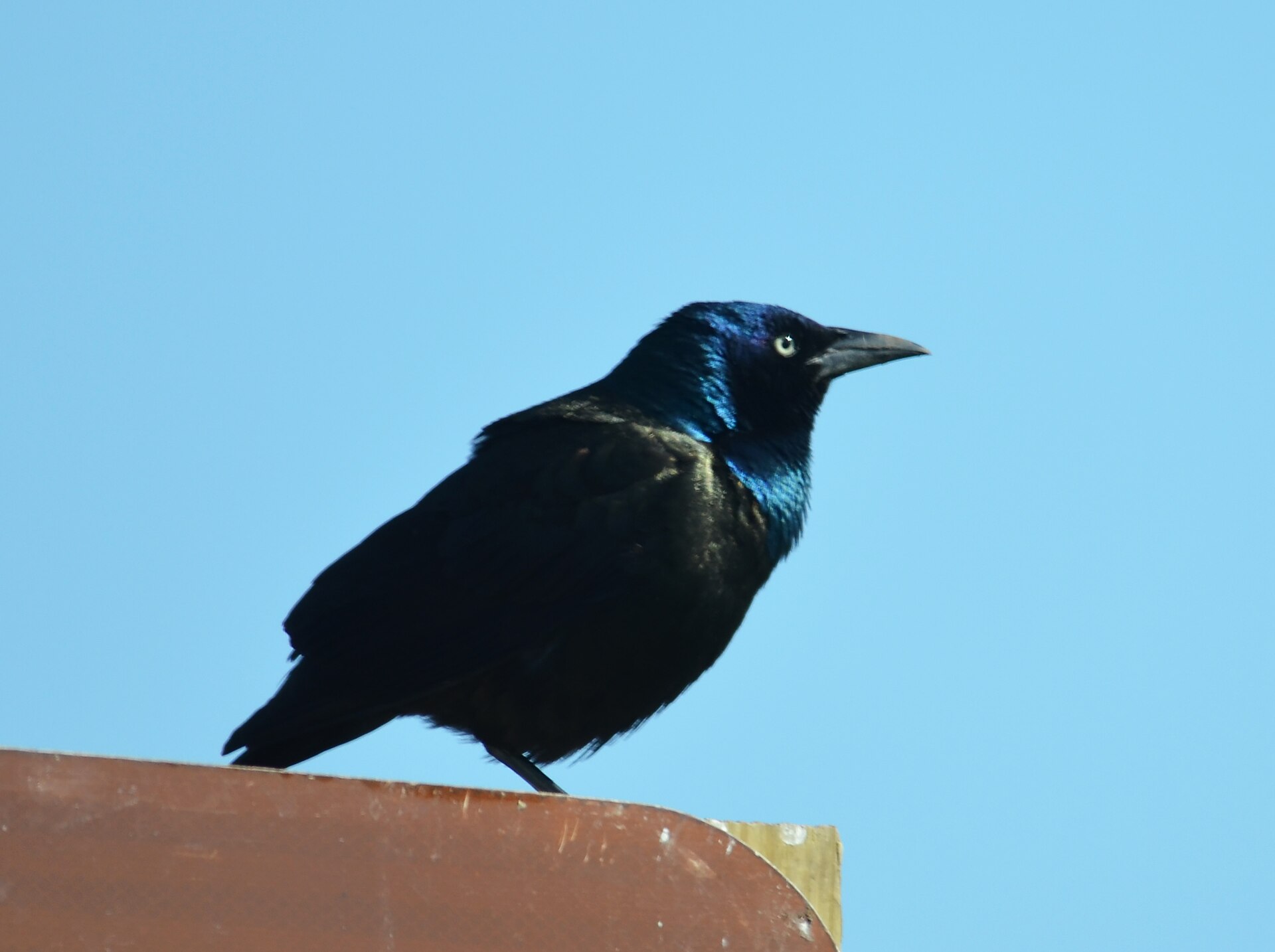
Fall flocks are mixed, and the loud, glossy, long-tailed birds get blamed for what the whole group does. Grackles have a pale yellow eye and a long tail that folds into a keel in flight. Red-winged blackbirds are smaller, with a dark eye, and the females look like big streaky sparrows. Starlings are stocky, short-tailed and speckled in fall. Cowbirds are the smallest, with a thick finch-like bill. Our guide to telling grackles, blackbirds and starlings apart sorts them in ten seconds, and it matters, because starlings are the ones raiding suet while grackles go for seed. In the western half of the country, a big glossy roost is more likely Brewer’s blackbirds or great-tailed grackles, which behave the same way.
Common questions
Do grackles migrate? Some do. Birds from Canada and the northern U.S. move to the central and southern states for winter; birds already in the South mostly stay. Cornell calls them a “resident or short-distance migrant.”
Why do they all fly at dusk? They are commuting to the night roost. Every bird in the area heads for the same patch of cover in the last hour of light, and leaves it at dawn.
Why do they roost in town? Cities are a few degrees warmer than open country and offer dense trees, evergreens and building ledges out of the wind. Urban roosts are also loud and messy, which is why towns sometimes try to move them.
Can I get rid of a roost near my house? Grackles are protected under the Migratory Bird Treaty Act, so the birds and their nests can’t be harmed, but roosts can be discouraged before they settle in with noise, lights or trimming dense cover. Once a big roost is established it is very hard to shift.
Are the flocks getting bigger? No. Grackle numbers are down roughly 78 percent since 1970 by Christmas Bird Count data. Today’s flocks are big, but the historic tens-of-millions roosts are rare now.
Bottom line
Fall grackle flocks are a survival strategy: many eyes against hawks, many wings to find scattered food, and one crowded roost to get through cold nights and stage the trip south. They build from August, peak in October and November, and are biggest and longest-lasting in the South. If you’re in the North, they’re passing through; wait a week. If you’re in the South, they’re settling in; change the feeder, not the calendar. Our guide to getting rid of grackles in your yard covers what to change, and what the law allows.