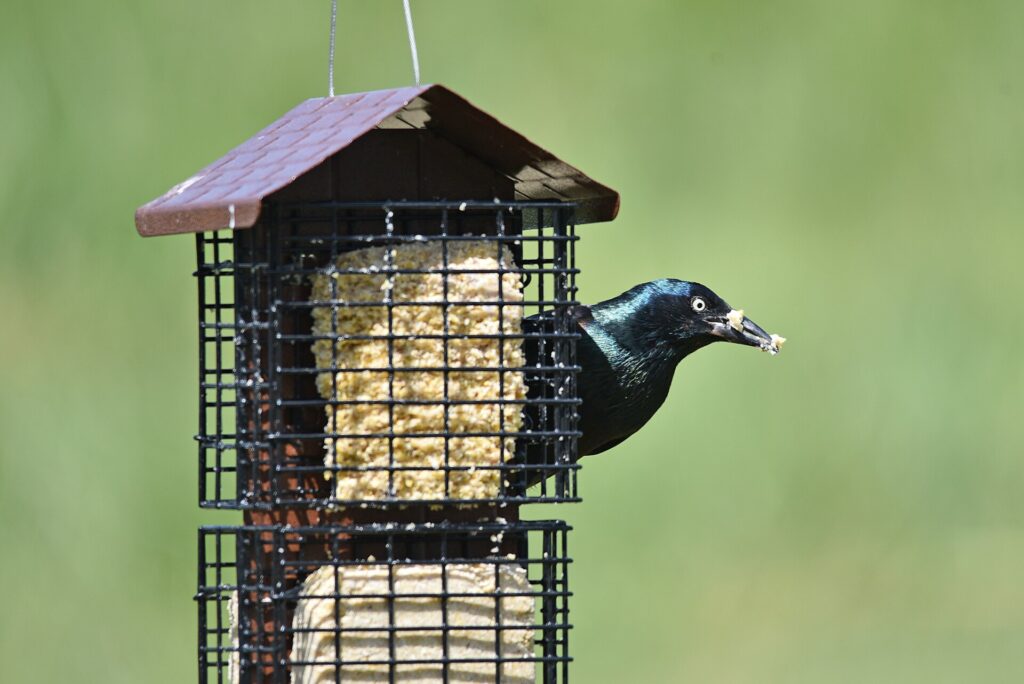
If a flock of big dark birds has taken over your feeder, the first useful question is which big dark bird. Grackles, red-winged blackbirds, starlings and cowbirds all show up in noisy groups, all eat cheap seed, and all get called “blackbirds” by people who are busy watching their sunflower disappear. But they are four different birds with different habits, and knowing which one you have tells you what will and won’t move them along. Here is how to tell them apart in about ten seconds, and what each one means for your feeder.
The ten-second version
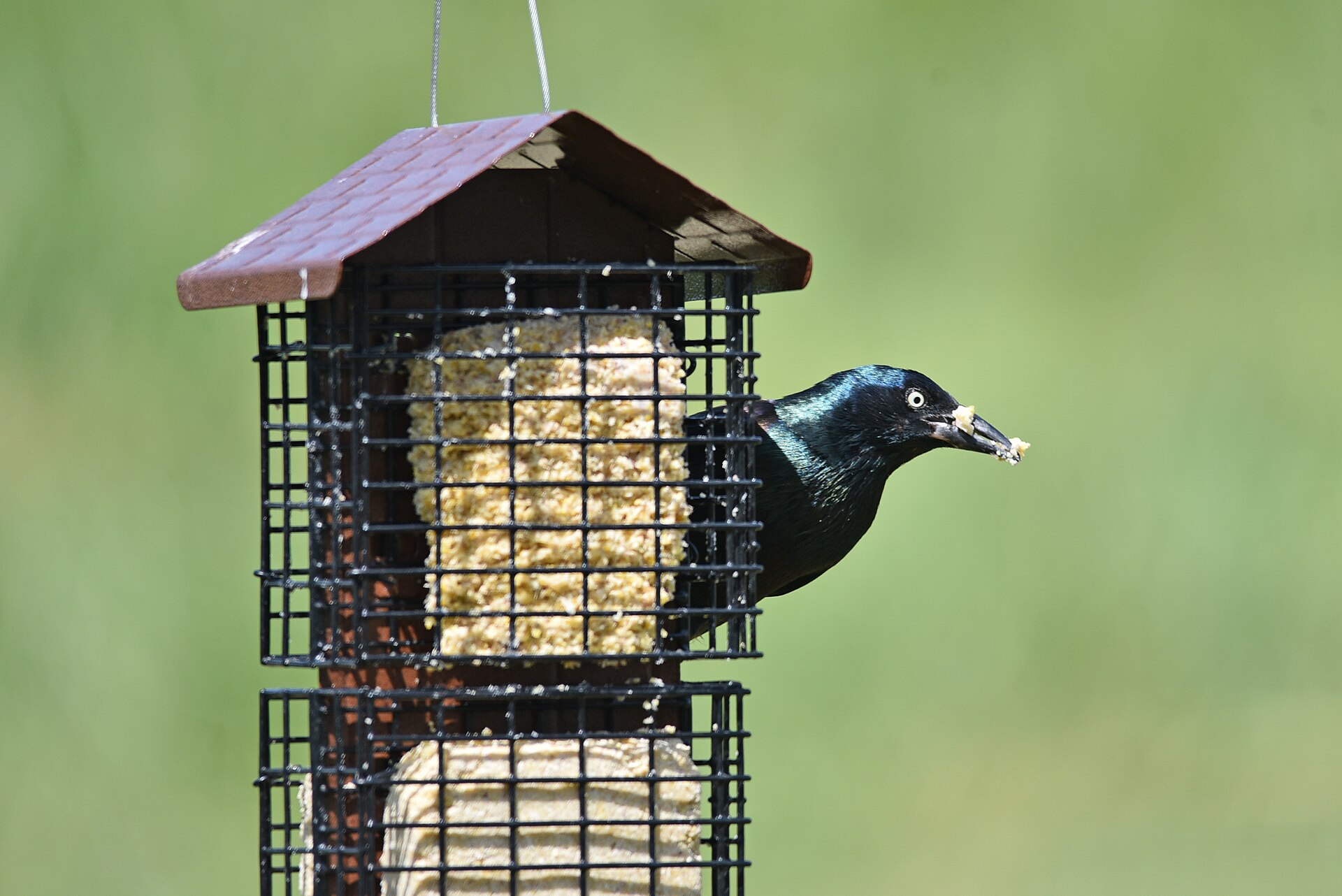
- Long, wedge-shaped tail, pale yellow eye, glossy purple-bronze sheen, bigger than a robin: common grackle.
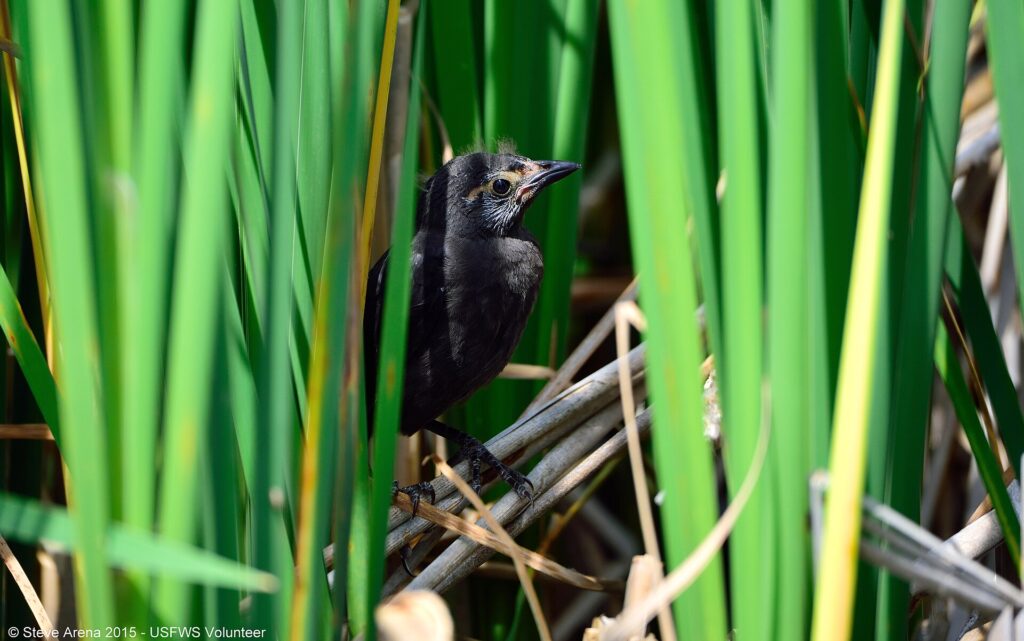
- Red and yellow shoulder patch on a black bird about robin size: male red-winged blackbird. A streaky brown bird that looks like a big, dark sparrow with a sharp bill is the female.
- Short tail, chunky body, long pointed bill, speckled or oily-looking feathers: European starling.
- Smaller, black body with a brown head, short thick bill like a finch: male brown-headed cowbird. The female is plain gray-brown all over.
Only one of these, the starling, is not native to North America. The other three are native blackbirds in the same family as orioles and meadowlarks. That matters for what you can legally do about them: native birds, their nests and eggs are protected under the Migratory Bird Treaty Act. Starlings are not.
Common grackle
The grackle is the one most people mean when they complain about a feeder takeover. It is 11 to 13 inches long, noticeably bigger than a robin, with a long tail that folds into a V or keel shape in flight. The eye is pale yellow, which is the fastest field mark once you know to look for it. In good light the head is glossy blue-purple and the body bronze or green, depending on the region; in flat light the whole bird just looks black. The bill is long, heavy and slightly hooked at the tip.
Grackles walk rather than hop, and they walk with some swagger. Their call is famously ugly, usually compared to a rusty gate. They eat almost anything: sunflower, cracked corn, bread, insects, other birds’ eggs and, at the shoreline, small fish. At a feeder they prefer to stand on a platform or the ground, and they will hang awkwardly from a tube feeder if that is what you have. Across most of the country they arrive in spring flocks, nest in loose colonies in conifers, and gather into enormous roosts in late summer and fall. In the Deep South and along the Gulf Coast they stay all year.
If you live in Texas, the Southwest or along the Gulf and Atlantic coasts, you may have the great-tailed grackle or the boat-tailed grackle instead. Both are larger, with tails so long they look like a mistake, and males are far louder. The same feeder tactics work for all three.
Red-winged blackbird
The male is easy: black, robin-sized, with a red shoulder patch bordered in yellow that he flashes when he sings. Sometimes the red is hidden and only the yellow edge shows, which fools people into thinking they have a different bird. The eye is dark, not yellow, and the tail is medium length and rounded, not the grackle’s keel.
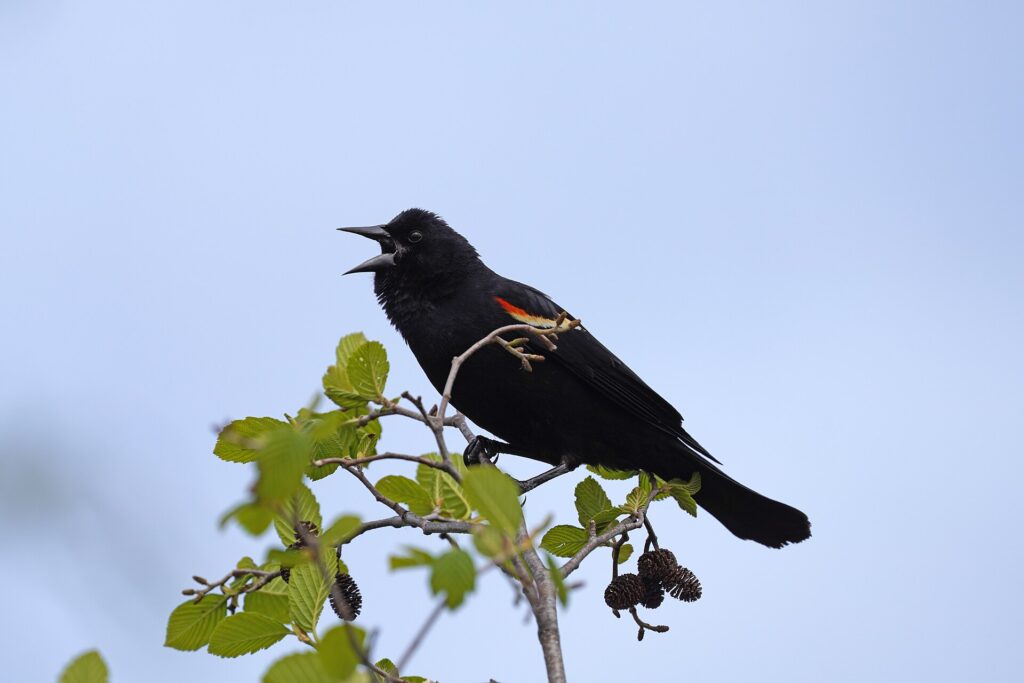
The female is the bird that causes the most confusion at feeders. She is heavily streaked brown above and below, with a pale eyebrow and a sharp, pointed bill, and she is bigger and longer-billed than any sparrow. If you have a “giant sparrow” at the feeder in spring, this is probably it.
Red-winged blackbirds nest in marshes and wet ditches and come to feeders mostly in early spring and again in fall, when they travel in flocks that can mix with grackles, cowbirds and starlings. They like cracked corn, millet and sunflower, and they feed on the ground or a tray more than at a hanging feeder. The song, a liquid “conk-la-REE,” is one of the first signs of spring across the northern half of the country.
European starling
Starlings are shorter and stockier than the blackbirds, about 8 inches, with a short square tail and a long, straight, pointed bill. That bill is bright yellow in the breeding season and dark in winter. Summer birds look glossy black with a green and purple sheen; winter birds are covered in white and buff speckles, which is why people sometimes report a “spotted blackbird.” In flight the wings look short and triangular, and starling flocks move as one twisting mass, which no blackbird flock quite does.
Starlings walk, probe the lawn with that bill open, and squabble constantly. At the feeder they are the main reason suet cages and mealworm dishes get emptied by mid-morning, because they are far more interested in fat and insects than the grackles are. They nest in cavities, which is why they are a problem for bluebirds, martins and woodpeckers. They are here all year, everywhere in the lower 48.
Seeing a black bird with white patches on its wings? It’s probably not a grackle or starling at all. Here’s our guide to black birds with white wings, including leucistic birds with random white feathers.
Brown-headed cowbird
The smallest of the four, about 7.5 inches, with a short, thick, conical bill that looks more like a finch’s than a blackbird’s. The male is glossy black with a plain brown head; the female is an unmarked gray-brown bird with a slightly paler throat, and she is a common “what is this dull bird” question in spring.
Cowbirds do not build nests. The female lays her eggs in the nests of other songbirds, and the foster parents raise the cowbird chick, often at the expense of their own. They come to feeders for millet, cracked corn and sunflower, mostly on the ground, and they are around in the largest numbers from spring through midsummer. In fall they join the big mixed blackbird flocks.
Side by side
| Bird | Size | Tail | Eye | Bill | Best field mark | Feeder habit |
|---|---|---|---|---|---|---|
| Common grackle | 11–13 in | Long, keel-shaped | Pale yellow | Long, heavy | Glossy purple head, yellow eye | Platform and ground; sunflower, corn |
| Red-winged blackbird | 7–9 in | Medium, rounded | Dark | Sharp, pointed | Red-and-yellow shoulder (male); heavy streaks (female) | Ground and tray; corn, millet |
| European starling | 8 in | Short, square | Dark | Long, straight, yellow in summer | Speckles in winter; chunky shape | Suet, mealworms, anything soft |
| Brown-headed cowbird | 7–8 in | Short | Dark | Short, conical | Brown head (male); plain gray-brown (female) | Ground; millet, corn |
Which one is emptying your feeder, and what to do
Grackles and red-winged blackbirds are seed birds. They come for cheap mixes heavy on cracked corn and milo, for black oil sunflower, and for anything spilled on the ground. Switching to safflower or striped sunflower, and taking away the ground buffet, moves most of them along within a week or two. Our guide to keeping grackles and blackbirds away from feeders walks through that in order, and our guide to what grackles eat explains why the seed switch works. If they’ve moved on to the lawn or the roof, see how to get rid of grackles in your yard.
Starlings are a different problem, because they mostly want suet and mealworms rather than seed. An upside-down suet feeder, which woodpeckers handle easily and starlings mostly can’t, solves the suet side, and a caged mealworm dish sized for bluebirds solves the other. Our bluebird feeder guide covers the starling-proof designs.
Cowbirds are the least of the four at a feeder. They are small, they are usually gone by late summer, and the same seed changes that discourage grackles discourage them. Their real cost is to nesting songbirds, and the honest answer there is that there is not much a backyard can do beyond keeping feeders from becoming a cowbird gathering point in spring.
Two birds that get mistaken for blackbirds
Rusty blackbird. In the eastern half of the country in fall and winter, a blackbird with a pale eye, a shorter tail than a grackle, and rust-colored feather edges is probably a rusty blackbird. They are shy, they like wet woods, and they have declined sharply over the last few decades, so one at your feeder is worth a second look rather than a shoo.
Brewer’s blackbird. West of the Great Plains, the yellow-eyed black bird in the parking lot is more likely a Brewer’s blackbird than a grackle. It is smaller, with a shorter tail and a more delicate bill, and the female is plain brown with a dark eye.
If the bird you’re trying to name is small and gray rather than big and black, start with our guide to 18 common gray birds instead.
For what these flocks are doing in fall, see why grackles gather in huge flocks.
Bottom line
Yellow eye and a long tail is a grackle. Red shoulder is a red-winged blackbird, and the streaky “giant sparrow” is his mate. Short tail, long yellow bill and speckles is a starling. Small, thick bill, brown head is a cowbird. Grackles and blackbirds leave when you change the seed. Starlings leave when you change the suet feeder. None of them is worth losing sleep over, and all but the starling are protected, so the answer is always the feeder, never the bird.