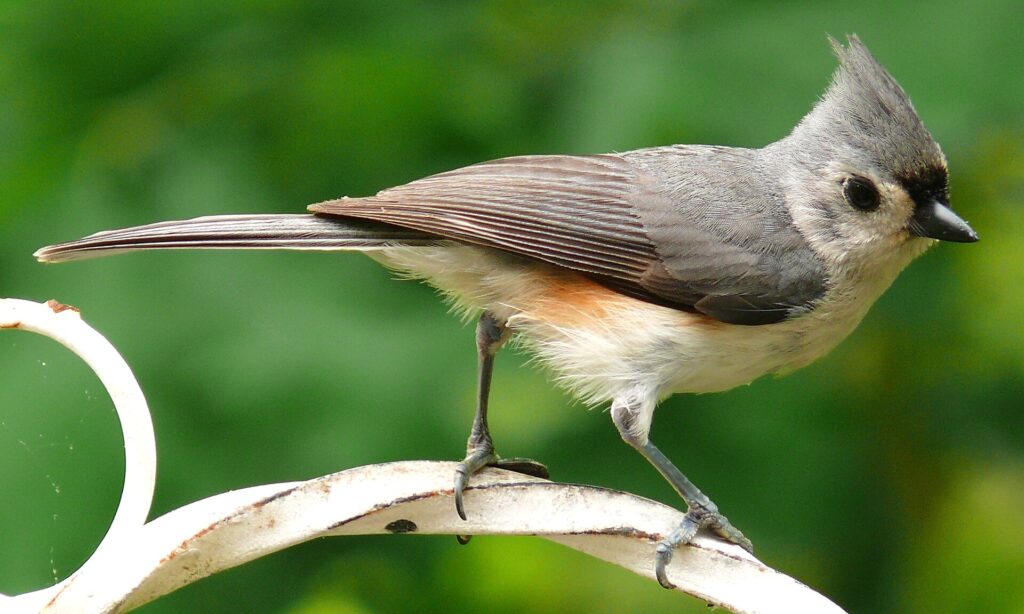
A small gray bird with a little pointed crest on its head is one of the most common “what is this?” questions from backyard feeders, and the good news is that the list of suspects is short. In most of the country it is a tufted titmouse. In the Southwest and Texas it is probably a different titmouse, or a phainopepla if it’s glossy. If the “crest” turns out to be a rounded gray head with no real point, you’re likely looking at a junco or a catbird. Here is how to sort them out, region by region, in the order they’re likely to show up.
The short version
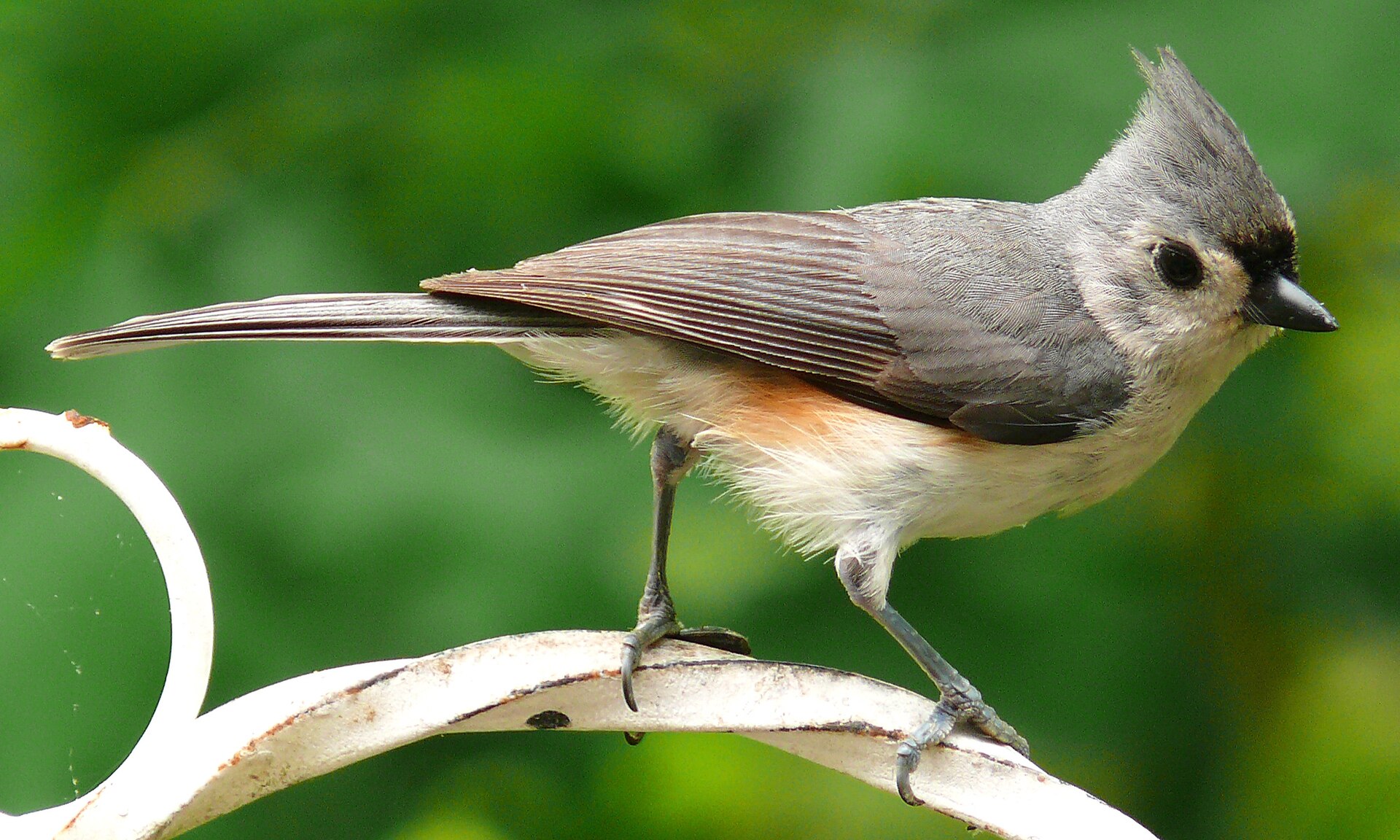
- Gray above, white below, rusty patch under the wing, big dark eye, pointed crest, comes to feeders: tufted titmouse. Eastern two-thirds of the country.
- Same bird but with a black forehead: black-crested titmouse. Central and south Texas.
- Plain gray-brown all over with a short crest, no white belly or rust: oak titmouse (California, southwest Oregon) or juniper titmouse (Great Basin, Four Corners).
- Tiny, plump, mostly gray with a short crest, in a big chattering flock: bushtit, only if you’re in the West. A tiny gray bird with a rusty wash and a crest in the Southwest is a verdin only when it’s yellow-headed, so check the head.
- Slender, glossy black or gray with a tall, thin crest and red eye, in desert mistletoe: phainopepla. Southwest deserts.
- Gray with a black cap and a rust patch under the tail, no crest, hides in shrubs: gray catbird.
- Slate gray with a white belly and white outer tail feathers, no crest, on the ground in winter: dark-eyed junco.
Tufted titmouse: the usual answer
If you live anywhere from the Great Plains east, from Texas and Florida up to New England and southern Ontario, the small gray crested bird at your feeder is almost certainly a tufted titmouse. It is about 6 inches long, soft gray on top and white underneath, with a peach or rusty wash along the flanks just under the wing and a large, round, dark eye that gives it an alert, slightly surprised look. The crest is gray and pointed and goes up and down with the bird’s mood. Males and females look the same.
Titmice are feeder regulars. They take one sunflower seed at a time, fly to a branch, hold it with their feet and hammer it open, then come back for the next. They love suet and peanuts, they will use a nest box with a 1¼-inch hole, and they travel in winter with chickadees, nuthatches and downy woodpeckers, so if you have one of those you usually have the others. The song is a clear, whistled “peter-peter-peter,” repeated, and it is one of the first songs of late winter.
Titmice do not migrate. If you see one in January, you’ll see it in July, and it is probably the same bird, since pairs hold a territory year-round. Their range has been creeping north for decades, helped by feeders, and they are now regular in places like Vermont and Michigan where they were rare fifty years ago.
The other titmice: Texas, California and the Great Basin
Black-crested titmouse. In central and south Texas, and just across the border, the tufted titmouse is replaced by a near-twin with a black crest and a pale forehead. The two species meet and hybridize in a band through central Texas, so a bird with a smudgy dark crest there may be a mix. Everything about its behavior is the same.
Oak titmouse and juniper titmouse. West of the Rockies the titmice lose their color. The oak titmouse, in California and southwestern Oregon, and the juniper titmouse, in the Great Basin and Four Corners country, are both plain gray-brown from head to tail with a short crest, no white belly and no rust. They were considered one species, the plain titmouse, until 1996. If you’re in the West and your crested gray bird is drab all over, this is it. Both come to feeders for sunflower and suet and both use nest boxes.
Bushtit: the tiny one in a crowd
Only in the West. Bushtits are tiny, under 4 inches, plump and gray with a long tail and a short, fluffy crest that is more of a rounded cap. You almost never see one; you see twenty or forty, moving through a shrub in a constant stream of soft chips, then gone. In winter they come to suet feeders in that same mob. Females have pale eyes, males dark. Coastal birds have brown caps; interior birds have gray caps and brown cheeks. If your crested gray bird arrived as a flock and left as a flock, it was bushtits.
Phainopepla: the glossy one in the desert
In the deserts of Arizona, southern California, Nevada, New Mexico and west Texas, a slim, upright bird with a tall, thin crest and a bright red eye perched on top of a mesquite is a phainopepla. Males are glossy black; females and young birds are gray. Both flash white wing patches in flight. They eat mistletoe berries almost exclusively in winter, so they are tied to trees that carry it, and they rarely come to seed feeders. If you’re not in the desert Southwest, it isn’t this.
Two gray birds people think have a crest
Gray catbird. A medium-sized, slim, all-gray bird with a black cap and a rust-colored patch under the tail. There is no crest, but the black cap on a gray bird reads as “something on its head” at a glance. Catbirds skulk in dense shrubs, mew like a cat, and copy other birds’ songs in long rambling strings. They eat fruit and insects and mostly ignore seed feeders, though they will come to grape jelly, oranges and mealworms. Most of the country in summer; the Southeast and Gulf Coast in winter.
Dark-eyed junco. The “snowbird.” Slate gray on top with a clean white belly, a pink bill and white outer tail feathers that flash when it flies. No crest, but the smooth, rounded gray head fools people. Juncos arrive at feeders in fall across most of the country and leave in spring for the mountains and the north woods. They feed on the ground under the feeder, in small flocks, and they like millet and cracked corn. In the West, juncos come in several color forms, including one with a black hood and rusty back.
Side by side
| Bird | Where | Size | Crest | Belly | Giveaway | At the feeder |
|---|---|---|---|---|---|---|
| Tufted titmouse | East and Midwest | 6 in | Gray, pointed | White, rusty flanks | Big dark eye | Sunflower, suet, peanuts |
| Black-crested titmouse | Central and south Texas | 6 in | Black, pointed | White, rusty flanks | Black crest, pale forehead | Same as tufted |
| Oak / juniper titmouse | California; Great Basin | 5.5 in | Short, gray | Gray-brown | Plain all over | Sunflower, suet |
| Bushtit | West | 3.5 in | Rounded cap | Gray | Flocks of 20 to 40 | Suet, in a mob |
| Phainopepla | Desert Southwest | 7.5 in | Tall, thin | Black (male), gray (female) | Red eye, white wing patch | Rarely; mistletoe |
| Gray catbird | Most of U.S. | 8.5 in | None, black cap | Gray | Rust under tail; mews | Jelly, fruit, mealworms |
| Dark-eyed junco | Most of U.S., winter | 6 in | None | White | White outer tail feathers | Ground; millet |
Getting titmice to stay
If the answer was tufted titmouse, you’re in luck, because they are among the easiest birds to keep. Black oil sunflower in any feeder they can perch on, a suet cage, and shelled peanuts in a mesh feeder cover everything they want. They nest in tree holes and readily take a nest box with a 1¼-inch entrance mounted 5 to 15 feet up; put it out by March. They will also pull hair from a sleeping dog to line the nest, which is not a myth.
For the seed and feeder types that suit titmice and their chickadee companions, see our guide to the best bird seed for backyard feeders. If your gray bird had no crest at all, our guides to 18 common gray birds and small grey birds with white bellies cover the rest of the lineup.
Bottom line
East of the Rockies, a small gray bird with a crest is a tufted titmouse, or its black-crested cousin in Texas. In California and the Great Basin it is a plain, drab oak or juniper titmouse. A tiny crested gray bird in a flock of dozens is a bushtit. A glossy, red-eyed one in the desert is a phainopepla. And if the “crest” is really just a dark cap or a smooth gray head, look at the tail: rust underneath means catbird, white edges mean junco.