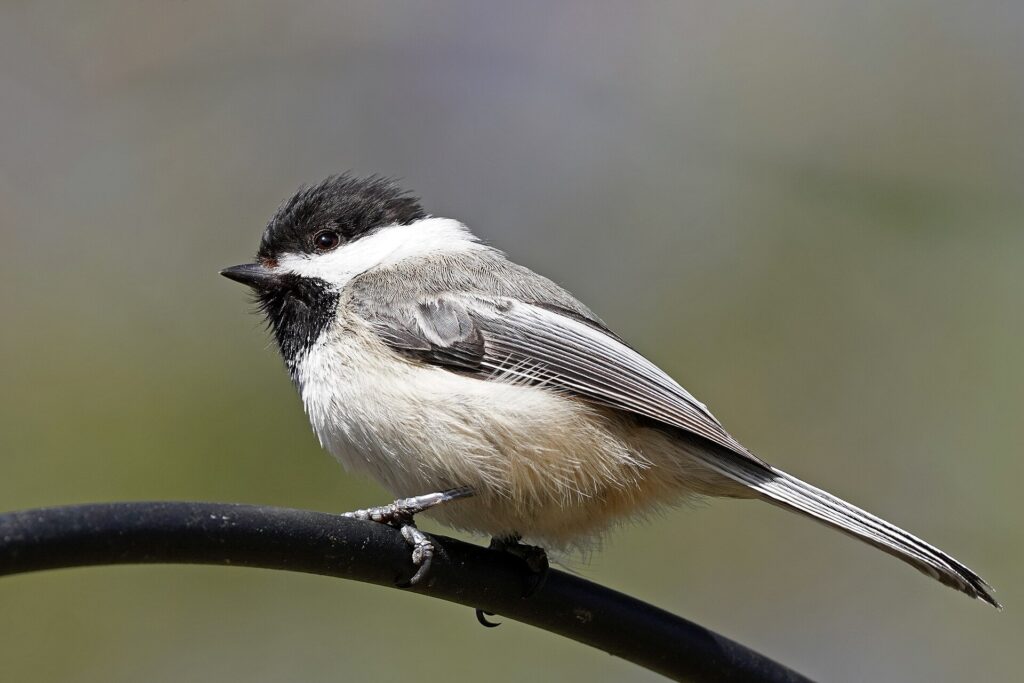
A small gray bird with a black cap is almost always a chickadee. If it also has a black bib under the bill and bright white cheeks, you can stop looking. If the cap is black but there’s no bib and the bird is walking down a tree trunk headfirst, it’s a white-breasted nuthatch. If the bird is bigger and slimmer, all gray, and has a rusty patch under its long tail, it’s a gray catbird. A dark hood over a pink bill means an Oregon junco, and a black crest in Texas means a black-crested titmouse. Here’s how to sort them out in a few seconds, and which chickadee you have depends mostly on where you live.
The short version
- Black cap + black bib + white cheeks, tiny and round: a chickadee. Black-capped in the North, Carolina in the Southeast, mountain chickadee (white eyebrow) in the western mountains.
- Black cap, no bib, white face, climbs headfirst down trunks: white-breasted nuthatch.
- Larger and slimmer, all gray, black cap, rusty under the tail, mews like a cat: gray catbird.
- Gray or dark hood, pink bill, white flashes in the tail, feeding on the ground: dark-eyed junco.
- Gray crest with a black spot over the bill, or a black crest in Texas: a titmouse.
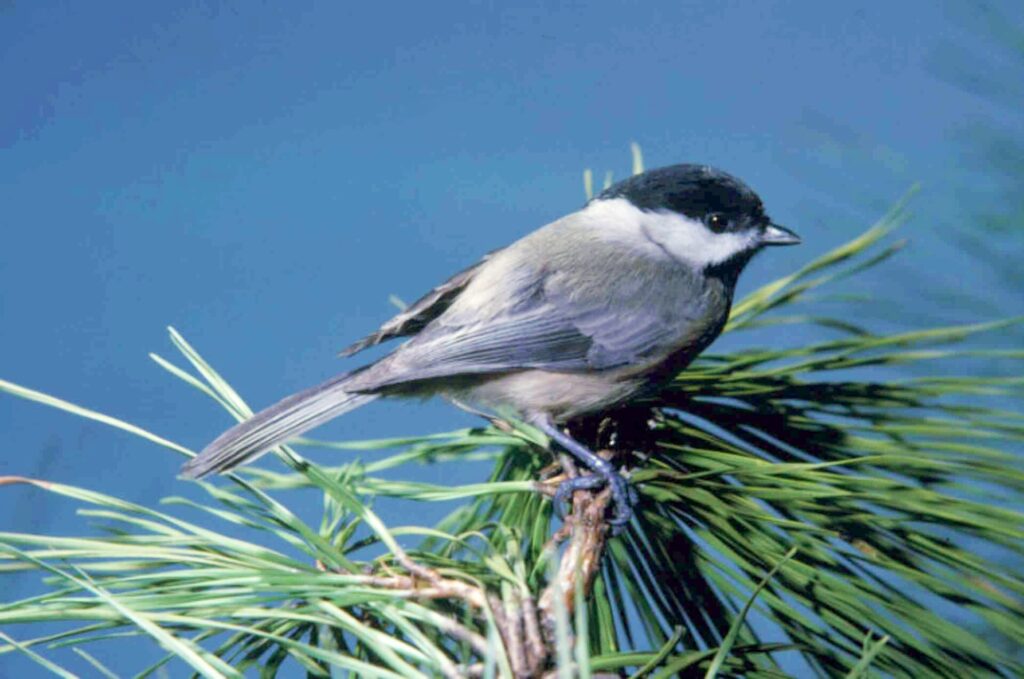
Chickadees: black cap, black bib, white cheeks
Cornell Lab’s All About Birds describes the black-capped chickadee as a tiny bird with “a short neck and large head,” which gives it an almost round body. The pattern is simple: “The cap and bib are black, the cheeks white, the back soft gray,” with buffy sides fading to white underneath. It measures 4.7 to 5.9 inches long and weighs well under an ounce. That combination, a black cap and a black bib with a white cheek patch between them, is the chickadee signature.
Watch what it does at the feeder. Cornell notes that black-capped chickadees “seldom remain at feeders except to grab a seed to eat elsewhere.” A chickadee lands, takes one seed, and flies off to eat it elsewhere or hide it for later. It also hangs sideways or upside down on twigs. They hide food in many separate spots, and Cornell says a chickadee “can remember thousands of hiding places.”
Listen, too. The song is a clear two- or three-note whistle, fee-bee, and the call is the bird’s name, chick-a-dee-dee-dee. Cornell reports that chickadees add more dee notes to that call the more alarmed they are.
Black-capped or Carolina chickadee?
The Carolina chickadee looks almost the same. Cornell describes it with “a black cap and bib separated by stark white cheeks” and a soft gray back, wings and tail. It’s a bit smaller, 3.9 to 4.7 inches. Audubon’s field guide puts it simply: the black-capped chickadee “is best identified by its range,” and the Carolina “replaces it in the southeastern states.” In the Appalachians, where the two meet, Audubon notes the Carolina lives at the lower elevations.
If you live near the line between them, these marks from Project FeederWatch help:
- Wings: on a black-capped, the wing feathers are broadly edged in white and form what looks like a long white panel. The Carolina’s wing is plainer and grayer.
- Bib: the black-capped’s bib has a ragged, uneven lower edge. The Carolina’s ends in a neat, sharp line.
- Side of the neck: mostly white on a black-capped, mostly grayish on a Carolina.
- Song: black-capped sings two or three notes. Cornell says the Carolina’s song is “often a four-note whistle,” like fee-bee-fee-bay, and its chickadee-dee-dee is faster.
One warning. The two species interbreed where their ranges meet, and Cornell says hybrids “can sing the songs of either species.” FeederWatch adds that a bird near the overlap zone that sings both songs, or an odd song, cannot be positively identified in the field. If that’s your yard, writing “chickadee” is the honest answer.
In the western mountains, check above the eye. Cornell says the white stripe over the eye “identifies Mountain Chickadees from all other chickadees.” Mountain chickadees live in dry evergreen forests on higher slopes across the West, where Cornell says they often hang upside down from pine cones.
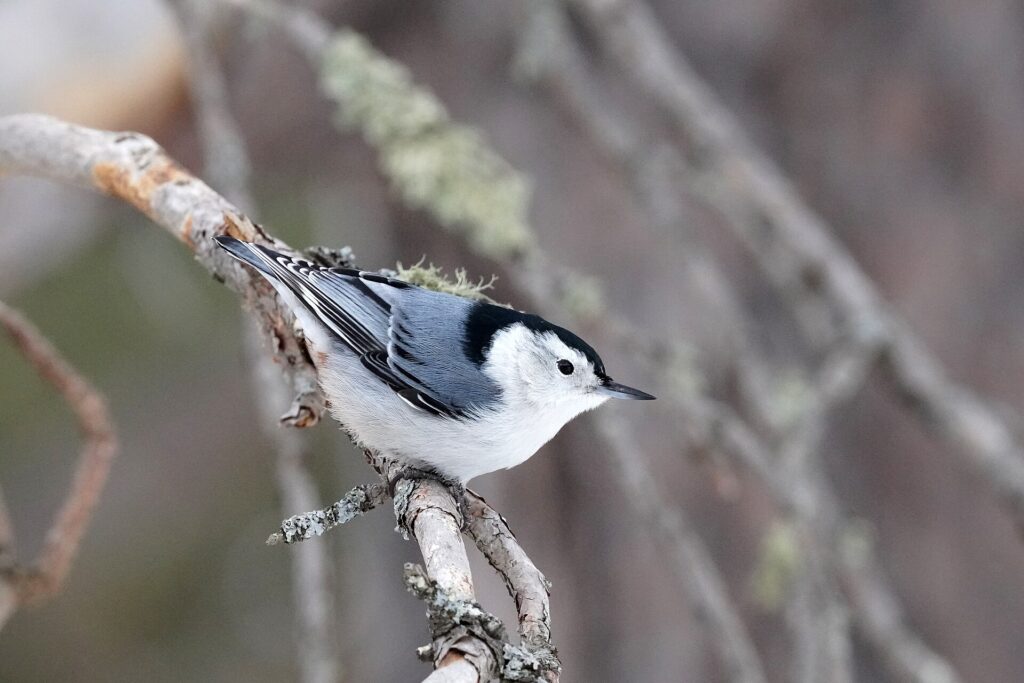
White-breasted nuthatch: black cap, no bib
A nuthatch is easy to confuse with a chickadee, because the two travel together in winter and both wear a black cap. The difference is the face. A white-breasted nuthatch has no black bib. Cornell describes it as “gray-blue on the back, with a frosty white face and underparts,” with a “black or gray cap” framing the face. The lower belly and the feathers under the tail are often chestnut.
Shape and behavior settle it. Cornell describes a large head and “almost no neck,” and the bird moves on tree trunks in a way no chickadee does. Cornell notes that nuthatches “often turn sideways and upside down on vertical surfaces,” creeping down trunks headfirst without bracing on their tails the way woodpeckers do. The voice is a loud, nasal yank, often repeated a few times. Size is a near match for a chickadee, 5.1 to 5.5 inches.
At the feeder, nuthatches take sunflower seeds, peanuts and suet. Like chickadees, they often grab a seed and leave; Cornell says they may wedge seeds into bark furrows to store them for later in the winter. In winter they join foraging flocks led by chickadees or titmice, which is why you so often see both at once.
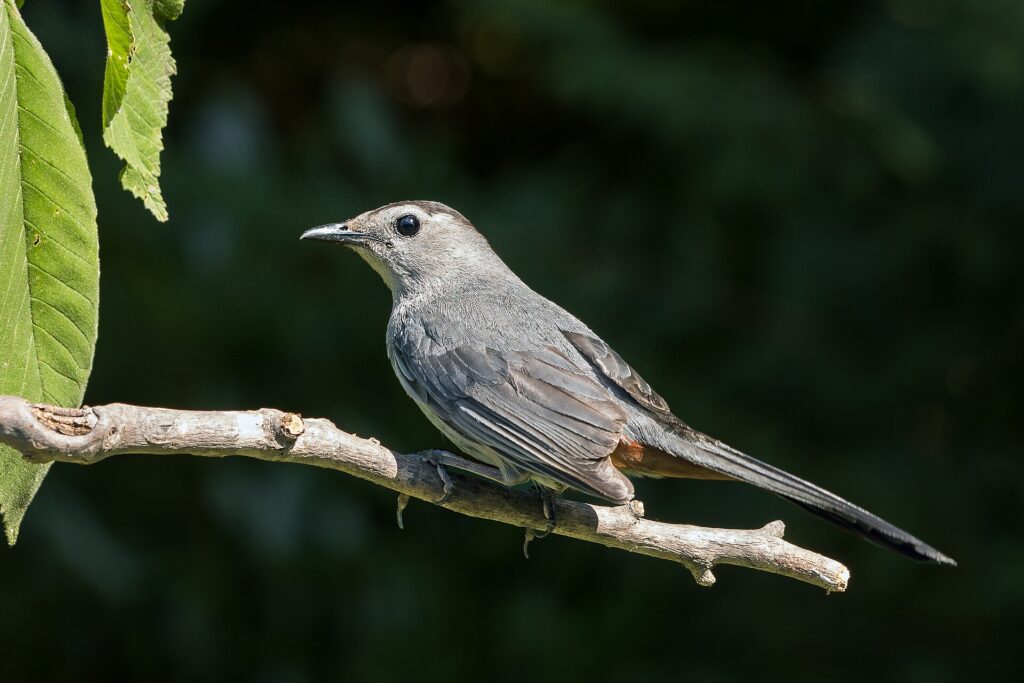
Gray catbird: the bigger one that mews
If your “small” gray bird looked more like a slim robin, it’s probably a gray catbird. At 8.3 to 9.4 inches, it’s much longer than a 4.7- to 5.9-inch chickadee. Cornell describes it as “entirely slaty gray” with “a small black cap, blackish tail, and a rich rufous-brown patch under the tail.” That rusty patch under the tail is the giveaway when the cap is hard to see. It often holds its tail down, which gives it a slightly hunched look.
You’ll usually hear a catbird before you see it. Its call is a catlike mew, and Cornell says, “Once you’ve heard its catty mew you won’t forget it.” Catbirds stay low in dense shrubs, vine tangles and thickets and are reluctant to fly across open areas.
Timing matters with this one. According to Cornell’s range map, catbirds are year-round residents along the Atlantic Coast, while catbirds from the rest of the continent spend the winter along the Gulf Coast from Florida to Texas and farther south. Audubon notes that “a few linger far to the north” when they have berries or a well-stocked feeder. So a black-capped gray bird in a northern yard in January is much more likely to be a chickadee or a nuthatch.
Audubon says catbirds eat “mostly insects and berries,” not seed. The Minnesota Department of Natural Resources lists them among birds drawn to grape jelly, apple halves and mealworms, and Cornell suggests planting native fruiting shrubs such as dogwood, winterberry and serviceberry.
Dark-eyed junco: a hood, not a cap
Juncos come up because their dark heads can read as a cap from a distance. Look at the bill and the tail. Cornell says all juncos have a “pink bill and white outer tail feathers,” and the white flashes when the bird flies. The eastern slate-colored form is gray over the whole head, throat and breast, with a white belly. The western Oregon form has a dark hood with buffy sides. Juncos are 5.5 to 6.3 inches and are “birds of the ground,” hopping under feeders rather than clinging to them. Across the East they appear as winter sets in and head north again in spring; our guide to dark-eyed juncos, the winter snowbird covers timing and feeding.
Titmice: a crest with black on it
A tufted titmouse is mostly gray with a gray crest, and Cornell notes a “black patch just above the bill,” the only black on its head. Check for the crest and the rusty-peach wash on the flanks. In central and southern Texas, the black-crested titmouse has a bold black crest over a pale forehead, gray above and whitish below, at about 5.9 inches. Any bird with a pointed crest belongs in our guide to small gray birds with a crest.
Side by side
| Bird | Where | Length | Head | Bib | Giveaway | At the feeder |
|---|---|---|---|---|---|---|
| Black-capped chickadee | North | 4.7–5.9 in | Black cap, white cheeks | Black, ragged edge | White wing panel; fee-bee | Sunflower, suet, peanuts |
| Carolina chickadee | Southeast | 3.9–4.7 in | Black cap, white cheeks | Black, neat edge | Plain gray wing; 4-note song | Sunflower, peanut chips, suet |
| Mountain chickadee | Western mountains | 4.3–5.5 in | Black cap, white eyebrow | Black | White stripe over the eye | Forages in high-slope evergreens |
| White-breasted nuthatch | Much of North America | 5.1–5.5 in | Black or gray cap, white face | None | Climbs down trunks headfirst; yank | Sunflower, peanuts, suet |
| Gray catbird | Resident on Atlantic Coast; winters Gulf Coast south | 8.3–9.4 in | Small black cap | None | Rusty under tail; mews | Jelly, fruit, mealworms |
| Dark-eyed junco | Most of U.S., winter | 5.5–6.3 in | Gray or dark hood | None (hood) | Pink bill; white tail edges | Ground; millet |
| Black-crested titmouse | Central and south Texas | 5.9 in | Black crest, pale forehead | None | Pointed crest | Visits feeders regularly |
For every common yard bird sorted by color, our free printable backyard bird ID chart puts these birds on one page.
How to keep chickadees and nuthatches coming back
Both are among the easiest birds to feed. Cornell calls chickadees “one of the easiest birds to attract to feeders, for suet, sunflower, and peanuts.” Nuthatches want the same menu. Black-oil sunflower in a tube or hopper covers both; for seed choices, see our guide to the best bird seed. A suet cage gives them fat in cold weather, and our roundup of suet feeders covers cages that work for clinging birds. Cornell says chickadees readily visit window feeders, which give you the closest look at that bib. If you offer peanuts, Cornell advises keeping them dry so they don’t mold.
Common questions
What’s the difference between a chickadee and a nuthatch? The bib and the behavior. Chickadees have a black bib and hop through twigs; nuthatches have a white face and throat and creep along trunks, often headfirst.
Is a black-capped chickadee the same as a Carolina chickadee? No, they’re separate species that look nearly identical. Range is the best clue, with the Carolina in the southeastern states, and the wing edging and song help where they meet.
What gray bird has a black head and a pink bill? Usually an Oregon-type dark-eyed junco, the western form with a dark hood. Look for white outer tail feathers when it flies.
Why does my gray bird with a black cap meow? That’s a gray catbird. The mew is its signature call.
Do chickadees migrate? Adult chickadees generally don’t. Audubon describes the black-capped chickadee as “mostly a permanent resident,” though some fall flights move south in the Northeast.
For more gray birds without a black cap, see 18 common gray birds and how to tell them apart and our guide to small gray birds with a white belly.
Bottom line
Black cap plus black bib means chickadee: black-capped in the North, Carolina in the Southeast, mountain chickadee if there’s a white eyebrow. Black cap with a white face and no bib, on a tree trunk, is a white-breasted nuthatch. A bigger all-gray bird with a black cap and a rusty patch under the tail is a gray catbird. Put out sunflower and suet and you’ll likely see the chickadees and nuthatches side by side all winter.