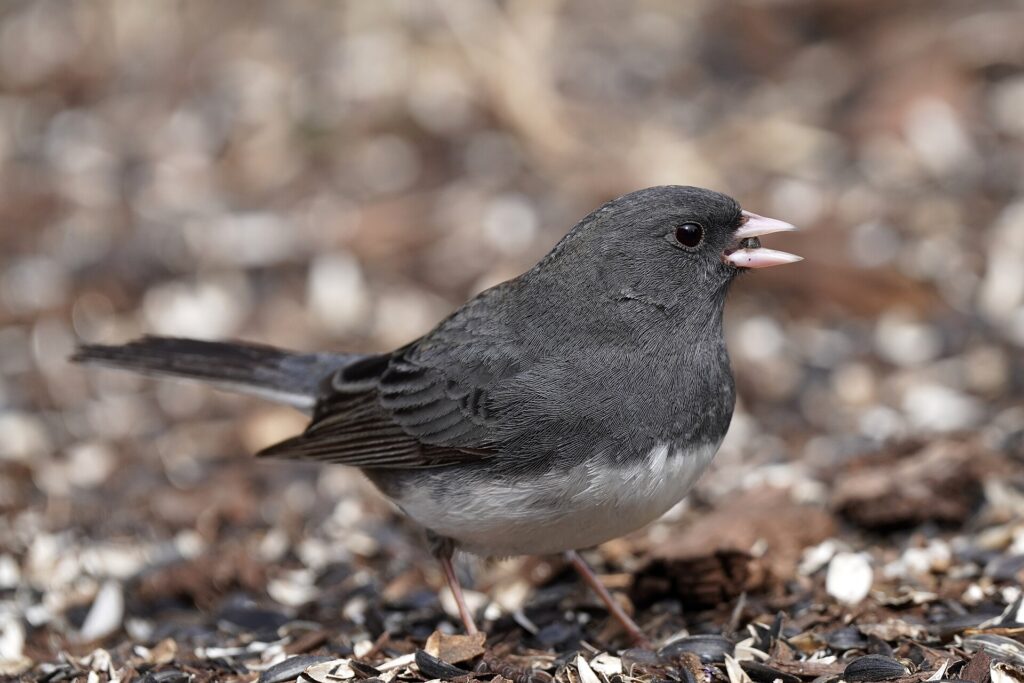
The small, round, slate-gray bird with a white belly that shows up under your feeder the week the weather turns is a dark-eyed junco, the bird generations of Americans have called the “snowbird.” Juncos nest in the North and in the mountains, then move into backyards across most of the country from late September through March. They feed on the ground, not at the feeder, they travel in loose flocks with a strict pecking order, and they want small seed, especially white millet, scattered where they can hop to it. If you have juncos, winter has arrived, and this is how to keep them around.
The short version
- Look for: a sparrow-sized bird, dark gray or brown above, clean white below, with a pale pink bill and white outer tail feathers that flash when it flies. Juncos often feed alongside other sparrows; here’s how to tell the common winter sparrows apart.
- When: arrives late September to October across the northern and central U.S., a few weeks later in the South; leaves in March and April.
- Where it eats: on the ground under the feeder, or on a low tray. Rarely at a hanging tube.
- What it eats: white millet first, then cracked corn and sunflower hearts. Small seed only; the bill can’t crack big shells.
- Why “snowbird”: the name goes back to the 1700s. The scientific name, Junco hyemalis, means “of the winter.”
How to identify a dark-eyed junco
Cornell’s All About Birds describes juncos as “neat, even flashy little sparrows that flit about forest floors,” and the two marks that settle it are the tail and the bill. When a junco flies, the outer tail feathers flash bright white against the dark tail. On the ground, the bill is a pale pink, almost ivory, and short and conical like a finch’s. No other common gray backyard bird has both.
The rest of the bird depends on where you live, because the dark-eyed junco comes in several regional forms that were considered separate species until the 1970s.
Slate-colored junco. The eastern and northern bird, and the one most of the country sees in winter. Smooth slate gray over the whole head, back and sides, with a sharply cut white belly. Females and young birds are browner and softer gray. This is the classic “snowbird.”
Oregon junco. The western bird, from the Pacific coast through the Rockies. A black or dark-brown hood, a rusty-brown back, and pinkish-brown sides against a white belly. It looks like a different species, and it once was.
Pink-sided, gray-headed, white-winged and red-backed juncos. Mountain and Plains forms with, respectively, pale pink flanks; a gray head with a rust back; white wing bars on a gray bird; and a rust back with a dark bill. Western flocks in winter can hold three or four forms at once.
If your gray bird has a crest, it’s a titmouse, and our guide to small gray birds with a crest covers that. If it’s gray with a black cap and no white in the tail, look at a chickadee or catbird in our guide to 18 common gray birds. For the whole family of small gray-and-white birds, start with small grey birds with a white belly.
Why they’re called snowbirds
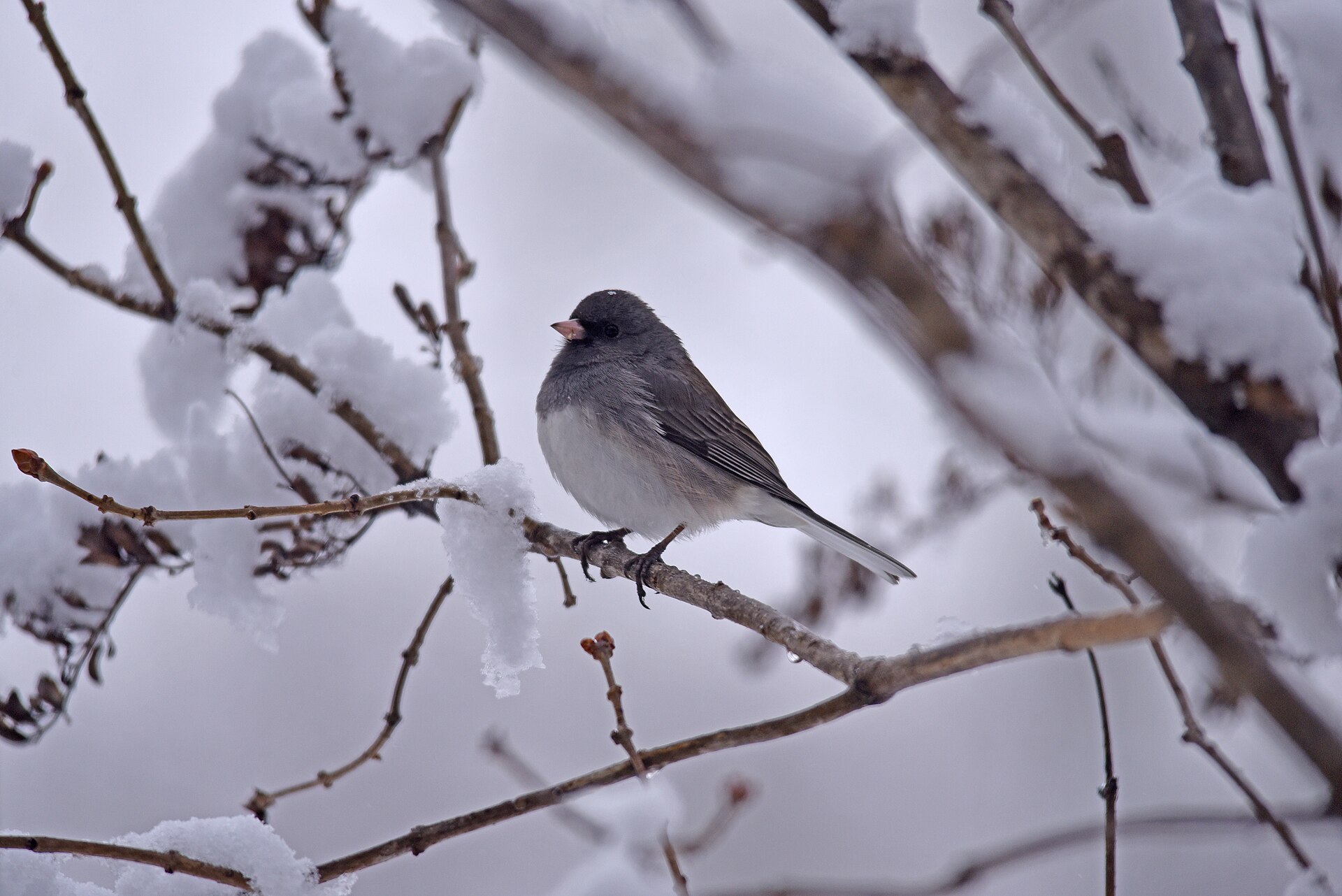
Juncos breed in the boreal forest of Canada and the northern states, and in mountain forests down the Appalachians and the West. When fall comes they move to lower ground and lower latitudes, which puts them in backyards across the eastern and central U.S. at almost exactly the moment the first frosts hit. Cornell calls them “the ‘snowbirds’ of the middle latitudes.” Audubon notes the nickname was in use by the 1700s and that John James Audubon used it. In most of the country, the arrival of juncos and the arrival of winter are the same event.
Not every junco migrates. Birds in the West and in the Appalachians often just move downhill for the winter, an “altitudinal” migration of a few thousand feet rather than a thousand miles. And the trip north in spring is triggered by day length, not warmth. Research going back to biologist William Rowan in the 1920s showed that juncos respond to changing daylight, which is why they leave on schedule in March even when it’s still snowing.
One more detail from Audubon: males winter farther north than females. The usual explanation is that a shorter trip back lets males claim a breeding territory first, while females trade that for an easier winter.
When juncos arrive and leave
Schlitz Audubon in Wisconsin reports that juncos “begin to arrive at the Center in large numbers at the end of September to early October.” That timing holds across the northern tier. The mid-Atlantic, Ohio Valley and lower Midwest see them by mid-to-late October, and the Southeast, Texas and the Gulf states by November. Departure runs the other way: southern yards lose them in March, northern yards in April, and by early May the only juncos left in the lower 48 are the ones that breed in the mountains and the far North.
How juncos behave at a feeder
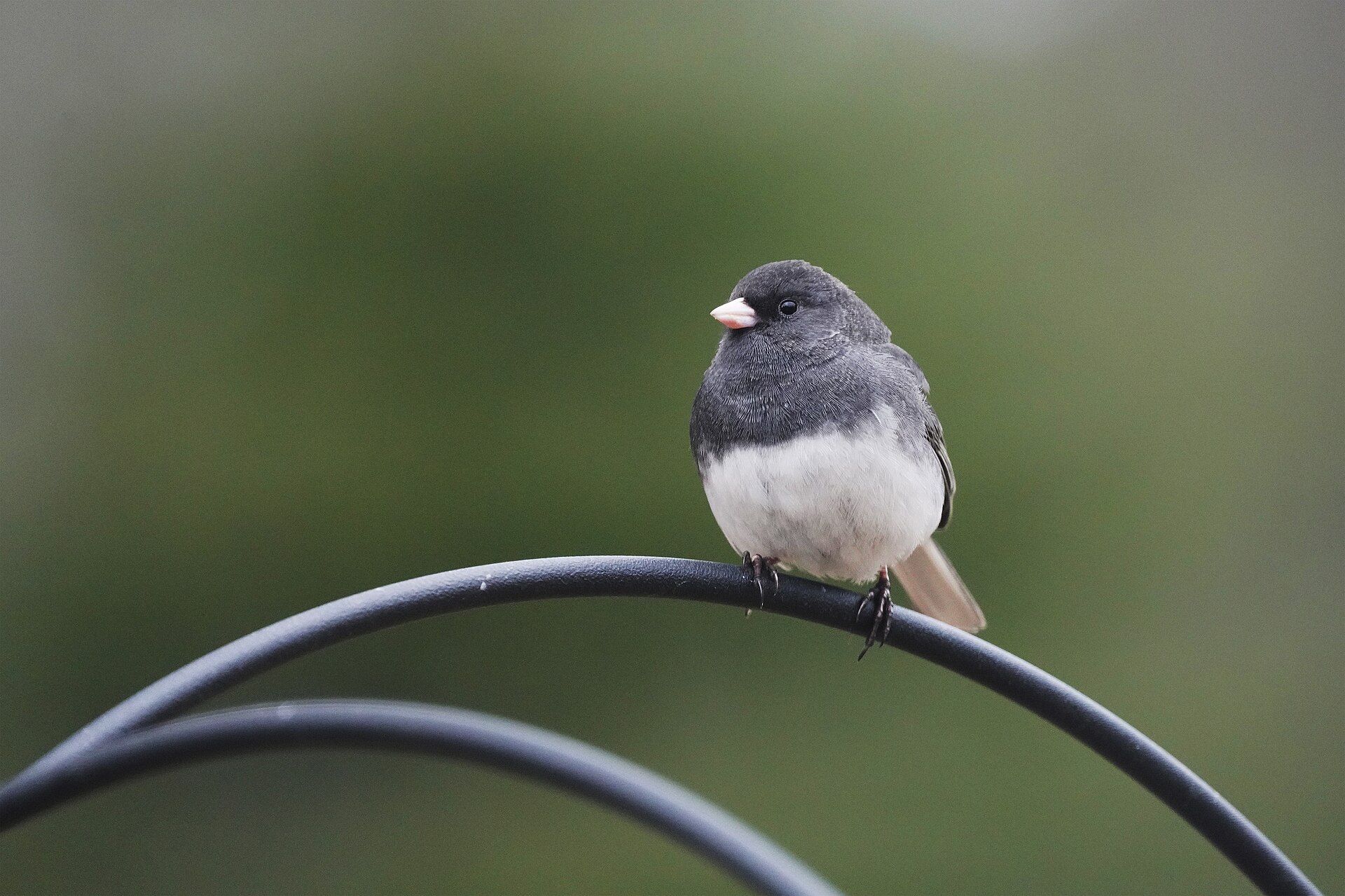
Juncos are ground birds. Audubon’s field guide puts it plainly: the junco “will come to bird feeders, but tends to forage on the ground under the feeding tray.” They hop, they scratch with both feet, they kick leaf litter and snow backward, and they pick up whatever falls from the feeder above. A junco at a hanging tube feeder is unusual; a dozen juncos under it is normal.
They come in flocks, usually a handful to a few dozen birds, and the flock keeps in contact with a soft, constant ticking call as it spreads out across a yard. Inside the flock there is a strict hierarchy. According to Audubon, males dominate females and older birds dominate younger ones, and you can watch it play out: one bird lunges, another gives way, and the best patch of seed goes to the top of the order. Winter flocks often mix with other ground feeders, especially white-throated sparrows, tree sparrows and, in the South, chipping sparrows.
Diet shifts with the season. Audubon notes that seeds make up about three-quarters of what a junco eats over the year, but in summer roughly half the diet is insects. By the time they reach your yard they have switched almost entirely to weed and grass seed, and that is what to imitate.
What to feed juncos
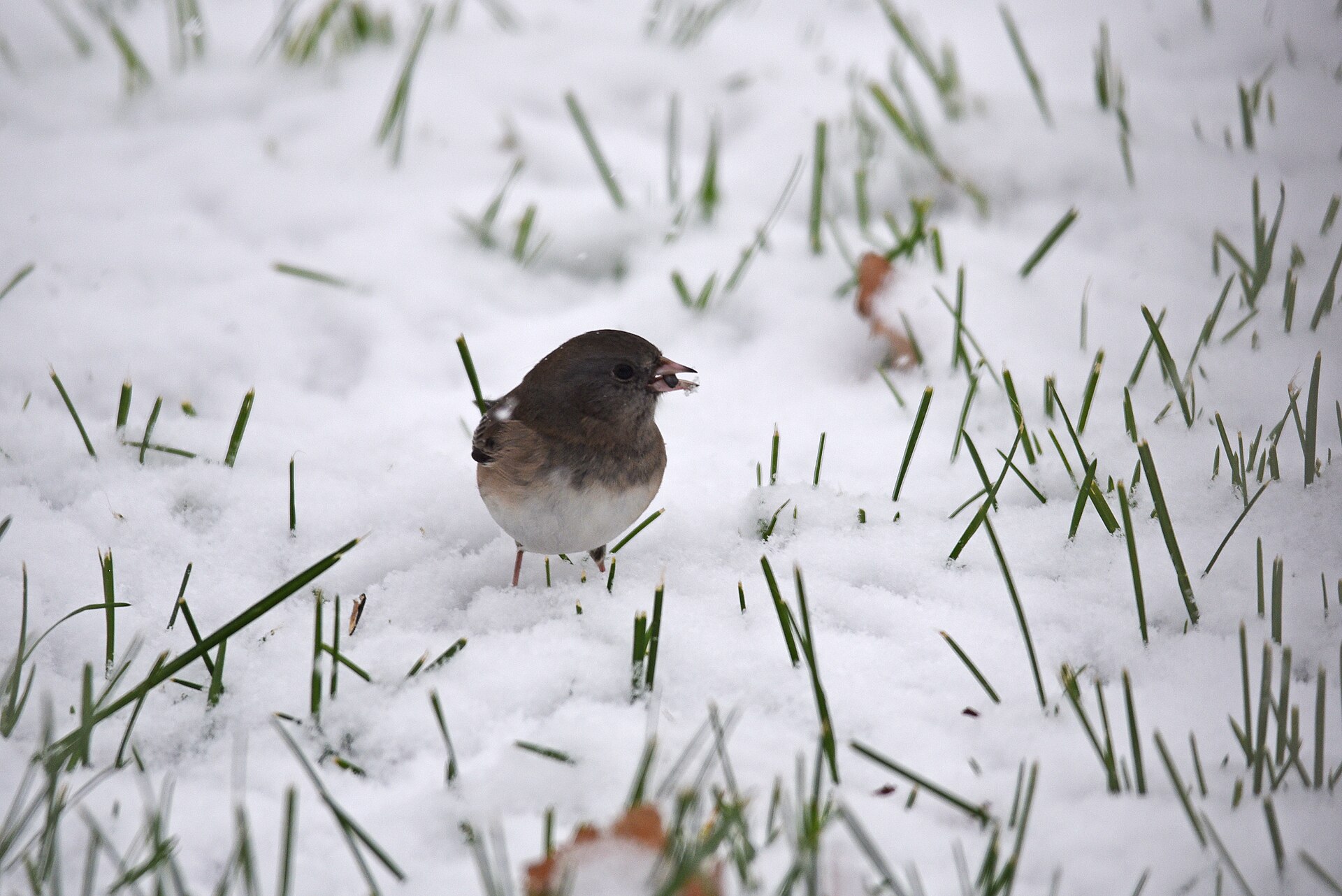
The rule is small. A junco’s bill can’t open a black oil sunflower shell, let alone striped sunflower or safflower, so the seed that feeds cardinals and chickadees does nothing for juncos except what spills as hulls. Feed them what they can swallow whole.
- White proso millet. The single best junco food. Cheap, small, and exactly the size of the grass seed they eat in the wild. Red millet works too but is less preferred.
- Cracked corn. Fine cracked corn, not whole kernels. Juncos take it readily, and so will everything else on the ground, so use it in small amounts.
- Sunflower hearts and chips. Hulled sunflower, broken into pieces, is high in fat and easy to swallow. This is the premium junco food and the one to put out in the coldest weather.
- Nyjer, sometimes. Juncos will pick up nyjer that goldfinches drop, and they eat it from a tray, but it isn’t a first choice.
Skip the cheap mixes built on milo and wheat. Juncos ignore milo, and the mix mostly ends up as a mat under the feeder. For what to buy and what to avoid, our guide to the best bird seed compares the options, and what to feed birds in winter covers the whole cold-weather lineup.
How to feed juncos
Scatter it on the ground. A few handfuls of millet tossed on bare ground, a patio, or a swept patch of snow is all it takes. Put it near cover, a shrub or a brush pile, because juncos feed in the open only when they can dive into something thick when a hawk comes through.
Or use a low platform. A tray feeder a foot or two off the ground, or a ground tray with a screen bottom, keeps seed off wet soil and lets you see the birds. Our platform feeder guide covers the designs that work in winter.
Keep it dry and keep it clean. Ground seed gets wet, and wet seed molds. Put out only what the flock clears in a day, sweep the hulls weekly, and move the feeding spot a few feet every couple of weeks so droppings don’t build up in one place. See how to clean a bird feeder for the full routine.
Give them a brush pile. The best junco magnet in a yard isn’t a feeder. It’s a loose pile of pruned branches in a corner. Juncos roost in it, hide in it, and feed beside it, and it costs nothing.
Water helps. Open water is scarce in a freeze, and juncos use a bird bath as readily as any bird. A heated bird bath keeps it available through the winter.
Juncos and the rest of the winter crowd
Juncos are a piece of the winter yard, not the whole thing. A junco-friendly setup of ground millet and a low tray also brings in sparrows, mourning doves and cardinals, and it’s the same ground seed that draws blackbirds and squirrels. If a grackle flock finds the millet, that’s a different problem, and our guide to getting rid of grackles covers it. For the full cast of what shows up in your area in cold weather, see winter backyard birds by region.
Common questions
Are juncos sparrows? Yes. Dark-eyed juncos are in the New World sparrow family, along with white-throated and song sparrows.
Why don’t I see juncos in summer? Because they’ve gone north or uphill to nest. Unless you live in the northern states, the mountains, or the Pacific Northwest, juncos are winter-only birds.
Do juncos eat from hanging feeders? Occasionally, from a tube with a tray attached or from a hopper with a wide ledge. Mostly they wait underneath.
Where do juncos sleep in winter? In dense evergreens, brush piles and thickets, often in a group. A spruce or a holly near the feeder gives them a roost.
Are juncos declining? Cornell rates them a species of low conservation concern and one of the most abundant birds in North America, with a population in the hundreds of millions. Audubon’s analysis of survey data shows the total has dropped since 1970, as it has for most seed-eating songbirds, but juncos remain common everywhere they occur.
Where do juncos nest? In the far north and the mountains. In Minnesota they nest in the northern forests and winter everywhere else; our guide to backyard birds in Minnesota covers the rest of that state’s winter crowd.
Juncos are one of several gray birds with a dark hood. Our guide to small gray birds with a black cap sorts out the look-alikes.
Bottom line
Dark-eyed juncos are the snowbirds: gray above, white below, white flashes in the tail, and they arrive with the first cold. They feed on the ground in flocks with a pecking order, and they want small seed. Scatter white millet near a brush pile, add a low tray and open water, and the same flock will be back under your feeder every winter.