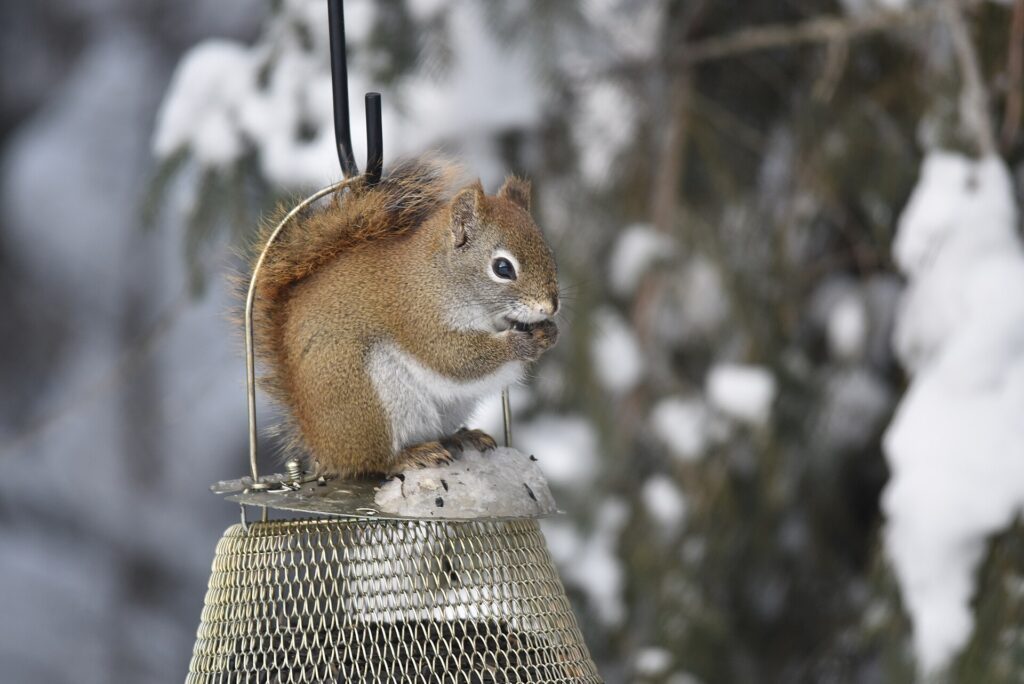
In most of the country, the hardest thing for a backyard bird to find between December and March is not food. It’s a drink. Seed is everywhere; open water is not, and a chickadee that has to eat snow to get it spends body heat it can’t spare. A heated bird bath fixes that for about $1 a month in electricity, and on a below-zero morning it will pull in birds a feeder never will: robins, bluebirds, waxwings, and the winter finches that don’t eat seed at all.
Below are the six heated baths worth buying, three de-icers for the bath you already own, and the two things that make the difference between a bath birds use and a bath that just runs up your power bill.
Spark Lark is reader-supported. As an Amazon Associate we earn from qualifying purchases made through links on this page, at no extra cost to you.
The short version
- Best overall: Allied Precision 650 deck-mount heated bath. 20-inch bowl, 150 watts, clamps to a deck rail, made in the U.S. and lasts a decade.
- Best pedestal: Allied Precision API 600 heated bath bowl. Same bowl as the 650, sold without a stand; an adapter clamp fits it to a pedestal or stand you supply.
- Best value: three-way-mount heated bath, 75 W. Hangs, clamps or sits on a stand; the one most people should start with.
- Budget: 100 W thermostatic heated bath. Cheapest bath we’d trust; two-season lifespan.
- Classic terracotta look: Farm Innovators 14-inch heated bath. Smaller and prettier; fine for a small yard.
- Already own a bath? Drop in the K&H Ice Eliminator de-icer for mild climates or the Allied BDT250 de-icer north of the Mason-Dixon line.
What a heated bath is actually doing
It is not warming the water. A good heated bath holds the surface a degree or two above freezing and nothing more; the thermostat cycles the element off the moment ice is impossible. That matters for two reasons. Warm water fogs, wastes electricity, and in a hard freeze can leave a bird with wet, icing feathers. Cold open water does the one job: it lets birds drink, and on sunny days, bathe.
The numbers to care about are wattage and thermostat. A 50-watt unit keeps water open to about 20°F; 75 to 100 watts handles most of the Midwest and Northeast; 150 to 250 watts is for the northern tier, high elevations and anywhere the wind gets at the bowl. Every unit below is thermostatically controlled, so a 150-watt bath in Georgia draws almost nothing; it only pulls full power when it has to.
One more thing: put it where the birds already are. A heated bath 30 feet from cover gets used by nobody. Ten feet from the feeder, near a shrub, is where it belongs. Our bird bath guide covers placement, depth and cleaning for any season.
The heated baths
1. Allied Precision 650 deck-mount heated bath — best overall
20-inch bowl · 150 W thermostatic · deck clamp included
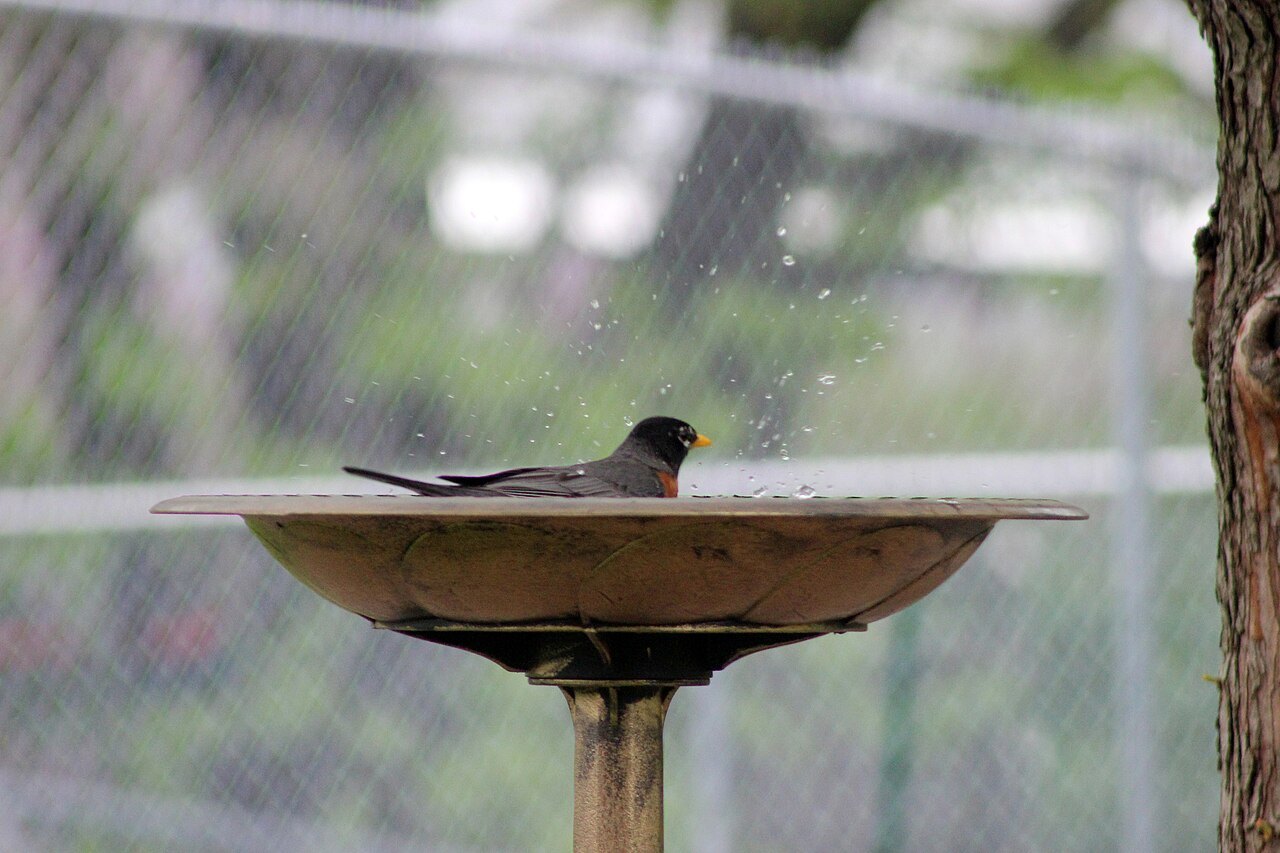
It is a 150-watt, 20-inch bowl from Allied Precision, a brand now made by Miller Manufacturing, and it has been sold for years. The bowl is a thick, textured plastic that doesn’t crack in cold, the element is sealed inside it so there is nothing sitting in the water, and the EZ-Tilt clamp mounts it to a 2×4 or 2×6 deck rail, which puts it at eye level from a kitchen window. Allied Precision makes these in Illinois and has for 30 years; the older ones are still running.
Downside: the bowl is light gray and looks like what it is, a plastic bowl. If the bath has to be pretty, look at the Farm Innovators below. The maker doesn’t list the cord length, so check how far it is to your outdoor outlet before you mount it.
2. Allied Precision API 600 heated bath bowl — best for a pedestal
20-inch bowl · 150 W thermostatic · bowl only, adapter clamp included
Same 20-inch bowl as the 650, sold as a bowl only, with an adapter clamp that fits most pedestals and stands. This is the one for a lawn, a garden bed, or anywhere you don’t have a rail: set it on a stand you already own, or buy one separately. Up off the ground with open space around it is also the setup cats have the hardest time with.
Downside: there is no stand in the box, so budget for one. Make sure your stand is sturdy enough for a 20-inch bowl full of water, and plan how the cord will reach a GFCI outlet.
3. Three-way-mount heated bath, 75 W — best value
14.5-inch bowl · 75 W thermostatic · hang, clamp or stand
You get a detachable bowl, a deck clamp, a hanging chain and a short ground stand, so it works wherever you put it. The 75-watt element is enough for a Missouri or Pennsylvania winter and the bowl lifts off the base for cleaning, which is the chore that kills most heated baths. This is the bath we’d tell a first-timer to buy, and if it converts you, upgrade to the Allied next year.
Downside: the bowl is shallow and small, so it needs topping up every couple of days in dry cold. Below about 0°F with wind, 75 watts falls behind.
4. 100 W thermostatic heated bath — budget
100 W thermostatic · deck clamp and stand
Cheaper than the three-way and, on paper, stronger. The listing says the thermostat switches on near 50°F and off at 86°F, the bowl is 13.4 inches across, and the clamp opens to 3.5 inches. It is a newer listing with a short track record. If you want the lowest price, this is the bath.
Downside: unknown longevity. Cheap imported baths tend to lose the element in the second or third winter, and there’s no real warranty path. Buy it knowing it may be a two-season bath.
5. Farm Innovators 14-inch terracotta heated bath — classic look
14-inch bowl · 75 W thermostatic
Farm Innovators is the other American maker, and this one is for the yard where a gray plastic bowl won’t do. The finish looks like fired clay, it sits on any pedestal or the ground, and 75 watts keeps it open into the teens. The bowl is molded with a gentle slope, which small birds like.
Downside: the lower rating is mostly about the cord entry cracking after a few winters and about the size; 14 inches is a two-bird bath. Buy it for looks, not for a crowd.
6. Wild Bird Lover’s 20-inch heated bath with rail brackets — the big-bowl alternative
20-inch slate-textured bowl · 150 W · deck rail brackets
A newer competitor to the Allied 650 with a nicer bowl: dark slate texture, 20 inches, a rim wide enough for a robin to stand on. Same wattage, similar clamp. It is cheaper and better looking; what it doesn’t have yet is the ten-year track record.
Downside: a short track record. If the element holds up it’s the better buy; nobody knows yet. We’d pick the Allied for a northern yard and this for a milder one.

If you already own a bath: de-icers
A de-icer is a submersible heater you set in the bowl of a bath you already have. It is cheaper than a heated bath and it lets you keep the concrete or ceramic bath you like, with two conditions: the bath must be safe to freeze and thaw around the element (concrete is; thin ceramic and glass often aren’t), and it needs to be deep enough that the unit stays submerged.
7. K&H Ice Eliminator de-icer, 50 W — mild-climate pick
50 W thermostatic · natural rock look
A flat, rock-shaped puck that sits in the bowl and is nearly invisible. Fifty watts is right for the Southeast, Mid-Atlantic and coastal West, where nights hit the 20s but not much lower. K&H says it won’t melt plastic baths or stain the bowl. The cord is only 18 inches, and K&H says not to use it with an extension cord, so it needs an outdoor outlet right beside the bath.
Downside: fifty watts is not enough for Minnesota, and it isn’t pretending to be. In a hard freeze the edges ice while the center stays open.
8. Allied Precision BDT250 de-icer, 250 W — northern pick
250 W multi-thermostat · cast aluminum
The de-icer for real winter. Cast aluminum, two thermostats so it cycles rather than runs, and the maker says it keeps a bath ice-free “even in sub-zero temperatures.” Rated safe for plastic too. Ten-foot cord.
Downside: overkill south of the Ohio River, where the 50-watt K&H is enough.
9. Farm Innovators C-50 cast aluminum de-icer — the middle option
150 W thermostatic · cast aluminum
Three times the K&H’s wattage at 150 watts, in a cast-aluminum body that lasts longer and sits flatter in a shallow bowl. If you want a de-icer that will still be running in five winters, this is it.
Downside: 150 watts is a middle output. For the hardest northern winters, the 250-watt Allied BDT250 is the safer pick.
Side by side
| Bath / de-icer | Bowl | Watts | Mount | Good to about |
|---|---|---|---|---|
| Allied 650 | 20 in | 150 | Deck clamp | -20°F |
| Allied API 600 | 20 in | 150 | Your stand (clamp incl.) | -20°F |
| Three-way mount | 14.5 in | 75 | Hang / clamp / stand | 5°F |
| 100 W budget | 14 in | 100 | Clamp / stand | 0°F |
| Farm Innovators 14-in | 14 in | 75 | Any pedestal or ground | 10°F |
| Wild Bird Lover’s 20-in | 20 in | 150 | Rail brackets | -20°F |
| K&H de-icer | Your bath | 50 | Submersible | 20°F |
| Farm Innovators C-50 | Your bath | 150 | Submersible | Below 0°F |
| Allied BDT250 | Your bath | 250 | Submersible | -30°F |
“Good to about” is our estimate for a sheltered spot with no wind; a bowl in the open on a ridge loses 10 to 15 degrees of that.
The two things that matter more than the bath
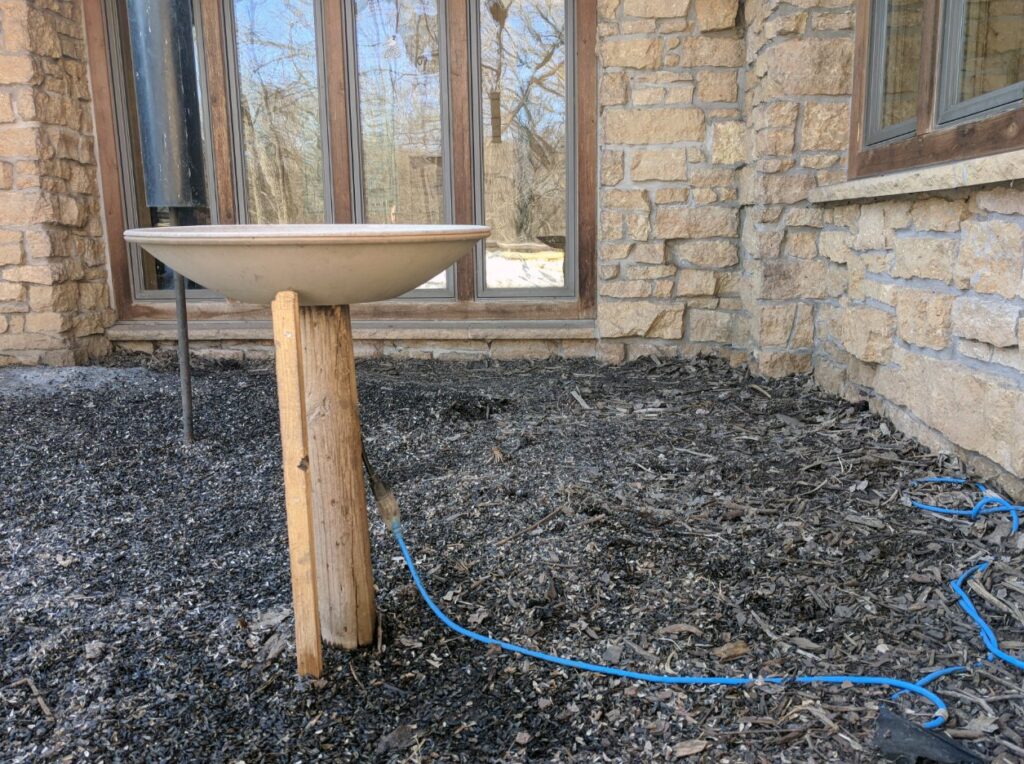
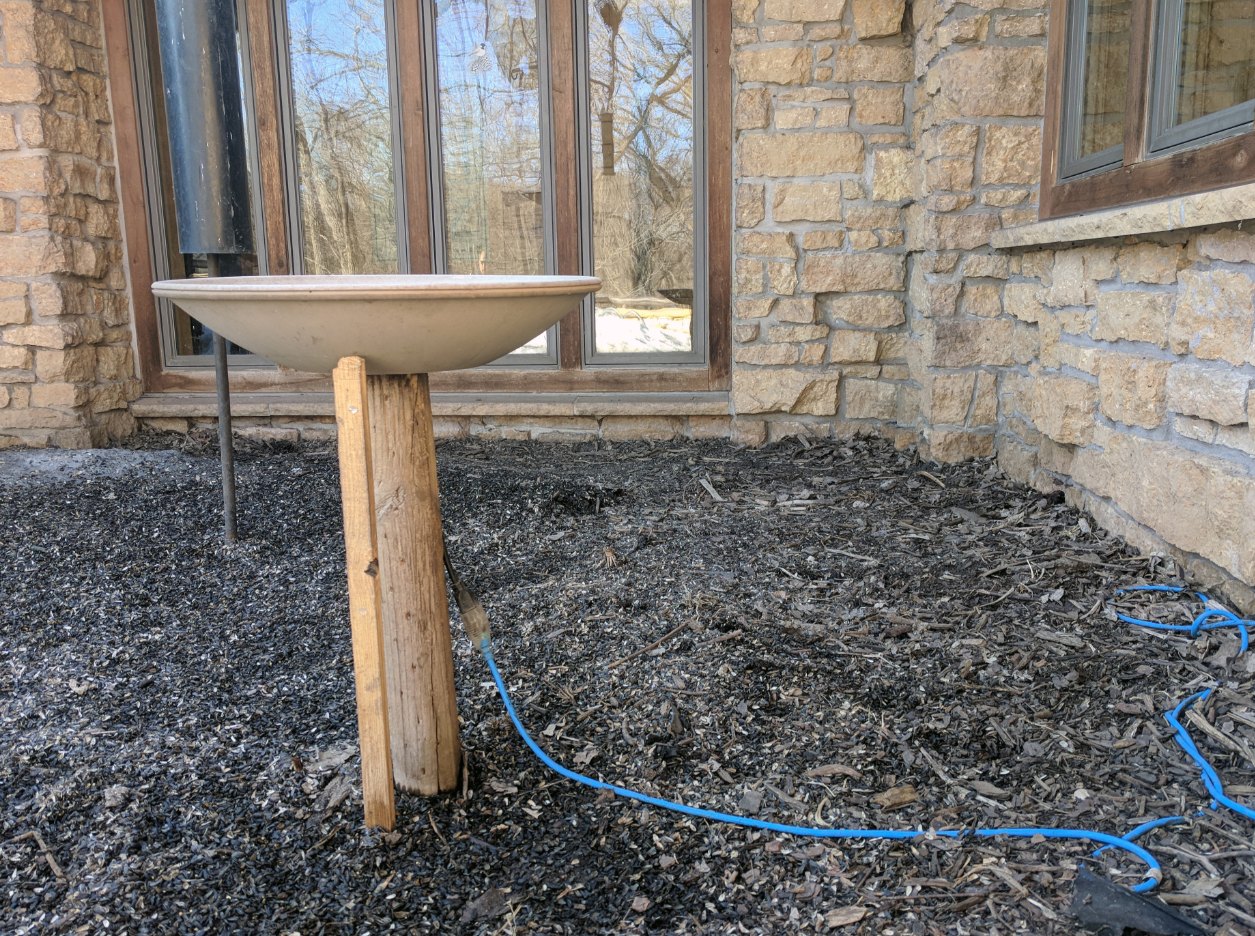
The cord. Every one of these needs a GFCI outlet. Check each maker’s rule on extension cords: K&H says not to use one with its de-icers at all. Where a maker allows one, use an outdoor-rated cord and keep the connection off the ground or inside a cord cover. A cord splice lying in slush is the number one way these fail, and it trips the breaker rather than the bath, so you find out when the water is a block of ice. A weatherproof cord connector box fixes it.
Keep it full and keep it clean. Heated water evaporates faster than cold, and a 14-inch bowl can go dry in three days. An element running dry in a cheap bath will burn out. Top it up when you fill the feeders, and once a week dump it, scrub it with a stiff brush and refill. No soap, no salt, no antifreeze, ever. Salt and glycol in a bird bath kill birds.
For what shows up at open water in your part of the country, our winter backyard birds by region guide has the list, and the suet feeder guide covers the food to put beside it.
Not ready to buy a heated bath? Our guide to keeping a bird bath from freezing covers the other ways to keep water open.
Bottom line
Buy the Allied Precision 650 if you have a deck rail and a real winter, the API 600 if you need it on a stand, and the three-way if you are not sure you’ll keep it up. Already own a bath you like? The K&H puck handles the South, the Allied BDT250 handles the North. Plug it into a GFCI, keep it full, and expect robins in January.