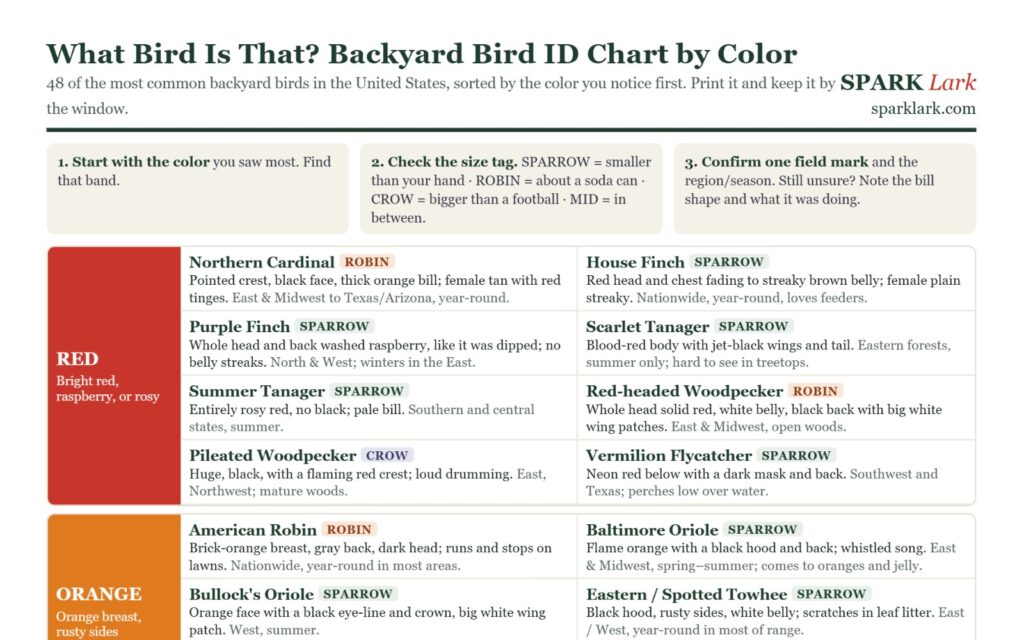
This free printable chart sorts 48 of the most common backyard birds in the United States by the color you notice first, then by size, with one field mark each. It is built for the moment a bird lands on the feeder and leaves before you can grab a field guide. Download the two-page PDF, tape it inside a cabinet door or by the kitchen window, and check it the next time a kid asks “what bird is that?”
How to use the bird ID chart
Most field guides are organized by bird family, which is the right way to learn birds and the wrong way to identify one in ten seconds. This chart starts where your eye starts: color. Follow three steps.
- Find the color band. Pick the color that covers the most of the bird, or the one that jumped out at you. A cardinal is in RED; a robin, with its gray back, is in ORANGE because the orange breast is what you saw.
- Check the size tag. Every bird carries a tag: SPARROW (smaller than your hand), ROBIN (about a soda can), or CROW (bigger than a football). These follow the size classes the Cornell Lab of Ornithology uses in its guides. Size alone rules out half the list.
- Confirm one field mark and the region. Each entry gives the single feature that settles it, such as the black necklace on a Blue Jay or the white outer tail feathers a Dark-eyed Junco flashes when it flies. The region and season note tells you whether the bird is even possible where you live.
Still stuck? Note the bill shape (thick and cone-shaped means a seed eater, thin and pointed means an insect eater) and what the bird was doing. A gray bird creeping headfirst down a trunk is a nuthatch, not a chickadee, no matter what the color says.
The chart
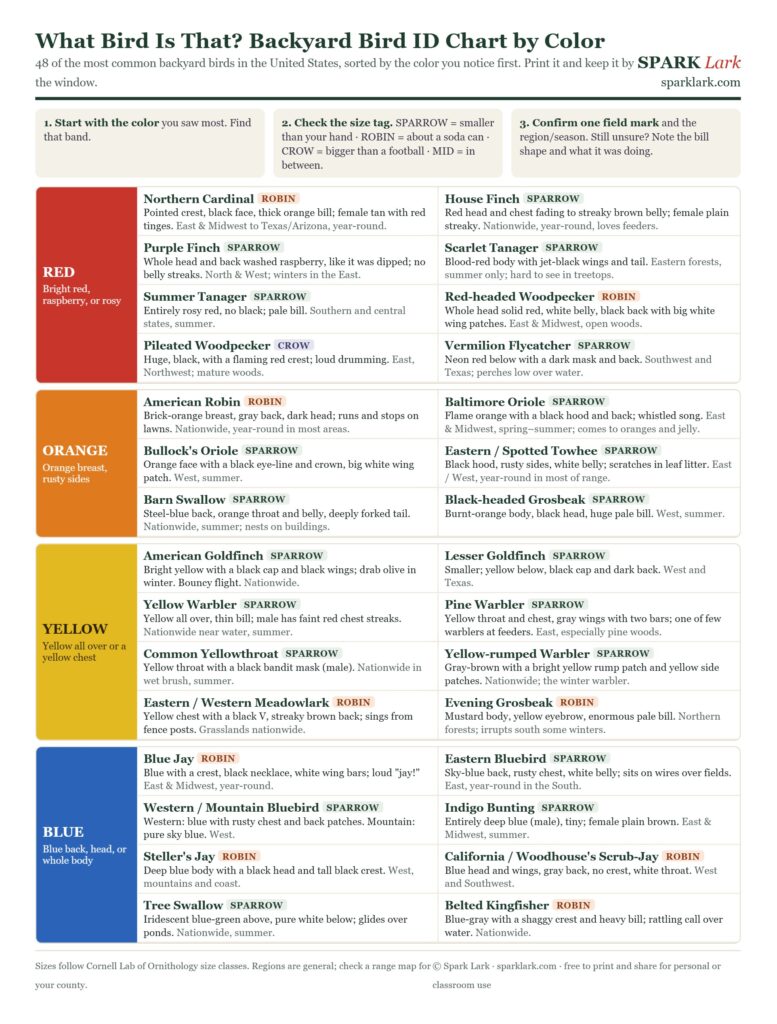
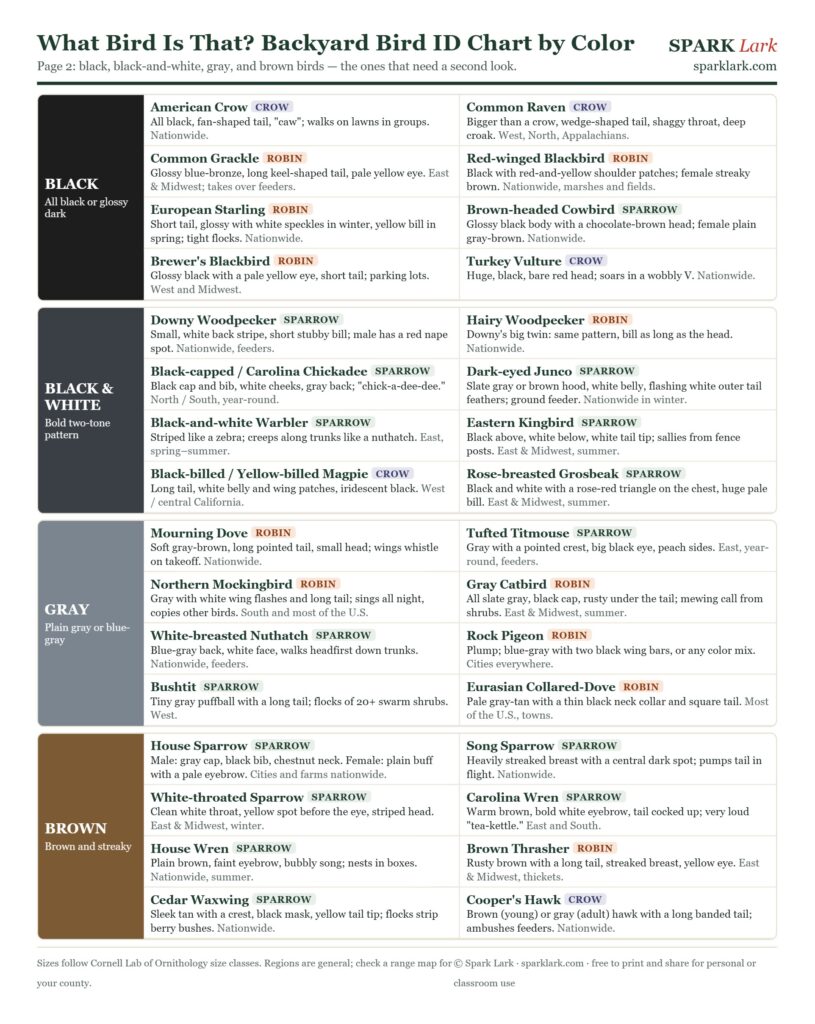
The full chart is below. It reads on a phone, prints on two letter-size pages, and the PDF version is identical. Both are free to print and share for personal or classroom use; a link back to this page is appreciated.
Pointed crest, black face, thick orange bill; female tan with red tinges. East & Midwest to Texas/Arizona, year-round.
Red head and chest fading to streaky brown belly; female plain streaky. Nationwide, year-round, loves feeders.
Whole head and back washed raspberry, like it was dipped; no belly streaks. North & West; winters in the East.
Blood-red body with jet-black wings and tail. Eastern forests, summer only; hard to see in treetops.
Entirely rosy red, no black; pale bill. Southern and central states, summer.
Whole head solid red, white belly, black back with big white wing patches. East & Midwest, open woods.
Huge, black, with a flaming red crest; loud drumming. East, Northwest; mature woods.
Neon red below with a dark mask and back. Southwest and Texas; perches low over water.
Brick-orange breast, gray back, dark head; runs and stops on lawns. Nationwide, year-round in most areas.
Flame orange with a black hood and back; whistled song. East & Midwest, spring–summer; comes to oranges and jelly.
Orange face with a black eye-line and crown, big white wing patch. West, summer.
Black hood, rusty sides, white belly; scratches in leaf litter. East / West, year-round in most of range.
Steel-blue back, orange throat and belly, deeply forked tail. Nationwide, summer; nests on buildings.
Burnt-orange body, black head, huge pale bill. West, summer.
Bright yellow with a black cap and black wings; drab olive in winter. Bouncy flight. Nationwide.
Smaller; yellow below, black cap and dark back. West and Texas.
Yellow all over, thin bill; male has faint red chest streaks. Nationwide near water, summer.
Yellow throat and chest, gray wings with two bars; one of few warblers at feeders. East, especially pine woods.
Yellow throat with a black bandit mask (male). Nationwide in wet brush, summer.
Gray-brown with a bright yellow rump patch and yellow side patches. Nationwide; the winter warbler.
Yellow chest with a black V, streaky brown back; sings from fence posts. Grasslands nationwide.
Mustard body, yellow eyebrow, enormous pale bill. Northern forests; irrupts south some winters.
Blue with a crest, black necklace, white wing bars; loud “jay!” East & Midwest, year-round.
Sky-blue back, rusty chest, white belly; sits on wires over fields. East, year-round in the South.
Western: blue with rusty chest and back patches. Mountain: pure sky blue. West.
Entirely deep blue (male), tiny; female plain brown. East & Midwest, summer.
Deep blue body with a black head and tall black crest. West, mountains and coast.
Blue head and wings, gray back, no crest, white throat. West and Southwest.
Iridescent blue-green above, pure white below; glides over ponds. Nationwide, summer.
Blue-gray with a shaggy crest and heavy bill; rattling call over water. Nationwide.
All black, fan-shaped tail, “caw”; walks on lawns in groups. Nationwide.
Bigger than a crow, wedge-shaped tail, shaggy throat, deep croak. West, North, Appalachians.
Glossy blue-bronze, long keel-shaped tail, pale yellow eye. East & Midwest; takes over feeders.
Black with red-and-yellow shoulder patches; female streaky brown. Nationwide, marshes and fields.
Short tail, glossy with white speckles in winter, yellow bill in spring; tight flocks. Nationwide.
Glossy black body with a chocolate-brown head; female plain gray-brown. Nationwide.
Glossy black with a pale yellow eye, short tail; parking lots. West and Midwest.
Huge, black, bare red head; soars in a wobbly V. Nationwide.
Small, white back stripe, short stubby bill; male has a red nape spot. Nationwide, feeders.
Downy’s big twin: same pattern, bill as long as the head. Nationwide.
Black cap and bib, white cheeks, gray back; “chick-a-dee-dee.” North / South, year-round.
Slate gray or brown hood, white belly, flashing white outer tail feathers; ground feeder. Nationwide in winter.
Striped like a zebra; creeps along trunks like a nuthatch. East, spring–summer.
Black above, white below, white tail tip; sallies from fence posts. East & Midwest, summer.
Long tail, white belly and wing patches, iridescent black. West / central California.
Black and white with a rose-red triangle on the chest, huge pale bill. East & Midwest, summer.
Soft gray-brown, long pointed tail, small head; wings whistle on takeoff. Nationwide.
Gray with a pointed crest, big black eye, peach sides. East, year-round, feeders.
Gray with white wing flashes and long tail; sings all night, copies other birds. South and most of the U.S.
All slate gray, black cap, rusty under the tail; mewing call from shrubs. East & Midwest, summer.
Blue-gray back, white face, walks headfirst down trunks. Nationwide, feeders.
Plump; blue-gray with two black wing bars, or any color mix. Cities everywhere.
Tiny gray puffball with a long tail; flocks of 20+ swarm shrubs. West.
Pale gray-tan with a thin black neck collar and square tail. Most of the U.S., towns.
Male: gray cap, black bib, chestnut neck. Female: plain buff with a pale eyebrow. Cities and farms nationwide.
Heavily streaked breast with a central dark spot; pumps tail in flight. Nationwide.
Clean white throat, yellow spot before the eye, striped head. East & Midwest, winter.
Warm brown, bold white eyebrow, tail cocked up; very loud “tea-kettle.” East and South.
Plain brown, faint eyebrow, bubbly song; nests in boxes. Nationwide, summer.
Rusty brown with a long tail, streaked breast, yellow eye. East & Midwest, thickets.
Sleek tan with a crest, black mask, yellow tail tip; flocks strip berry bushes. Nationwide.
Brown (young) or gray (adult) hawk with a long banded tail; ambushes feeders. Nationwide.
Download or print the chart
The PDF has both pages at print resolution. If you use the Print button instead, your browser will print just the chart, not the rest of this page.
What if my bird isn’t on the chart?
Forty-eight birds cover the large majority of what shows up in a yard, but not everything. Three situations trip people up:
- Females and young birds. Many of the bright birds on this chart have drab mates. A plain streaky brown finch at the feeder is often a female House Finch; a dull olive-yellow bird in January is an American Goldfinch in winter plumage. When the bird is brown and streaky, check the BROWN band and then look for the male nearby.
- Gray birds. Gray is the hardest color because so many species share it. Our guide to 18 common gray birds and our post on the small gray bird with a white belly go deeper than one line each.
- Black birds with a flash of white. Magpies, kingbirds, and several woodpeckers land in the BLACK & WHITE band, but if you saw white only in the wings, start with black birds with white wings.
Hummingbirds are left off on purpose: in most of the country there is only one, and timing matters more than color. Our 50-state guide to when hummingbirds leave covers that. Hawks are represented by the Cooper’s Hawk, the one most likely to visit a feeder; if a large raptor has you worried, read whether hawks are dangerous to humans.
Using the chart with kids
Color-first is how children already sort the world, which makes this chart a natural first field guide. Tape it up at kid height, give them the three-step routine, and let them make the call before you confirm it. A running tally on the chart itself (a tick mark next to each bird they identify) turns it into a yard list. If they take to it, our guide on getting kids interested in birdwatching has the next steps, and identifying birds by song adds the second sense.
Frequently asked questions
Can I print this chart for my classroom or nature center?
Yes. It is free for personal, classroom, library, and nature-center use. Please keep the Spark Lark credit on it and link back to this page if you post it online.
Why isn’t the chart organized by family like a field guide?
Because a field guide assumes you already know the bird is a finch or a warbler. Most people don’t, and the bird is gone in seconds. Color and size are what you actually remember, so that is what the chart is sorted by. Once you know the name, a real field guide or the free Merlin app will tell you the rest.
How accurate are the regions?
They are deliberately broad. “East” or “Nationwide” is enough to rule a bird in or out for most yards, but ranges have edges and birds wander. Check a range map for your county before you argue with a neighbor.
Bottom line
Start with the color, narrow by size, confirm one field mark. That routine identifies most backyard birds on the first try, and the chart puts all 48 of the usual suspects on two printable pages. Download the PDF, hang it by the window, and let the next unknown bird be a five-second question.
Want new printables by email?
When we publish a new free printable for families (bird ID sheets, checklists, backyard activities), we’ll send it to you, plus a short note now and then on what’s showing up at feeders. The chart and life list stay free to download right here, no signup needed.
You’ll get one email to confirm. Unsubscribe anytime. See our privacy policy.