
The best birdwatching spots in Zanzibar are Jozani-Chwaka Bay National Park for forest birds and bay shorebirds, Kiwengwa-Pongwe Forest Reserve for Fischer’s turaco and crowned hornbill, Chumbe Island and Mnemba for terns and crab-plovers, and Pemba Island’s Ngezi Forest for four birds found nowhere else on Earth. Add Bwawani Wetland on the edge of Stone Town and the tidal flats of Menai Bay, and you can see a good cross-section of the archipelago’s birds without leaving the beach circuit most families already plan. October through March brings the migrant shorebirds; June through October is the dry, comfortable season.
Zanzibar is not a big-list destination like mainland Tanzania. The Zanzibar Birdwatching Society counts a little over 230 species across the archipelago, with four full endemics, all on Pemba. The appeal is that the birding fits around everything else: forest walks are short and flat, and the shorebirds come to the beach you’re already sitting on. Palearctic migrants dominate October to March, intra-African migrants peak May to October, and roughly one fifth of the world’s crab-plovers winter here, which is why that black-and-white bird with the heavy bill shows up at so many sites below.

Jozani-Chwaka Bay National Park: forest birds and bay shorebirds
Jozani is Zanzibar’s only national park, about 50 square kilometers (19 square miles) of groundwater forest, coastal forest, grassland, mangroves, and salt marsh in the south of the main island (Unguja). Everyone comes for the Zanzibar red colobus, an endemic monkey with a population around 1,000, and it’s a real highlight for children. Ask your guide to slow down for birds on the same trail.
The park lists 168 bird species. Forest birds tied to Jozani include Fischer’s turaco (an endemic Zanzibar subspecies of a near-threatened East African bird), mangrove kingfisher, brown-headed parrot, black-bellied starling, East Coast akalat, mouse-colored sunbird, African paradise flycatcher, and Zanzibar red bishop. The turaco is a 16-inch green bird with a red-tipped crest and red flight feathers, so it stands out crossing a gap in the canopy.
The Chwaka Bay side is different habitat entirely: seagrass beds fringed by mangrove, with an elevated boardwalk. The society reports roughly 20 kinds of wader in the bay, and park records include greater sand plover, crab-plover, Saunders’s tern, and ruddy turnstone. Go at low tide for the flats and early morning for the forest.
Kiwengwa-Pongwe Forest Reserve: coral rag forest on the east coast
This reserve sits on Unguja’s northeast coast, about 20 kilometers (12 miles) from Zanzibar Town, in coral rag forest (dry scrubby woodland on old coral rock). It’s smaller and quieter than Jozani and the closest forest birding to the Kiwengwa and Pongwe beach strip. Forty-seven bird species are recorded, including Fischer’s turaco, crowned hornbill, Zanzibar sombre greenbul, white-browed coucal, and eastern nicator. The Mchekeni coral caves inside the reserve are open to visitors and hold bats, pythons, and whip spiders, which is either a selling point or a warning depending on your kids.
Chumbe Island and Mnemba: terns, crab-plovers, and beach waders
Chumbe Island Coral Park is a small protected island off the west coast, south of Stone Town. More than 80 bird species have been recorded across its coral rag forest, mangroves, and shoreline. The park’s own list includes roseate tern, bridled tern, crab-plover, dimorphic egret, African fish eagle, palm-nut vulture, mangrove kingfisher, African pygmy kingfisher, purple-banded sunbird, and Narina trogon in the forest.
Mnemba is the small triangular island 3 kilometers off Unguja’s northeast tip, a short boat ride from Matemwe. The island is private with a 500-meter exclusion zone for non-guests, but the surrounding reef is Zanzibar’s most popular snorkel trip. Shorebirds feed and roost on its beaches; a guide to the island lists curlew sandpiper, ruddy turnstone, sanderling, lesser sand plover, and crab-plover at high tide. If your boat passes the sandbars, have the binoculars out.

Pemba Island: the four Pemba endemics in Ngezi Forest
Pemba is the hilly, green northern island, a short flight from Zanzibar. It has four birds found nowhere else: Pemba scops owl, Pemba green pigeon, Pemba sunbird, and Pemba white-eye, plus endemic subspecies of African goshawk and black-bellied starling. Ngezi Forest Reserve, about 1,440 hectares (3,600 acres) at the northwestern tip, is where most people look; its records include the scops owl, sunbird, white-eye, African goshawk, palm-nut vulture, and malachite kingfisher.
Two of the four are easy. Birdquest’s 2022 report saw the sunbird and white-eye repeatedly around the tour’s seaside base and had “good looks” at the scops owl in Ngezi at dusk. The green pigeon is the hard one, called “the most difficult of the island’s endemics” in that report; it favors primary forest and is most abundant in Ngezi and Msitu Mkuu. Book a local guide for a dawn walk and a separate dusk owl session. Other Pemba birds from that trip: Dickinson’s kestrel, olive bee-eater, Malagasy pond heron, and white-cheeked tern offshore.
Menai Bay, Stone Town, and the Nungwi coast: birding without a reserve
Menai Bay Conservation Area covers 470 square kilometers (180 square miles) of southwest Unguja, including the villages of Unguja Ukuu, Fumba, and Kizimkazi. It’s known for dolphin trips, but the mangroves, mudflats, and coral flats are an Important Bird Area, and the society flags it for Palearctic waders from October to March. Birds tied to Menai Bay include black heron, whimbrel, and greater flamingo (seasonal). A boat day out of Unguja Ukuu or Fumba usually includes a sandbank stop at low tide; that’s your shorebird window.
Bwawani Wetland is the surprise on this list: reed-fringed brackish and freshwater pools at the north end of Creek Road in Stone Town, with mangroves and tidal mudflats to the east. Regulars include white-faced whistling duck, black-winged stilt, pied kingfisher, water thick-knee, African sacred ibis, purple heron, black-crowned night heron, African swamphen, mangrove kingfisher, gull-billed tern, crab-plover, whimbrel, greenshank, curlew sandpiper, and little stint. You can walk there from most Stone Town hotels.
Stone Town itself is dominated by house crows, an Indian species that arrived in the 1890s and has resisted control programs for decades. Kids will notice them first. Look past them for African palm swifts overhead, scarlet-chested sunbirds in flowering trees, cattle egrets, and along the seafront, whimbrel, black-bellied plover, and sooty gull, a coastal gull whose range runs south to Tanzania and Mozambique.
Nungwi and Kendwa at the north tip have no reserve and no hotspot list. Nungwi is about an hour’s drive from Stone Town, with beaches lined by palm, mangrove, and casuarina. Treat it as low-tide birding: the crab-plover’s habitat is exactly this, “sandy beaches and shorelines, as well as coral outcrops,” and sooty gulls work the intertidal zone. Walk the exposed flats and let the kids sort shorebirds by leg color and bill shape.
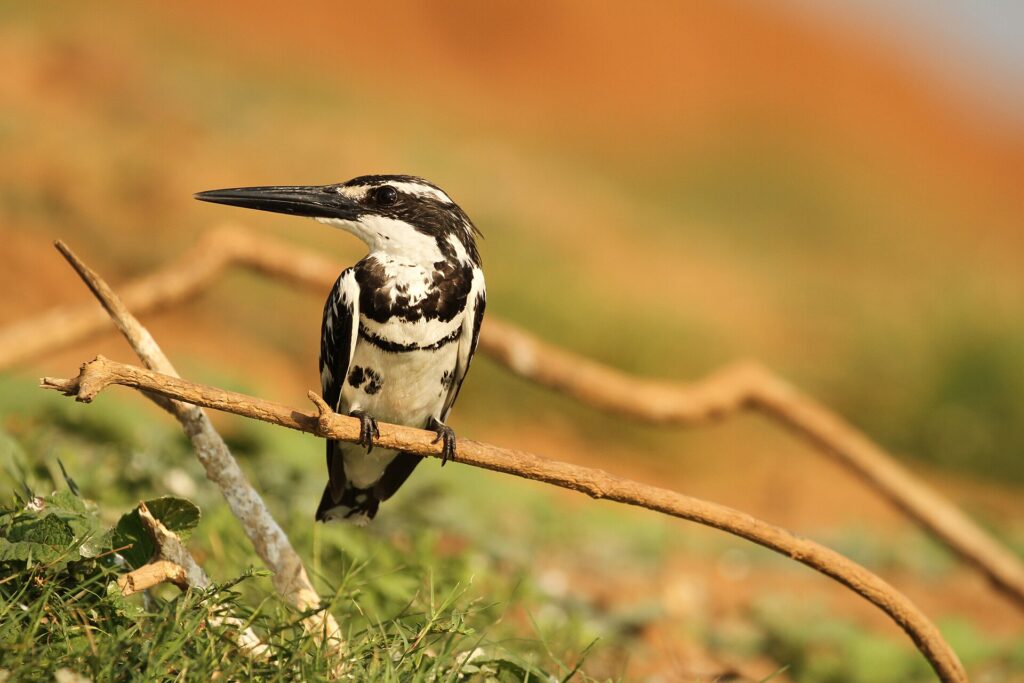
Zanzibar birding spots at a glance
| Spot | Key birds | Best time | How to get there |
|---|---|---|---|
| Jozani-Chwaka Bay National Park | Fischer’s turaco, mangrove kingfisher, brown-headed parrot, Zanzibar red bishop; crab-plover, greater sand plover, Saunders’s tern in the bay | Early morning for forest; low tide Oct–Mar for waders | South-central Unguja by road; guided walks and mangrove boardwalk |
| Kiwengwa-Pongwe Forest Reserve | Fischer’s turaco, crowned hornbill, Zanzibar sombre greenbul, white-browed coucal | Early morning, any season | Northeast coast, about 20 km from Zanzibar Town; near Kiwengwa and Pongwe beaches |
| Chumbe Island Coral Park | Roseate and bridled terns, crab-plover, dimorphic egret, fish eagle, Narina trogon | Dry season (Jun–Oct) for calm seas | Boat from the west coast south of Stone Town; day visits are limited |
| Mnemba | Crab-plover, curlew sandpiper, ruddy turnstone, sanderling, lesser sand plover | High tide roost, Oct–Mar | Boat from Matemwe; island is private, view from the water |
| Ngezi Forest, Pemba | Pemba scops owl, Pemba green pigeon, Pemba sunbird, Pemba white-eye | Dawn and dusk, any season | Flight from Zanzibar to Pemba, then road to the northwest tip |
| Menai Bay / Unguja Ukuu | Black heron, whimbrel, greater flamingo (seasonal), migrant waders | Low tide Oct–Mar | Boat day from Unguja Ukuu, Fumba, or Kizimkazi |
| Bwawani Wetland, Stone Town | Whistling ducks, stilts, herons, kingfishers, crab-plover, migrant sandpipers | Early morning, Oct–Mar best | Walk to the north end of Creek Road |
| Nungwi / Kendwa | Crab-plover, sooty gull, beach waders | Low tide | About one hour north of Stone Town by road |
When to go, what to bring, and how to bird responsibly
Zanzibar has two wet seasons. The long rains run March to May, peaking in April, and most beach lodges close. The short rains are lighter and less predictable in November and December. The long dry season, June through October, is the comfortable window, and January to February is a hot, mostly dry gap. For birds, November to April is the richest period across Tanzania because migrants are present and many residents are in breeding plumage. For a family, June through October or the January to February window gives you dry days and still overlaps with wintering shorebirds.
Pack light. A pair of 8x binoculars per adult is the single best investment; see our guide to binoculars for birding under $200. A spotting scope is overkill in the forest but earns its space on the tidal flats, where birds sit far out; our spotting scope guide covers what to look for. Add a tide table, sun protection, insect repellent, and closed shoes for the coral rag.
Hire local guides at Jozani, Ngezi, and Chumbe. They know the calls, keep you on the trails, and the fee supports the reserves. Keep your distance from roosting terns and shorebird flocks; a flushed flock burns energy migrants can’t spare. Don’t feed the red colobus, and skip playback for the Pemba scops owl and green pigeon, both vulnerable species with small populations. Traveling with children? Our tips on getting kids interested in birdwatching apply here; a “spot five shorebirds” challenge on a sandbank works.
Frequently asked questions
Do I need to go to Pemba to see anything special?
Only if you want the four endemics. Unguja has the turaco, the red colobus, and all the shorebirds. Pemba is a separate flight and at least two nights for a real chance at the green pigeon.
Can we bird Zanzibar without a guide?
Beaches, Bwawani Wetland, and hotel gardens, yes. Jozani, Ngezi, and Chumbe are guided reserves, and a guide turns a 30-minute forest walk into a dozen species instead of two.
What is the one bird a family should try to see?
The crab-plover. It’s big, black-and-white, loud, unmistakable, and occurs at nearly every coastal site here. Second choice: Fischer’s turaco at Jozani or Kiwengwa.
Is the rainy season a bad time for birds?
Not for birds; November to April is peak migrant season. It’s bad for logistics, since the long rains (March to May) close lodges. For migrants and dry feet, aim for November to February.
Bottom line
Build one morning at Jozani, one low-tide session at a sandbank or Bwawani, and one boat trip near Mnemba or Chumbe into a normal Zanzibar beach week and you’ll see the turaco, the crab-plover, terns, and a dozen migrant shorebirds. Add Pemba only if the four endemics are the goal. Go June to October for comfort or November to February for migrants, and bring binoculars for every adult.