
Four falcons occur in San Diego County: the peregrine falcon, the American kestrel, the merlin, and the prairie falcon. Peregrines nest on the sea cliffs at Torrey Pines and Point Loma and on structures around San Diego Bay, kestrels are the small falcon on wires in open country, merlins visit from fall through early spring, and prairie falcons stay inland in the mountains and the Anza-Borrego desert. This guide covers how to tell them apart, where to find them, and how to rule out the hawks people confuse them with.
Which falcons live in San Diego County?
The San Diego County Bird Atlas, the county-wide survey published by the San Diego Natural History Museum, documents all four species.
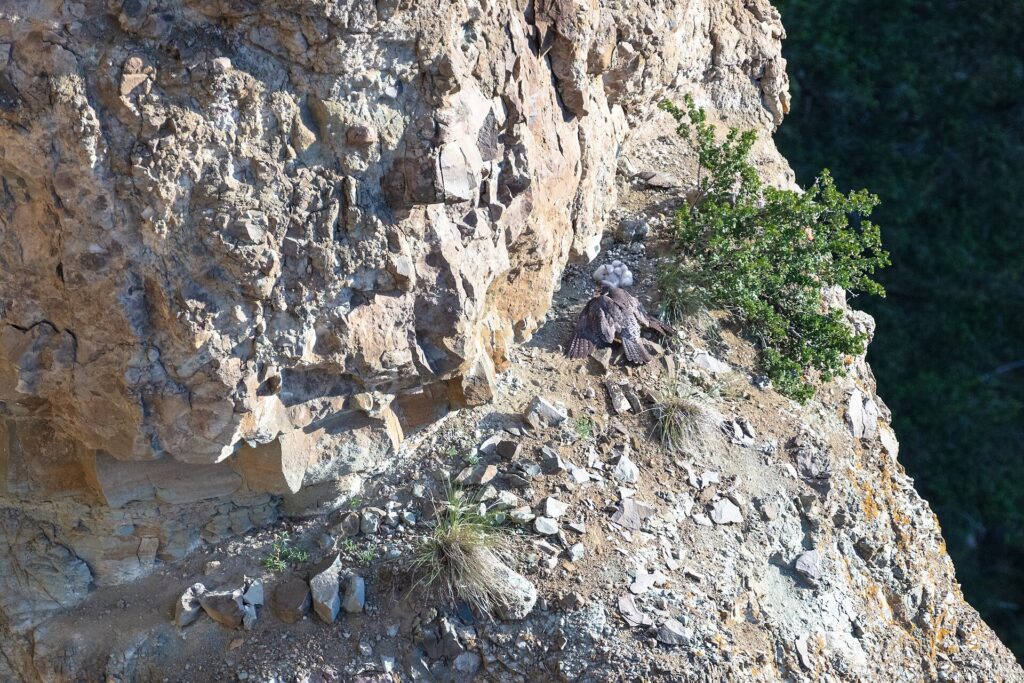
Peregrine falcon. The big coastal falcon most people ask about. The atlas describes it as mainly a winter visitor, most frequent October through February, plus a small breeding population that had reached five pairs by 2004. Local nests have been on cliff ledges and on structures: the San Diego-Coronado Bay Bridge (used since 1989), a Point Loma cliff, a crane in National City, and the U.S. Grant Hotel downtown. Buena Vista Audubon reported a pair nesting in the Torrey Pines cliff starting in 2015, and Cabrillo National Monument describes resident peregrines on Point Loma.
American kestrel. The smallest and most widespread falcon here. The atlas calls it a year-round resident, more numerous in winter, found across the coastal slope and valley floors. It nests in tree cavities, power poles, nest boxes, and, more often than anywhere else, in palm fronds.
Merlin. A rare winter visitor, mainly October through March. The atlas estimates roughly 100 merlins winter in the county, favoring coastal lowlands and grasslands, and notes that fall migrants funnel south along Point Loma.
Prairie falcon. Strictly inland. The atlas ranks it among the county’s scarcest breeders at 20 to 30 pairs, with every nest at least 23 miles from the coast, on cliffs from the inland coastal slope to the eastern mountains and the Anza-Borrego badlands.
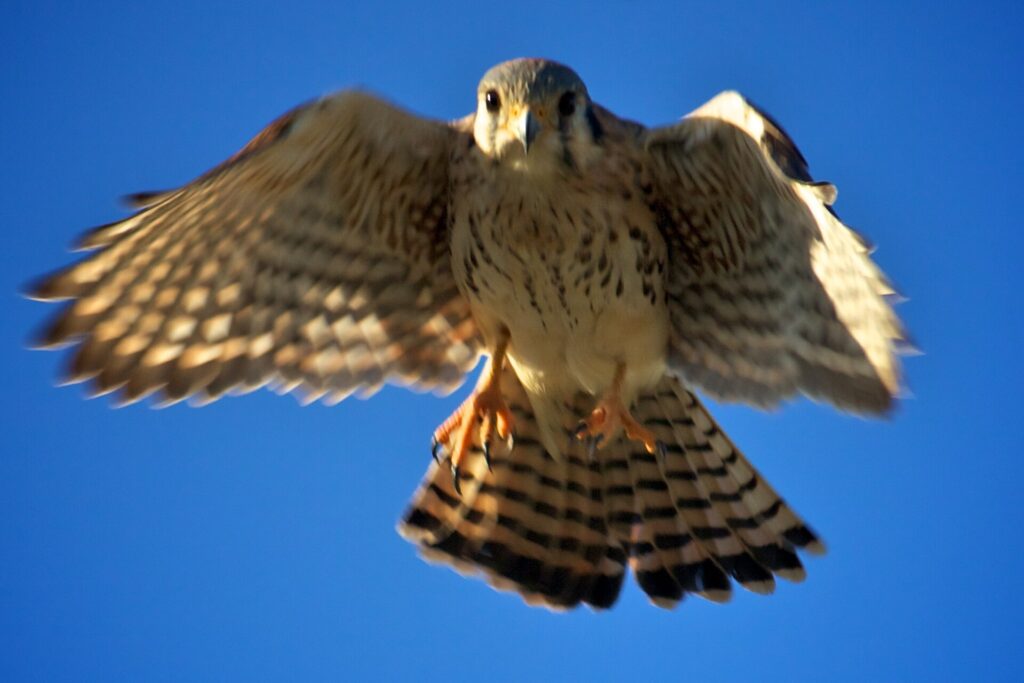
How to tell San Diego’s falcons apart
All four share the falcon shape: long, pointed wings, a longish tail, and fast, direct flight. Size, face pattern, and location usually settle it. Measurements are from the Cornell Lab of Ornithology.
| Species | Size | Wing shape and flight | Face and color | Where and when in San Diego |
|---|---|---|---|---|
| Peregrine falcon | 14–19 in long, 39–43 in wingspan. Crow-sized or bigger; females larger. | Long, pointed wings, long tail. Steady, powerful wingbeats; hunts with high-speed dives (stoops). | Dark head with a thick “sideburn” that looks like a helmet. Blue-gray back, barred belly. Juveniles browner and streaked. | Coast: Torrey Pines, Point Loma, San Diego Bay, downtown. A few pairs year-round; most common October–February. |
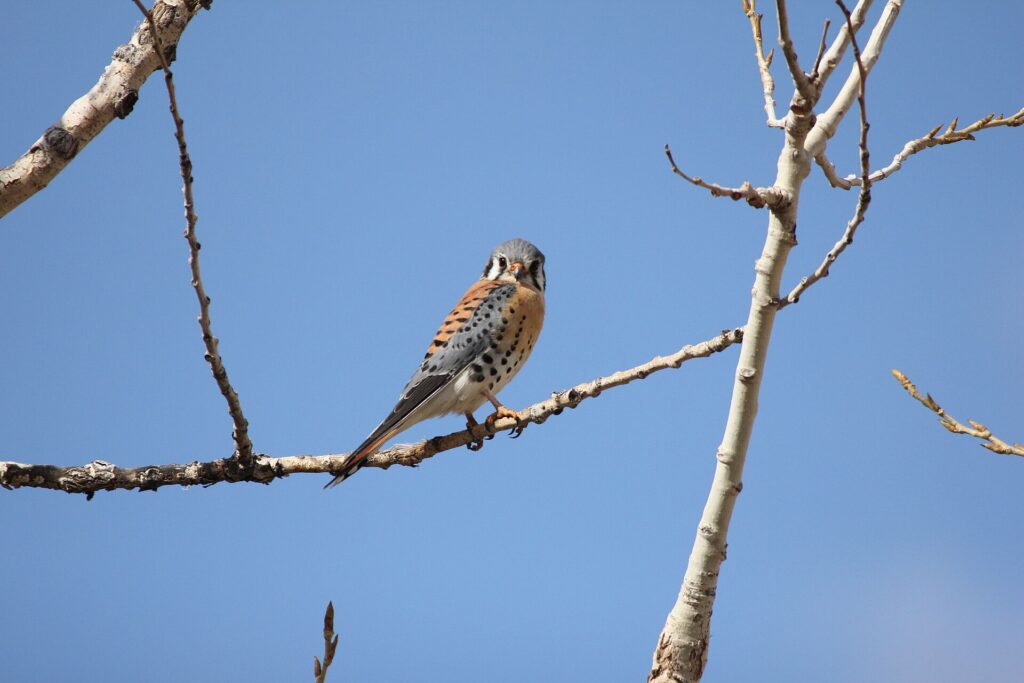
| American kestrel | 9–12 in long, 20–24 in wingspan. Mourning dove-sized. | Narrow wings, long square-tipped tail. Hovers into the wind; pumps its tail when perched. | Two black vertical slashes on a pale face. Male slate-blue wings and rusty back; female rusty with barring. | Open country, wires, fence posts county-wide. Year-round, more in winter. |
| Merlin | 9–12 in long, 21–27 in wingspan. Stockier than a kestrel. | Sharply pointed wings, broad chest. Rapid, choppy wingbeats, almost no gliding. | Dark and heavily streaked below; dark tail with thin white bands. Faint or no mustache. | Coastal lowlands, lagoons, grasslands. Roughly October–March only. |
| Prairie falcon | 15–19 in long, 35–45 in wingspan. Peregrine-sized. | Pointed wings, medium-long tail. Often hunts low, hugging the ground. | Pale sandy brown above, whitish below, thin brown mustache. Dark “armpits” show in flight. | Inland only: Anza-Borrego, east county mountains, Warner Valley. Year-round at cliffs; more in winter grasslands. |
Two rules of thumb. A falcon hovering over a field or bobbing its tail on a wire is almost certainly a kestrel. A big, dark-headed falcon near the ocean or a tall building is a peregrine; the same size bird in pale tan out in the desert is a prairie falcon.
Was it a falcon or a hawk? Common mix-ups
Most “falcon” reports in San Diego turn out to be one of three other raptors. Wing shape sorts them fastest: falcons have pointed wings, and these birds don’t hunt the same way.
- Cooper’s hawk. The hawk that raids backyard feeders. Cornell describes broad, rounded wings and a very long tail with a flap-flap-glide flight. Adults are blue-gray above with reddish barring below. It’s crow-sized like a peregrine, but it lives in neighborhoods and wooded canyons and never stoops from high overhead.
- Red-tailed hawk. The big brown hawk on freeway light poles. Very broad, rounded wings and a short, wide tail. It soars in circles and, per Cornell, drops slowly with legs extended rather than folding into a dive. Adults show a brick-red tail and often a dark belly band.
- White-tailed kite. The one that fools people most, because it has pointed wings and hovers like a kestrel. It’s larger (about 13 to 15 inches long) and mostly white with black shoulder patches, a white tail, and red eyes up close. Watch for it over grasslands and marsh edges; the Tijuana Slough refuge list records it year-round.
Calls help too; see our guide to why hawks screech.
Where to see falcons in San Diego
These are public places where a reliable source ties falcons to the site. Cliff nests are distant, so binoculars are the minimum and a scope is better; see our guides to binoculars for birding under $200 and spotting scopes for birding.
- Torrey Pines State Natural Reserve and State Beach. The best-known peregrine nest in the county. Buena Vista Audubon reported the pair nesting in an opening in the cliff south of Lifeguard Tower #1. View from the beach at low tide in late afternoon light, or walk the Guy Fleming Trail on June mornings for fledglings.
- Cabrillo National Monument and Point Loma. The National Park Service reports resident peregrines and lists peregrine falcon, red-tailed hawk, and osprey among the park’s raptors. Early morning and late afternoon are the park’s suggested times.
- San Diego Bay and the Coronado Bridge. Peregrines have nested on the bridge since 1989, and the atlas says wintering peregrines concentrate around the bay. Scan bridge structure and downtown high-rises.
- Tijuana River estuary and Tijuana Slough National Wildlife Refuge. The refuge bird list records peregrine falcon as occasional in all four seasons, merlin and prairie falcon as occasional in spring and fall, and kestrel and white-tailed kite year-round. A peregrine near the river mouth by the visitor center made local news in 2013.
- Anza-Borrego Desert State Park and east county. Prairie falcon territory. The atlas places about seven pairs in the rocky hills and badlands of Anza-Borrego, with more on the eastern mountain slopes, and says the Borrego Valley and Warner Valley grasslands are best in winter.
Check eBird before you go to see what’s been reported at each hotspot this week. Taking kids? Our tips on getting kids interested in birdwatching apply.
When is the best time to see peregrines in San Diego?
Two windows. For the most birds, go in winter: the atlas says peregrines are most frequent October through February, when northern migrants join the local pairs along the coast. For the most action, go in spring and early summer. Local pairs lay eggs from late February into April, and the Torrey Pines timeline runs hatching in May, first flights in June, and independent young by the end of July. Fledglings are noisy and clumsy, so they’re much easier to spot than a quiet adult.
The peregrine’s recovery in San Diego
Wiped out by DDT
The atlas states that the county held about 12 breeding pairs historically and that the entire population disappeared in the 1950s and 1960s because DDT kept females from depositing enough calcium in their eggshells. A paper in Western Birds notes California had lost more than 95 percent of its peregrines by 1970.
Back from the brink and delisted in 1999
The turnaround came from the 1972 DDT ban and captive breeding. The U.S. Fish and Wildlife Service reported that North America bottomed out at 324 nesting pairs in 1975, that more than 6,000 captive-raised falcons were released starting in 1974, and that at least 1,650 pairs were breeding in the U.S. and Canada when the species came off the endangered list on August 20, 1999. Interior Secretary Bruce Babbitt called it “a perfect example of the success we can have” through partnership.
Locally, a captive-bred female released at Point Loma in 1986 nested on the Coronado Bay Bridge in 1989, the first San Diego nest in 39 years. Pairs then spread to cranes, hotels, and cliffs, and the County of San Diego recorded the species in four county preserves in 2024.
What to do if you find an injured falcon or hawk
Call Project Wildlife, run by the San Diego Humane Society, at 619-299-7012 (press 1 for wildlife). Drop-off is the Pilar & Chuck Bahde Wildlife Center, 5433 Gaines St., San Diego 92110, open 10 a.m. to 6 p.m. daily except holidays; the Humane Society’s Ramona campus handles birds of prey, so staff may route a raptor there. The U.S. Fish and Wildlife Service also lists Sky Hunters at 619-985-9686 for hawks and owls.
The Humane Society’s raptor guidance: wear thick leather gloves, drop a towel over the bird, and move it into a cardboard box with air holes. Keep it dark and quiet, and get it to the center promptly. Do not offer food or water or try to care for it yourself. If you can’t pick it up safely, set a laundry basket over it and call. Talons are the hazard, not the beak; our post on whether hawks are dangerous to humans explains why gloves matter. And skip rodent poison at home: the Humane Society notes young raptors get sick from eating poisoned prey.
Frequently asked questions
Are peregrine falcons rare in San Diego?
Uncommon, not rare. A handful of pairs breed in the county and 15 to 35 birds winter here in a typical year, according to the atlas. You usually see one at a time.
How fast does a peregrine falcon dive?
Cornell puts the stoop at around 200 mph. The County of San Diego notes normal flight is a modest 24 to 33 mph, so a peregrine flapping along the cliffs won’t look fast until it folds up and drops.
Bottom line
San Diego has four falcons: peregrines on the coastal cliffs, bridges, and downtown; kestrels nearly everywhere open; merlins in winter; and prairie falcons in the desert and east county. Check wing shape and face pattern first, then location. For a near-guaranteed peregrine, walk Torrey Pines State Beach or the Point Loma trails in late spring, and call Project Wildlife at 619-299-7012 if you find a raptor that can’t fly.