To keep starlings off suet, make the birds eat upside down: put the suet in a feeder that only opens from the bottom, or inside a wire cage with 1.5-inch openings set far enough out from the cake that a starling can’t reach it. To keep them off mealworms, serve the worms inside an enclosed feeder with 1.5-inch entry holes, put out only a small handful at a time, and keep that feeder well away from your seed feeders. Starlings can’t hang and feed upside down, and they can’t squeeze through a 1.5-inch hole, so both fixes shut them out while woodpeckers, chickadees, nuthatches and bluebirds keep eating. Everything below is about how to set that up, what to stop doing, and what doesn’t work.
The short version
- Suet: feed it from the bottom only. Starlings have weak feet and can’t hang upside down; woodpeckers and chickadees do it without thinking.
- Suet, plan B: a cage of 1.5-inch wire around the suet, with a gap between the wire and the cake. Starlings get through 2-inch wire.
- Mealworms: an enclosed feeder with 1.5-inch holes, a small amount twice a day, and nowhere near the seed feeders.
- Stop: platform trays, food on the ground, and cheap mixes heavy on millet.
- Skip: hot-pepper suet. It stops squirrels, not birds.
First, make sure it’s starlings
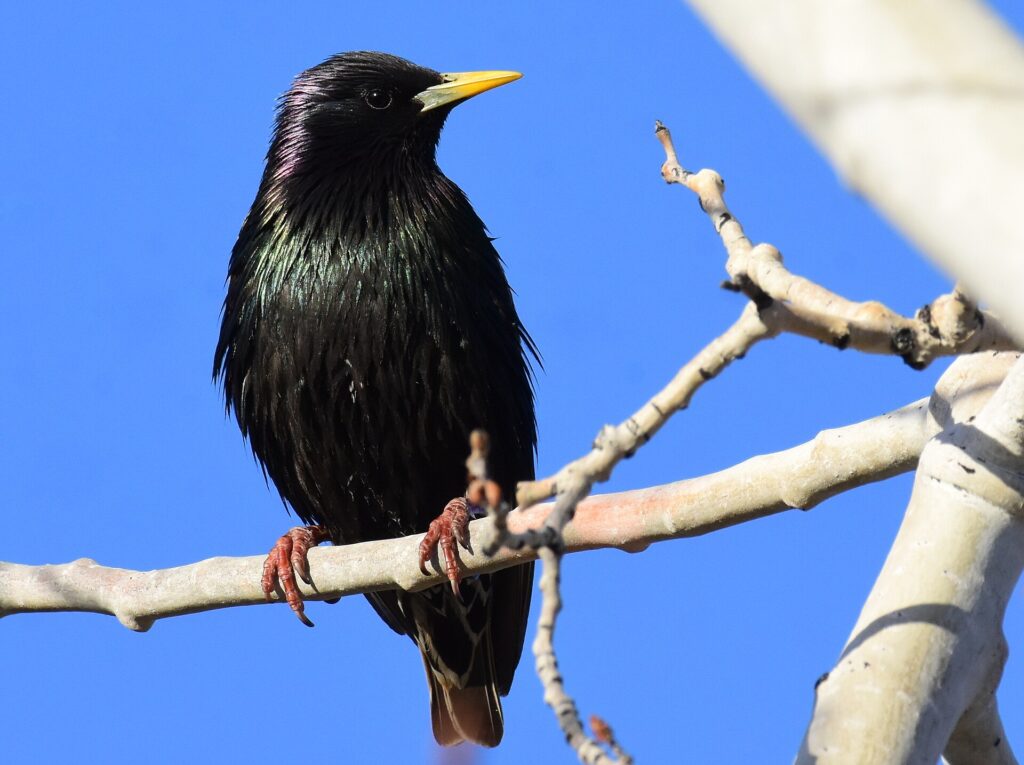
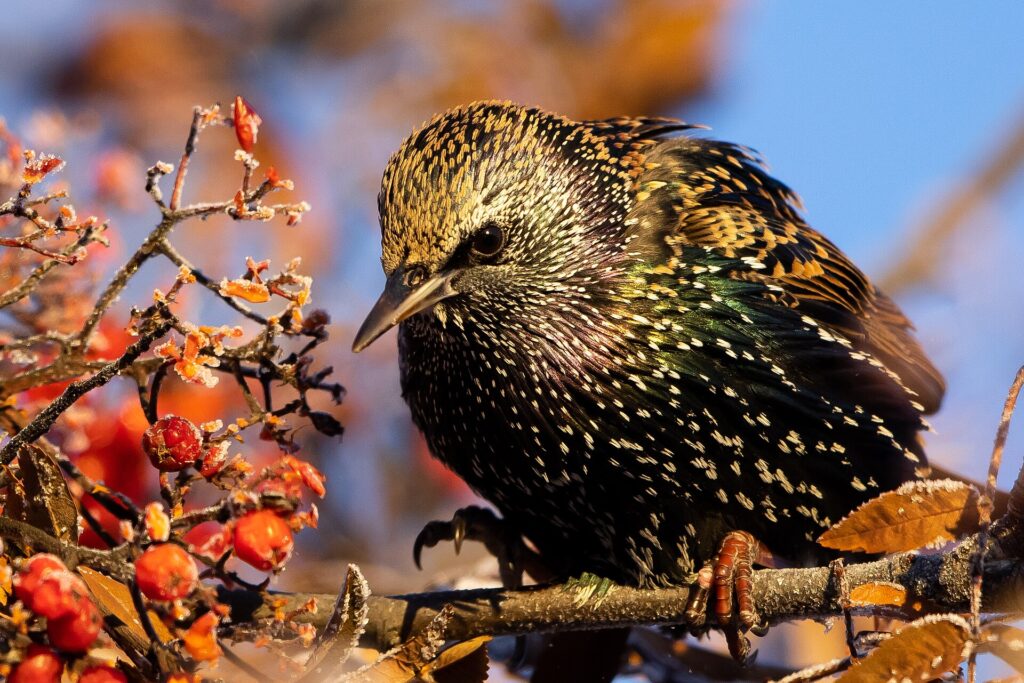
Starlings, grackles and blackbirds often arrive together in fall and winter, and they don’t all respond to the same fixes. Starlings are stocky black birds with short tails, triangular wings and long, pointed bills. Cornell’s All About Birds describes them as “covered in white spots during winter,” turning “dark and glossy in summer.” If the bird working over your suet cake is short-tailed and speckled, it’s a starling.
| Bird | What to look for | What it goes after | What stops it |
|---|---|---|---|
| European starling | Stocky, short tail, long pointed bill; white-spotted in winter, glossy in summer | Suet, mealworms, millet, peanut hearts | Upside-down suet feeder, 1.5-inch cage, 1.5-inch mealworm holes |
| Common grackle | Bigger and lankier, long keel-shaped tail, pale yellow eye | Seed on trays and the ground, mixes, suet | Seed switch, weight-activated feeder, no trays |
| Red-winged blackbird | Smaller; male black with red-and-yellow shoulders, female streaky brown | Seed, especially on trays and the ground | Same as grackles |
| Downy or hairy woodpecker | Black and white, clings to the feeder, often upside down | Suet | Nothing; this is who you’re feeding |
If grackles are the bigger problem, our guide to telling grackles, blackbirds and starlings apart sorts the whole flock out, and how to keep grackles and blackbirds away from feeders covers the seed side of the problem, and its roosts and nests section covers the rest of the yard. This article is about the two foods starlings want most: suet and mealworms.
Why starlings go straight for suet and mealworms
Starlings are mostly insect eaters. By one estimate on Sialis.org, animal matter makes up 44 to 97 percent of their diet depending on the season. Cornell describes them walking over lawns and fields, “poking their closed bill into the ground” and prying it open to find grubs. When the ground freezes and the insects disappear, a suet cake or a dish of mealworms is the closest thing in the yard to what they’re built to eat.
They also come in numbers. Starlings were released in New York’s Central Park in the late 1800s, and Cornell now puts the population at about 93 million across the U.S. and Canada. In winter they roost together in flocks that Sialis.org says can reach a million birds, and they visit feeders in groups. A Maine Department of Agriculture fact sheet sums up their feeder manners: starlings are “very aggressive at feeders, and will chase other birds away.” The foods it lists as starling magnets are suet, white millet, peanut hearts and, to a lesser degree, sunflower seed.
The good news is that the same body that makes a starling good at probing lawns makes it bad at two things: hanging upside down and fitting through small holes. Every fix that works uses one of those.
How to keep starlings off suet feeders
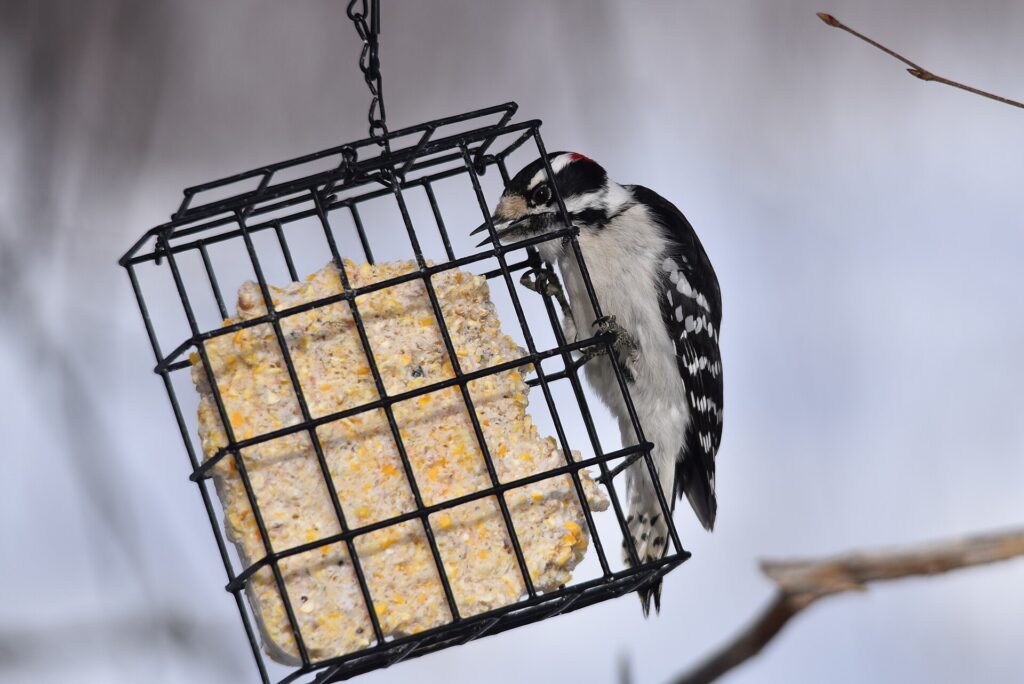
1. Feed suet upside down. This is the fix Cornell’s All About Birds recommends: offer suet “in a feeder that requires birds to feed hanging upside down.” Project FeederWatch says the same about starling-proof suet feeders, which give access to the suet only from the bottom. The Maine fact sheet explains why it works: starlings “have weak feet” and “are unable to hang and feed upside down.” Woodpeckers, nuthatches and chickadees cling to bark at every angle all day, so feeding from below is normal for them.
You don’t have to buy anything new to try it. A standard square suet cage can be fixed under a board or a small roof so the only open face points at the ground. Covering the top and sides also keeps rain off the cake. If you’d rather buy one built for the job, our best suet feeders guide includes upside-down models.
2. Put the suet inside a cage. The second option is an exclusion cage: a wire box around the suet feeder with openings small birds pass through and starlings don’t. The Maine fact sheet calls for 1.5-inch wire and warns that starlings can get through 2-inch wire. It also stresses leaving space between the wire and the suet. If the cake sits right against the cage, a starling can simply stand on the outside and reach in with that long bill. Leave enough space that the suet sits beyond a starling’s reach. The trade-off is that bigger birds you might want, such as red-bellied woodpeckers, flickers and jays, get shut out too.
3. Watch what’s in the cake. Plain suet and suet mixed with seed are both starling food, but cakes full of millet or peanut hearts give them two reasons to stay. If starlings are thick, keep the suet plain and move any seed-feeding to the seeds they tend to skip. Wild Birds Unlimited notes that safflower seed cylinders are “typically not preferred” by grackles, blackbirds and starlings.
4. Feed suet in the cold months. Cornell advises offering raw suet only in winter, because it “grows rancid quickly when temperatures are above freezing.” Soft suet can also coat a bird’s belly feathers, which is a real problem in spring and summer when birds are sitting on eggs. Taking suet down in warm weather also helps with starlings, because it removes the draw just as Cornell sees young starlings leave the nest and start showing up at feeders in late spring.
How to keep starlings off mealworm feeders
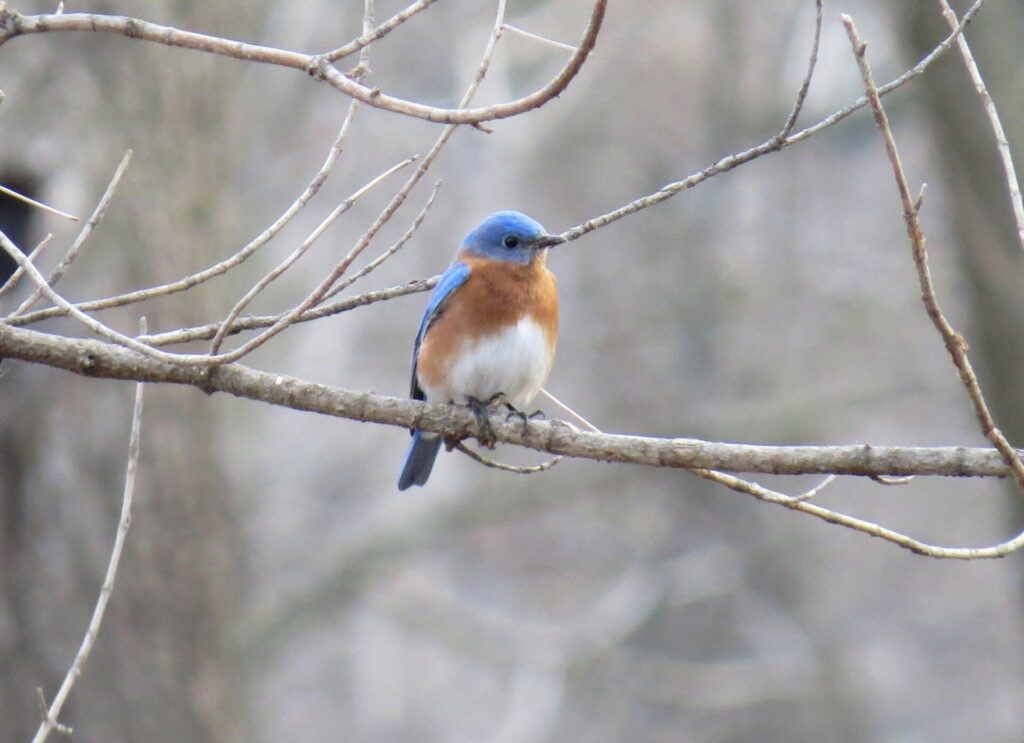
Mealworms are usually put out for bluebirds, and starlings love them just as much. Cornell notes that birds will “voraciously gobble up mealworms,” so an open dish doesn’t last long once starlings find it. Four habits keep the worms going to the birds you meant them for.
1. Use an enclosed feeder with 1.5-inch holes. Cornell recommends special bluebird feeders that exclude most other birds. These are small boxes, often with clear sides, that birds enter through a round hole. Sialis.org, a long-running bluebird resource, suggests openings of 1.5 to 1.75 inches to let in “fat bluebirds but not larger birds.” Aim for the small end of that range. Sialis.org also notes that starlings can enter a 1⅝-inch round hole but not a 1.5-inch one, and the Georgia Department of Natural Resources explains that bluebird nest boxes use 1.5-inch holes precisely because that size keeps starlings out. A 1.75-inch hole is big enough for a determined starling.
2. Put out a little, twice a day. Sialis.org recommends “feeding smaller amounts twice a day” so bluebirds get some and other species never discover the feeder. Cornell’s advice is similar: offer “a few at a time.” A dish that sits full all day is an advertisement. A dish that’s empty by 9 a.m. isn’t.
3. Keep it away from the seed feeders. Sialis.org is blunt about this: putting mealworms next to seed feeders “just teaches other birds to eat mealworms.” Hang the mealworm feeder at the far edge of the yard, closer to open ground and a fence line or perch where bluebirds hunt.
4. Train the bluebirds, then close the doors. Bluebirds may not use an enclosed feeder right away. Sialis.org suggests starting with about a dozen mealworms in a small dish near where bluebirds perch, moving the dish to the top of the feeder once they find it, and, for enclosed feeders, leaving the feeder open for a while so they get used to going inside. Once they have it figured out, you can move the feeder a short distance every day or so to where you want it. Our best bluebird feeders guide covers enclosed mealworm designs.
What to stop doing
Project FeederWatch’s list of things that invite starlings and blackbirds is short: platform trays and food spread on the ground. Both let a heavy bird stand and eat as long as it likes. If starlings are a problem, take the tray down for the season and rake up spilled seed under the feeders. FeederWatch also suggests tube feeders “that have short perches and no catch basins” and feeders “that close under the weight of a large bird.” Not every weight-activated squirrel feeder does this, though: Brome’s own page for the Squirrel Buster Plus says it “will NOT deter Grackles, Starlings.” For seed feeders, the Maine fact sheet suggests a ring of 1-inch chicken wire around the feeder, which chickadees pass through and starlings don’t.
What doesn’t work
Hot-pepper suet. It’s sold as a pest deterrent, and it does stop squirrels. But as Wild Birds Unlimited explains, capsaicin triggers a pain receptor that mammals have and birds don’t. Pepper does nothing to keep starlings off the cake.
Taking the feeders down for a day. A flock that knows your yard has food comes back to check. The design of the feeder is what changes their behavior, not a short break.
Scare devices. Fake owls, reflective tape and spinning gadgets are easy to buy, but none of our sources recommend them for starlings.
Trapping or poisoning. Starlings are an introduced species and are on the U.S. Fish and Wildlife Service’s list of birds the Migratory Bird Treaty Act does not protect. That doesn’t make it a feeder solution. Poison put out for starlings kills whatever else eats it, and in a yard full of songbirds that’s the birds you’re trying to feed. Changing the feeder is cheaper and safer, and it works.
Common questions
Will an upside-down suet feeder keep woodpeckers away too? No. Cornell recommends it specifically because it keeps starlings out while woodpeckers and chickadees keep coming.
What size hole keeps starlings out of a mealworm feeder? 1.5 inches. Starlings can squeeze through a 1⅝-inch round hole, according to Sialis.org, so anything bigger than 1.5 inches is a gamble.
Why are starlings suddenly all over my suet in fall? Insects are getting scarce and winter flocks are forming. Suet is the easiest high-fat food in the neighborhood. Switch to an upside-down or caged feeder before the flock gets into the habit. For more on what to put out as it gets colder, see what to feed birds in winter.
Do grackles eat suet too? Yes, and the same fixes work on them. For the rest of the grackle picture, see what grackles eat and why grackles flock in fall.
Will the starlings ever leave? Unlike migrating grackle flocks, starlings live in most of the U.S. all year, so waiting them out rarely works. A feeder they can’t use is the long-term answer.
Timing helps too: see when to put out suet for the season-by-season calendar.
For feeders built to keep starlings and grackles off, see our guide to the best starling-proof and grackle-proof bird feeders.
Bottom line
Starlings can’t hang upside down and can’t fit through a 1.5-inch hole. Build your suet and mealworm feeding around those two facts: suet from the bottom or inside a 1.5-inch cage with room to spare, mealworms in an enclosed feeder with 1.5-inch holes, a small amount at a time, far from the seed. Take away the trays and the ground food, skip the pepper suet, and the starlings move on to someone else’s yard while your woodpeckers and bluebirds keep eating.