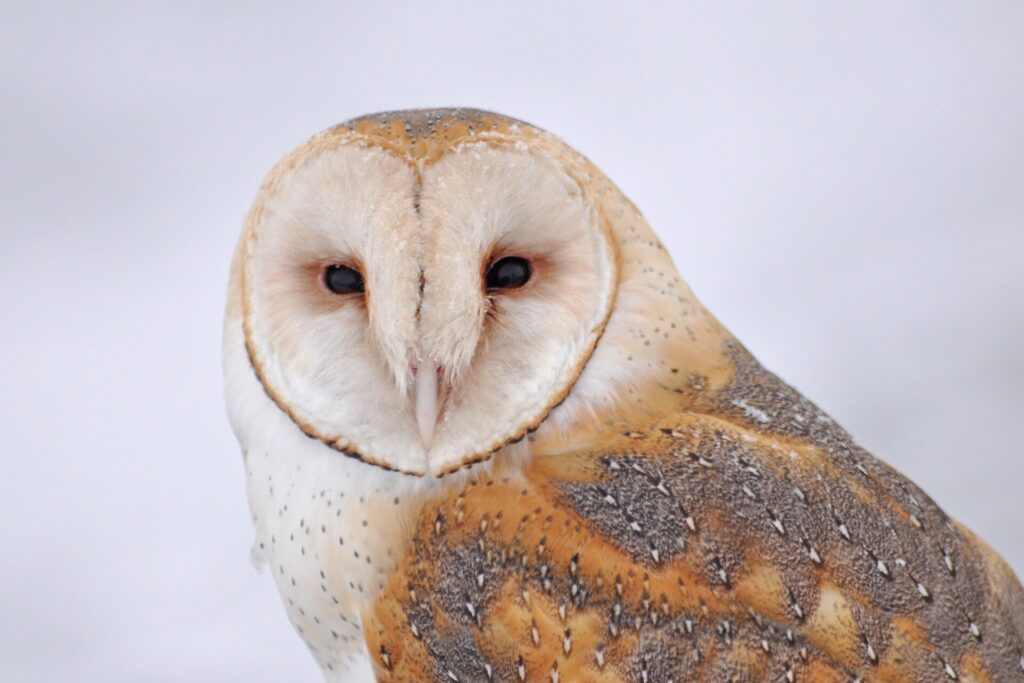
A family of barn owls is raising young in a rooftop water tower on Manhattan’s Upper West Side, and it is national news because, as far as anyone can tell, it has never happened before. The Associated Press reports that a Cornell Lab of Ornithology ecologist called the find “totally shocking” and said there has been no barn owl nest in Manhattan “at least in recorded history.” Barn owls are not rare worldwide, but New York sits at the cold northern edge of their range, the state says their numbers have fallen sharply, and nobody expected one to pick a block near Central Park. Here is what happened, why it matters, and how to tell a barn owl’s scream from the owls you are more likely to hear in your own yard.
What happened on the Upper West Side
The owls were found by ear before they were found by eye. According to the AP, residents of a block on West 75th Street near Central Park West started hearing screeching in early September. Resident Elisabeth Williams and her husband first saw a single owl on an apartment windowsill, then spotted several more at a hole in the water tower on top of a nearby building. Smithsonian Magazine reports that Williams identified the bird with the Merlin bird ID app and confirmed it with a photo on October 3. She told the AP, “I think we’re about to become birders.”
How many owls are up there depends on who is counting. Manhattan birder David Barrett, who runs the Manhattan Bird Alert account, told the AP he has seen at least one adult and five fledglings, and that two adults are believed to be present; some photographers say they have counted six young. CBS New York put it at two adults and up to six young. Another birder, Po Mang, told CBS: “Nobody’s seen five owls before in New York City.” CBS also reports the young have started practice flights around the water tower at night while the parents hunt.
The block has turned into a nightly owl watch. The AP describes photographers and onlookers gathering on the street after dark, with about 20 people on one neighbor’s roof deck on a single night.
Why a barn owl nest in Manhattan is a big deal
Barn owls themselves are not rare birds. Audubon’s field guide calls the barn owl “one of the most widespread of all landbirds,” found on six continents, and rates it low concern overall. The surprise is the place:
- New York is the edge of the map. The AP notes that the state sits at the northern edge of the barn owl’s range, and that the New York State Department of Environmental Conservation says the population has declined “at an alarming rate.” The city’s Parks Department told the AP that barn owl sightings in city parks are very rare.
- They need open hunting ground. The Cornell Lab’s All About Birds says barn owls hunt by “flying low, back and forth over open habitats” such as marshes, grasslands and farm fields. Manhattan has very little of that, which is why the nest surprised the people who study these birds. Paul Sweet of the American Museum of Natural History told the news site Hell Gate, as quoted by Smithsonian, that “some environments in New York City are becoming more raptor-friendly.”
- Nobody has a record of it. Barrett told the AP that a family breeding in Manhattan “for the first time ever” is “special news.” Jessica Wilson, executive director of the NYC Bird Alliance, told CBS a nest “right in the middle of the country’s biggest city” is exciting, and told the AP that barn owls are nocturnal, secretive and “not commonly seen.”
A water tower is actually a sensible choice for a barn owl. Audubon says the species nests in caves and hollow trees but also in “many artificial sites such as barn lofts,” church steeples and nest boxes, and that it builds no real nest, just a crude depression in whatever debris is there. A dark, quiet wooden tank on a rooftop is not so different from a hayloft.
What a barn owl sounds like (and why the neighbors noticed)
If you are picturing a soft “hoo-hoo,” forget it. All About Birds says barn owls “don’t hoot the way most owls do” and instead give “a long, harsh scream that lasts about 2 seconds.” Males make the scream most often, sometimes repeatedly from the air. A softer, wavering version is a purring call used between mates, and an owl disturbed at the nest can let out a loud hiss lasting three to four seconds. Audubon sums up the repertoire as “hissing notes, screams, guttural grunts, and bill snapping,” and says young birds make rapid clicks. That matches what Barrett described to CBS: “loud raspy screeching noises” at night. The AP quotes Cornell’s Andrew Farnsworth saying that screech is typical of barn owls communicating with each other.
That scream is the single best clue for anyone outside New York, too. If you hear a drawn-out, raspy shriek in the dark rather than a hoot, you may have a barn owl. If you hear a whinny or a trill, it is more likely a screech-owl, which, as Audubon points out, does not actually screech. Our guide to night birds that sound like squeaky toys covers the other strange noises that come out of a backyard after dark.
Barn owl vs. the owls in your backyard
Most Americans who hear an owl at night are hearing one of three species: the great horned owl, the barred owl or the eastern screech-owl (western screech-owls take over in the West). Here is how a barn owl compares, using descriptions from Audubon’s field guide and the Cornell Lab’s All About Birds.
On a phone, swipe the table sideways to see all five columns.
| Owl | Size | Face and head | What it sounds like | Where it nests |
|---|---|---|---|---|
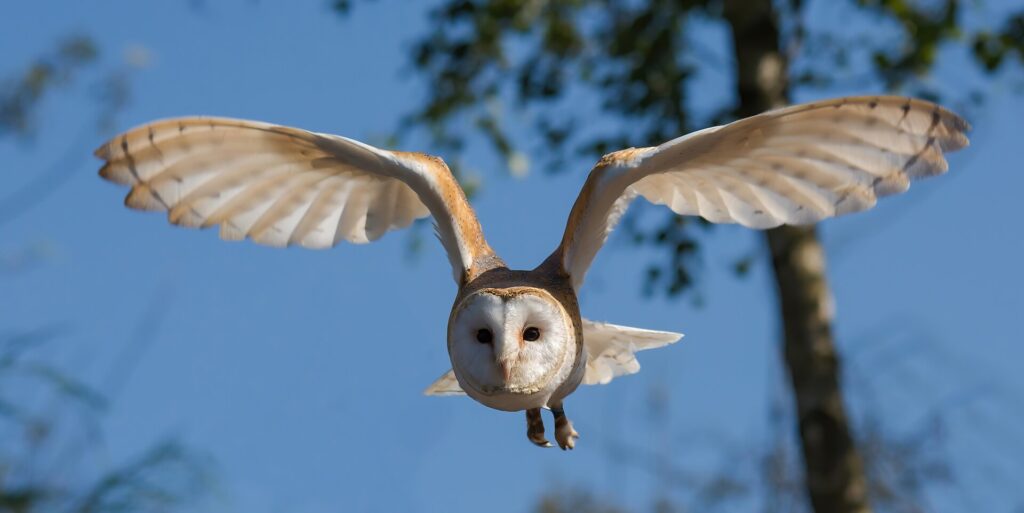
| Barn owl | 12.6–15.8 in long, 39–49 in wingspan (Cornell Lab) | Heart-shaped white face, dark eyes, no ear tufts; can look all white at night | A long, harsh 2-second scream; hisses at the nest; no hoot | Cavities, barns, silos, steeples, nest boxes; builds no real nest |
| Great horned owl | 18–24 in long (Audubon) | Big “ear” tufts, white throat | “Series of low, sonorous, far-carrying hoots” | Old nests of hawks, crows, herons, usually 20–60 ft up |
| Barred owl | Large (Audubon) | Round head, dark eyes, no ear tufts; bars across the chest, stripes down the belly | Barking “hoo, hoo, hoo-hoo; hoo, hoo; hoo, hooo-aw!” | Large tree hollows, broken snags, old hawk or squirrel nests |
| Eastern screech-owl | About 10 in, “about the size of a Robin” (Audubon) | Short ear tufts; gray, red or brown | “A tremulous, descending wail; soft purrs and trills”; whinnies, not screeches | Tree cavities, old woodpecker holes, nest boxes; common in city parks and suburbs |
One more field mark: the build. All About Birds describes long, rounded wings, a short tail and long legs, with a buoyant, looping flight. The barn owl is “larger than a screech-owl, but smaller than a Great Horned Owl,” and weighs only 14 to 25 ounces, less than it looks. (That gap between apparent size and real weight is why a soaked owl looks so skinny.)
The rat poison problem, and the Flaco connection
Almost everyone quoted about the owls raised the same worry. Barn owls eat “mostly rodents,” according to Audubon, and in Manhattan that means rats and mice, some of which have eaten poison bait. Wilson told CBS that owls eating poisoned rodents risk secondary poisoning, and Smithsonian quotes her warning that an owl eating several rats a day could die that way.
New Yorkers have seen this before. Smithsonian connects the new family to Flaco, the Eurasian eagle-owl that lived wild in the city until he died in 2024 after hitting a building; a necropsy found rodenticides in his system. The city later passed what is known as Flaco’s Law, which Smithsonian says includes a pilot program for contraceptive-based rat control. Whether the Upper West Side owls avoid the same fate is the open question hanging over every photo of them. For more on what owls hunt, see our guide to what owls eat.
Could a barn owl show up near you?
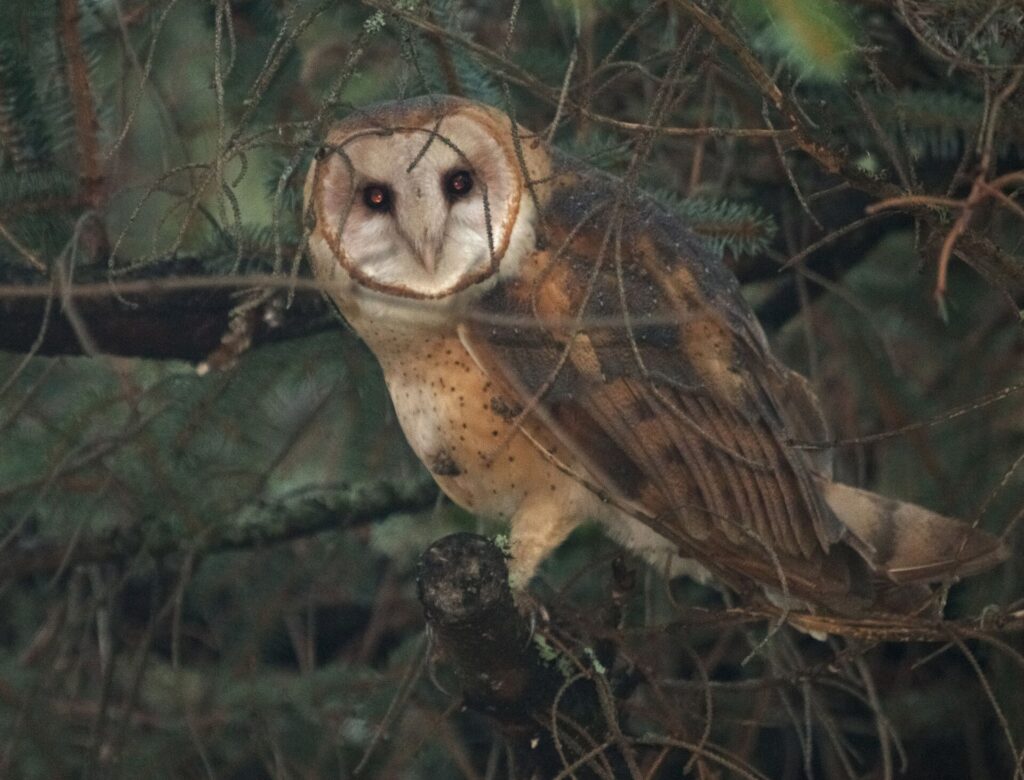
Across most of the United States, yes, and far more easily than in Manhattan. Audubon describes the barn owl as a bird of “open or semi-open country in lowlands” that may nest in forests or cities if there is open foraging land nearby. Farm country, marsh edges and big grassy parks are the kinds of places it hunts. It is active at night, so you are more likely to hear it than see it.
Barn owls are also famously good at what they do. All About Birds says their ability to find prey by sound alone is “the best of any animal that has ever been tested,” and that they can catch mice in complete darkness. They swallow prey whole and cough up pellets about twice a day, so a pile of furry gray pellets under a barn beam is a strong sign one roosts there.
If you live near open land, a nest box is the most practical way to invite one. Audubon says nest boxes appear to help barn owls in some areas, and All About Birds recommends putting a box up well before breeding season with a predator guard on it. Our guide to birdhouses and roosting boxes covers box placement for cavity nesters in general.
FAQ
Where exactly are the Manhattan barn owls? In a water tower on top of a building on West 75th Street near Central Park West, according to the AP. CBS New York reported the location as near 76th Street and Central Park West; the two reports describe the same block.
How many owls are there? Reports range from five to eight. The AP says at least one adult and five fledglings have been seen, with two adults believed present; CBS New York says two adults and up to six young. No source has given a confirmed total.
Are barn owls endangered? Not globally. Audubon lists the species as low concern and says numbers have “declined slightly in some regions, drastically in others.” In New York, the AP reports, the state conservation department says the population has declined at an alarming rate.
Is a barn owl the same as a screech-owl? No. A barn owl is a mid-sized, pale, heart-faced owl that screams. An eastern screech-owl is a robin-sized owl with ear tufts that whinnies and trills, and Audubon notes that despite the name it does not screech.
Bottom line
The Upper West Side barn owls are a first for Manhattan, not a first for barn owls. The species lives on six continents and across most of the lower 48, but it is scarce in New York, needs open land to hunt, and has never been recorded nesting in the borough. Add a heart-shaped face, a scream instead of a hoot, nightly crowds on the sidewalk and the memory of Flaco, and you have the bird story of the week. If you hear a long, raspy shriek in your own neighborhood some night this fall, step outside and look up.