A “wet owl” is just an owl that has been soaked by rain or a bath, and the reason it looks so shockingly skinny is that a dry owl is mostly fluff. Owl feathers are unusually soft, built for silence and warmth rather than for shedding water, so when they get drenched they flatten against the body and show how slim the bird underneath really is. The viral “wet owl” photos are funny, but they are also a real look at owl anatomy. Here’s what is going on, which owls you’re likely to see this way, and what to do if you ever find one soaked in your yard.
The short version
- What it is: any owl whose feathers are soaked flat, usually by rain, a storm or a bath. It’s not a species.
- Why it looks so thin: owls carry a lot of soft, fluffy plumage. Wet, it collapses, and the body is much smaller than the dry bird suggests.
- Why owls get so wet: the same soft, velvety feathers that make owls silent fliers are not as waterproof as many other birds’ feathers.
- Is it in danger? A wet owl that is perched and alert may just be drying off. A soaked owl on the ground that can’t fly may need help from a licensed wildlife rehabilitator.
- Can you see one in the US? Yes. Great horned owls live in backyards and cities across the country, and some owls bathe in backyard bird baths.
How much does an owl really weigh?
The fastest way to understand a wet owl is to look at how little a dry one weighs. We pulled the published measurements for eight U.S. owls from the Cornell Lab of Ornithology’s All About Birds species pages and charted them. A great horned owl can stand nearly two feet tall and spread its wings close to five feet, yet it tops out around 5.5 pounds. An American barn owl, with wings up to about 49 inches across, weighs no more than about a pound and a half. That gap between how big an owl looks and how much it weighs is mostly feathers, and it’s exactly what a soaking reveals.
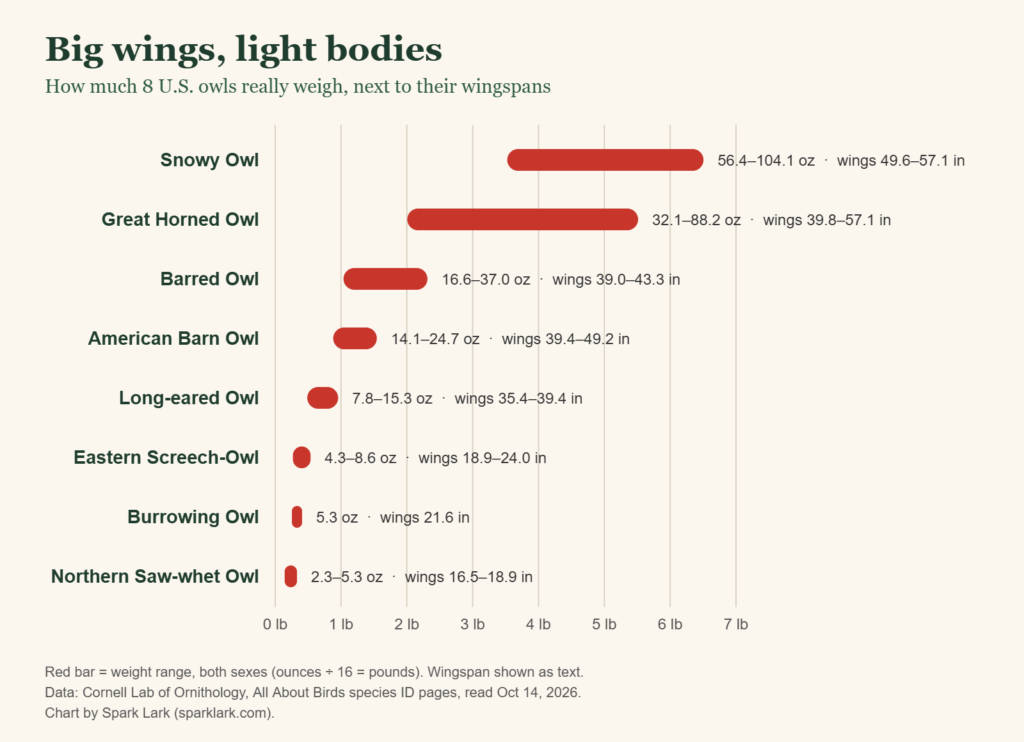
| Owl | Length | Wingspan | Weight | Heaviest, in pounds |
|---|---|---|---|---|
| Snowy owl | 20.5–27.9 in | 49.6–57.1 in | 56.4–104.1 oz | 6.5 lb |
| Great horned owl | 18.1–24.8 in | 39.8–57.1 in | 32.1–88.2 oz | 5.5 lb |
| Barred owl | 16.9–19.7 in | 39.0–43.3 in | 16.6–37.0 oz | 2.3 lb |
| American barn owl | 12.6–15.8 in | 39.4–49.2 in | 14.1–24.7 oz | 1.5 lb |
| Long-eared owl | 13.8–15.8 in | 35.4–39.4 in | 7.8–15.3 oz | 1.0 lb |
| Eastern screech-owl | 6.3–9.8 in | 18.9–24.0 in | 4.3–8.6 oz | 0.5 lb |
| Burrowing owl | 7.5–9.8 in | 21.6 in | 5.3 oz | 0.3 lb |
| Northern saw-whet owl | 7.1–8.3 in | 16.5–18.9 in | 2.3–5.3 oz | 0.3 lb |
Source: Cornell Lab of Ornithology, All About Birds “ID” pages for each species, both sexes, read October 14, 2026. Method: the top of each weight range divided by 16 and rounded to one decimal place.
Look at the barn owl and the barred owl side by side: the barn owl’s wings can be wider, but it weighs less. Owls have large wings for their body weight, which lets them fly slowly with little flapping, according to Audubon. All of that wing and body surface is covered in soft feathers, so a dry owl reads as a big, round bird. Wet, you see the frame.
Why owl feathers soak through
Most birds shed water thanks to the structure of their feathers. Each feather vane is made of barbs that carry smaller barbules, and tiny hooks lock neighboring barbules together, forming a barrier against wind and water, as KQED Science explains. Preening realigns that structure, and birds also spread oil from a gland near the tail over their feathers. A 2024 review in the Journal of Avian Biology (Muzio and Rubega, highlighted by the University of Connecticut) stresses that the barbule structure itself does much of the water-repelling work.
Owls trade some of that for silence. Audubon describes three features that make owl flight nearly noiseless: comb-like serrations on the leading edge of the wing feathers, a soft fringe on the trailing edge, and “a velvety texture unique to owl feathers.” The Cornell Lab notes that great horned owl feathers are very soft, which keeps the birds warm and lets them fly quietly. The cost shows up in bad weather. WildCare, a wildlife hospital in Marin County, California, says an owl’s soft wing feathers are “not as waterproof as other feathers,” and the Barn Owl Trust in the U.K. calls barn owl plumage “not particularly waterproof.”
That’s why a rain-soaked owl looks so dramatic. Its plush, airy plumage soaks through more easily than many birds’ feathers, goes flat and clings, and the “big round owl” shrinks to a narrow, bony-looking bird with a face that suddenly seems too large.
Where the “wet owl” meme came from
The best-known wet owl picture traces back to filmmaker David Hoffman, who posted it after he and his wife found a drenched owl at Elkhorn Slough in Northern California following a rainstorm, according to a July 2024 explainer from the Daily Dot. The image spread on Tumblr and X, then TikTok, where people pasted the soggy, wide-eyed owl into everything from movie posters to app ads. Some viewers found it creepy, others adorable. The Daily Dot piece does not name the species, and we haven’t found a source that does, so we won’t guess.
Real wet owls make the news, too. In May 2022, Colorado Parks and Wildlife officers rescued a young owl in Fountain, Colorado, after a stretch of wild weather. A CPW spokesman told CBS Colorado the owlet “was just soaked and looked terrible.” It wasn’t injured, and the officers put it back up in its tree.
Which owls you’re most likely to see wet
Any owl can get soaked. These four U.S. owls are good examples of the look:
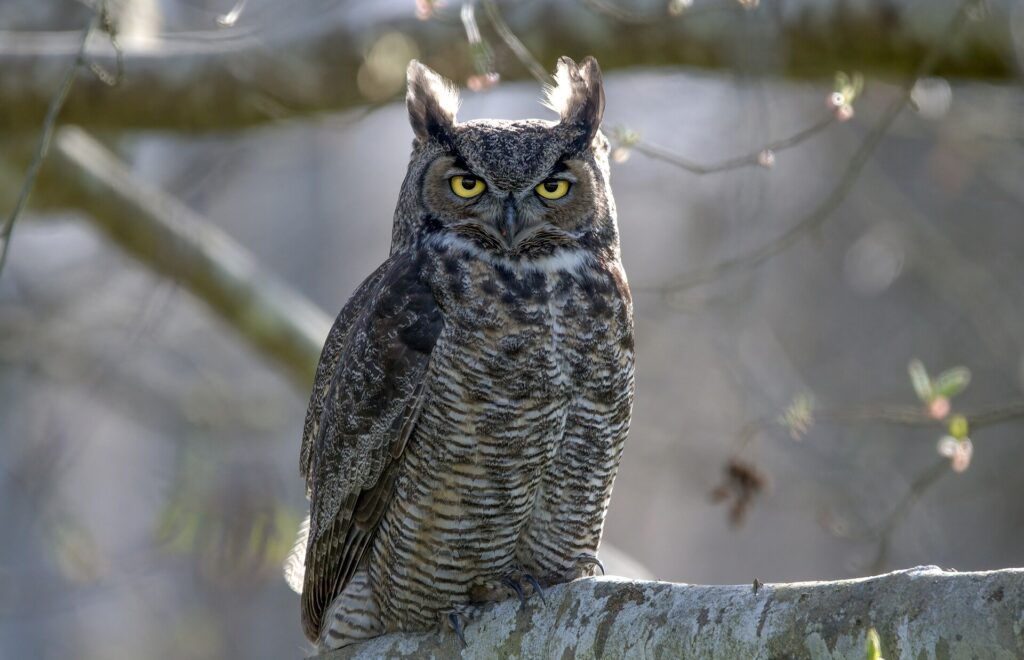
- Great horned owl. The Cornell Lab calls it one of the most common owls in North America, at home in deserts, wetlands, forests, backyards and cities. Dry, it’s a hefty, thick-bodied bird with ear tufts. Wet, it looks startlingly thin.
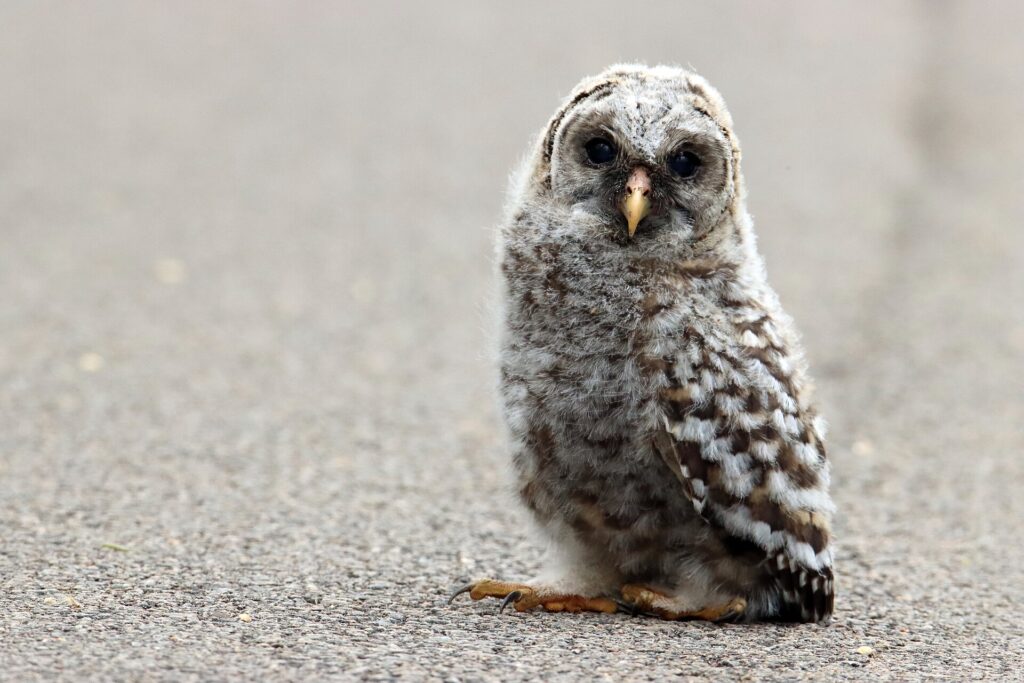
- Barred owl. A round-headed brown-and-white owl. Its fledglings are covered in fluffy juvenile feathers and leave the nest before they can fly, according to the U.S. Fish and Wildlife Service, so a young barred owl caught in a storm is a classic “wet owl” look.
- Barn owl. Pale, lanky and nocturnal, it hunts open fields. Its plumage is the one specifically described as not very waterproof, and the Barn Owl Trust says barn owls tend to avoid hunting in the rain because wet feathers make more noise.
- Screech-owls. Small enough to use a backyard nest box and a bird bath. Sacramento Audubon members described a western screech-owl that flopped into a backyard bird bath, then later bathed fully, fluffing and soaking its feathers.
Can you see one in the US?
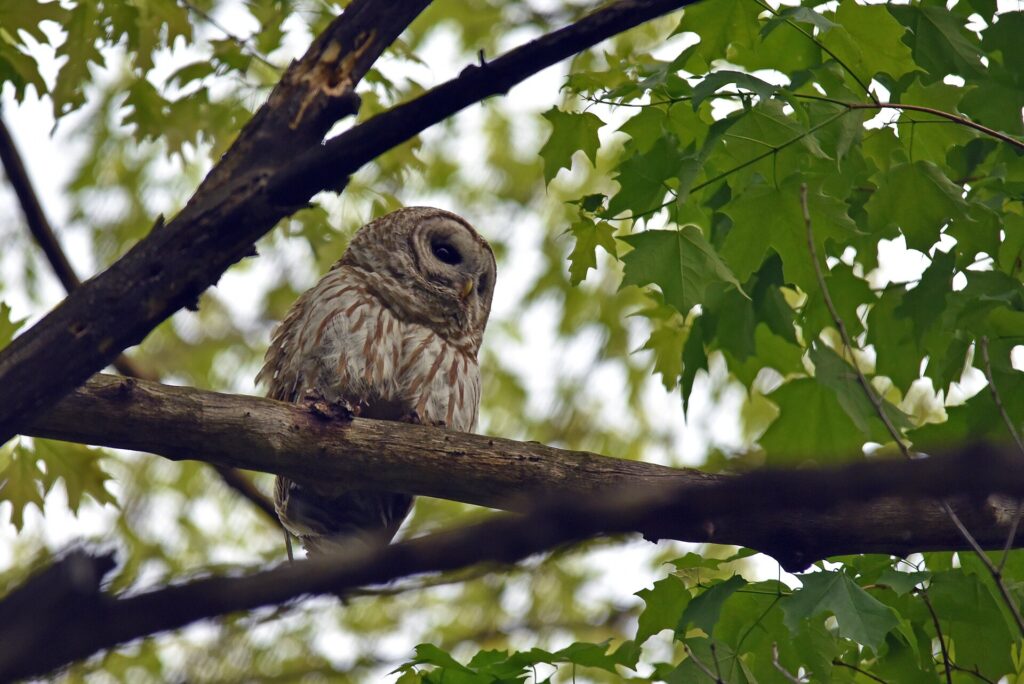
Yes, and you don’t need a zoo. The owls in the chart above all live in the U.S., and great horned owls are found from the Arctic to the tropics, including in towns and cities. Your best chances of seeing a wet owl:
- Right after a storm. Both the Elkhorn Slough owl and the Colorado owlet were found after heavy rain or rough weather.
- At a bird bath. The Sacramento Audubon observers thought heat and drought may push birds to bathe more, and suspected owls bathe mostly at night, when people aren’t watching. A bird camera aimed at your bath is the easiest way to catch it.
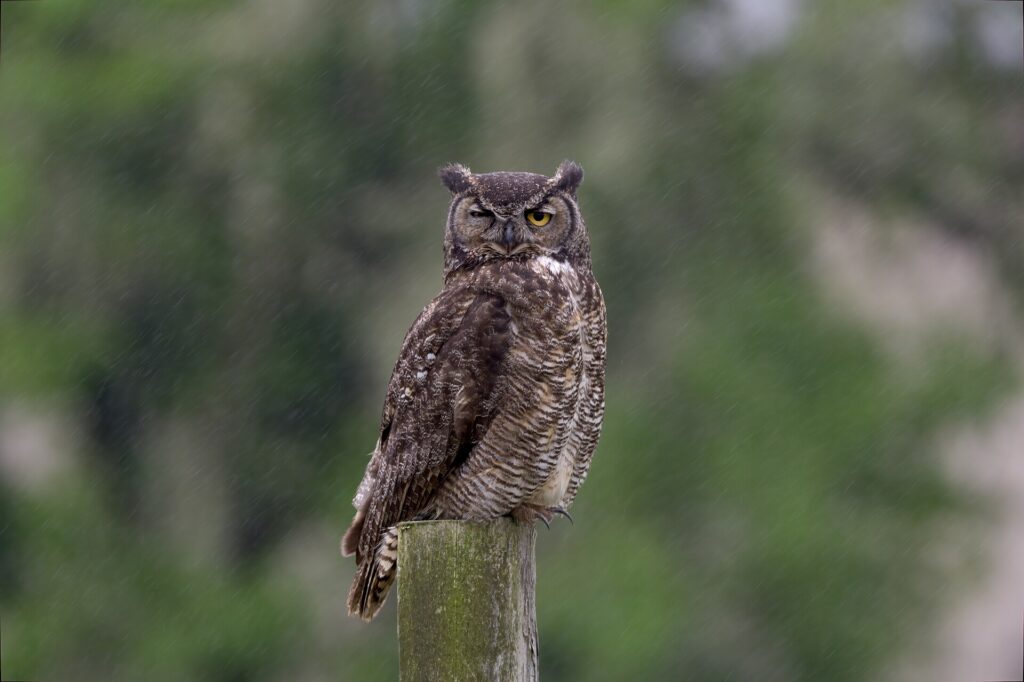
- On wildlife refuges. Most of the owl photos on this page were taken on National Wildlife Refuges. At Julia Butler Hansen Refuge in Washington, where the rainy owl at the top was photographed, the Fish and Wildlife Service says great horned owls are often heard calling in late winter as they prepare to nest.
If you want owls and other birds using your water, our bird bath guide covers depth and placement, and in winter a heated bird bath keeps open water available when everything else is frozen. (Our tips on keeping a bird bath from freezing cover the no-electricity options.)
Found a soaked owl? What to do
A wet owl that is perched and alert may simply be waiting for its feathers to dry; the Colorado owlet above was soaked but uninjured. The concern is an owl on the ground that is soaked and can’t fly. WildCare notes that rain chills birds, that young, sick or injured birds are most at risk, and that wet owls struggle to fly and hunt, since heavy rain also muffles the sounds of prey.
- Check whether it’s a fledgling. The U.S. Fish and Wildlife Service explains that barred owl fledglings leave the nest at about 4 to 5 weeks, before they can fly, and may end up on the ground. Their parents are usually nearby and still feeding them.
- Watch from a distance and keep pets inside. As Colorado Parks and Wildlife put it, young owls “usually climb back up the tree.”
- Call for help before handling it if the owl is injured, out in the open in cold rain, or grounded with no sign of parents nearby. Contact a licensed wildlife rehabilitator or your state wildlife agency. Don’t grab it: the Cornell Lab notes it takes 28 pounds of force to open a great horned owl’s clenched talons.
FAQ
Is “wet owl” a type of owl? No. It’s a nickname for any owl photographed while soaked. The viral photo’s species hasn’t been identified in the sources we read.
Why do wet owls look so skinny? Because owls have a lot of soft, fluffy plumage over a fairly light body. A great horned owl that can be two feet long weighs at most about 5.5 pounds. When the feathers are soaked flat, you see the real outline.
Are owls waterproof? Less than many birds. Their velvety, fringed feathers are built for silent flight, and wildlife groups describe owl feathers as not as waterproof as other birds’ feathers.
Do owls take baths? Yes, at least some do. Sacramento Audubon observers recorded a western screech-owl bathing in a backyard bird bath, and they suspect owls bathe mostly at night.
Can owls fly when wet? Not well. Soaked feathers make flight harder and noisier, which is why barn owls tend to avoid hunting in the rain.
Bottom line
The wet owl isn’t a strange species. It’s an ordinary owl whose soft, silent-flight feathers have soaked through, revealing how small and light the bird under all that fluff really is. A great horned owl that looks like a feathered barrel weighs a few pounds at most, and a barn owl with wings up to about four feet across weighs no more than about a pound and a half. If you see a wet owl in a tree, enjoy the rare look. If you find a soaked one on the ground that can’t fly, give it space and call a wildlife rehabilitator. Curious what keeps all those feathers fueled? See what owls eat, or meet another internet-famous fluffball, the shima enaga.