Spark Lark is reader-supported. As an Amazon Associate we earn from qualifying purchases, at no extra cost to you. How we choose products.
The best birdhouse is the one built for the bird you want: the right entrance size, thick unpainted wood or weatherproof poly, drainage and vents, no perch, and a door that opens for cleaning. A winter roosting box is different. It has its hole near the bottom, perches inside and fewer vents, so a group of small birds can hold in their body heat on cold nights.
Fall is a good time to put both up. Birds can use a box for shelter this winter, and it will already be in place when nesting season starts. Cornell’s NestWatch says to have nest boxes up by February in the South and by mid to late March in the North.
The short version
- Best overall bluebird box: Nature’s Way CWH3 Cedar Bluebird Box. Cedar, a clean-out door and a raised mesh floor.
- Best wood box for serious bluebirders: WHITEHORSE Bluebird House. 3/4-inch cedar, a recessed floor and a double entrance guard.
- Premium pick with pole: JCs Wildlife Ultimate Bluebird House and Universal Pole Kit. Poly lumber house plus a galvanized pole.
- Best weatherproof poly box: DutchCrafters Gilbertson Bluebird House. A poly box with a removable base.
- Best winter roosting box: Coveside Small Winter Roost. A bottom entrance, three perches inside and 1-inch pine walls.
- Best for wrens and chickadees: Nature’s Way CWH1 Cedar Wren House. A small cedar box with a 1⅛-inch hole.
- Best owl box: JCs Wildlife Screech Owl House. Sized for screech owls and saw-whet owls.
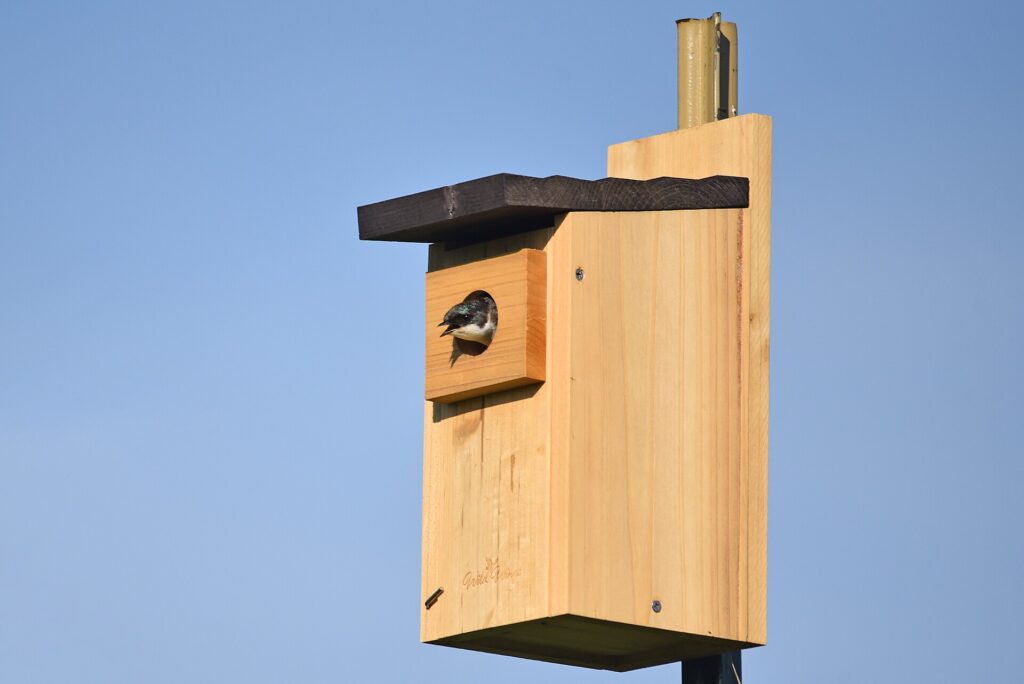
How to choose a birdhouse
Cornell’s NestWatch keeps a checklist of what makes a good birdhouse. These are the points that matter most when you’re shopping instead of building:
- Untreated, unpainted wood (or poly lumber). NestWatch recommends untreated cedar, pine or cypress, with walls at least 3/4 inch thick to insulate the nest. Some boxes below use recycled poly lumber instead; JCs Wildlife says its poly lumber won’t crack, split or fade.
- A roof that overhangs. NestWatch suggests a sloped roof that overhangs the front by 2 to 4 inches to keep out driving rain.
- Drainage and vents. Look for holes in the floor and vent holes near the top of the side walls.
- No perch. Birds don’t need one. NestWatch says a perch “can actually help predators gain access to the box.”
- A door that opens. A hinged side or front lets you check and clean the box.
- The right hole. This decides who moves in. See the table below.
Entrance hole sizes by bird
These are the entrance sizes in NestWatch’s species plans. NestWatch notes that 1¼ inches is the smallest hole house sparrows can fit through, so a bluebird-size hole won’t keep them out, and 1 9/16 inches is the smallest European starlings can use.
On a phone, swipe the table sideways to see all three columns.
| Bird | Entrance hole (NestWatch) | Box height from ground (NestWatch) |
|---|---|---|
| House wren | 1 inch | 5–10 ft |
| Black-capped and Carolina chickadees | 1⅛ inches | 4–15 ft (Carolina), 5–15 ft (black-capped) |
| Tufted titmouse | 1¼ inches | 5–15 ft |
| White-breasted nuthatch | 1¼ inches | 5–20 ft |
| Tree swallow | 1⅜ inches | 5–6 ft |
| Western bluebird | 1½ inches | 4–6 ft |
| Mountain bluebird | 1 9/16 inches | 4–6 ft |
| Eastern screech-owl | 3 inches | 10–30 ft |
Every bluebird box below has a 1½-inch hole, the size in NestWatch’s western bluebird plan. For any other bird, NestWatch’s free plans list the right size for your species.
What makes a winter roosting box different
Birds only nest in spring and summer, but some use boxes for shelter all winter. The Cornell Lab names bluebirds, chickadees, titmice, nuthatches and small woodpeckers as birds that may use a roost box, and notes that sometimes more than a dozen birds pile into one box to stay warm.
According to the Cornell Lab, a roost box differs from a nest box in four ways:
- The entrance is near the bottom, so rising warm air stays inside.
- It has fewer ventilation holes.
- Several perches are staggered inside, since roosting birds perch or cling rather than sit in a nest.
- The inside walls are rough so woodpeckers can grip them.
For the hole, Cornell says about 2 inches admits most small birds, and about 1½ inches keeps out starlings. Mount it on a pole or post with a metal baffle below, out of the prevailing wind. As Cornell puts it, “South-facing boxes receive the most warmth from the winter sun.”
You don’t have to buy a separate box. Cornell notes that some people turn a nest box’s front panel around so the hole is at the bottom, add twigs for perches, and plug some of the vent holes for winter.
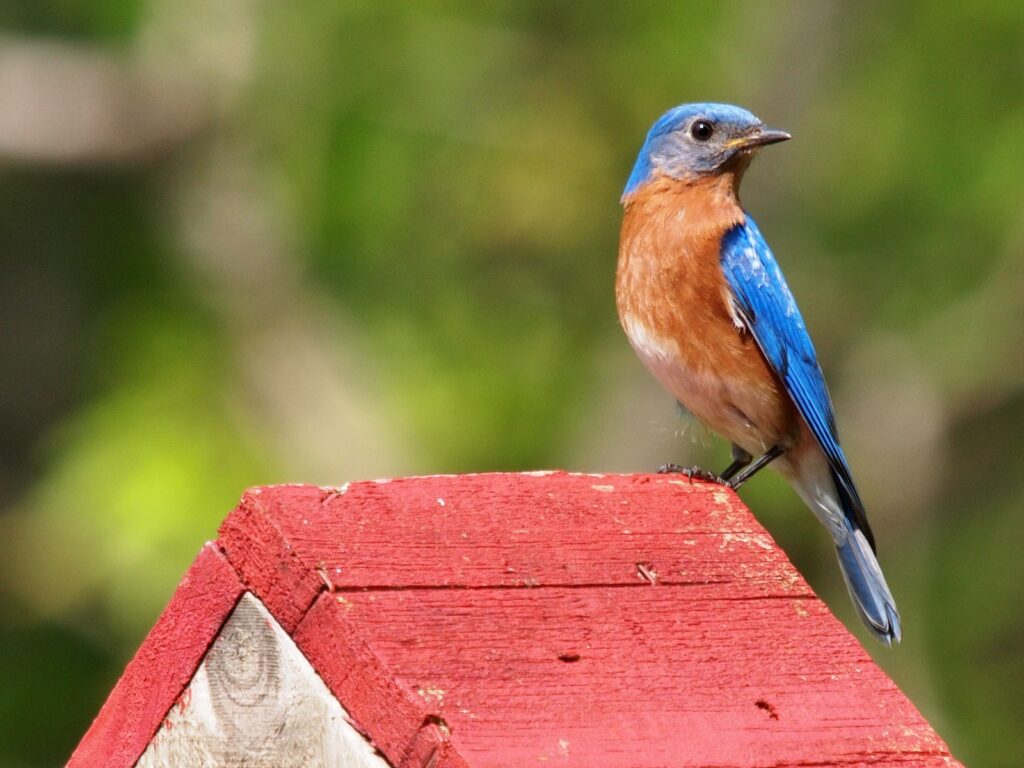
The best birdhouses and roosting boxes
1. Nature’s Way CWH3 Cedar Bluebird Box — best overall bluebird box
Cedar · 1½-inch entrance with predator guard · clean-out door · elevated galvanized mesh floor · wall and floor vents · fledgling kerfs · stainless-steel hardware · about 12 x 8 x 5.5 in
This box checks most of the NestWatch list in one package. It’s rot-resistant cedar with stainless hardware, it vents through the walls and floor, and the front opens for cleaning. It adds a raised wire-mesh floor that Nature’s Way says helps manage blowfly, and shallow cuts (kerfs) inside the front that give fledglings a grip to climb out, which NestWatch also recommends. The added block around the hole makes the entrance deeper.
Downside: Nature’s Way doesn’t list the wall thickness, so you can’t check it against NestWatch’s 3/4-inch guideline before you buy. It’s also vented for summer; plug a few vents in winter if you want it to double as a roost.
2. WHITEHORSE Bluebird House — best wood box for serious bluebirders
3/4-inch cedar · 1½-inch entrance · stainless-steel hole guard plus 1-inch wooden guard · door and floor recessed 3/4 inch · angled vents · floor drain holes · bottom-hinged door · 15-inch house
WHITEHORSE says this box is built to the North American Bluebird Society’s specs and inspired by the Gilwood and XBOX bluebird box designs. The walls are the 3/4-inch thickness NestWatch asks for, the vents are cut at an upward angle to shed rain, and the floor sits up from the bottom edge to keep the nest dry. WHITEHORSE says the metal ring protects the hole from squirrels and woodpeckers, and the thick wooden block makes it harder for a cat or raccoon to reach in.
Downside: the floor is small, 4.25 by 3.5 inches. That’s the point of this design, but it’s much smaller than the 5½-inch floor in NestWatch’s bluebird plan, so it’s a box for bluebird fans who know the trade-off.
3. JCs Wildlife Ultimate Bluebird House and Universal Pole Kit — premium pick with pole
Recycled poly lumber · 1½-inch entrance with built-in predator guard · side view door with acrylic window · clean-out door · galvanized pole with ground auger and universal mounting flange · made in the USA
NestWatch recommends mounting nest boxes on a metal pole rather than trees or fence posts, and this kit includes a rust-resistant galvanized pole that augers into the ground, plus a flange that mounts the house on top or on the side. JCs Wildlife says the poly lumber won’t crack, split or fade, and the view door lets you look in through a window without letting the nestlings out.
Downside: it’s the priciest pick here. And a bare pole doesn’t stop climbing predators, so add a baffle, as NestWatch advises. Our squirrel baffle guide and feeder pole guide cover pole-mounted baffles.
4. DutchCrafters Gilbertson Bluebird House — best weatherproof poly box
Recycled HDPE poly roof and PVC body · 1½-inch entrance · 8-inch-deep cavity · inner grooves for fledglings · base removes for cleaning · fits a 1/2-inch pole (not included) · handmade in Indiana
DutchCrafters says the round body is designed to resemble a birch tree so it blends into the yard. It says the base pulls off for cleaning and monitoring, and the inside has grooves so young birds can climb out. The maker also says it’s sturdy enough to use as a winter house or roosting box.
Downside: it’s plastic rather than the 3/4-inch wood NestWatch recommends, and you need to supply a 1/2-inch pole.
5. Coveside Small Winter Roost — best winter roosting box
1-inch-thick eastern white pine · 1½-inch entrance near the bottom with a slate guard · three perches inside · swing-open front · about 12.5 x 9 x 7 in · handcrafted in Maine
This is a true roost box, built the way the Cornell Lab describes: the hole is low and the perches are inside. The walls are 1-inch pine. Coveside says the three perches hold six or more birds at once and lists wrens, chickadees, titmice and bluebirds as users. The 1½-inch hole is the size Cornell gives for keeping starlings out, and the slate plate keeps squirrels and woodpeckers from widening it.
Downside: it’s a premium price for a box that isn’t meant for nesting, and there’s no guarantee birds will find it the first winter. Put it up on a baffled pole facing south, out of the wind.
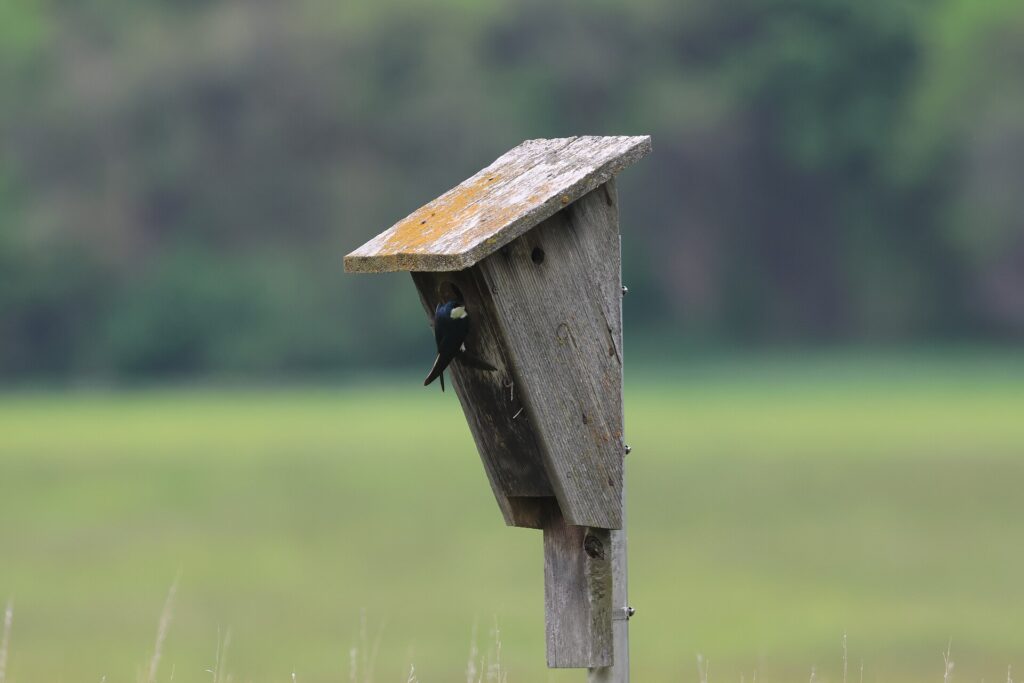
6. Nature’s Way CWH1 Cedar Wren House — best for wrens and chickadees
Cedar · 1⅛-inch entrance · wall and floor vents · stainless-steel hardware · hanging cable · about 8 x 8.9 x 8.1 in
A 1⅛-inch hole is the size NestWatch lists for chickadees, and Nature’s Way says it keeps out sparrows and larger birds. House wrens fit through it too. It’s a simple, budget cedar box. If chickadees are your goal, our guide to the small gray bird with a black cap helps you confirm who’s visiting.
Downside: it hangs from a cable, while NestWatch recommends a metal pole with a baffle. Mount it on a baffled pole if you can.
7. JCs Wildlife Screech Owl House — best owl box
Cedar body · recycled poly lumber roof · 12 W x 14 H x 10.5 D in · entrance sized for screech owls and saw-whet owls · drain holes · vents under the roof · front swings up for cleaning · pine shavings included · handmade in Indiana
NestWatch publishes a nest box plan for eastern screech-owls with a 3-inch hole, and Cornell says larger woodland birds such as flickers and screech-owls need a 3-inch entrance hole in a roost box. This cedar box comes ready to mount, with drainage, ventilation and a front door that opens without taking the box down. JCs Wildlife recommends mounting it 10 to 20 feet high in a large tree; NestWatch’s screech-owl plan lists 10 to 30 feet.
Downside: mounting it takes a tall ladder, and an owl box is a long-term bet. It also needs wooded habitat nearby.
Side by side
On a phone, swipe the table sideways to see all five columns.
| Box | Best for | Entrance | Material | Cleaning access |
|---|---|---|---|---|
| Nature’s Way CWH3 | Bluebirds | 1½ in, guarded | Cedar | Clean-out door |
| WHITEHORSE | Bluebirds | 1½ in, double guard | 3/4-in cedar | Bottom-hinged door |
| JCs Wildlife Ultimate + pole | Bluebirds | 1½ in, guarded | Poly lumber | Clean-out door, view window |
| DutchCrafters Gilbertson | Bluebirds | 1½ in | PVC body, poly roof | Removable base |
| Coveside Small Winter Roost | Winter roosting | 1½ in, low, slate guard | 1-in pine | Swing-open front |
| Nature’s Way CWH1 | Wrens, chickadees | 1⅛ in | Cedar | Not listed |
| JCs Wildlife Screech Owl | Screech and saw-whet owls | Owl-sized | Cedar, poly roof | Front swings up |
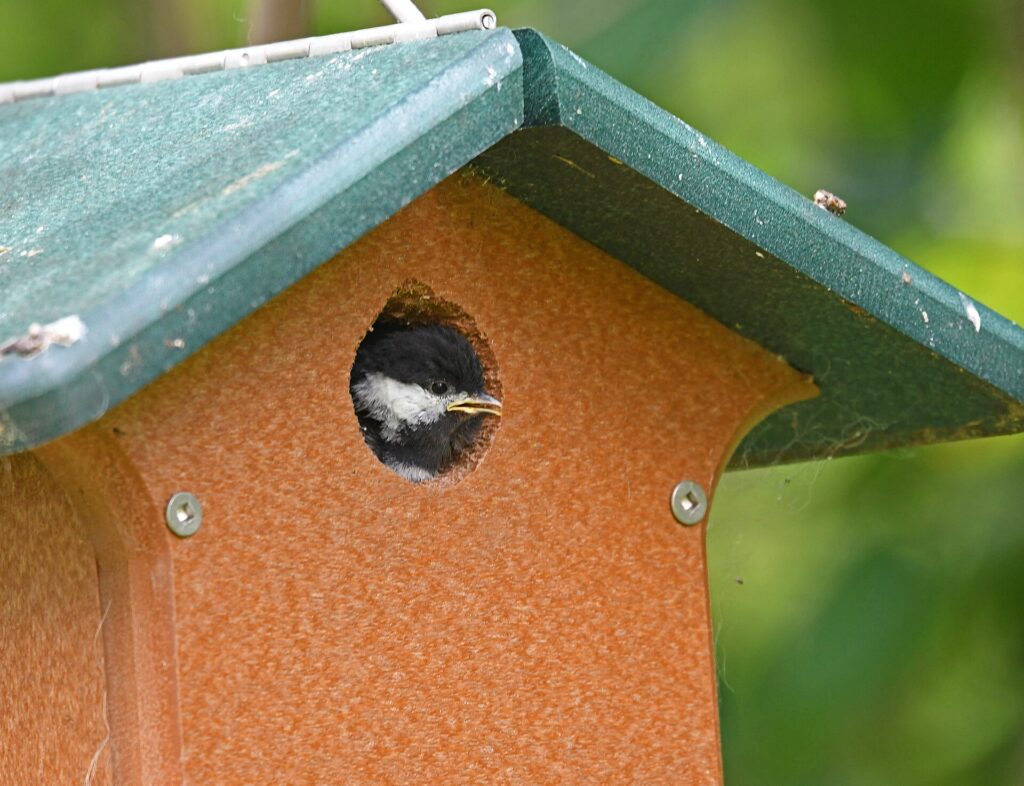
Tips for putting up a birdhouse
- Use a metal pole and a baffle. NestWatch advises against mounting nest boxes on trees or fence posts, where climbing predators reach them easily.
- Face it the right way. NestWatch says eastern bluebird boxes should face open habitat, ideally east; a chickadee box should face away from the prevailing wind; a winter roost box does best facing south.
- Watch for sparrows and starlings. Both are non-native and compete for boxes. Our guide on keeping starlings off suet and mealworm feeders covers them at the feeder.
- Clean it between nests. NestWatch advises cleaning out a bluebird box as soon as a brood fledges so the pair can nest again.
FAQ
Should I take my birdhouse down in winter? No need. The Cornell Lab says some birds use nest boxes to roost in after the breeding season, and leaving a box up means it’s ready for spring.
Should a birdhouse have a perch? No. NestWatch says birds don’t need one, and a perch can help predators get in.
Bottom line
For most backyards, start with the Nature’s Way CWH3 cedar bluebird box on a metal pole with a baffle. If you want the most complete setup, the JCs Wildlife Ultimate comes with its own pole. For winter, add the Coveside roost box facing south. Add a bluebird feeder nearby and you give bluebirds a reason to stay. Not sure which birds are around? Our free, printable backyard bird ID chart can help.