Birds crash into windows because they can’t see glass. A window that reflects trees and sky looks like more trees and sky, and a clear window with plants or another window behind it looks like an open path. The bird flies at what it thinks is habitat and hits a hard, invisible wall. It happens at homes far more than at skyscrapers, and most of it can be prevented with markings on the outside of the glass, spaced about 2 inches apart. Here is why it happens, which windows are most dangerous, what actually works, and what to do if a bird hits your window.
The short version
- Why it happens: reflections of vegetation or sky, or a see-through view to plants or daylight on the other side of the glass.
- When: any time of day or year, but most often at dawn and dusk during spring and fall migration.
- How many: a 2014 study estimated 365 to 988 million birds die from building collisions in the U.S. each year, and about 44% of those deaths happen at homes.
- What works: markings on the outside of the glass, spaced about 2 inches apart across the whole window, or outside screens, cords or films that cover it.
- What doesn’t: one or two stickers on a big window, or a single hawk silhouette.
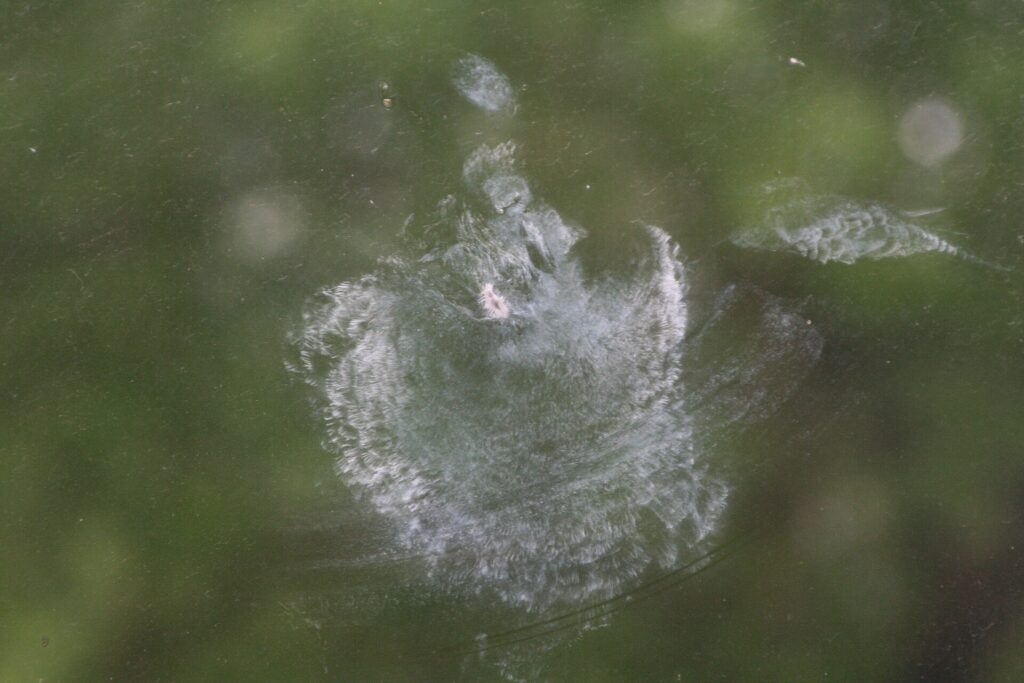
Why birds can’t see windows
To a bird, glass is “worse than invisible,” as the Cornell Lab of Ornithology puts it. There are two ways a window fools a bird:
- Reflection. In daylight, many windows reflect like mirrors from the outside. A bird sees the yard, the trees and the sky reflected in the glass and flies toward them.
- See-through. When a bird can look through the glass to houseplants, or through a room to a window on the other side, the house looks like a gap it can fly through.
The American Bird Conservancy notes that birds can’t see the clear glass used in homes, schools and stores.
When collisions happen most
Collisions can happen at any hour and in any season, but Cornell says they peak at dawn and dusk during spring and fall migration. Many songbirds migrate at night. At dawn they drop into trees and shrubs to rest and feed, and at dusk they take off again. Both trips in and out of cover put them near glass that reflects that same cover.
Night lighting adds to the problem. Bright lights draw migrating birds into towns and cities, especially on foggy or low-cloud nights. Birds that land there may then face reflective windows the next morning. That is why many U.S. cities now run “Lights Out” programs during migration.
How many birds die from window strikes
The most-cited estimate comes from a 2014 study in The Condor by Scott Loss and colleagues, which pulled together 23 studies and more than 92,000 fatality records. It estimated that 365 to 988 million birds (median 599 million) are killed by building collisions in the U.S. each year. The American Bird Conservancy now puts the yearly toll at more than 1 billion.
Two findings from that study matter for anyone with a backyard:
- Homes are a big part of it. About 44% of the deaths were at residences and about 56% at low-rise buildings. High-rises accounted for less than 1%, because there are far fewer of them.
- Only cats kill more. Building collisions ranked second only to outdoor cats among the direct human-related causes of bird deaths in the U.S.
Do birds survive hitting a window?
Often not, even when they fly off. Cornell notes that many birds that seem only stunned die later from internal bleeding or bruising, especially to the brain. Daniel Klem, a Muhlenberg College researcher who has studied window collisions since the 1970s, calls glass “an indiscriminate killer that takes the fit as well as the unfit of a species’ population.”
That is why prevention matters more than rescue. A window that birds can see is the only reliable fix.
Why a bird keeps attacking the same window
A robin or cardinal that taps or flies at the same window again and again is doing something different. It is fighting its own reflection, which it takes for a rival. Cornell calls this “reflection aggression.” It is most common in spring, when birds are defending territories. It is annoying, but it is seldom a threat to the bird. The same fixes that prevent collisions usually stop it, because they break up the reflection.
Which of your windows are most dangerous
Go outside and look at your windows the way a bird would. If you can see branches or sky in the glass, or see straight through the house, a bird sees the same thing. Cornell flags these windows as the riskiest:
- Large picture windows
- Pairs of windows that meet at a corner, at right angles
- Windows with bird feeders outside them
You may have read that feeders should sit either within 3 feet of a window or more than 30 feet away. Christine Sheppard, who directs the American Bird Conservancy’s bird collisions program, told Cornell that this distance advice is no longer considered valid. If a window is near a feeder, make the window bird-friendly instead of moving the feeder. That goes for window feeders too: treat the rest of the glass.
How to stop birds from hitting your windows
The rule behind every fix is the same. Birds need to see that the glass is solid, with gaps between markings too narrow to fly through. Cornell’s guidance is to space markings uniformly about 2 inches apart across the entire outside surface of the glass. That spacing protects even the smallest birds, such as hummingbirds and kinglets. Cornell says all markings go on the outside of the window.
- Soap or tempera paint. The cheapest option. Draw a 2-by-2-inch grid, or any pattern or artwork with gaps no bigger than that, on the outside of the glass. This also makes a good project with kids.
- Decals, tape or sticky notes. These work only when they are spaced closely across most of the glass. One or two stickers on a large window won’t stop collisions, and Cornell says hawk silhouettes do little.
- Dot or tape products. Pre-spaced dot tapes, such as those from Feather Friendly, make the 2-inch spacing easy to get right and last a long time.
- Hanging cords. Rows of cord hung down the outside of the window, sold as Acopian BirdSavers or sometimes called “zen curtains,” can be spaced 4 inches apart because they are easier to see. Cornell uses them at its own headquarters, and you can make your own.
- Outside screens. Insect screens are very effective if they are on the outside of the window and cover the whole pane.
- One-way film. Films such as Collidescape make the window look solid from outside while you can still see out from inside. They also cut some light and heat.
Inside the house, a few habits help too. Keep vertical blinds half closed on problem windows, and close a door or shade so birds can’t see straight through to a window on the far side. If you are replacing windows or building, look at external shutters, awnings or sun shades, and screens that cover the full outside of the glass. The American Bird Conservancy also keeps a database of bird-safe glass and products.
At night, turn off outdoor lights you don’t need, especially during spring and fall migration, and use downward-facing fixtures for the ones you keep.
What to do if a bird hits your window
A dazed bird may have injuries you can’t see, and on the ground it is easy prey for cats. Cornell’s advice is to get it help from a wildlife rehabilitator right away:
- Contain it gently. Approach from behind and cover the bird with both hands. Hold it loosely; don’t close your fingers tightly around its body.
- Box it. Put it in an unwaxed paper bag or a small cardboard box lined with paper towel so it can grip. Close it and set it somewhere dark, quiet and warm, away from children and pets.
- Leave it alone. Don’t handle it, feed it or give it water. Wild birds may see people as predators, so keep stress to a minimum.
- Call a rehabber. Find a wildlife rehabilitator near you and follow their instructions.
- Release only if told to. If the rehabber says to release it, take it to suitable habitat away from buildings and open the box facing cover. If it doesn’t fly well, call them back.
Common questions
Why do birds fly into windows? They see reflected trees and sky, or a clear view through the glass, and think it is open space or habitat.
What does it mean when a bird hits your window? In practical terms, it means that window reflects the yard or lets birds see through it, and it is likely to be hit again. Treat that window first.
Do hawk silhouette stickers work? Not on their own. Cornell says they do little. Any decal works only when the decals are spaced about 2 inches apart across the glass.
Why does a bird keep tapping on my window? It is usually attacking its own reflection, most often in spring. Breaking up the reflection on the outside of the glass usually stops it.
Should I move my feeder away from my windows? Bird-collision experts now say to make the nearby windows bird-friendly instead of relying on feeder distance. While you’re at it, our winter feeder checklist covers the rest of a feeder setup.
Bottom line
Birds hit windows because glass reflects habitat or shows a clear path, and homes account for a large share of the hundreds of millions of collisions each year. Look at your windows from outside, start with the big picture windows and the ones near feeders, and cover the outside of the glass with markings no more than 2 inches apart, cords, screens or one-way film. If a bird does hit, box it, keep it dark and quiet, and call a wildlife rehabilitator.