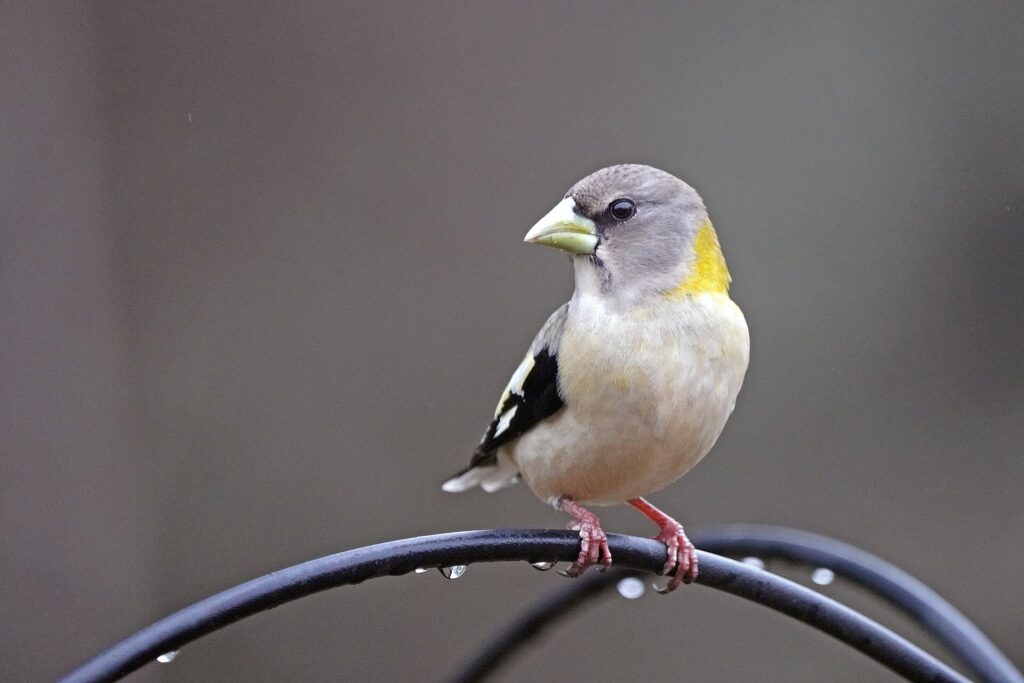
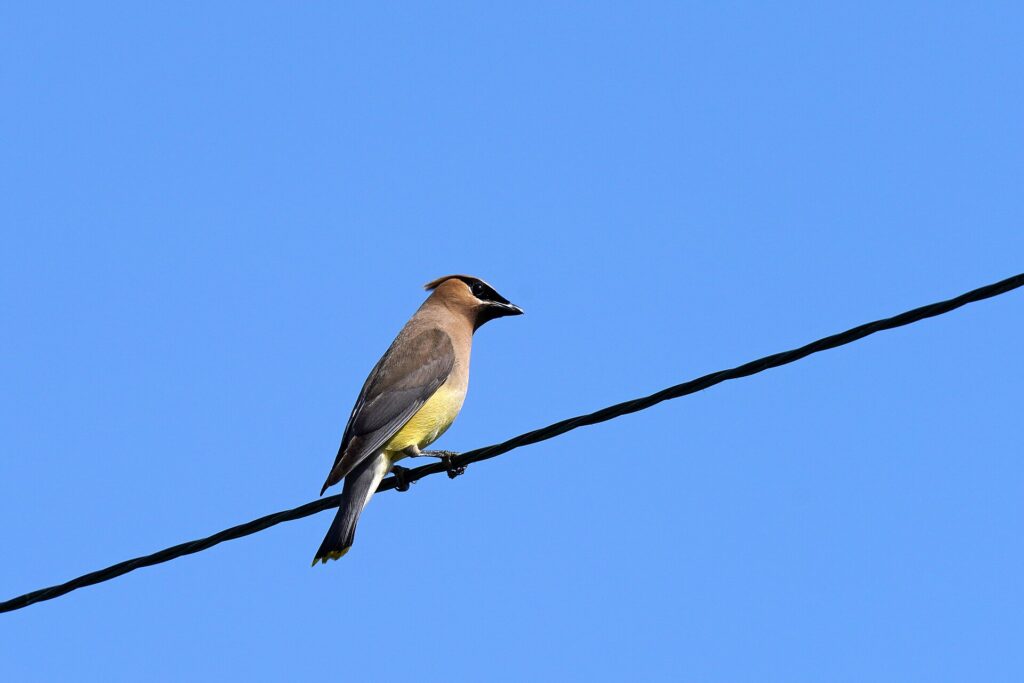
A little gray bird with yellow on it is often a yellow-rumped warbler in fall and winter: drab gray-brown with a bright yellow patch on the rump and a little yellow on the sides. If the yellow is a stripe on top of the head of a tiny bird in the evergreens, it’s a golden-crowned kinglet. A streaky bird with yellow flashing in its wings at the nyjer feeder is a pine siskin, and a sleek, crested bird with a yellow tail tip is a cedar waxwing. A chunky gray finch with a yellowish neck and a very thick bill is a female evening grosbeak. In summer, a bigger gray-headed bird with a lemon-yellow belly is a great crested flycatcher in the East or a western kingbird in the West.
The fastest way to sort them is to look at where the yellow sits. That’s what our chart below is built on.
The short version
- Yellow on the rump, drab gray-brown body, fall or winter: yellow-rumped warbler.
- Yellow stripe on the crown, tiny, in conifers: golden-crowned kinglet.
- Streaky brown, yellow edges on the wings and tail, at a thistle feeder: pine siskin.
- Pale yellow belly, yellow tail tip, black mask, in a flock eating berries: cedar waxwing.
- Big gray finch, yellowish neck and sides, very thick bill: female evening grosbeak.
- Yellow throat and yellow under the tail, wagging its tail on the ground: palm warbler.
- Gray head, yellow breast, white eye-ring, in migration: Nashville warbler.
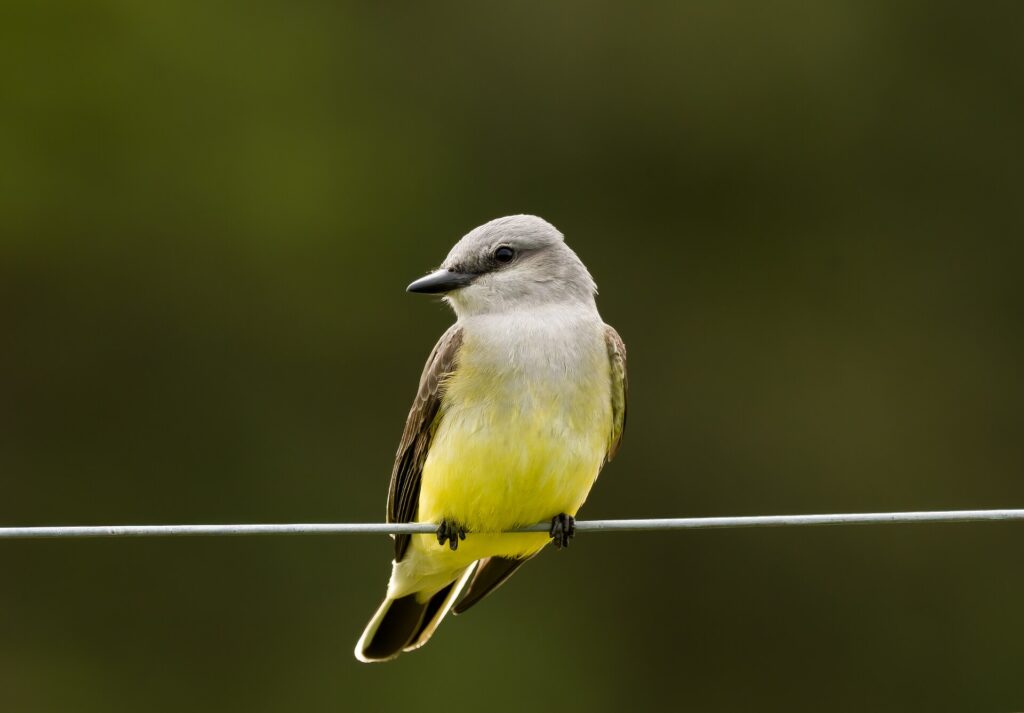
- Larger, gray head and throat, lemon-yellow belly, summer: great crested flycatcher (East) or western kingbird (West).
Where’s the yellow? Our field-mark chart
We charted nine birds that people describe as small and gray (or close to it) with yellow on them. Each row shows where Cornell Lab’s species descriptions place the yellow, whether it’s bright or just a tinge, how long the bird is, and when you’re most likely to see it in the U.S.
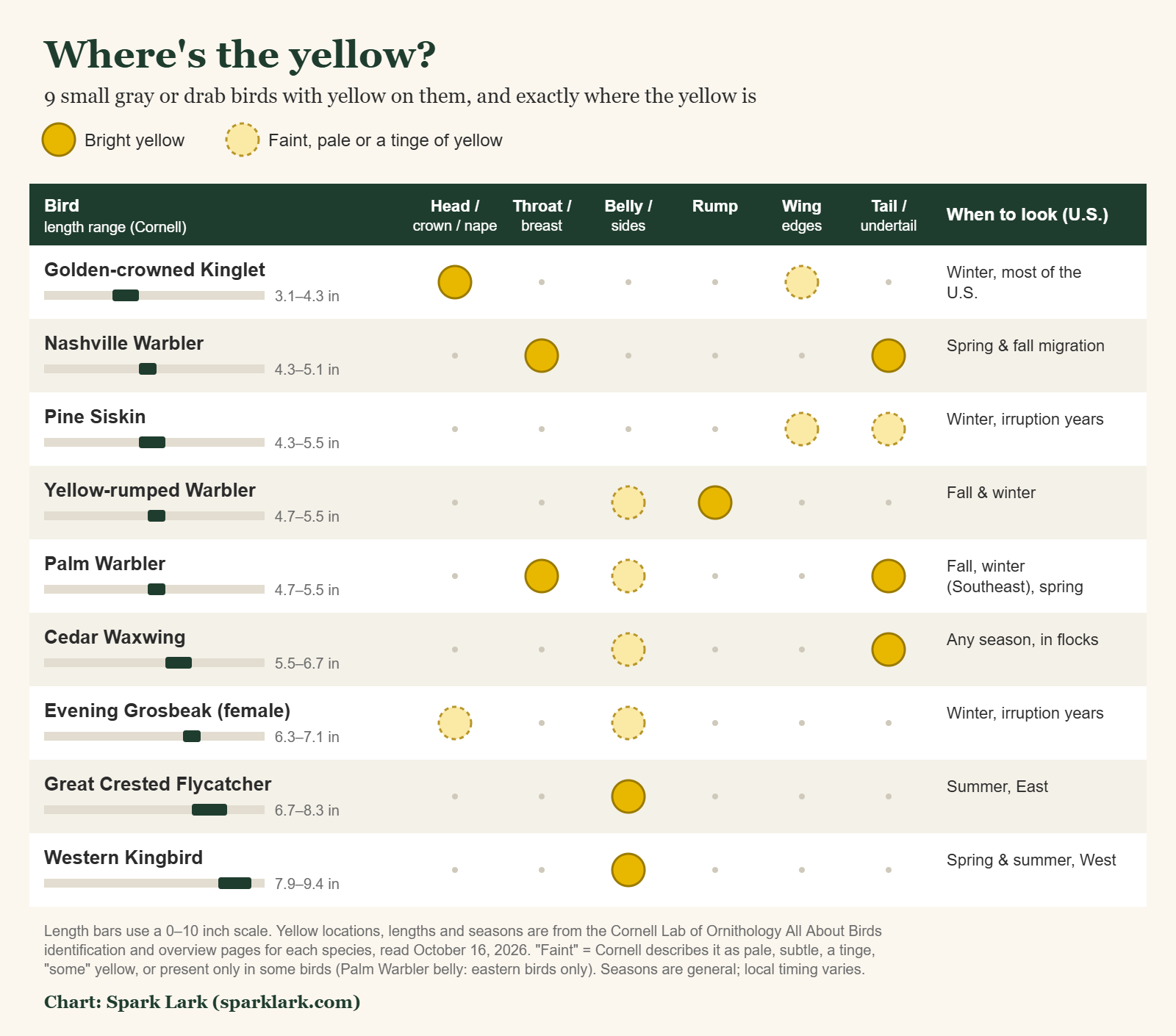
Source and method: yellow locations, length ranges and seasons come from the Cornell Lab of Ornithology’s All About Birds identification and overview pages for each species, read October 16, 2026. “Faint” marks yellow that Cornell describes as pale, subtle, a tinge, “some” yellow, or present in only part of the population. Length bars share a 0–10 inch scale. Seasons are general; timing varies by region.
Want a printable to keep by the window? Our free backyard bird ID chart by color covers 48 common birds, no signup.
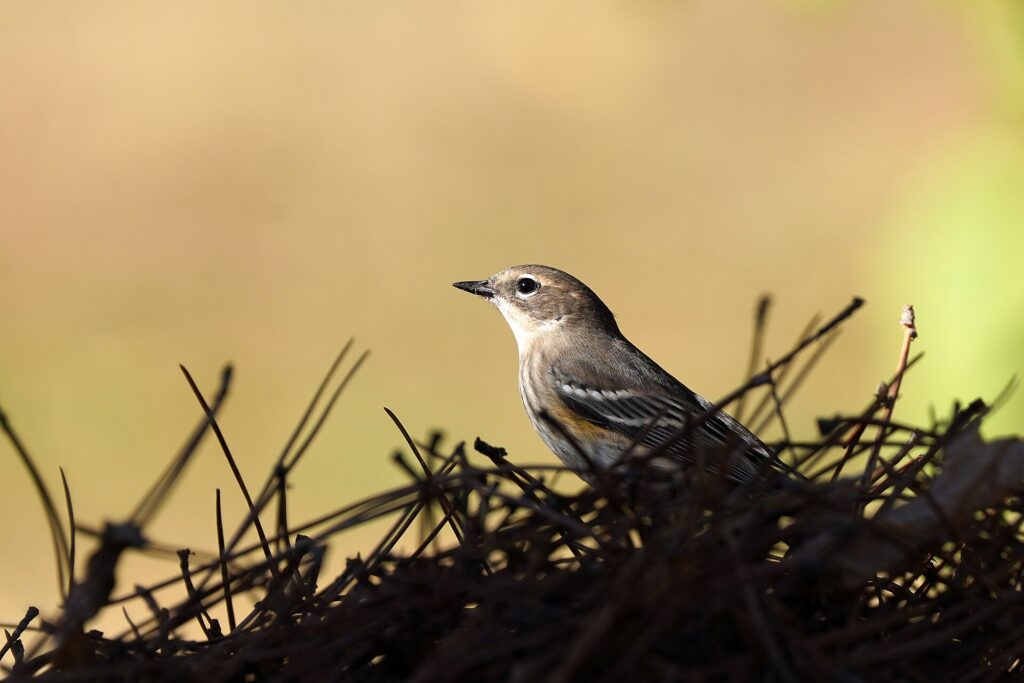
Yellow-rumped warbler: the fall and winter regular
Cornell describes the yellow-rumped warbler as a fairly large, full-bodied warbler, “about the size of a Black-capped Chickadee” and 4.7 to 5.5 inches long. In summer it’s a crisp gray with yellow on the face, sides and rump. In winter it turns “paler brown, with bright yellow rump and usually some yellow on the sides.” That rump patch is the giveaway: watch for it when the bird flies off or turns around.
These warblers show up in big numbers. Cornell says they “flood the continent each fall” and winter across much of the central and southeastern U.S. They’re the only warbler that can digest the wax on bayberries and wax myrtles, which lets them winter farther north than other warblers. In yards, Cornell suggests sunflower seed, raisins, suet and peanut butter. If you want to try suet, our guide to the best suet feeders covers the main styles.
Golden-crowned kinglet: tiny, with a yellow stripe on top
If the bird is smaller than a chickadee and won’t sit still, think kinglet. Golden-crowned kinglets are 3.1 to 4.3 inches long, “pale olive above and gray below,” with a black-and-white striped face and a “flashy lemon-yellow crest.” Their wing feathers also have yellow edges.
They breed in the far north and western mountains and visit most of North America in winter, usually high in spruce, fir and other conifers. Listen for very high, thin calls. Cornell notes these birds can survive nights of –40 degrees, sometimes huddling together for warmth.
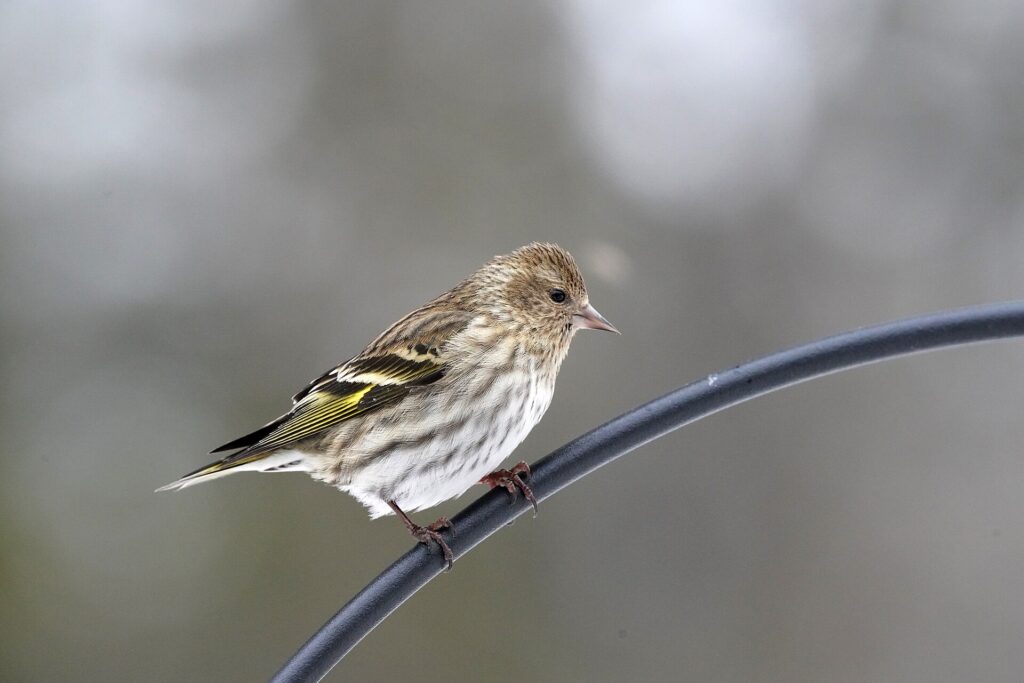
Pine siskin: streaky, with yellow in the wings
Pine siskins are brown, “very streaky birds with subtle yellow edgings on wings and tails.” At rest the yellow can be hard to see; Cornell notes it flashes when they take flight or flutter at branch tips. Look also at the bill, which is thinner and more pointed than most finches’.
Siskins are nomads. Cornell says that about every other year they irrupt into central and even southern parts of the continent, depending partly on northern cone crops. When they come, they flock to thistle (nyjer) feeders and also take millet and hulled sunflower seeds.
Cedar waxwing: yellow belly, yellow-tipped tail
Cedar waxwings are pale brown on the head and chest, fading to soft gray on the wings. Cornell describes the belly as pale yellow and the tail as “gray with a bright yellow tip,” set off by a narrow black mask. If you see a sleek, crested bird in a flock stripping a berry tree, check the tail tip.
Waxwings travel in flocks year-round and are drawn to fruit more than seed. Cornell recommends planting native trees and shrubs with small fruits, such as dogwood, serviceberry, cedar, juniper, hawthorn and winterberry.
Female evening grosbeak: a big gray finch with a yellowish neck
Males are bold yellow and black, but females and immatures are “mostly gray, with white-and-black wings and a greenish-yellow tinge to the neck and flanks.” At 6.3 to 7.1 inches, with a thick, powerful bill, they’re larger than most birds on this list.
Evening grosbeaks irrupt south in fall when northern cone crops are poor. Cornell notes those irruptions used to happen every 2–3 years in the eastern U.S. but have become less frequent there since the 1980s, and calls the species declining. When they do come, they eat sunflower seeds and often use platform feeders because they travel in sizable flocks. See our picks for the best platform bird feeders.
Palm warbler: yellow under the tail, always wagging
The palm warbler is “dull brownish-olive above with yellow under the tail and throat.” Eastern birds are yellow below, while western birds have a white belly. The clue that clinches it is behavior: a nearly constant up-and-down tail wag, usually while the bird walks on the ground.
Outside Canada, spring, fall and winter are the times to see one. They winter in the Caribbean and a narrow strip along the southeastern U.S., often in weedy fields and edges alongside sparrows, juncos and yellow-rumped warblers.
Nashville warbler: gray head, yellow below
Cornell sums up the Nashville warbler as “a mostly yellow warbler with a green back, gray head, and white eyering.” From below, look for yellow breast, white lower belly and yellow under the tail. Across most of North America, migration is the time to look, at middle heights in brushy or semi-open places, often mixed in with chickadees, titmice and kinglets. Cornell says they start leaving their breeding grounds in October.
Summer look-alikes: great crested flycatcher and western kingbird
Both are bigger than the birds above (roughly 7 to 9 inches), and both are gone from most of the U.S. in winter. The western kingbird has a gray head, whitish chest and throat, and a yellow belly, with a black tail edged in white. Cornell calls it “a familiar summertime sight in open habitats across western North America,” usually perched on fences and utility lines.
In the East, the great crested flycatcher has a “brownish-gray head, gray throat and breast,” and a “bright lemon-yellow belly,” with rufous flashes in the wings and tail. It stays high in the canopy, so its loud, rising whistle is often the first clue. Northern birds leave in September. It’s the only eastern flycatcher that nests in cavities, so it will use a nest box; see our guide to birdhouses and roosting boxes, and our great crested flycatcher ID and drawing guide.
All nine at a glance
| Bird | Where the yellow is | Other clues | Where and when |
|---|---|---|---|
| Golden-crowned kinglet | Lemon-yellow crest; yellow edges on the wing feathers | Tiny, olive above, gray below, black-and-white striped face | Conifers in winter, across most of the U.S. |
| Nashville warbler | Yellow breast and yellow under the tail, white lower belly between | Gray head, white eye-ring, green back | Brushy edges during spring and fall migration |
| Pine siskin | Subtle yellow edges on the wings and tail | Very streaky brown, thin pointed bill | Nyjer and sunflower feeders, mostly in irruption winters |
| Yellow-rumped warbler | Bright yellow rump; usually some yellow on the sides | Paler brown in winter, streaky, sharp chip call | Berry shrubs, parks and yards in fall and winter |
| Palm warbler | Yellow throat and under the tail (eastern birds also yellow below) | Brownish olive, wags its tail nonstop, walks on the ground | Weedy fields and edges; winters in the Southeast |
| Cedar waxwing | Pale yellow belly; bright yellow tail tip | Soft gray wings, brown crest, black mask | Fruiting trees, in flocks, any season |
| Evening grosbeak (female) | Greenish-yellow tinge on the neck and flanks | Mostly gray, very thick bill, black-and-white wings | Sunflower and platform feeders in irruption winters |
| Great crested flycatcher | Bright lemon-yellow belly | Gray throat and breast, rufous flashes in wings and tail | Treetops in eastern woods and neighborhoods, summer |
| Western kingbird | Yellow belly | Gray head, whitish chest, black tail with white edges | Fences and wires in open country, western U.S., spring and summer |
Quick tips for pinning it down
- Note where the yellow is first. Rump, crown, wing edges, belly and tail tip each point to a different bird.
- Check the size against a chickadee. Kinglets are smaller, a yellow-rumped warbler is about the same, and grosbeaks, flycatchers and kingbirds are clearly bigger.
- Watch what it does. Tail-wagging on the ground is a palm warbler; hovering in conifers is a kinglet; flocks in berry trees are waxwings.
- Think about the season. In winter, the flycatcher and kingbird are off the table for nearly everyone.
FAQ
Could it be an American goldfinch? Possibly. Cornell describes winter goldfinches as “drab, unstreaked brown, with blackish wings and two pale wingbars,” and females as duller yellow below and olive above. A goldfinch has no streaks, which separates it from a pine siskin.
What small gray bird has a yellow rump? In fall and winter, most likely a yellow-rumped warbler.
What tiny gray-and-olive bird has a yellow stripe on its head? A golden-crowned kinglet.
Still stuck on a gray bird? Try 18 common gray birds, our guide to the small gray bird with a crest, or gray birds with an orange belly.
Bottom line
From fall through spring, a little gray bird with yellow on it is often a yellow-rumped warbler; look for the yellow rump. A yellow crown on a tiny bird means a golden-crowned kinglet, yellow-edged wings on a streaky bird means a pine siskin, and a yellow tail tip means a cedar waxwing. In summer, a larger gray-headed bird with a yellow belly is a great crested flycatcher in the East or a western kingbird in the West. Check where the yellow is, how big the bird is and what it’s doing, and the chart above will usually get you to the answer.