Spark Lark is reader-supported. As an Amazon Associate we earn from qualifying purchases, at no extra cost to you. How we choose products.
A bird bath de-icer is a small submersible heater that sits in the bowl of the bath you already own and switches itself on when the water gets close to freezing. The right one depends on two things: how big your bath is and how cold your winters get. Low-wattage units (roughly 44 to 80 watts) suit smaller baths and milder winters; 150- to 250-watt units are for big bowls and hard freezes.
The short answer: the Allied Precision BDT250 if your winters are long and cold, and the K&H Super Ice Eliminator if you want a quiet, rock-style heater for an average backyard bath near an outlet.
The short version
- Best for cold winters: Allied Precision BDT250. 250 watts, multiple thermostats, aluminum, made in the USA.
- Best cast-aluminum all-rounder: Farm Innovators C-50. 150 watts with a built-in thermostat in a heavy cast body.
- Best for larger baths near an outlet: K&H Super Ice Eliminator, 80 W. Safety-certified, rock-look finish, three-year warranty.
- Best for small baths: Saillong 60 W birdbath de-icer. A low-wattage aluminum puck with a thermostat and an automatic shut-off.
- Budget thermostatic pick: GESAIL 50 W cast-aluminum de-icer. A thermostat and a longer cord than the K&H units.
- For shallow or odd-shaped bowls: Farm Innovators B-9, 44 W. A flat foil pad you can bend to fit the bowl.
Why open water matters in winter
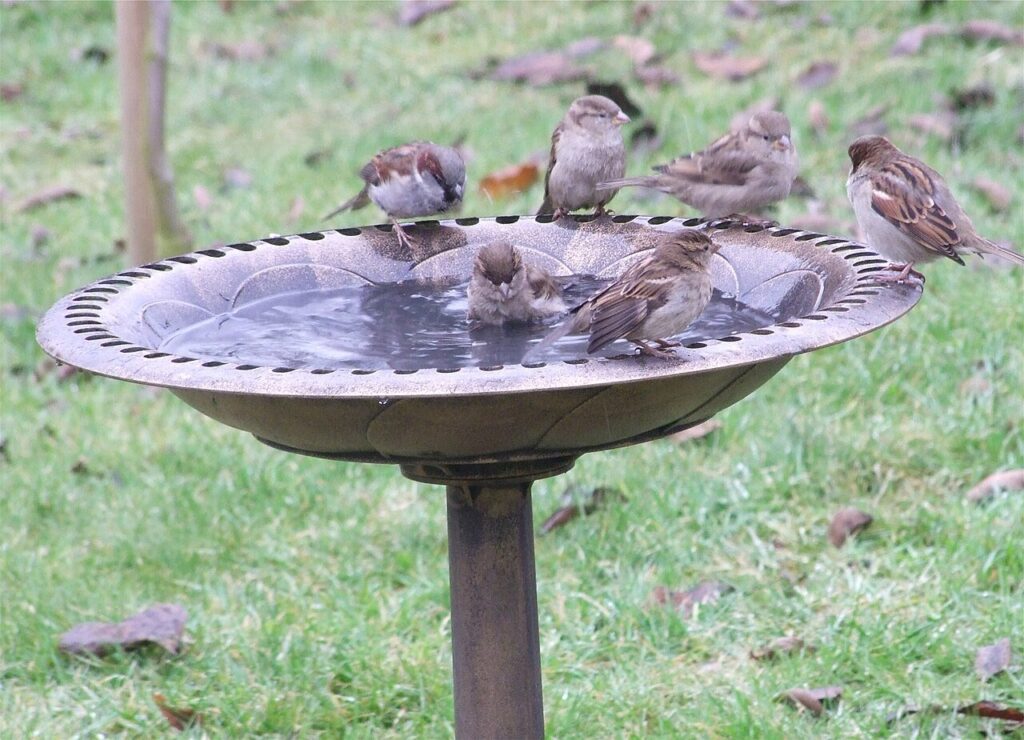
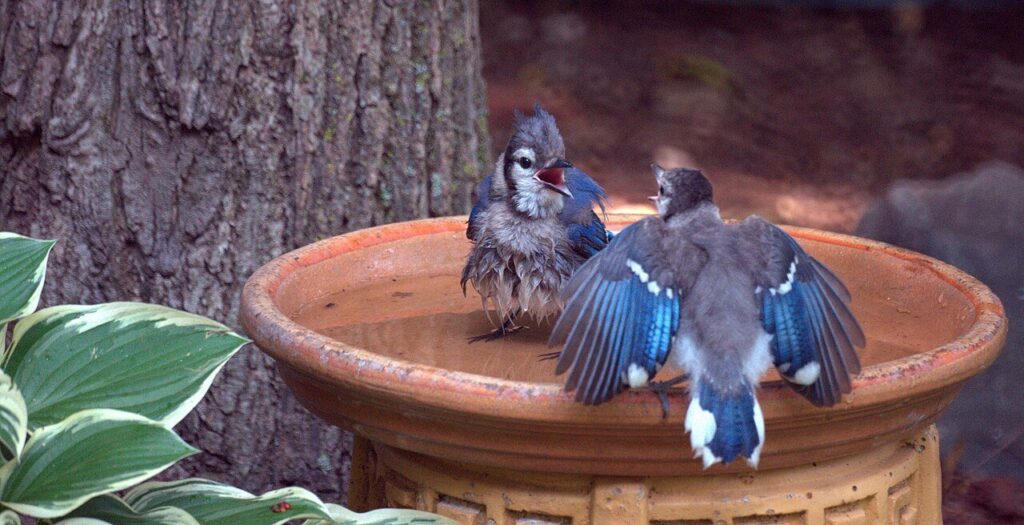
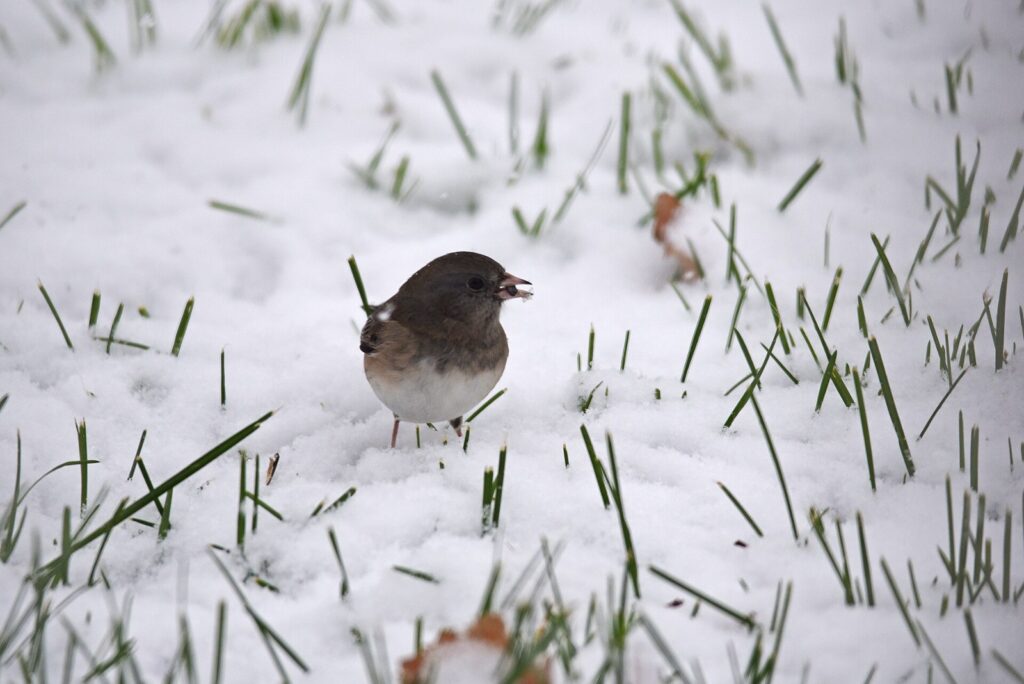
Birds still drink and bathe when it is bitterly cold. Audubon’s Steve Kress notes that “many kinds of birds bathe in and drink from open water in frigid weather.” When every puddle and pond is frozen, a bath with liquid water can draw birds that rarely or never visit your feeders. (Which species you see depends on where you live; our winter backyard birds by region guide covers the regulars.)
The Cornell Lab of Ornithology’s guide to providing water for birds says immersion-style heaters are “perfect for keeping the water from freezing in a birdbath.” Cornell and the National Wildlife Federation both warn against adding glycerin as antifreeze: it can harm birds that drink it and mat their feathers, costing them insulation. Never add salt or any additive to bath water. A de-icer is the safe way to keep it liquid.
How to choose a bird bath de-icer
- Wattage vs. your climate and bath size. More watts keep more water open in colder air. K&H, for example, rates its 50-watt model for baths of 10 gallons or less and sells an 80-watt version for bigger baths. If your nights regularly drop well below zero, or your bath sits in the open wind, size up.
- A thermostat. Thermostatic de-icers switch on only near freezing and off once the water is safe, which saves electricity and keeps the water from getting warm. One pick below (the Farm Innovators B-9) has no thermostat and runs whenever it is plugged in, so unplug it in mild spells.
- It must stay underwater. De-icers are made to work submerged; K&H and GESAIL both say the unit must be fully covered. In dry winter air a bath evaporates fast. Audubon advises “frequent refills” in winter, so check the level daily.
- Your bath’s material. Audubon cautions that ceramic baths can crack in freezing weather. Concrete, stone, metal and sturdy plastic handle winter better. Check that the de-icer is rated for your bath: the BDT250 and GESAIL listings say they are safe in plastic baths, and K&H says its heaters won’t melt plastic baths.
- The cord and outlet. Cornell recommends plugging any bath heater into a ground-fault (GFCI) protected outlet. Cord rules differ by brand: K&H’s cord is 18 inches long and K&H says not to use an extension cord, so the bath has to sit close to an outdoor outlet. Farm Innovators’ B-9 listing says it connects to an outdoor extension cord. Follow the maker’s instructions for the one you buy.
The de-icers
1. Allied Precision BDT250 — best for cold winters
250 W · multiple thermostats · coated aluminum element · 4.75-in diameter · made in the USA
Allied Precision (API) is the company behind several of the heated baths in our heated bird bath guide, and the BDT250 is its stand-alone de-icer. At 250 watts it is the most powerful heater on this list. API’s listing describes a low-profile, coated aluminum element with a large surface area “for cooler operation,” which is why it says the unit is safe in plastic baths. Multiple thermostats control when it runs. If you live where January means weeks below freezing, this is the one to start with.
Downside: it is more heater than a small bath in a mild climate needs, and it draws the most power of anything here when it is running. The listing does not state cord length, so measure the distance to your outlet before you buy.
2. Farm Innovators C-50 — best cast-aluminum all-rounder
150 W · built-in thermostat · heavy-duty cast aluminum · 8.2 x 5 x 1.25 in · 1.42 lb
The C-50 sits in the middle of the wattage range, which makes it a sensible choice for most of the country. Farm Innovators builds it from heavy-duty cast aluminum, and its thermostat “automatically turns off when warm enough,” in the maker’s words. At just over an inch tall, it lies low in the bowl, so it is easier to keep covered in a moderately shallow bath than a taller unit.
Downside: 150 watts is a middle output. For the coldest northern winters or a very large bowl, the 250-watt BDT250 gives more headroom.
3. K&H Super Ice Eliminator, 80 W — best for larger baths near an outlet
80 W · thermostatic · aluminum housing, enamel rock finish · 4.5 x 6.5 in · MET safety certified · 3-year warranty
K&H’s Super Ice Eliminator is the bigger sibling of its original 50-watt model, meant for larger baths. K&H says it keeps water open “even in sub-zero temperatures,” and its Amazon listing puts that at -20°F. The enamel finish looks like a stone, so it disappears in a concrete or stone bath, and K&H says you can spray-paint it to match. K&H also points out that it has the whole product safety-certified by MET Labs, not just the parts.
Downside: the cord is only 18 inches, and K&H says not to use it with an extension cord. Unless you have an outdoor outlet right by the bath, this one won’t work for you. There is no on/off switch, and it must stay fully underwater.
4. Saillong 60 W birdbath de-icer — best for small baths
60 W · thermostatic with automatic shut-off · aluminum base · 120 V
A low-profile aluminum puck for a small bath. The listing describes a thermostat that runs the heater only when needed, a second thermostat that cuts the power if the base passes 95°F, and a protected cord so birds and squirrels can’t peck into it. Sixty watts is a modest draw for a heater that may sit in the bath from December to March, and the maker rates it for weather down to 0°F.
Downside: it comes from a smaller brand than API, Farm Innovators or K&H, and the listing does not mention a safety certification, so check the box and manual for one. In a big bowl or a hard cold snap, 60 watts may keep only part of the surface open.
5. GESAIL 50 W cast-aluminum de-icer — budget thermostatic pick
50 W · 120 V · thermostatic · cast aluminum · 25-in cord
GESAIL’s de-icer is a lower-cost way to get a thermostat and a cast-aluminum body. The maker says it runs “only when necessary” and won’t heat the water, and that it is safe in metal, plastic, stone or glass baths. Its 25-inch cord is longer than the K&H units’ 18 inches, and the listing says the unit is heavy enough to stay put in the bowl. For an average bath in a moderate winter, it covers the basics.
Downside: it is a 50-watt heater, so it has the same limits in a large bowl or a deep freeze as the other low-wattage picks. It comes from a smaller brand than API, Farm Innovators or K&H, and the listing does not mention a safety certification, so check the box and manual for one.
6. Farm Innovators B-9, 44 W — for shallow or odd-shaped bowls
44 W · no thermostat · heavy-duty foil pad · 10 x 10 x 1 in · 0.58 lb · 10-in grounded cord
The B-9 is a different design: a flat, heavy-duty foil pad that you can mold to the shape of the bowl. That makes it the option for a wide, shallow bath where a puck-style heater would sit too high to stay covered. Farm Innovators says it is made for shallow birdbaths, and its short grounded cord is designed to connect to an outdoor extension cord.
Downside: it has no thermostat. Farm Innovators says it “works at all times,” so it heats whenever it is plugged in, even on a 50-degree afternoon. Plug it into an outdoor-rated timer or thermostatic outlet, or unplug it during warm spells.
Side by side
On a phone, swipe the table sideways to see all five columns.
| De-icer | Watts | Thermostat | Body | Best for |
|---|---|---|---|---|
| Allied Precision BDT250 | 250 | Yes (multiple) | Coated aluminum | Long, hard winters |
| Farm Innovators C-50 | 150 | Yes | Cast aluminum | Most of the country |
| K&H Super Ice Eliminator | 80 | Yes | Aluminum, enamel | Larger baths by an outlet |
| Saillong 60 W | 60 | Yes | Aluminum base | Small baths, mild winters |
| GESAIL 50 W | 50 | Yes | Cast aluminum | Average baths, mild winters |
| Farm Innovators B-9 | 44 | No | Foil pad | Shallow, wide bowls |
De-icer or heated bird bath?
If you already have a sturdy bath you like, a de-icer is the cheaper fix and lets you keep it. If your bath is ceramic, very shallow, or far from an outlet, a bath with the heater built in is usually simpler: the element is sealed into the bowl, nothing sits in the water, and there is no puck to keep covered. We compare those in our best heated bird baths guide.
Tips for running a de-icer all winter
- Use a GFCI outlet. Cornell recommends a ground-fault protected circuit for any bath heater. If the maker allows an extension cord, use an outdoor-rated one and keep the connection up off the ground or inside a weatherproof cord cover.
- Keep it clean. Cornell advises cleaning a bath every couple of days and not letting water go stale. Unplug the de-icer before you scrub. Our bird bath guide covers cleaning, and here’s what to know about apple cider vinegar in bird baths.
- Put it where birds feel safe. Cornell suggests placing a bath near trees or shrubs so birds can escape a cat or hawk. Pick a spot you can see from a window, so the daily water check is easy.
- Pair it with food. A bath and a feeder together make a full winter stop. See what to feed birds in winter and our picks for the best bird feeders for winter.
FAQ
Do bird bath de-icers make the water warm? Thermostatic models are meant to stop ice, not warm the water. They switch on near freezing and off again; GESAIL, for one, says its unit “will not heat up the water.”
Can I use a de-icer in a plastic bird bath? Yes, if the maker says so. Allied Precision and GESAIL say their units are safe in plastic baths, and K&H says its Ice Eliminators won’t melt them.
How much electricity does a de-icer use? The wattage is the most it draws while heating. A thermostatic unit only runs part of the time, so actual use depends on how cold it gets. A 50-watt unit running nonstop for a full day would use 1.2 kilowatt-hours; a 250-watt unit, 6.
Can I just add something to the water so it won’t freeze? No. Cornell does not recommend glycerin, and the U.S. Fish and Wildlife Service notes that salt can endanger wildlife. Use a heater, or replace frozen water with fresh water each morning.
If a de-icer isn’t practical where your bath sits, see 8 ways to keep a bird bath from freezing.
Bottom line
For long, hard winters, get the Allied Precision BDT250. For most yards, the 150-watt Farm Innovators C-50 is a solid middle choice. If you have an outdoor outlet right next to the bath, the 80-watt K&H Super Ice Eliminator is tidy and safety-certified, and the 60-watt Saillong is the small-bath pick. The GESAIL is the lower-cost thermostatic option, and the Farm Innovators B-9 pad fits shallow bowls that a puck can’t. Whichever you choose, plug it into a GFCI outlet, keep it underwater and keep the bath clean. Not sure who’s drinking? Our free backyard bird ID chart can help.