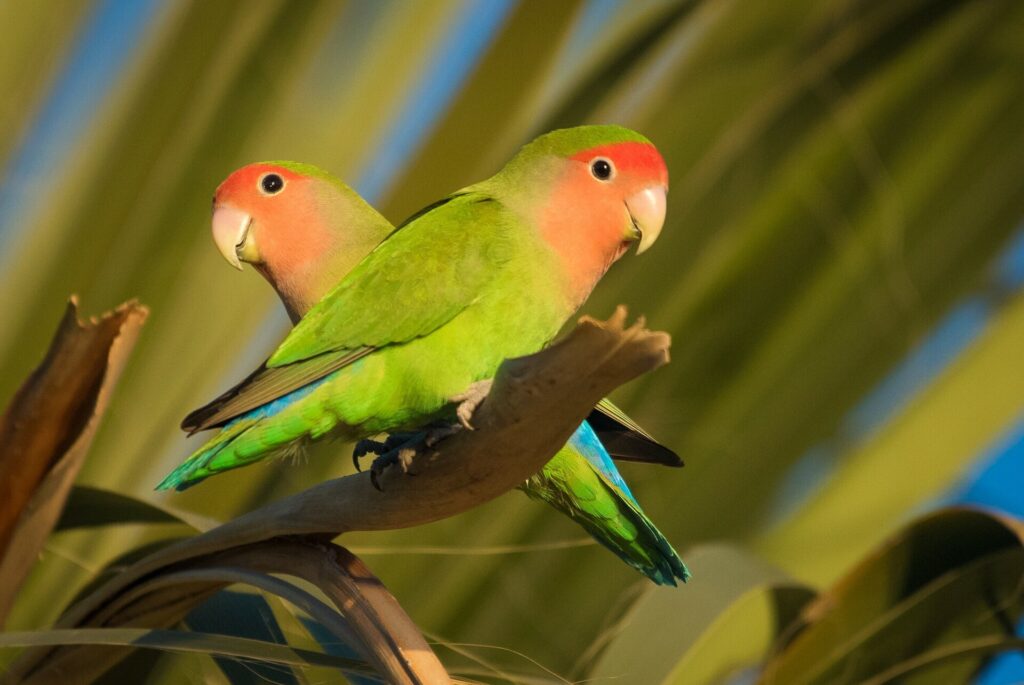
There are no lovebird “breeds” in the way there are dog breeds. Lovebirds are nine separate species in one genus, Agapornis, all small parrots native to Africa and Madagascar. What pet shops sell as different breeds is usually one of three species, often in a color that breeders created on purpose. Here is how to tell all nine apart, which ones you will actually meet, and what to know before bringing one home.
Species, not breeds
A breed is a variety humans shaped within one species. Lovebirds are different: each of the nine is a wild species with its own range, call and look. The confusion comes from color mutations. Breeders have selected for genes that change feather color, so one species can show up in green, yellow, blue and many shades between. A blue peach-faced lovebird and a green one are the same species; a peach-faced and a Fischer’s lovebird are not.
All lovebirds are small. VCA Animal Hospitals’ veterinarians give an average length of 5 to 6.5 inches and a weight of 1.5 to 2 ounces, depending on species. The name comes from their strong pair bonds: mated birds spend long stretches sitting pressed together.
All 9 lovebird species at a glance
| Common name | Scientific name | Native range | How to recognize it |
|---|---|---|---|
| Peach-faced (rosy-faced) | Agapornis roseicollis | Namibia and nearby southwest Africa | Green body, pink face, blue rump |
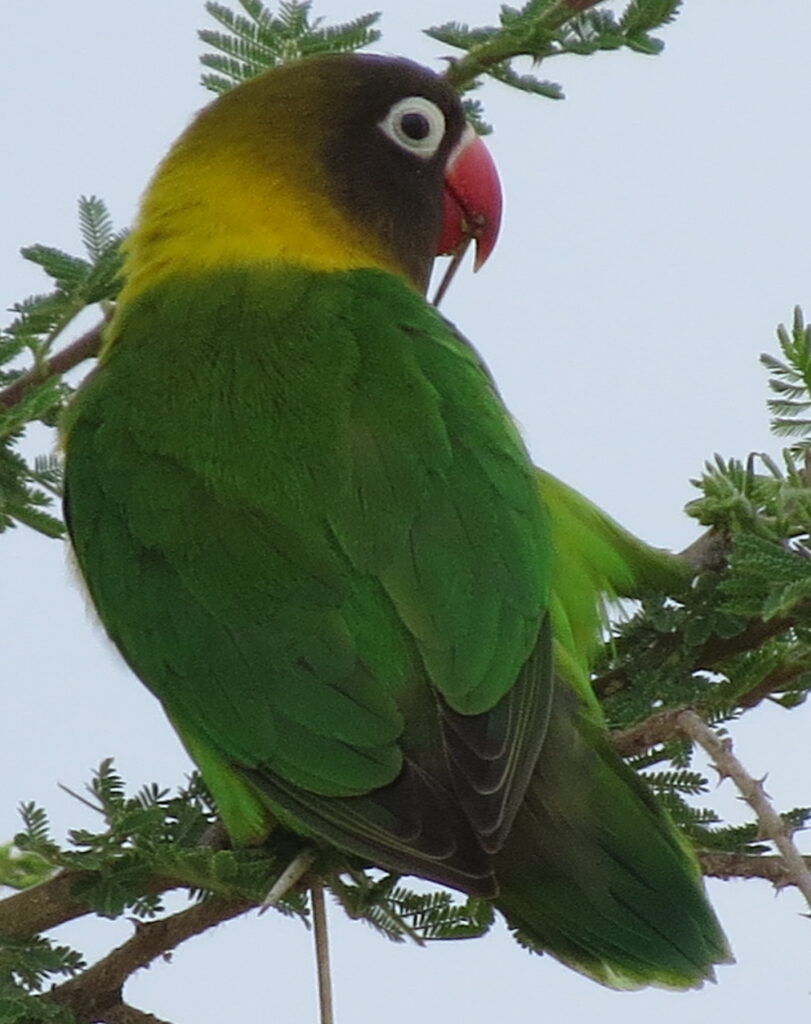
| Yellow-collared (masked) | Agapornis personatus | Tanzania | Black head, yellow collar and chest, white eye ring |
| Fischer’s | Agapornis fischeri | Northern Tanzania, around Lake Victoria | Orange-red face, olive crown, red bill, white eye ring |
| Lilian’s (Nyasa) | Agapornis lilianae | Malawi, Zambia, Zimbabwe, Mozambique, Tanzania | Orange head, green rump, red bill, white eye ring |
| Black-cheeked | Agapornis nigrigenis | Southwest Zambia to Victoria Falls | Brownish-black cheeks and throat, reddish-brown forehead, white eye ring |
| Grey-headed (Madagascar) | Agapornis canus | Madagascar | Green with a darker back and a pale grey bill; males and females differ |
| Black-winged (Abyssinian) | Agapornis taranta | Eritrea and Ethiopia | Green with a red bill and some black wing feathers; males and females differ |
| Red-headed (red-faced) | Agapornis pullarius | Central Africa | Green with a red-orange face |
| Black-collared (Swindern’s) | Agapornis swindernianus | Equatorial African forests | Green with a thin black collar on the back of the neck |
Two shortcuts help. Four species (masked, Fischer’s, Lilian’s and black-cheeked) have a bare white ring of skin around the eye, which makes them look wide-eyed. Three species (grey-headed, black-winged and red-headed) are the only ones where males and females look clearly different. In the popular peach-faced lovebird, VCA notes, “there are no obvious, external differences between male and female birds,” so ask an avian vet about DNA sexing if it matters to you.
The three you will actually see for sale
Most of the nine are rarely kept. In US pet stores and from breeders you will mostly find three:
- Peach-faced lovebird. VCA calls it “the largest and most commonly kept of the nine species.” Wild-type birds are green with a pink face; many pet birds are color mutations.
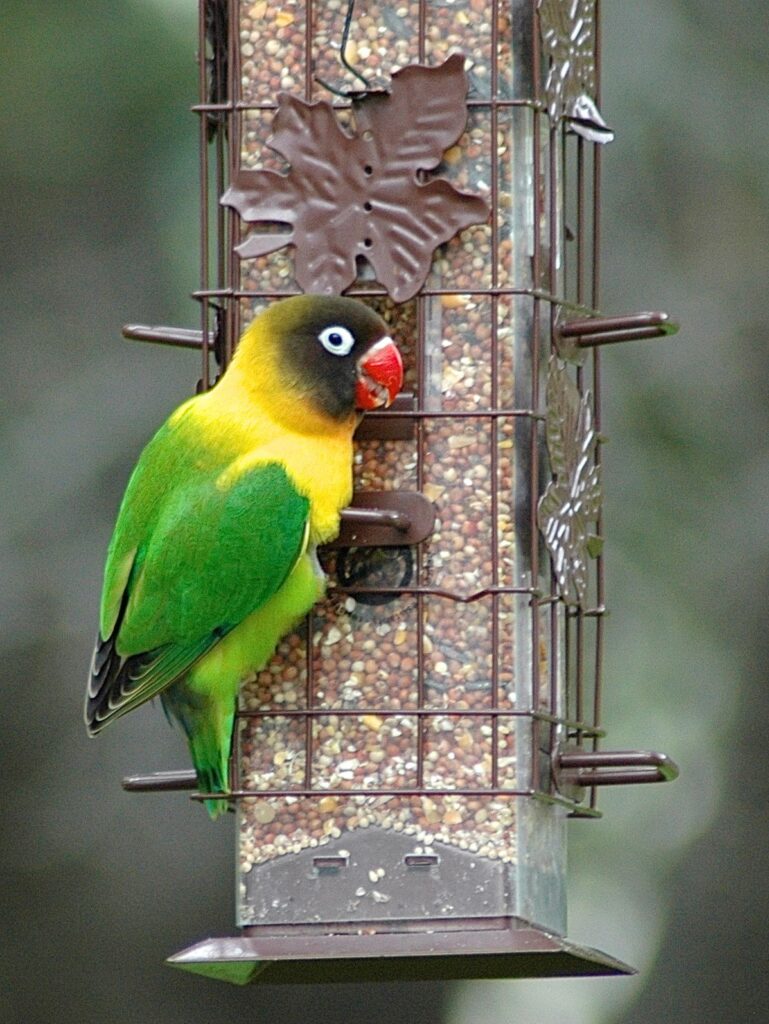
- Masked (yellow-collared) lovebird. Sold as “black-masked” in its natural colors and as “blue-masked” in a blue mutation. Both are the same species.
- Fischer’s lovebird. The orange-faced bird with the red bill and white eye ring.
If a seller offers a “Lilian’s” or “black-cheeked” lovebird, ask questions. The World Parrot Trust describes the black-cheeked lovebird as rare in captivity, and both species are under pressure in the wild (more on that below).
Colors are mutations, not breeds
Green in parrots comes from yellow pigment layered over feathers that scatter blue light. Remove the yellow and you get a blue bird; remove the blue structure and you get a yellow one. Breeders of peach-faced lovebirds have built on that. Two of the most popular results are the lutino, a yellow bird, and the Dutch blue. Combine mutations and you get the long list of color names you see in breeder ads.
Color does not change the bird’s needs, lifespan or temperament. A lutino peach-faced lovebird is still a peach-faced lovebird, and the care advice below applies to every color. The same idea explains the blue quaker parrot, which is a color mutation of the ordinary green monk parakeet.
Wild lovebirds in the United States
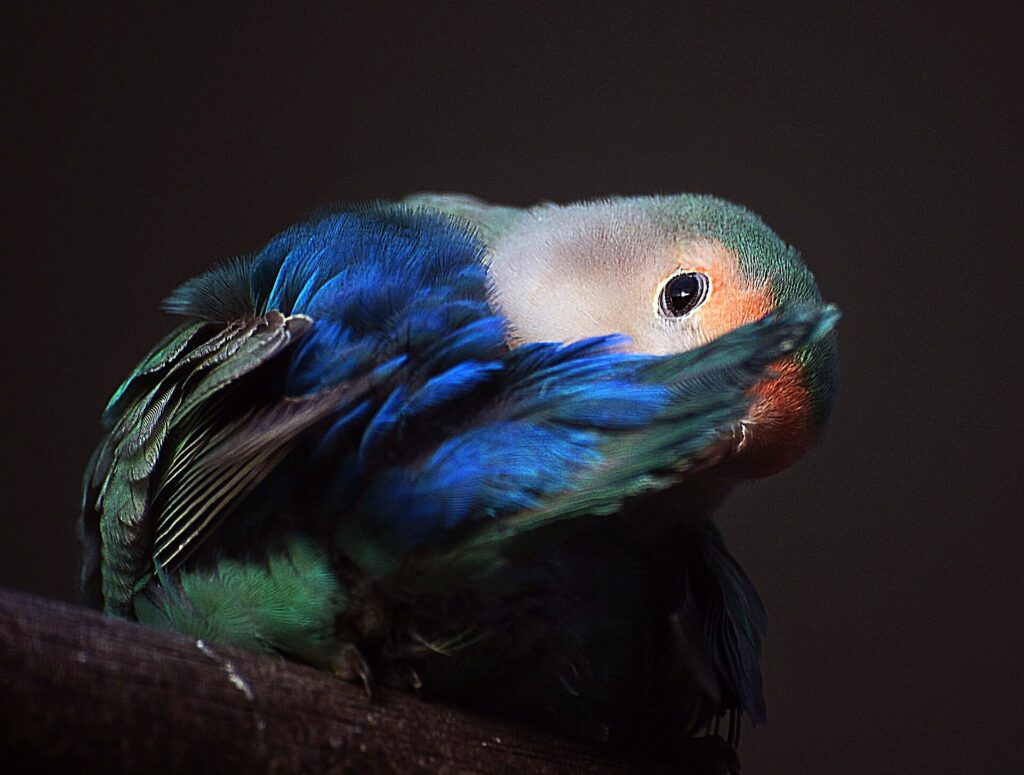
One lovebird is now a backyard bird in parts of the US. The Cornell Lab of Ornithology’s All About Birds lists the rosy-faced (peach-faced) lovebird as introduced to Arizona and the Hawaiian Islands, “where they occur in backyards and city parks.” In their African homeland they forage for seeds in flocks that can number in the hundreds and nest in rock crevices or inside the huge communal nests that weaver birds build.
Outside those areas, a lovebird at your feeder is almost certainly an escaped pet. They are easy to pick out: a small, stocky, mostly green parrot with a short tail and a hooked bill looks like nothing else at a feeder. If one shows up, check local lost-pet listings before assuming it is wild. Not sure what else is visiting your yard? Our free backyard bird ID chart by color covers the common native birds.
Before you bring a lovebird home
Lovebirds are small, but they are not short-term pets. These points come from VCA Animal Hospitals’ avian veterinarians:
- Lifespan: an average of 10 to 15 years, with a maximum around 20.
- One or two: a single lovebird can bond closely with its people. A pair “often bond more strongly to each other than their owners,” so a pair is less hands-on.
- Cage: at least 2 feet wide, 2 feet tall and 3 feet long.
- Personality: curious, playful and chatty, but generally poor talkers. They like to chew.
- Breeding: birds mature at 8 to 12 months and lay 3 to 7 white eggs that hatch in 18 to 24 days.
The purchase price is only the start of the cost of any parrot. If you are weighing a bigger one, our guide to how much a macaw costs shows how the lifetime bill adds up.
What lovebirds eat
A seed-only diet is the most common mistake. VCA’s guidance is that pellets “should ideally represent approximately 75%-80% of the bird’s diet,” with fruits, vegetables and greens making up much of the rest, and that seeds “should only be a very small part of a balanced diet.” Lovebirds do not need grit, because they hull seeds before swallowing them. Fresh water should always be available.
Some foods are dangerous. VCA warns that “avocado and onion are potentially toxic and should never be offered to a bird,” and to never give chocolate, alcohol or anything with caffeine. When in doubt about a specific fruit or snack, ask an avian veterinarian before offering it.
Three lovebirds in trouble in the wild
The pet trade made lovebirds famous, and it has also cost some species dearly. According to the World Parrot Trust:
- Black-cheeked lovebird: listed as Vulnerable, with roughly 8,000 to 11,500 mature birds and falling. Threats include trapping for the bird trade, habitat loss, drought and farmers switching from sorghum to maize.
- Lilian’s lovebird: Near Threatened, with 6,000 to 15,000 mature birds and decreasing, hit by loss of mopane woodland, trapping and poisoning at waterholes.
- Fischer’s lovebird: Near Threatened. The Trust says that “due to the bird trade, the rate of decline over three generations is suspected to fall in the 20-29% range.”
The peach-faced lovebird, by contrast, is listed as Least Concern. If you buy a lovebird, buy a captive-bred bird from a breeder or adopt one from a rescue, and never buy a bird that may have been caught in the wild.
Comparing other small pet birds? See how long parakeets can go without food and our guide to caring for a pet dove.
Quick answers
How many types of lovebirds are there? Nine species. Every “type” beyond that is a color mutation of one of them, most often the peach-faced lovebird.
What is the most common pet lovebird? The peach-faced (rosy-faced) lovebird, followed by the masked and Fischer’s lovebirds.
Can you tell a male from a female? Only in the grey-headed, black-winged and red-headed species. For the common pet species, an avian vet can arrange a DNA test.
Do lovebirds live wild in the US? Yes. The Cornell Lab lists introduced rosy-faced lovebirds in Arizona and Hawaii. Anywhere else, a lovebird is most likely an escaped pet.
Sources: VCA Animal Hospitals, “Lovebirds: General Information” and “Feeding Lovebirds” (Gregory Rich, DVM; Laurie Hess, DVM; Rick Axelson, DVM); Cornell Lab of Ornithology, All About Birds, “Rosy-faced Lovebird”; World Parrot Trust Parrot Encyclopedia entries for the black-cheeked, Lilian’s and Fischer’s lovebirds.