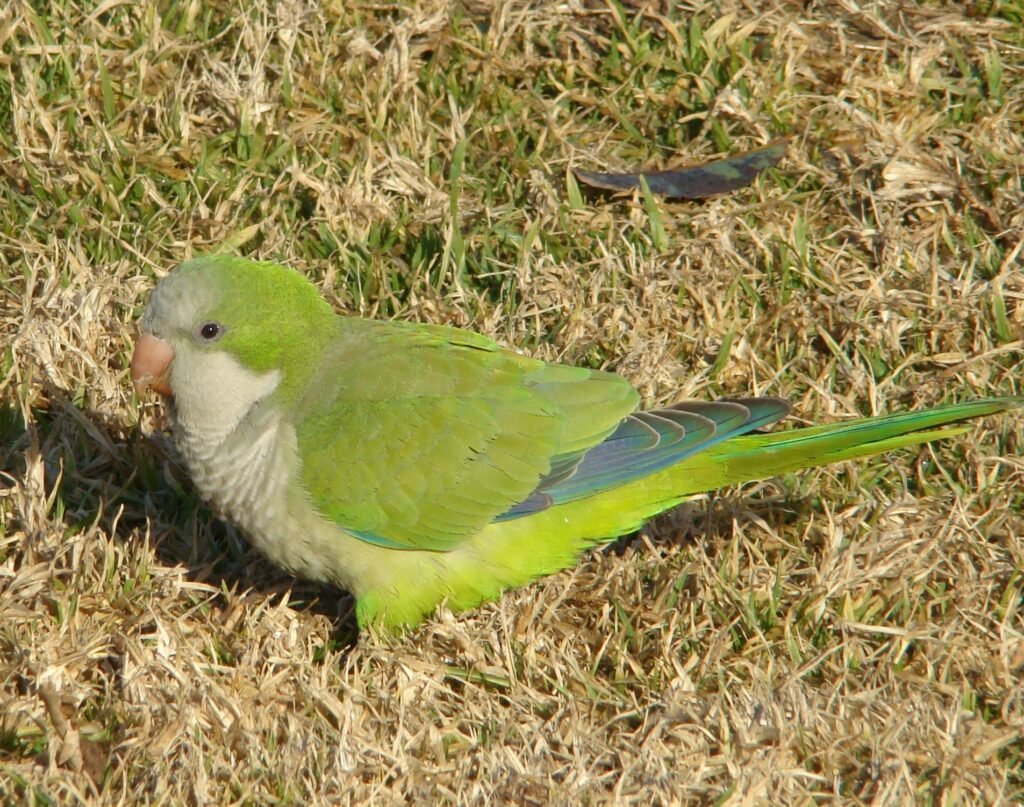
A blue quaker parrot is not a separate species. It is a color mutation of the monk parakeet (Myiopsitta monachus), the same green bird pet owners call the quaker parrot and that lives wild in Florida, Texas, Chicago and New York. Blue quakers exist only because breeders selected for a recessive gene that first appeared in captivity in the 1940s. Everything else, from the 20 to 30 year lifespan to the talking ability and the state-by-state legal problems, is identical to the green bird.
What is a blue quaker parrot?
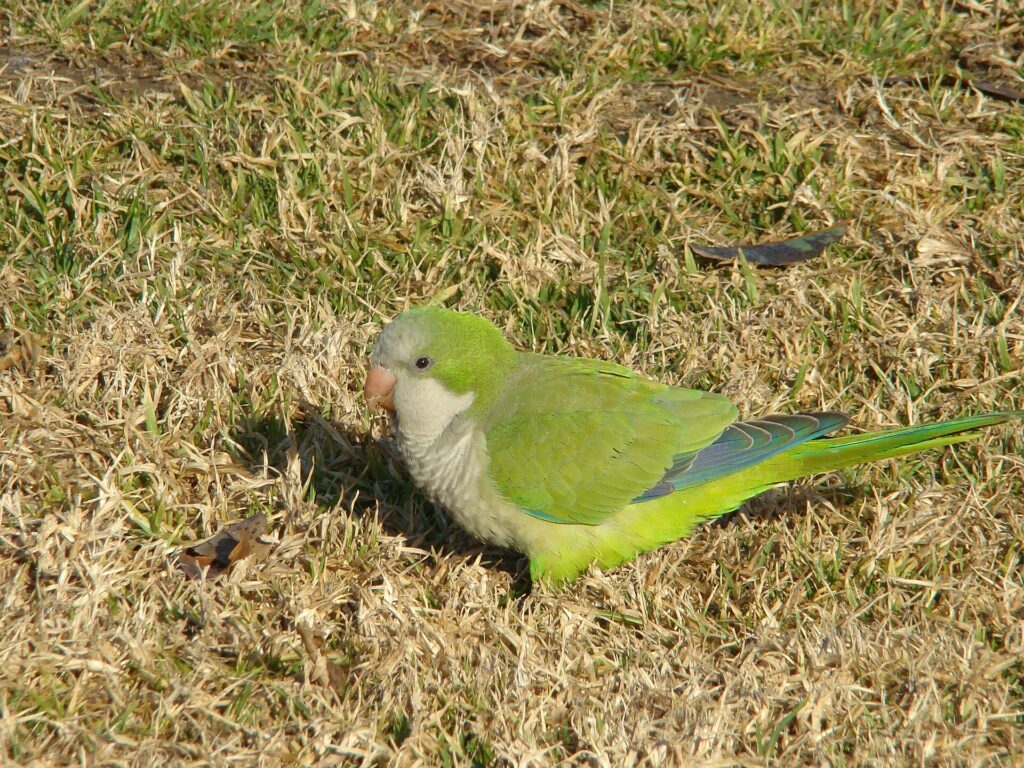
The wild monk parakeet is bright green with a pale gray face and chest, blue flight feathers and a horn-colored beak. Native to Argentina and neighboring parts of South America, it is one of the few parrots built to survive cold winters, which is how escaped pets settled in northern US cities.
The blue quaker is the same bird with one gene switched. Green in parrots comes from yellow pigment layered over blue feather structure; the blue mutation removes the yellow, so the bird looks powder blue and its gray face reads as silvery white. Bob Nelson, writing in the AFA Watchbird, reported that “the first blue mutation apparently appeared in Belgium in the 1940s,” and that “the blue mutation is simple recessive.” A chick needs a copy of the gene from both parents to turn out blue.
Blue is the best known quaker mutation but not the only one. Breeders have also established cinnamon, lutino (yellow with red eyes) and dark-eyed yellow lines, plus stacked combinations such as albino and turquoise. None occur in the wild. A blue monk parakeet flying free in a US city is almost certainly a lost pet.
Blue quaker size, lifespan and personality
Quakers are small parrots, about 11 to 12 inches long including the tail and roughly 3 to 5 ounces, according to VCA Animal Hospitals. Males and females look the same, so sexing requires a DNA test.
In captivity, VCA gives a lifespan of 20 to 30 years, and Lafeber says up to 30 with good care. Cornell’s All About Birds puts wild lifespans at six or more years. The practical takeaway: a blue quaker bought for a 10-year-old may still be alive when that child is 40.
Personality is why people fall for these birds. VCA describes them as self-assured, highly intelligent and social, and hand-raised birds bond hard to their people. Lafeber ranks their talking ability alongside African greys, remarkable for a parrot this small; many learn dozens of words and use them in context. The flip side is that a quaker left alone too much can become depressed, territorial or a feather plucker.
Are quaker parrots loud?
Yes, by small-parrot standards. Lafeber’s care sheet is blunt: quakers are decidedly vocal, will wake sound sleepers and are not a good choice for noise-sensitive households. The call is a sharp, chattering squawk rather than a cockatoo scream, but a bored quaker can keep it up for a long time. Our guide to identifying birds by their songs and calls is a good way to learn that sound before you commit.
The nest-building instinct
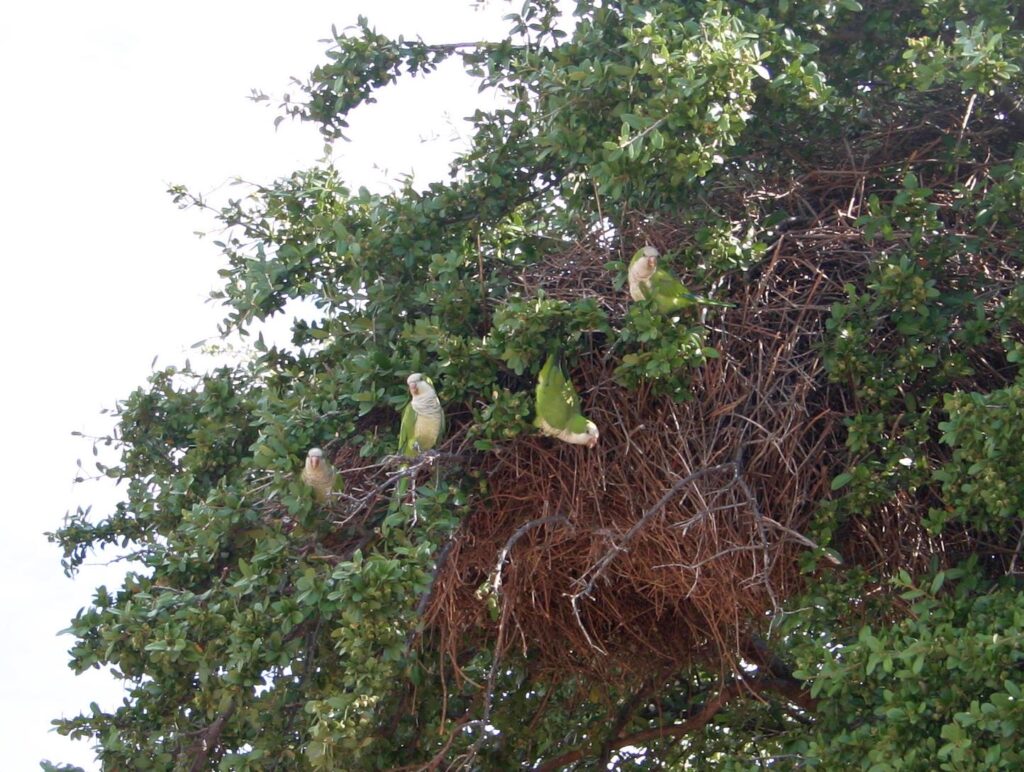
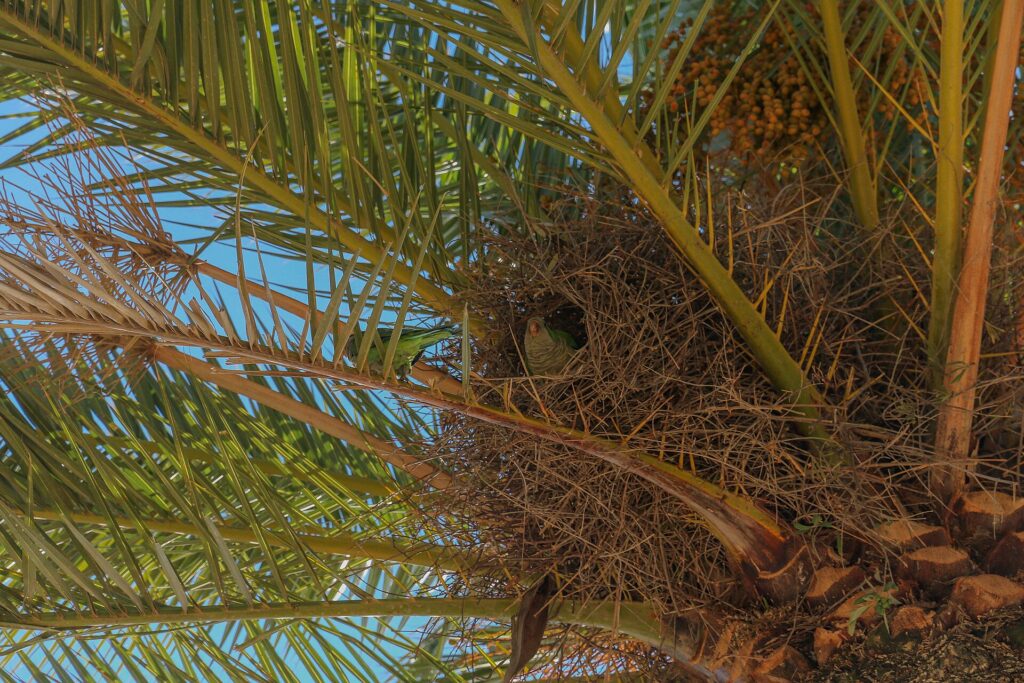
Monk parakeets are the only parrots that build free-standing stick nests, and they build them in colonies. Cornell reports that one structure can hold up to 20 chambers, extreme examples top 200, and the biggest weigh more than a ton. Feral birds in the US pile them onto trees, palms and, most troublesome of all, utility poles and transformers, where they cause outages and fires.
That instinct does not switch off in a cage. Lafeber notes that captive quakers prefer weaving multi-chambered twig nests over a standard nest box, and warns that “quaker parakeets are voracious chewers.” Expect your bird to stash toys and paper in a corner of the cage and defend it. Safe chewable branches and shreddable material give the urge somewhere to go.
Diet and space needs
VCA and Lafeber flag the same problem: quakers on an all-seed diet get fat and develop fatty liver disease. The recommended base is a formulated pellet, with fresh vegetables, some fruit and seed as a treat. Wild birds eat seeds, buds, berries and nuts and visit feeders in winter, but a caged bird burns far fewer calories.
For housing, VCA lists a minimum cage of about 2 by 2 by 3 feet; bigger is better for a bird this active. Plan on daily out-of-cage time, a rotating supply of toys and an annual avian vet visit. If the cage will be in a kid’s room, reread the noise section first.
How much does a blue quaker parrot cost?
Because blue is recessive and needs two carrier parents, blue quakers cost more than green. A 2026 review of breeder listings by ThePricer put green quakers at roughly $300 to $400 and blue at roughly $500 to $600, with rarer colors like lutino, albino, cobalt and turquoise at $600 to $900 or more. Treat those as ballpark figures; prices vary by region, breeder, whether the bird is hand-fed and weaned, and shipping.
| Color | Typical breeder price range (2026 listings) | Why |
|---|---|---|
| Green (wild type) | About $300–$400 | Most common, easiest to breed |
| Blue | About $500–$600 | Recessive gene, fewer breeders |
| Lutino, albino, cobalt, turquoise | About $600–$900+ | Stacked or rare mutations |
| Rescue adoption | Often $0–$150 | Fee covers care; adult birds, sometimes with a cage |
The purchase price is the small part. First-year costs for a cage, toys, food and a vet exam usually add up to several times the bird’s price, and that spending continues for decades.
Adopting a quaker from a rescue
Quakers are surrendered to rescues constantly, usually over noise, hormonal biting, or an owner who did not plan for a 30-year commitment. Florida Parrot Rescue lists quaker adoption fees around $150 with a cage included, and the Quaker Parakeet Society’s rehoming program charges no fee. Groups like the Parrot Outreach Society in Punta Gorda, Florida require an application, bonding sessions with the bird and a home check first.
Blue birds turn up in rescues less often than greens, but adopting an adult means you already know its temperament and whether it talks. If your goal is to get children excited about birds, a rescue visit pairs well with our guide to getting kids interested in birdwatching.
Are quaker parrots illegal in your state?
This is the part most buyers skip. Because feral colonies damage crops and power infrastructure and compete with native birds, a number of states ban or restrict monk parakeets. Color does not matter; a blue quaker is legally the same animal as a green one.
We checked the current statute or regulation for every state below rather than relying on pet-site lists. Each of these names Myiopsitta monachus in its own code: California (14 CCR § 671, listed “(D)” for detrimental, so possession needs a permit), Georgia (Rule 391-4-8-.03, “live individuals are prohibited,” with an exception only for people who already held a wild animal license), Hawaii (Department of Agriculture prohibited animal list), Kansas (K.A.R. 115-18-10, importation or possession prohibited without a wildlife importation permit), Kentucky (301 KAR 2:082, “shall not import, transport into Kentucky, or possess”), Maine (Chapter 7 captive wildlife rules, “cannot be possessed with or without a permit”), New Jersey (N.J.A.C. 7:25-4.8 potentially dangerous species; the state says listed exotic birds “may not be sold or possessed”), Pennsylvania (58 Pa. Code § 137.1, unlawful to “import, possess, sell, offer for sale or release”), Tennessee (Class V wildlife, which may only be held in zoos), Wisconsin (NR 40, prohibited invasive species; pets owned before the listing are grandfathered) and Wyoming (Game and Fish Commission Chapter 10, “a permit shall not be issued”).
So as of our check in late September 2026, the states that ban private ownership of quaker parrots are:
- California
- Georgia
- Hawaii
- Kansas
- Kentucky
- Maine
- New Jersey
- Pennsylvania
- Tennessee
- Wisconsin
- Wyoming
States with conditions rather than a full ban: Connecticut bars pet shops from selling or displaying the species (Conn. Agencies Regs. § 22-344-50) but we found no rule against keeping one; Virginia requires a permit unless the bird is captive-bred and wears a seamless closed band (4VAC15-30-40); Rhode Island requires a permit (250-RICR-40-05-3). Pet sites often add New York, Ohio, Idaho and Nebraska to these lists. We could not find a current New York or Ohio rule that names the species, Idaho’s Department of Agriculture calls it an invasive species with possible extra import requirements but does not list it as prohibited, and Nebraska only excludes it from the birds that can be imported freely. New Hampshire repealed its ban in 2011.
Laws change; Tennessee’s Class V listing took effect in 2022, Georgia’s rule in 2024 and Kentucky’s was amended in 2025. Before you buy or adopt, call your state wildlife agency or state veterinarian’s office and ask specifically about Myiopsitta monachus. Do not rely on a breeder or pet store.
Wild monk parakeets: the backyard-bird angle
If a flock of loud green parrots just flew over your yard, you are not imagining things. Cornell’s All About Birds reports feral monk parakeet populations established since the 1960s around New York, Chicago, Miami, Houston, Dallas, New Orleans, Phoenix, San Diego and Portland, Oregon, all descended from escaped or released pets.
In the wild they are green, always. A blue one on your feeder is somebody’s escaped pet and is worth reporting to a local parrot rescue. Our backyard bird ID chart by color covers the birds that actually belong in your region, and for the other big-city bird, see our piece on whether pigeons are dirty birds.
Frequently asked questions
Is a blue quaker parrot a different species from a green one?
No. Both are Myiopsitta monachus. Blue is a single recessive color gene, so a blue bird has the same size, voice, lifespan, diet and legal status as a green one.
Do blue quakers talk as well as green quakers?
Yes. Talking ability depends on the individual bird and how much you interact with it, not on feather color. Quakers as a group are among the best talkers of the small parrots.
Is a blue quaker a good first parrot for a family?
It can be, if the household can handle the noise, daily handling and a 30-year commitment. Check state law first, then consider adopting an adult whose personality is already known.
Bottom line
A blue quaker parrot is a captive-bred color form of the monk parakeet: smart, affectionate, a real talker, loud, and a compulsive nest builder that lives 20 to 30 years. Expect to pay more for blue than green, or check a rescue, where adult quakers are common and fees are low. First, confirm the bird is legal in your state, because in eleven states it is not, whatever its color.