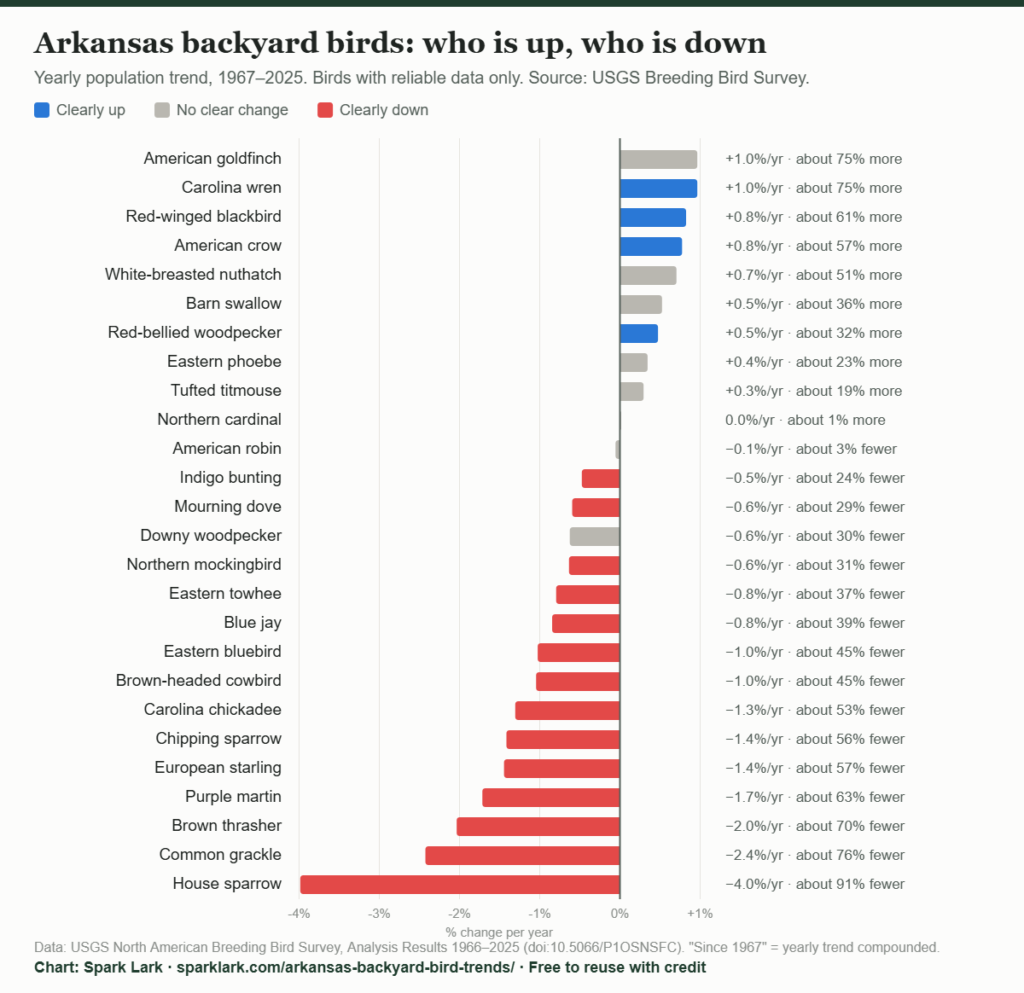
Of the 26 common backyard birds with reliable data in Arkansas, 14 have clearly declined since 1967 and 4 have clearly increased, according to our analysis of the U.S. Geological Survey’s newest Breeding Bird Survey results. The biggest clear gain is the Carolina wren, with about 75% more since 1967. The steepest clear drop is the house sparrow, with about 91% fewer since 1967. Below is every backyard species, a chart you can reuse, and a free spreadsheet of all 137 species the survey tracks in Arkansas.
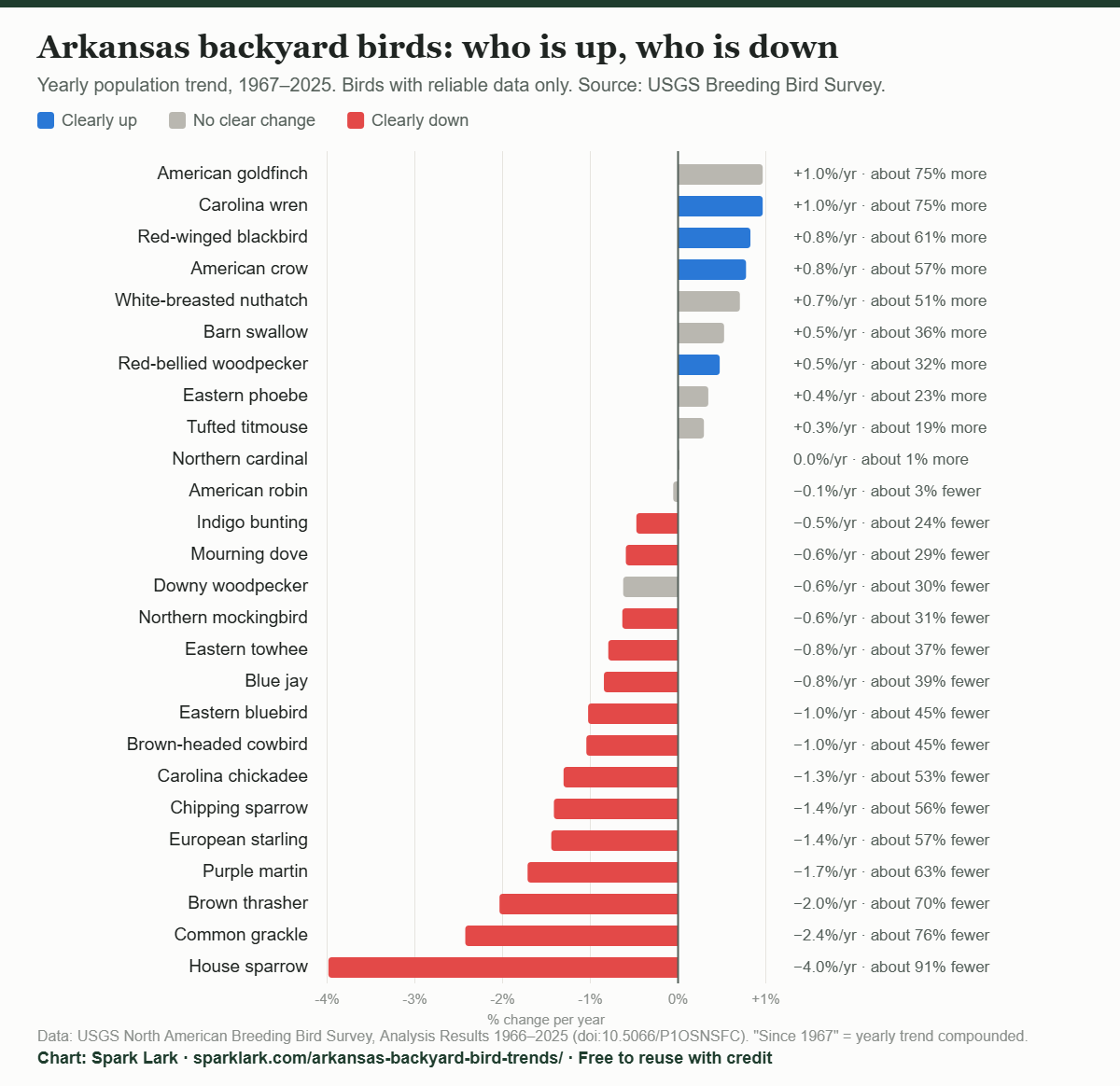
The short version
- Doing better: Carolina wren (about 75% more), red-winged blackbird (about 61% more), American crow (about 57% more).
- Falling the most: house sparrow (about 91% fewer), common grackle (about 76% fewer), brown thrasher (about 70% fewer).
- State bird: Arkansas’s northern mockingbird is clearly down, with about 31% fewer than in 1967.
- No clear change: 8 of the 26, where the survey can’t tell a real rise or fall from year-to-year noise.
- Compared with the U.S.: 54% of Arkansas’s backyard birds are clearly down, a larger share than the country as a whole (23 of 50 backyard birds nationally, or 46%).
Every backyard bird in Arkansas, from biggest gain to steepest drop
| Bird | Trend per year | Change since 1967* | Result |
|---|---|---|---|
| American goldfinch | +1.0% | about 75% more | No clear change |
| Carolina wren | +1.0% | about 75% more | Clearly up |
| Red-winged blackbird | +0.8% | about 61% more | Clearly up |
| American crow | +0.8% | about 57% more | Clearly up |
| White-breasted nuthatch | +0.7% | about 51% more | No clear change |
| Barn swallow | +0.5% | about 36% more | No clear change |
| Red-bellied woodpecker | +0.5% | about 32% more | Clearly up |
| Eastern phoebe | +0.4% | about 23% more | No clear change |
| Tufted titmouse | +0.3% | about 19% more | No clear change |
| Northern cardinal | 0.0% | about 1% more | No clear change |
| American robin | −0.1% | about 3% fewer | No clear change |
| Indigo bunting | −0.5% | about 24% fewer | Clearly down |
| Mourning dove | −0.6% | about 29% fewer | Clearly down |
| Downy woodpecker | −0.6% | about 30% fewer | No clear change |
| Northern mockingbird | −0.6% | about 31% fewer | Clearly down |
| Eastern towhee | −0.8% | about 37% fewer | Clearly down |
| Blue jay | −0.8% | about 39% fewer | Clearly down |
| Eastern bluebird | −1.0% | about 45% fewer | Clearly down |
| Brown-headed cowbird | −1.0% | about 45% fewer | Clearly down |
| Carolina chickadee | −1.3% | about 53% fewer | Clearly down |
| Chipping sparrow | −1.4% | about 56% fewer | Clearly down |
| European starling | −1.4% | about 57% fewer | Clearly down |
| Purple martin | −1.7% | about 63% fewer | Clearly down |
| Brown thrasher | −2.0% | about 70% fewer | Clearly down |
| Common grackle | −2.4% | about 76% fewer | Clearly down |
| House sparrow | −4.0% | about 91% fewer | Clearly down |
*Our calculation: the USGS yearly trend compounded over the survey years (1967–2025). Treat it as a rough size of the change. Source: U.S. Geological Survey, The North American Breeding Bird Survey, Analysis Results 1966–2025 (public domain). Spark Lark analysis. On a phone, swipe the table sideways.
Free spreadsheet: all 137 species in Arkansas
The table above covers backyard birds only. The spreadsheet has every species the survey reports for Arkansas: 137 in all, with the yearly trend, its 95% credible range, the number of survey routes, and the USGS data-quality flag for each one. Rows USGS flags as weak are included and labeled, so check that column before you quote a number.
Using this chart or data
Reporters, teachers, Audubon chapters and bird clubs are welcome to use the chart and the spreadsheet in stories, newsletters, classes and websites, free. Please credit “Spark Lark analysis of USGS Breeding Bird Survey data” and link to this page. If you need a species or a time period that isn’t here, get in touch.
Where these numbers come from
The North American Breeding Bird Survey is a volunteer count run in the U.S. by the USGS. Each June, observers drive fixed roadside routes and count every bird they see or hear at 50 stops. USGS scientists turn those counts into a yearly trend for each species in each state. We used the 2026 release, which covers 1967 to 2025 in Arkansas, and in the table above kept only the estimates USGS rates as reliable: at least 14 routes, enough birds and enough precision (no data-quality warning). “Clearly up” or “clearly down” means the trend’s 95% credible range sits entirely above or below zero, using USGS’s own significance flag.
Two limits matter. This is a June count, so it tracks birds that nest in Arkansas, not winter visitors at your feeder. And a trend shows how much a bird changed, not why.
More on backyard bird trends
- More state pages: New York, Oregon, Pennsylvania and New Jersey.
- See how Arkansas compares with every other state: backyard birds declining in your state.
- Count your feeder birds this winter with our free FeederWatch tally sheet.
- Learn who’s visiting with our backyard bird ID chart by color.