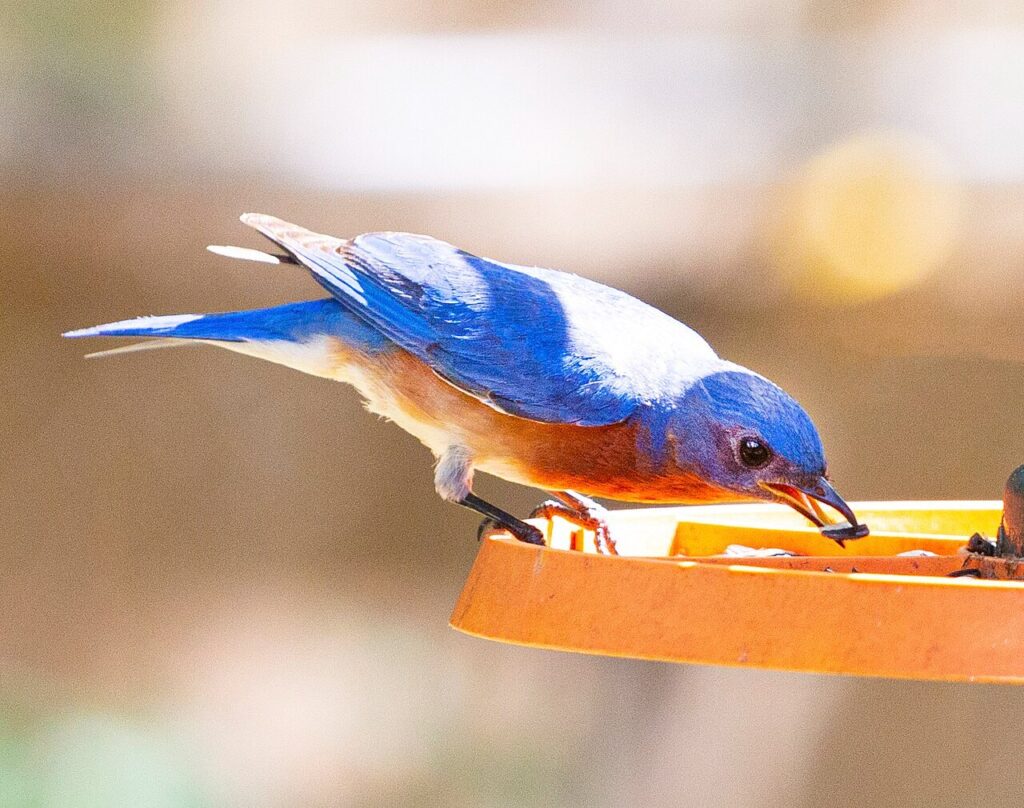
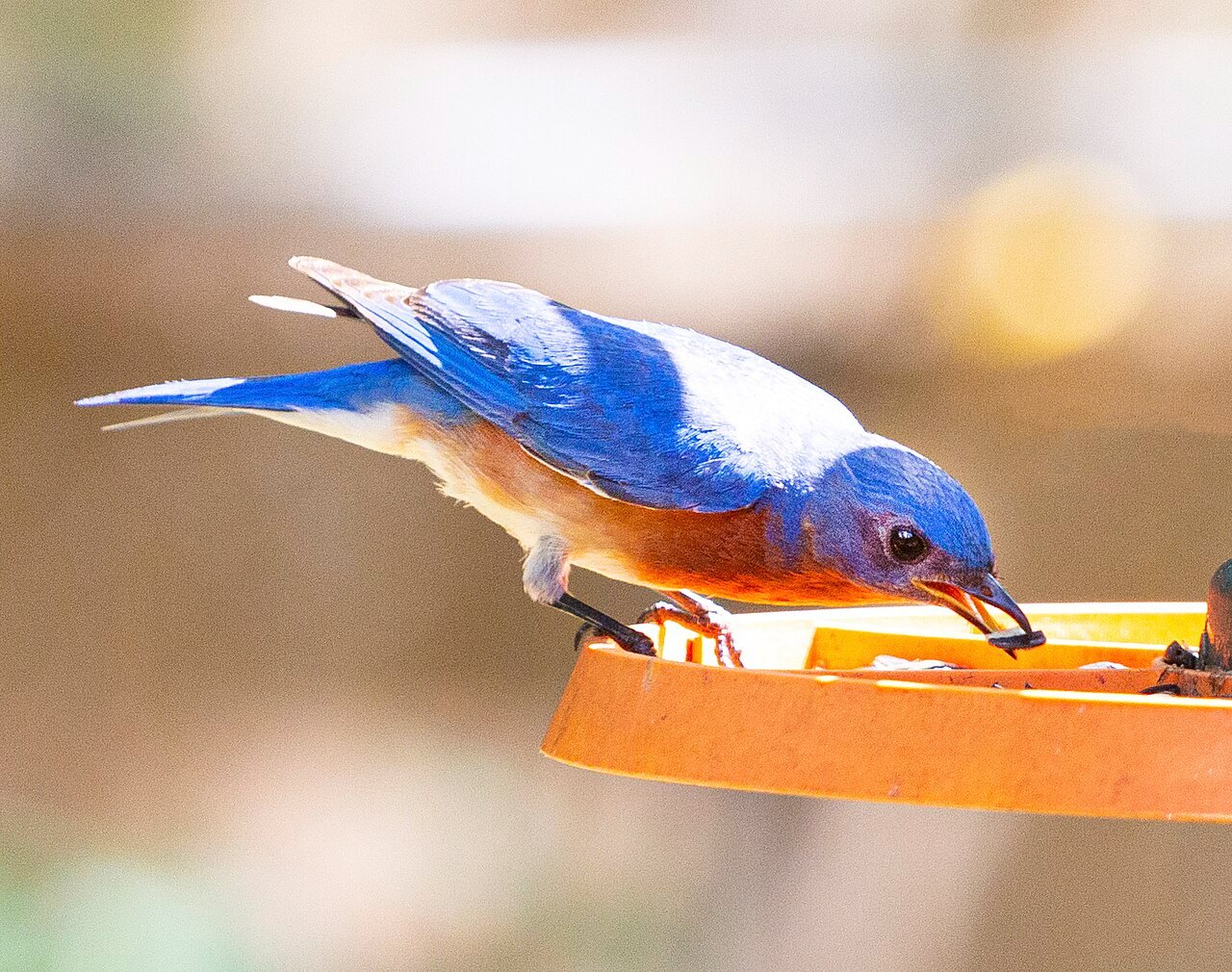
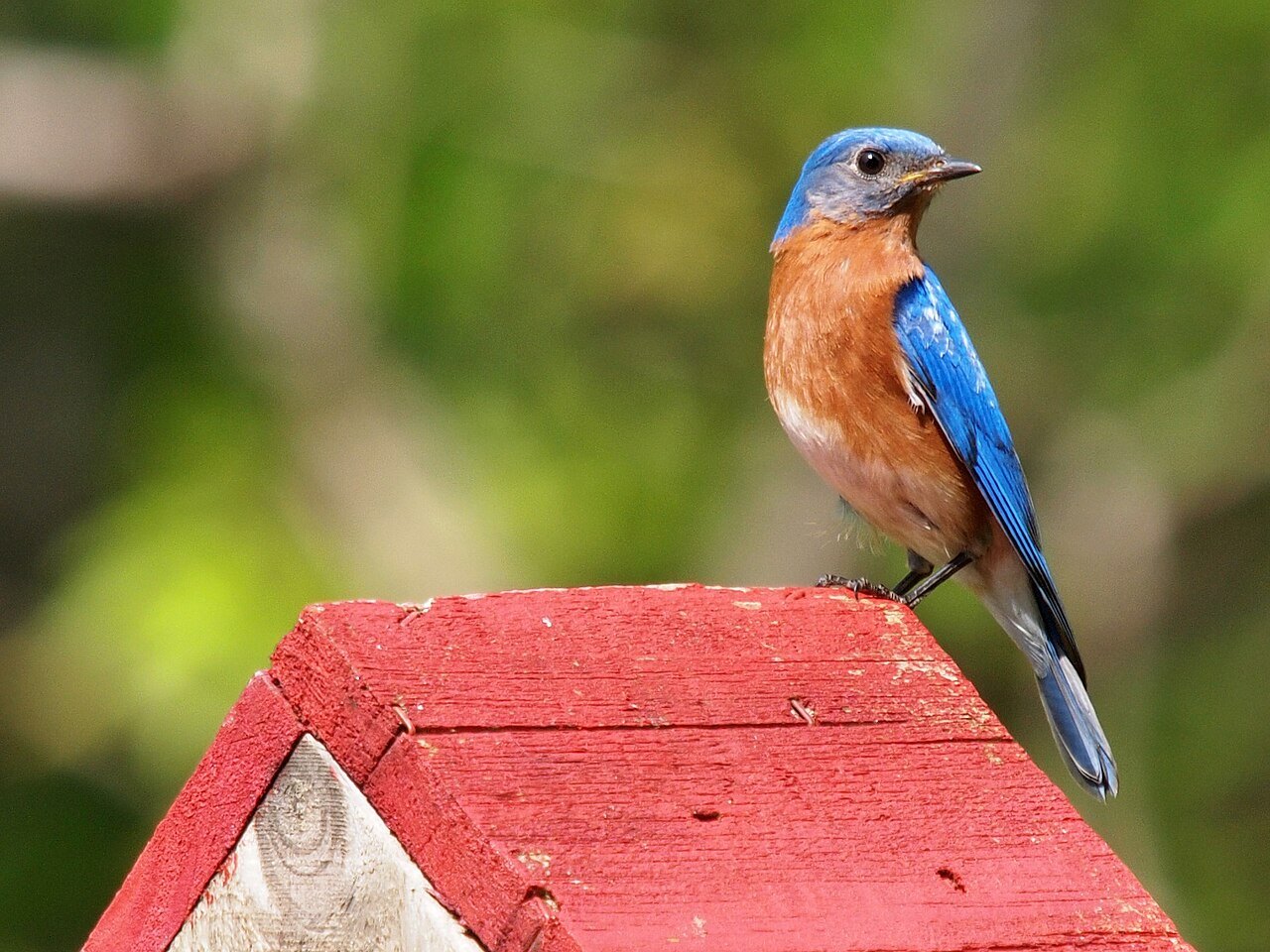
Bluebirds don’t eat seed. That is the whole reason a yard full of feeders can go years without one, and why a $25 mealworm feeder changes it in a week. Eastern, western and mountain bluebirds all take dried or live mealworms, and once a pair learns where the dish is they come back every morning, bring the fledglings in June, and stay through a winter they would otherwise leave.
The feeders below are the six worth buying, ranked by how well they keep the mealworms for the bluebirds and away from the starlings, robins and squirrels that will otherwise clean the dish out before breakfast. Then the mealworms themselves, and the three things that decide whether bluebirds ever find the feeder at all. Prices are Amazon list prices on September 21, 2026.
Spark Lark is reader-supported. As an Amazon Associate we earn from qualifying purchases made through links on this page, at no extra cost to you.
The short version
- Best overall: Kingsyard bluebird feeder ($24.99). Metal roof, glass dish, 1.5-inch entry holes that let bluebirds in and keep starlings out; 1,700 reviews.
- Best wood: cedar hanging bluebird feeder ($41.50). Classic cedar house with a clear front so you can see the dish; U.S.-made.
- Buy-it-once: recycled-plastic bluebird feeder ($52.00). Poly lumber, never rots, hangs or post-mounts.
- The starling answer: starling-proof barrier-guard feeder ($83.99). A cage sized so only bluebird-and-smaller birds get to the cup. Expensive; works.
- Simplest: Hummble hanging glass cup ($20.99). A 3.4-ounce glass dish on a hanger. Bluebirds learn it in a day; so does everything else.
- Budget: Kingsyard metal mealworm feeder ($16.89). Metal mealworm tube with a lid, a clear window and a wide perch; fine where starlings aren’t a problem.
- Mealworms: Kaytee dried mealworms ($6.49 to start), then a 10-pound bag ($38.24) once they’re coming daily.
What the feeder has to do
Three things. Hold a small dish of mealworms up off the ground where a bluebird will see it from a perch. Keep rain out, because wet dried mealworms mold in a day. And, in most of the country, keep out European starlings, which are bigger than bluebirds, travel in flocks and will empty a $6 bag of mealworms in one visit.
The starling part is what separates a $20 feeder from a $50 one. Bluebirds fit through a 1.5-inch hole; starlings don’t. So the good bluebird feeders are little houses with a roof, a clear side, and round entry holes at that size. The cheap ones are open dishes, which work fine until the first starling finds them.
Bluebirds also need somewhere to nest and something to drink. A nest box within fifty feet of the feeder and a bird bath in sight of both is the setup that keeps a pair on your property all year; our bird bath guide covers the water side.
The feeders
1. Kingsyard bluebird feeder — best overall
$24.99 · metal roof and frame · glass dish · two 1.5-in entry holes · 4.3 stars, 1,720 reviews
A small metal house with a glass mealworm dish inside and a 1.5-inch round entrance on each end. The size does the work: bluebirds, chickadees, wrens and titmice go in; starlings, robins, jays and grackles stand outside and complain. The roof lifts to refill, the glass dish lifts out to wash, and it hangs from a hook or a shepherd’s crook. At $25 it is the feeder most people should buy and the one with the most owners behind it.
Downside: a few reviewers report bluebirds taking a couple of weeks to try the holes. Bait it by putting a few mealworms on the roof for the first days, then move them inside.
2. Cedar hanging bluebird feeder — best wood
$41.50 · western red cedar · clear acrylic front · 1.5-in entry holes · 4.4 stars, 1,300 reviews
The traditional design in cedar, with a clear front panel so the bluebird can see the mealworms from outside and you can see the bluebird from the kitchen. Two 1.5-inch holes, a hinged roof, a removable dish. Cedar weathers to gray and lasts a decade; the acrylic front is the piece that eventually clouds. Made in the U.S.
Downside: the acrylic panel is glued and can pop in a hard freeze. Pricier than the Kingsyard for the same function; you’re paying for the wood.
3. Recycled-plastic bluebird feeder — buy it once
$52.00 · recycled poly lumber · clear side panels · hang or post-mount · 4.4 stars, 735 reviews
Same house shape in recycled plastic lumber, the material that outlasts cedar because nothing eats it and it never rots. Clear sides, a lift-off roof, a dish, and a base you can screw to a post as well as hang. It is the feeder for someone who has already replaced a wooden one.
Downside: the most expensive of the house-style feeders, and the plastic look isn’t for everyone. Same 1.5-inch holes, same learning curve.
4. Starling-proof barrier-guard feeder — the starling answer
$83.99 · steel cage around a glass cup · hangs · 4.3 stars, 730 reviews
Instead of a house, a wire cage around a mealworm cup, with the bars spaced so a bluebird slips through and a starling can’t. Bluebirds take to it faster than the enclosed houses because they can see the food from every angle and there is no hole to work out. In a yard where starlings show up in twenties, it is the only feeder here that stays full until the bluebirds arrive.
Downside: eighty-four dollars for a wire cage and a cup. And it is not squirrel-proof; a squirrel reaches through. Hang it from a baffled pole.
5. Hummble hanging glass cup — simplest
$20.99 · 3.4-oz glass cup · steel hanger · 4.6 stars, 220 reviews
A glass cup on a steel ring, and that’s all. Bluebirds learn an open dish in a day, which makes this the best first feeder for training a pair to your yard; once they’re coming, move the mealworms into an enclosed feeder. It is also the right feeder for the West and for rural yards where starlings are scarce.
Downside: open to everything: rain, robins, starlings, and the mockingbird that will guard it as its own. A 3.4-ounce cup holds one morning’s worth.
6. Kingsyard metal mealworm feeder — budget
$16.89 · metal tube with lid and wide perch · hangs · 4.1 stars, 613 reviews
A metal mealworm tube with a lid on top, a clear window so you can see the level, and a widened perch. Cheaper than the enclosed Kingsyard, the lid keeps the rain off, and drainage holes in the base let water out. For a yard without starling pressure it does everything the $25 feeder does.
Downside: no entry restriction, so starlings and robins use it as freely as bluebirds. The dish is fixed; you wash it in place.

The mealworms
Dried mealworms are what the feeders are built for: no refrigeration, no escapes, and bluebirds take them once they’ve learned. Start with a 7-ounce bag of Kaytee ($6.49, 12,500 reviews) to find out whether you have bluebirds at all. Once they’re daily, buy in bulk: a 2-pound bag runs $19.99 and a 10-pound bag from kimoe is $38.24, about a third the per-pound price. Ten pounds lasts a single pair most of a year.
Two rules. Feed a tablespoon or two, morning and evening, not a full dish; a full dish feeds the starlings and grows mold. And soak a few in water for ten minutes during nesting season (May through July), because nestlings can’t handle dry ones. Live mealworms work faster for training but need a fridge and a lidded dish; most people go dried and stay dried.
Side by side
| Feeder | Price | Type | Starling-proof | Rain | Squirrels |
|---|---|---|---|---|---|
| Kingsyard bluebird feeder | $24.99 | Enclosed house, metal | Yes | Roofed | Can raid |
| Cedar hanging | $41.50 | Enclosed house, cedar | Yes | Roofed | Can raid |
| Recycled plastic | $52.00 | Enclosed house, poly | Yes | Roofed | Can raid |
| Barrier-guard | $83.99 | Caged cup | Yes | Open | Reach through |
| Hummble glass cup | $20.99 | Open cup | No | Open | Yes |
| Kingsyard metal tube | $16.89 | Lidded tube | No | Roofed | Yes |
Getting bluebirds to find it
Put it where they already are. Bluebirds hunt from a perch over open ground: a fence line, a lawn edge, a pasture. A feeder in a thicket of shrubs, next to the busy seed feeders, doesn’t get found. Mount it on a pole in the open, twenty to fifty feet from a nest box or the fence post you’ve seen one sit on.
Bait it for a week. Put a few mealworms on top of the feeder and a few on the ground below it. When those go, move them to the dish. When you see the first bluebird on the dish, go to twice-daily feeding at the same times; they learn a schedule fast and will be waiting.
Add a box and water. A nest box within sight of the feeder, and a bath, are what turn a visiting pair into a resident one. For the box side, our beginner’s guide covers what to buy first; for the water, the bird bath guide.
Bottom line
Start with the $25 Kingsyard and a $6 bag of Kaytee mealworms. If bluebirds are slow to use the holes, hang the glass cup beside it for a week to train them, then take the cup down. If starlings are a plague, the barrier-guard cage is the fix and worth the $84. Feed a tablespoon at a time, twice a day, and buy the 10-pound bag once you’re sure.