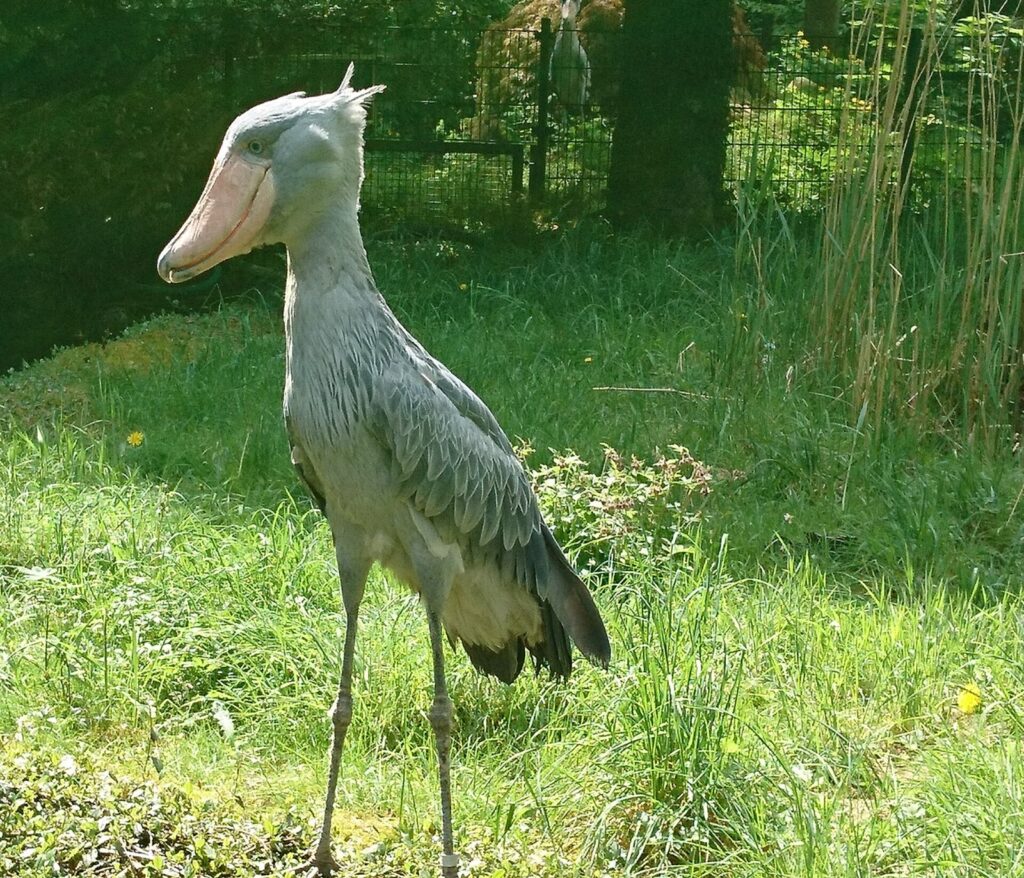
The shoebill is a real bird: a gray, 3½- to 5-foot-tall swamp hunter from East and Central Africa with a bill shaped like a giant wooden clog. It can stand without moving for long stretches while it waits for a fish, then collapses forward onto its prey. That stillness, the huge bill and a fixed, staring look are why videos and GIFs of shoebills have been spreading online for more than a decade. Here’s what a shoebill is, how big it really gets, what it eats, why it went viral, and whether you can see one in the United States.
The short version
- What it is: a large wading bird (Balaeniceps rex) of African swamps. Despite the old name “shoebill stork,” DNA and eggshell studies place it closer to pelicans than to storks, per Mental Floss.
- How big: 3.5 to 5 feet tall with a wingspan of about 7.7 to 8 feet, and 11 to 12 pounds (ZooTampa, San Diego Zoo Wildlife Alliance).
- What it eats: mostly big fish such as lungfish, catfish and tilapia, plus water snakes, frogs, monitor lizards and young turtles.
- Why it went viral: the “death stare,” the slow head turn toward the camera, and a loud bill-clattering sound.
- Can you see one in the US? Not in the wild. Shoebills live only in Africa. In the US, ZooTampa at Lowry Park in Florida lists the shoebill among its animals.
How big is a shoebill?
Shoebills look like monsters in close-up videos, so we put real numbers next to big birds Americans can see in the wild. The chart below compares the shoebill’s published wingspan and weight with six large US birds, using San Diego Zoo Wildlife Alliance and ZooTampa for the shoebill and the Cornell Lab of Ornithology’s All About Birds for the US species.
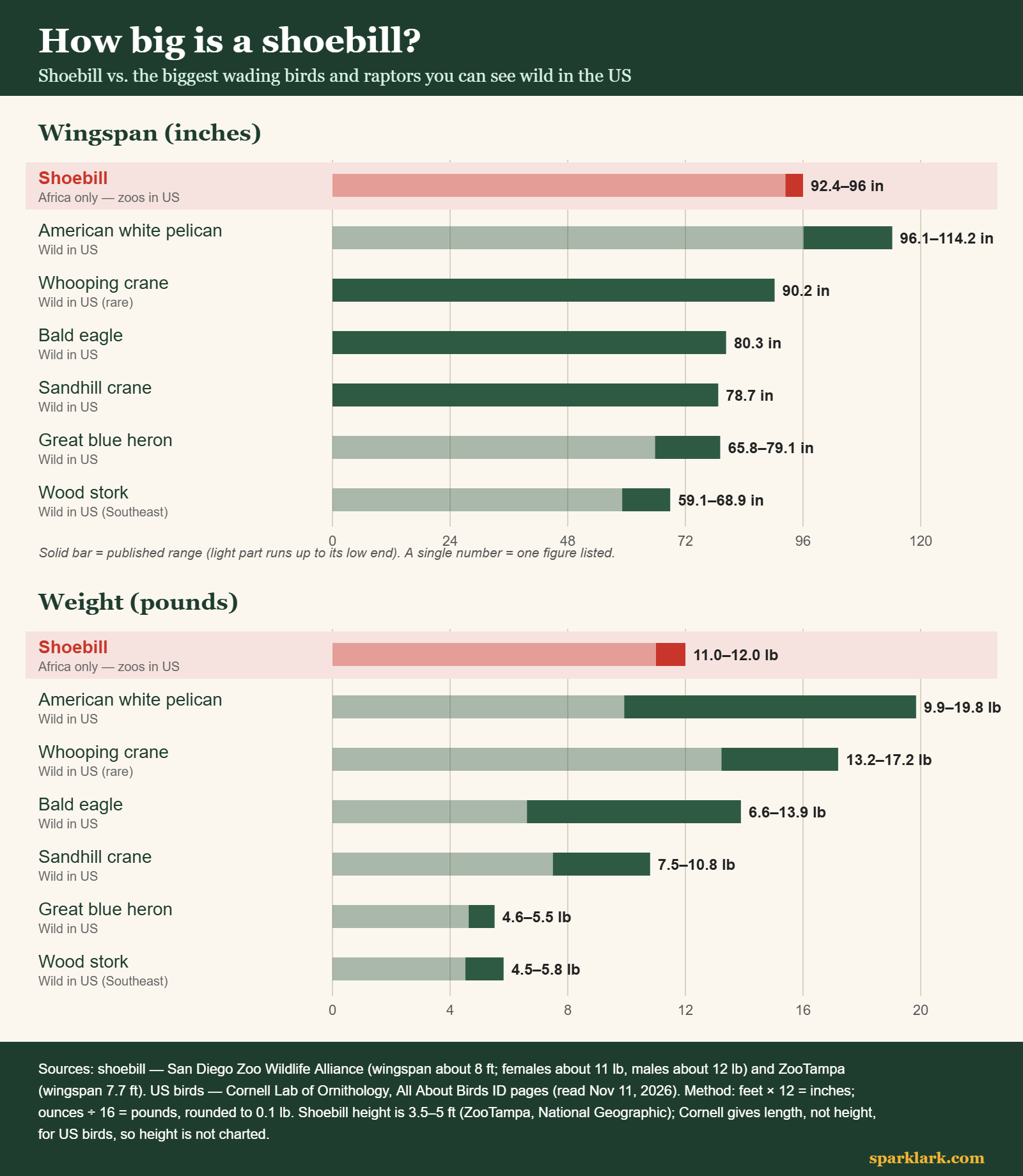
What the numbers show:
- Wingspan: at roughly 92 to 96 inches, a shoebill’s wings are wider than a bald eagle’s (80.3 inches) or a great blue heron’s (65.8 to 79.1 inches), and about level with a whooping crane’s (90.2 inches). Only the American white pelican, at 96.1 to 114.2 inches, beats it on our chart.
- Weight: 11 to 12 pounds is more than twice a great blue heron (4.6 to 5.5 pounds) and inside the bald eagle’s range (6.6 to 13.9 pounds).
- Height: ZooTampa and National Geographic give 3.5 to 5 feet; San Diego Zoo Wildlife Alliance says 3.5 to 4.5 feet, or “taller than a mailbox.” Cornell lists length rather than height for US birds, so we left height off the chart instead of mixing the two.
Shoebill quick facts
| Fact | Shoebill | Source |
|---|---|---|
| Scientific name | Balaeniceps rex | ZooTampa |
| Height | 3.5–5 ft | ZooTampa, National Geographic |
| Wingspan | 7.7–8 ft | ZooTampa, San Diego Zoo Wildlife Alliance |
| Weight | About 11 lb (female), 12 lb (male) | San Diego Zoo Wildlife Alliance |
| Bill | Over 7 in long and nearly as wide (SDZWA); National Geographic says about a foot long | SDZWA, National Geographic |
| Home | Swamps and marshes of East and Central Africa, from South Sudan and Ethiopia to Zambia | SDZWA, National Geographic |
| Main food | Lungfish, catfish, tilapia, eels; also snakes, frogs, monitor lizards, young turtles | SDZWA, ZooTampa |
| Eggs | 1–3 (usually 2); both parents incubate about 30 days | SDZWA |
| Lifespan | Up to about 35 years | SDZWA, ZooTampa |
| Status | Vulnerable (IUCN); about 3,300–5,300 mature birds | SDZWA, National Geographic |
Is a shoebill a stork?
Not really. “Shoebill stork” is a common nickname, and naturalists argued for a long time over whether the bird was a heron or a stork. Mental Floss (Kat Long, 2019) reports that eggshell and DNA studies now place the shoebill in the order Pelecaniformes, the group that includes pelicans, and that it may be more closely related to pelicans than to storks. The name in older sources is colorful too: Audubon reports that Arabic speakers called it Abu Markhub, “father of a slipper.”
Why does a shoebill have such a big bill?
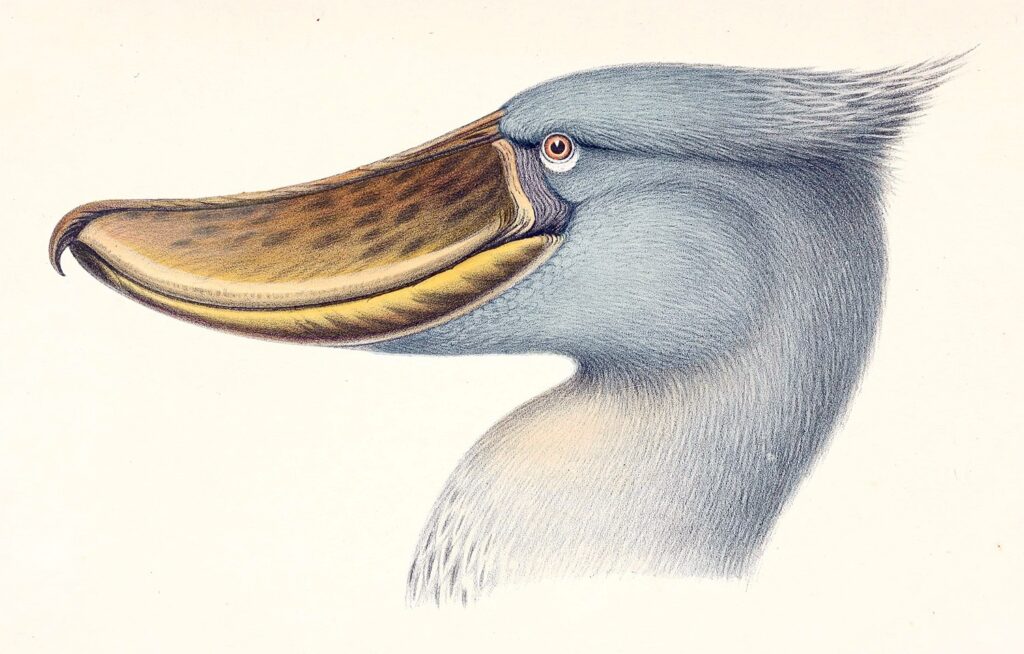
The bill is a fish trap. Shoebills hunt in shallow water with tall vegetation for cover, and they either stand and wait or walk very slowly until they spot prey, per ZooTampa. San Diego Zoo Wildlife Alliance calls the method “freeze and seize”: when the moment comes, the bird lunges and drops its full body weight onto the prey, and the bill takes most of the impact.
That lunge scoops up more than lunch. Audubon describes the shoebill coming up with water, mud and plants along with the fish, shaking its head to get rid of the extras, and using the sharp edges of its bill to cut off the prey’s head before swallowing. Its favorite target is the lungfish, according to ZooTampa, and shoebills often hunt in water low in oxygen, where fish have to come up for air more often.
The deep-water problem explains where they live. The tactic doesn’t work well in deep water, so shoebills stick to shallow swamps, such as the papyrus swamps of the Sudd in South Sudan and marshy lake edges in Uganda (SDZWA).
Why did the shoebill go viral?
Mostly because it looks like it’s judging you. The meme tracker Know Your Meme traces shoebill posts back to a 2006 forum thread, then lists the moments that made it famous:
- The head turn (2014): a Reddit GIF of a shoebill slowly turning to face the camera.
- The bow (2015): a YouTube video of a shoebill bowing to a man.
- The chicks (2016): a BBC Earth Planet Earth clip of shoebill chicks fighting.
- The anime (2017): a shoebill character in the anime series Kemono Friends, followed by a GIF of a bathing shoebill that passed 47,600 points on Reddit within a week.
Then there’s the sound. Shoebills are mostly silent, but pairs greet each other by clattering their bills (ZooTampa), and Audubon compares the noise to machine-gun fire. Adults may also make “mooing” noises, and chicks hiccup when begging for food, ZooTampa says. Pair that with a bird that can hold still for long periods and you get the “death stare” reputation, which Audubon played up in its 2016 headline calling the shoebill “the most terrifying bird in the world.”
The fandom is real offline, too. Tokyo’s official travel site, GO TOKYO (Aug. 2026), calls the shoebill “one of Ueno Zoo’s most popular residents.” The zoo has four of them and added a shoebill-themed cart ride in April 2026.
Odd shoebill habits that sound made up
- Egg-watering: a parent fills its bill with water or wet grass, pours it over the nest and rolls the eggs to keep them cool (ZooTampa). SDZWA says this can happen four to five times a day.
- Cooling off the gross way: shoebills squirt liquid waste onto their own legs, and the evaporation cools them down (SDZWA, Audubon).
- Loners: shoebills are almost never found in groups, and even a breeding pair forages at opposite sides of its territory (ZooTampa).
- One chick: pairs usually lay two eggs, but usually only one chick survives, and they don’t lay a replacement clutch if it dies (SDZWA).
- Floating nests: nests sit on floating plants or a solid island such as an old termite mound, and a floating nest can sink, so the birds keep adding material (SDZWA). National Geographic says a nest can be up to 8 feet wide.
Can you see a shoebill in the US?
Not in the wild. Shoebills live only in the swamps of East and Central Africa and don’t migrate, according to ZooTampa, so there is no wild shoebill to find anywhere in North America.
In a zoo: ZooTampa at Lowry Park in Tampa, Florida, lists the shoebill on its animal pages (read Nov. 11, 2026). When the zoo reopened its shoebill habitat in 2021, FOX 13 Tampa Bay reported it had three shoebills, three of only four in the US at the time, and that in 2009 it became the first wildlife institution in North America to hatch a shoebill outside its native range. Zoo animals can move between facilities or go off display, so check the zoo’s website before you plan a trip around one. We have not confirmed any other US zoo from a zoo’s own page.
Big wild waders closer to home: the great blue heron and, in the Southeast, the wood stork are the tall fish-eating birds on our chart that you can find in the wild here. Both are less than half a shoebill’s weight. If you’re near Maine, read how birders told a rare gray heron from a great blue heron.
Are shoebills endangered?
The IUCN lists the shoebill as Vulnerable, one step below Endangered, with an estimated 3,300 to 5,300 mature birds left and a declining population (SDZWA, National Geographic). San Diego Zoo Wildlife Alliance names habitat loss, human disturbance and illegal trade as the threats. Some news stories call the shoebill “critically endangered”; that isn’t the IUCN listing reported by those two sources.
Shoebill FAQ
Are shoebills dangerous to people? None of the zoo or conservation sources we read describe shoebills attacking people. They hunt fish and other animals in the water. Like any large wild bird, they should be watched from a distance. (For a US comparison, see are hawks dangerous to humans.)
Do shoebills really eat baby crocodiles? Sometimes. San Diego Zoo Wildlife Alliance lists young crocodiles as less common prey; most of the diet is fish.
Can a shoebill fly? Yes. ZooTampa says they soar on thermals above their territory and make short moves between nesting and feeding areas.
How long do shoebills live? Up to about 35 years, per SDZWA and ZooTampa. National Geographic says up to 50 in captivity.
Why is it called a shoebill? Its bill is shaped like a shoe or clog. The old Arabic name reported by Audubon, Abu Markhub, means “father of a slipper.”
Bottom line
The shoebill went viral for its stare, and that stillness is how it hunts: stand still, wait for a lungfish to surface, then fall on it with a bill built like a clog. It’s an African swamp bird with a wingspan wider than a bald eagle’s, and the only way to see one in the US is at a zoo such as ZooTampa. For more internet-famous birds, see the big-eyed potoo that poses as a branch, why a wet owl looks so skinny, and the fluffy shima enaga. To name the birds in your own yard, print our free backyard bird ID chart by color.