
In most suburban yards a bird bath brings in more species than a feeder does. Robins, bluebirds, warblers, catbirds, thrushes, and waxwings rarely touch seed, but every one of them needs to drink and bathe, and in a neighborhood where the nearest clean water is a storm drain, a shallow basin of fresh water is the best thing on the block. This guide covers what makes a bath birds will actually use, which styles work, the five we’d buy, and the questions readers have sent us over the years about depth, cleaning, copper, fountains, winter, and why the birds sometimes stop coming.
Spark Lark is reader-supported. As an Amazon Associate we earn from qualifying purchases made through links on this page, at no extra cost to you.
The short version
- Best overall: Best Choice Products 28-inch resin pedestal bath. Light enough to move, a hollow base you fill with sand so it doesn’t tip.
- Best for decks and apartments: Hanizi 12-inch deck-mounted bath. Clamps to a railing, bowl lifts out to rinse in the sink.
- Best for winter: heated bird bath with three mounting options. Thermostat keeps water open below freezing.
- Best cheap upgrade: Mellbree pure copper disc. Drop it in and algae grows far slower.
- Best for moving water: Mademax solar fountain, with a caveat about sun explained below.
What a bird actually wants from a bath
Birds bathe in puddles. Everything that makes a bath work is a puddle imitation: shallow, gently sloped, rough enough to grip, and still enough that a bird can judge the depth before it commits. Get four things right and the material, color, and style barely matter.
Depth. One inch at the edge, no more than two inches in the center. Songbirds are small; a chickadee bathing in three inches of water is a chickadee that can’t touch bottom. Most store-bought baths are too deep. Fix it with a layer of flat stones or pea gravel in the basin, or by simply not filling it all the way. A few larger rocks that break the surface give the birds somewhere to stand and drink without getting wet, and that alone doubles the traffic.
Grip. A glazed, slick bowl is a bird’s least favorite thing. Concrete, unglazed terra cotta, rough resin, or a smooth bowl with gravel in it all work. If you bought a pretty glazed one, the gravel fixes it.
Stability. A bath that rocks or wobbles gets used once. Pedestal baths need a level base; resin ones need the hollow pedestal filled with sand. Hanging baths swing and most birds avoid them until they’re desperate.
Cover nearby, not overhead. Birds want a shrub or low branch within ten to fifteen feet to retreat to, and a clear view in every direction while they’re wet and slow. Directly under a tree is bad on two counts: it drops leaves and droppings into the water, and it gives a cat a launch pad. Dappled shade a few feet from cover is the spot.
Bath styles, and who each one is for
Pedestal
The classic. Birds recognize it, it’s stable, and it puts the water at a height cats can’t easily ambush. Concrete lasts decades but weighs 60 to 100 pounds and cracks if water freezes in it; resin weighs a tenth of that and survives winter if you empty it. The Best Choice Products 28-inch resin pedestal is the sensible default:, a 20-inch bowl, and a fillable base. Add gravel to the bowl and it’s done.
Deck-mounted
Clamps to a railing. It’s the right answer for apartments, condos, and anyone who wants to see the birds from a chair, and because it’s ten feet from the kitchen it actually gets cleaned. Downside: the birds are now on your deck, and so is everything they leave behind. Go 12 inches across at minimum; smaller bowls only fit one bird at a time and empty in a day. The Hanizi 12-inch deck bath has a steel clamp that fits rails up to two inches thick and a bowl that lifts out.
Ground level
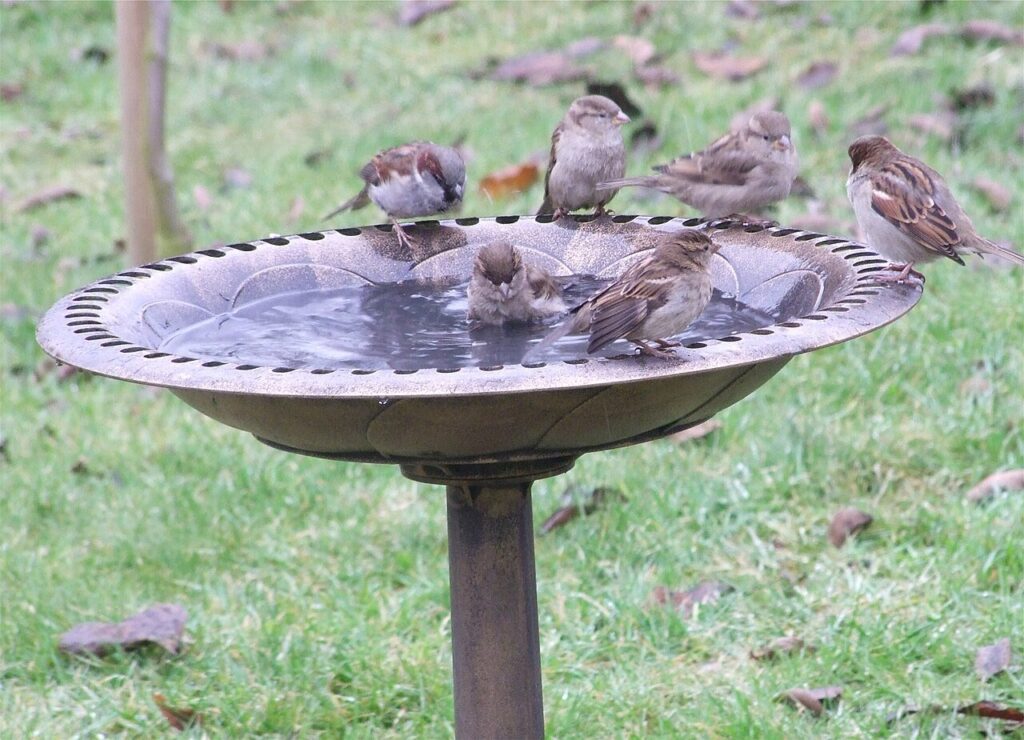
The one birds like best, because it’s the one that most resembles a puddle. Towhees, thrushes, sparrows, doves, and in the right yard even hawks use a ground bath that would never visit a pedestal. It’s also the cheapest: a large plant saucer, a shallow concrete basin, or a bowl set on a stump all work. The trade-offs are cats, which is why it needs open sightlines and no cover within six feet, and the raccoons and opossums that will also drink from it at night. A 14-inch heavy plastic bath bowl at 1.6 inches deep is exactly the right depth out of the box and sits on anything flat.
Hanging
Small, swings in wind, and needs refilling daily. Fine as a second water source on a balcony; a poor choice as the only one.
Materials: what matters and what doesn’t
Concrete is the most durable and the most bird-friendly surface, but it’s heavy and will crack if you let it freeze full. Resin is light, cheap, and lasts five to ten years in sun. Glazed ceramic looks best and is the slipperiest; add gravel. Metal bowls heat up in full sun. Copper is the one material that does something: it’s mildly biostatic, so algae grows slower in a copper bowl or with a copper disc in the water. The amount of copper that leaches into a bath is far below anything that affects a bird (fish are a different story; keep copper out of ponds). Bronze is a copper alloy and behaves the same way. Brass is copper and zinc and is also fine, with one exception: old or antique brass can contain lead, so don’t use a vintage brass bowl you can’t identify.
Color doesn’t matter much. Birds find water by sight and sound, not color. Earth tones and blues look natural; the only color worth avoiding is bright white, which reads as a warning in a lot of bird plumage. Decorative ceramic birds on the rim don’t scare real birds off; real birds ignore them.
Keeping it clean
This is the whole job. A dirty bath spreads disease; a clean one is the most-visited spot in the yard. The routine that works: dump and refill every day or two in summer (mosquito larvae need about a week of still water, so a bath refreshed twice a week never breeds them), and scrub once a week with a stiff brush and a splash of white vinegar or a 10 percent bleach solution, then rinse well. Birds don’t need vinegar in the water and it doesn’t help them; it’s a cleaning aid, not an additive. A tablespoon of diluted vinegar that ends up on nearby plants when you dump the bath won’t hurt them.
The one thing that cuts the scrubbing in half is a pure copper disc dropped in the bowl, and the algae film that used to show up in three days shows up in ten. It doesn’t replace cleaning. It stretches the interval.
Seeing birds sit with their bills open on hot days? That’s panting, and a shaded bath helps. Here’s why birds keep their mouths open, and when it signals a problem.
Moving water: fountains, drippers, and the shade problem
The sound of dripping or trickling water is the single most effective bird attractant there is. Migrating warblers that would fly straight over a still bath will drop out of the sky for a dripper. You have three options.
A dripper is a hose fitting that lets one drop fall every few seconds into the bath. It costs almost nothing to run, it keeps the water fresh, and it makes exactly the sound birds are listening for. The basic dripper kit is inexpensive.
A solar fountain floats in the bath and sprays when the sun is on it. Here’s the catch several readers have pointed out: we told you to put the bath in shade, and a solar pump needs full sun. Both are true, and the fix is to buy one with the solar panel on a cord rather than built into the float, so the bath sits in dappled shade and the panel sits in the sun six feet away. The Mademax fountain is the best-reviewed of a mediocre category; every solar fountain on the market stalls in clouds and stops when leaves land on the panel, so treat it as a nice-to-have, not the reason birds will come.
A plug-in pump is the reliable version if you have an outdoor outlet: it runs all day, all season, in any weather, and it’s what you’ll see at every serious birder’s bath.
Fall bird bath care: what to do, and what to skip
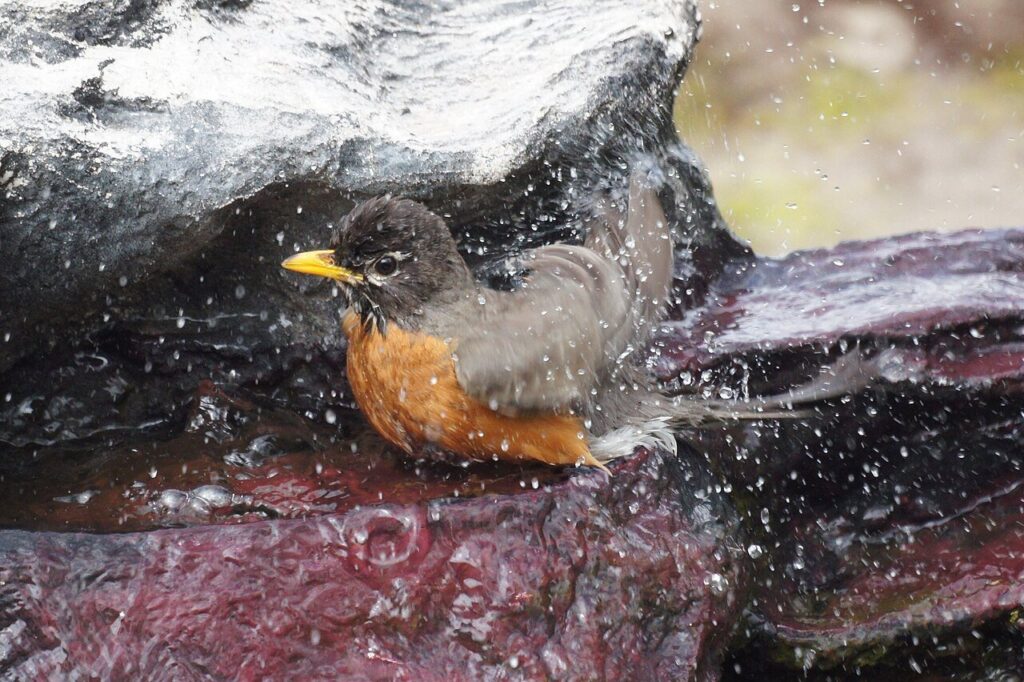
Fall is when a bird bath earns its keep. Migrants are passing through, puddles dry up, and resident birds start depending on reliable water. A few habits keep it working:
- Skim it daily. Falling leaves and seed hulls sink and rot fast, and that is what turns water green and slimy.
- Change the water every 2–3 days. Cooler weather slows algae, but it does not stop it.
- Scrub weekly. Use a stiff brush and a 9:1 water-to-white-vinegar mix, or 9:1 water-to-bleach for stubborn algae. Rinse until you cannot smell it, and let the bath dry in the sun before refilling.
- Keep it shallow. One to two inches, with a flat stone so small birds have footing.
- Skip the shortcuts. Never add antifreeze, salt, or glycerin to slow freezing. All three harm birds and strip the waterproofing from their feathers.
When should you empty your bird bath for the season?
Ideally, you don’t. In winter, open water is often harder for birds to find than food, so a heated bath or thermostat-controlled de-icer keeps birds coming all season. If you won’t heat it, empty concrete and ceramic baths before the first hard freeze, because ice expands and cracks them. Resin and plastic baths handle a freeze better, but an empty bath does birds no good, so bring it in until spring.
Winter: the bath that outdraws the feeder
North of the frost line, open water in January is rarer than food, and a heated bath pulls in bluebirds, robins, waxwings, and every feeder bird in the neighborhood. The heated bath with three mounting options (deck clamp, pedestal, or ground) has a built-in thermostat that runs the 60-watt element only when the water would freeze, so it costs a few dollars a month to run. If you already own a bath you like, a submersible de-icer does the same job in it.
Two winter rules: never add antifreeze, glycerin, or salt to keep water open (all three kill birds), and empty a concrete or ceramic bath before hard freezes if it isn’t heated, or the ice will crack it. Birds do bathe in winter; wet feathers dry fast in cold air and the bath is used more, not less. See our winter birds by region guide for who to expect.
Why are birds not coming to my bird bath?
Run down this list in order. It’s almost always one of the first three.
- Too deep. Add stones until the edge is an inch deep and the middle no more than two.
- Too new. A bath takes anywhere from a day to three weeks to be discovered. Adding a dripper cuts that to hours.
- Too exposed, or too hidden. No cover within fifteen feet and birds won’t risk it; cover within three feet and a cat will. Move it.
- Stale water. Green or cloudy water gets skipped. Dump, scrub, refill.
- A predator has moved in. If a bath that was busy goes dead overnight, a Cooper’s hawk or a neighbor’s cat has been working it. The birds come back within a week or two once the threat moves on; a second bath somewhere else in the yard helps in the meantime.
- It wobbles. Level the base, fill the pedestal, or set the bowl on something solid.
- Natural water is everywhere. In a wet spring, or on a rural property with ponds, a bath competes with a hundred puddles and traffic drops. It picks back up in a dry spell.
Reader questions
Can I use a tree stump as a base? It’s one of the best bases there is: heavy, natural, and near the ground where birds prefer to bathe. Level the top with a rasp or a shim, set a shallow concrete or plastic basin on it, and seal the cut surface with a coat of exterior sealer so it doesn’t rot from underneath.
What size bath for hawks? Red-tailed, red-shouldered, and Cooper’s hawks all bathe, and they’ll use a yard bath if it’s big enough: a ground-level or low concrete basin at least 24 inches across, two to three inches deep, with a rough rim they can grip. Keep it well away from your songbird bath, or the songbirds will stop coming to theirs.
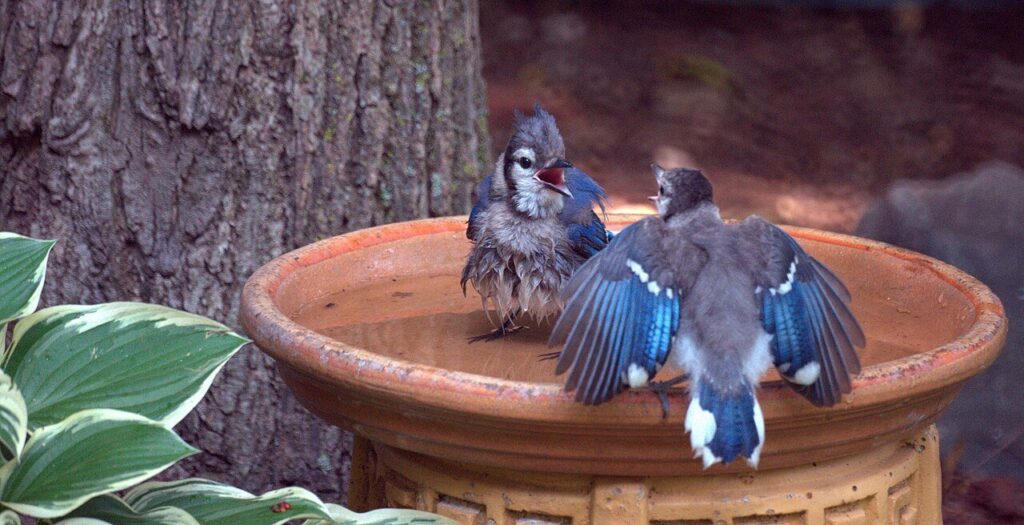
Can birds drown in a bird bath? Adults, essentially never, if the depth is right. Fledglings can get into trouble in a deep, slick basin, which is one more reason for the stones and the two-inch rule.
Do bird baths attract mosquitoes? Only if the water sits for a week. Change it every two or three days, or add a dripper or fountain, and they can’t complete a life cycle. Never use larvicide tablets meant for ponds in a bath.
Do bird baths attract snakes? Rarely, and only in the sense that anything attracting small birds and frogs interests a snake. A pedestal bath in the open is the least attractive setup for one; a ground bath next to a rock wall is the most.
Is tap water safe? Yes. If you can drink it, they can.
Why do birds poop in the bath? Because they poop everywhere, and they spend a lot of time in the bath. It’s another reason to clean it weekly and to put the bath where you won’t mind.
Thinking about a camera bath? See our review of the Birdfy Bath Pro, and for the vinegar question, apple cider vinegar in bird baths.
Bottom line
Buy a wide, shallow bath you’re willing to clean once a week, put it in dappled shade ten feet from a shrub, add a handful of stones, and keep the water fresh. That’s the whole recipe. The resin pedestal does it; a plant saucer on a stump does it for free. Add a dripper when you want more birds, a heater when it freezes, and a window feeder when you want to see them up close.
Related: Why you should keep your bird bath clean · Essential rules for attracting birds to your yard · Winter backyard birds by region
Follow @sparklarkbirding for daily backyard birding tips →

Hello Ms. Rose,
What diameter bird bath do you recommend for Hawks? We have Red Tail, Red Shoulder, and Cooper’s living in the hood. We have a small ground level bath (14″ diam) that the small birds all use. Hawks have approached, but will not use it. I think it is too close to the house, and might be too small.
Hi Ronn,
For birds of prey, they’ll likely prefer a ground-level bath that has thick edges to grip. I’d stick with a concrete basin with a diameter of 15 inches or more. The sturdiness of the concrete will help prevent the bath from wobbling while a hawk is using it. These birds also don’t like thin branches to perch on so a bath with a thicker edge will be easier for them to navigate.
I also agree that moving the bath away from your house is a good option since hawks typically don’t come close to windows or people’s dwellings.
Hope this helps,
Stephanie Rose
I’m confused. The article suggests keeping the birdbath in the shade so the water stays cool and then says adding a solar powered fountain is a good idea to attract birds. The bath needs to be in the sun if the fountain is going to work. ??
Hi Stephanie
Great post. Thanks for sharing your amazing knowledge on the topic.
I’m keen to purchase a deck bird bath but the ones I read about often say that the polyproylene plastic bowl cracks in winter. Are there any you can recommend?
Also, if the bowl was 11 or 12 inches in diameter and one bought a 6 inch solar fountail, would there be enough space for the birds to bath or would they just use it to drink?
Thanks again!
I live in a wooded area in NJ & I never knew I had so many hummingbirds. Only saw one in the 55 years I’ve lived here. I put out a hummingbird feeder & I love it! My problem is my birdbath which is a glass bowel with a peacock design but the feathered design looks like big black eyes. Could this be the reason I have never seen any kind of bird using it?
will a bird bath with decorative ceramic birds scare the real birds away from using the bird bath
Excellent information. Thank you.
I am very rural surrounded by Woodland and Savannah’s and ponds everywhere. ( at least before the drought)
Birds have been coming feeding from the hanging bird feeders for years. But…… I wanted to enjoy watching them Splash in the water from the porch. So I purchased a pedestal bird bath antique green and floating solar fountain. They would sit in a tree branch or on the feeders looking at it but wouldn’t use it. The Basin did not have gradual sides! So I cut the sides of a butter tub down 2 1/2″ tall, drilled holes around the sides near the bottom. The tub diameter was large enough for the pump part of the fountain to fit in. Then lined the bottom around that tub with aquarium type gravel. Also put some in the bottom of the tub to Anchor it. Then placed a larger sloping Rock in the basin as well. Yoo-hoo Birds had to wait their turn ?. So much so I have considered putting in a much larger cascading waterfall in the front yard. Now after reading I realize the bottom should be no more than a few inches above ground.
Thanks
By the way squirrels, raccoons, possums Maybe cute, but they are far from harmless! Squirrels well overrun a bird feeder keeping birds away. And can cost thousands of dollars in damage. And not just with dwellings but they love to eat the wiring harnesses of vehicles. ? If you try to keep free ranging chickens coons, possums will come in Kill Them All and eat very little.
Hi SR. Awesome article. I am slightly bewildered pretty much everything you have recommended I have done. But for a few days now I’ve had no birds it is 2 1/2 feet off the ground yellow plastic 14 inch wide, 3” max. Depth, fountain style fresh clean water , Half a day of sun, shrubbery cover no predators that I can discern. I have lots of robins in the yard and about 15 other species in Rockland county New York any advice would be greatly appreciated. 🙂
I do have a cat and two Rottweilers but the birdbath is 50 feet from the back door and the pets are not out here much. I’ll send a picture if that’s possible
Great article — very helpful! I am interested in setting up our first bird bath. Have a large-diameter low tree stump that I’d like to use as the base. I will need a sturdy basin (preferably at least 24″) to withstand the wind, so it sounds like concrete might be my best bet? Can you recommend sources for this type of basin? Thank you.
Are copper and bronze or brass safe materials for use in a bird bath?
Good morning. I have a bird bath in front of a trellis with a flowering vine, and have small flowers around the bottom. Will the vinegar in the water, even though it is a small amount, effect these plants?? I replace the water quite often. The bird bath is deep, so I put a clean brick in the center for the birds to perch for drinking. I like your idea about the rock for butterflies and bees to drink. Will add that to one side if that would be okay. Thank you.
A small amount of vinegar in the bird bath water is unlikely to significantly harm your plants, especially if you replace the water often. However, it’s best to be cautious. Here are a few tips:
Dilution: Ensure the vinegar is well-diluted. A ratio of about one tablespoon of vinegar per gallon of water should be safe.
Avoid Overflow: Try to avoid water spilling out of the bird bath and onto the plants directly. This will minimize any potential impact.
Monitor Plants: Keep an eye on your plants for any signs of distress. If you notice any issues, you might want to reduce or eliminate the vinegar.
Adding a rock for butterflies and bees to drink from is a great idea and should be fine. Just ensure the rock is stable and partially submerged to provide a safe landing spot for the insects.