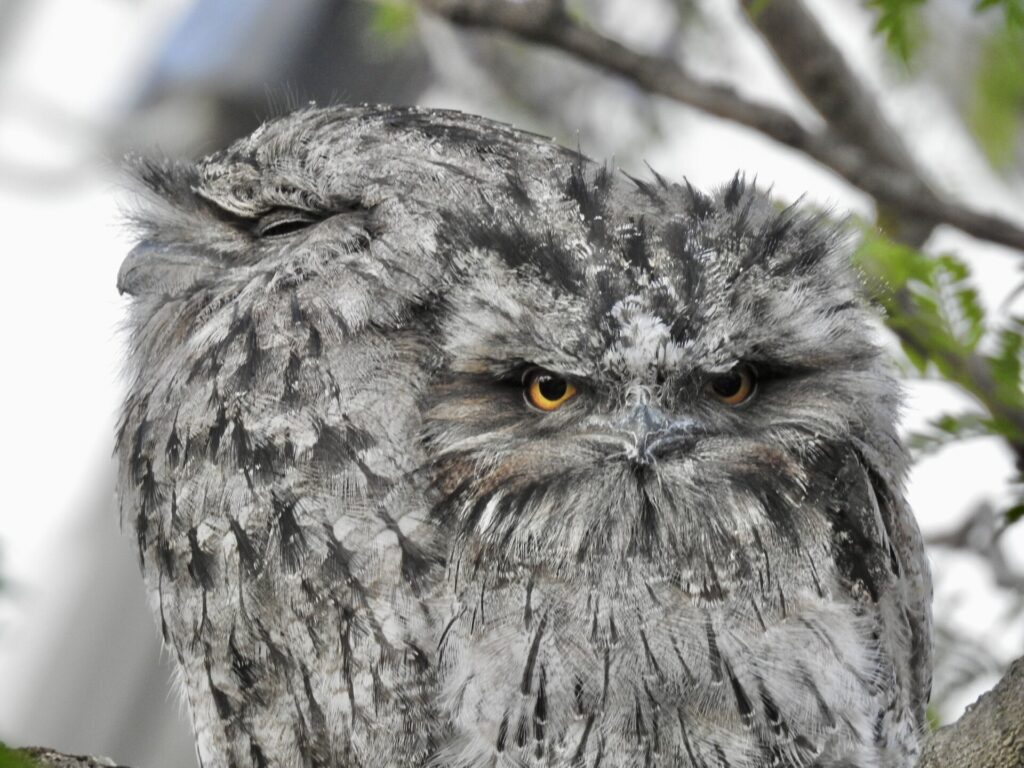
The tawny frogmouth is not an owl. It is an Australian night bird with a huge, wide bill, yellow eyes and streaked gray feathers, and it is more closely related to nightjars such as nighthawks and whip-poor-wills than to owls, according to the Australian Museum. By day it freezes on a branch with its bill pointed at the sky so it looks like part of the tree, and its grumpy-looking face has made it a favorite on social media. Here’s how to tell a frogmouth from an owl, what it eats, why it went viral, and where you can see one in the United States.
The short version
- What it is: a medium-sized night bird (Podargus strigoides) in the frogmouth family, Podargidae. San Diego Zoo Wildlife Alliance counts about 14 frogmouth species.
- Is it an owl? No. It has weak feet without the curved talons owls have, and it catches prey with its bill, not its feet.
- How big: about 13 to 21 inches long and up to roughly 1.5 pounds, with a wingspan of 25 to 38 inches (Australian Museum, San Diego Zoo Wildlife Alliance).
- Why it went viral: the wide frowning mouth, the “I’m a branch” pose, and a 2021 study that named the frogmouth the “most Instagrammable bird.”
- Can you see one in the US? Not in the wild. Tawny frogmouths live only in Australia, including Tasmania. Several US zoos keep them, including the Saint Louis Zoo, Lincoln Park Zoo in Chicago and the Virginia Zoo.
Frogmouth or owl? Our size and ID chart
Several zoos note that the tawny frogmouth is often mistaken for an owl. To show where it really fits, we drew its published body length on the same scale as four US owls and two of its US nightjar relatives, then listed six field marks that separate it from any owl. It’s about the length of a barred owl, but it’s built around its mouth, not its talons.
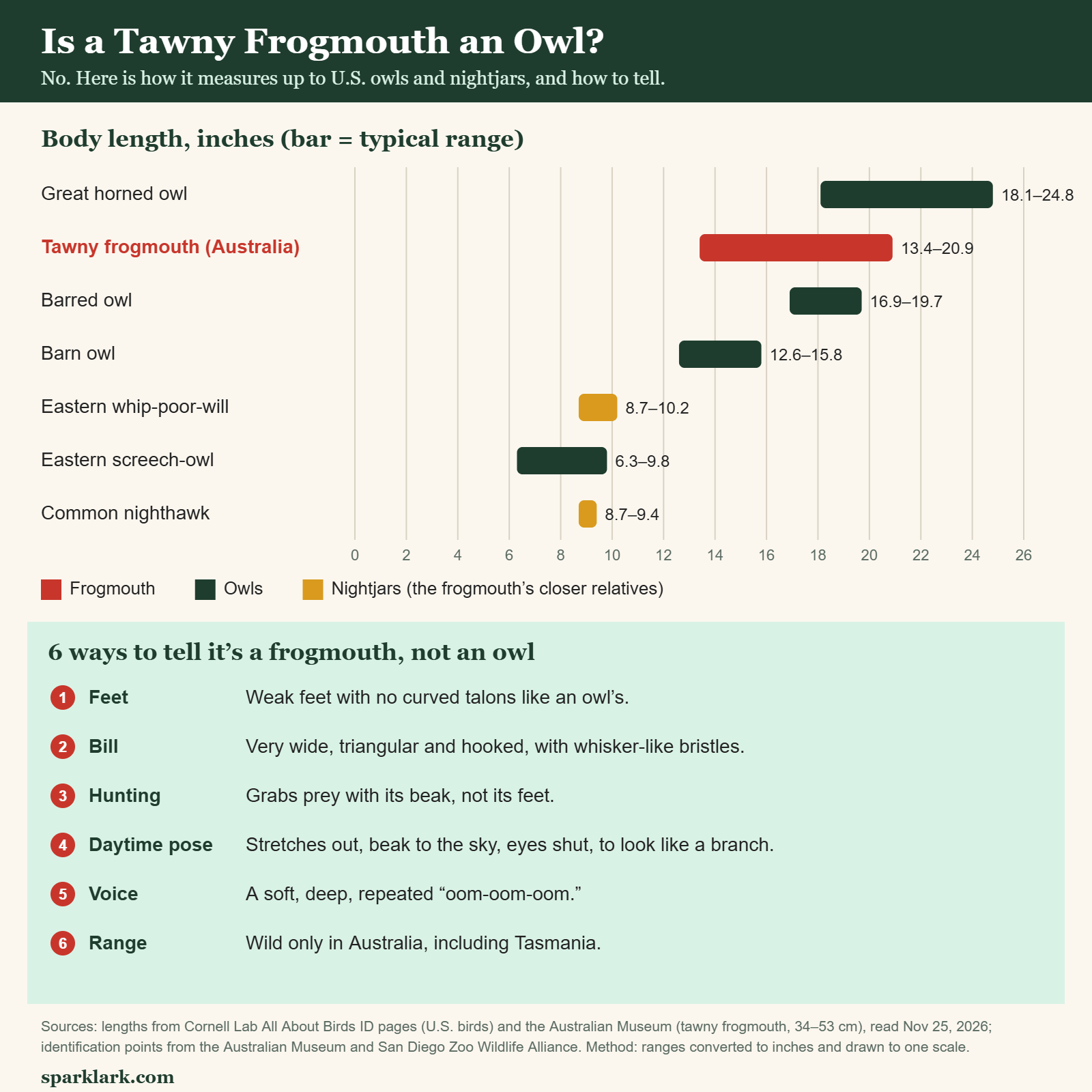
The numbers behind the bars:
| Bird | Family | Length |
|---|---|---|
| Tawny frogmouth | Frogmouths | 13.4–20.9 in |
| Great horned owl | Owls | 18.1–24.8 in |
| Barred owl | Owls | 16.9–19.7 in |
| Barn owl | Owls | 12.6–15.8 in |
| Eastern screech-owl | Owls | 6.3–9.8 in |
| Eastern whip-poor-will | Nightjars | 8.7–10.2 in |
| Common nighthawk | Nightjars | 8.7–9.4 in |
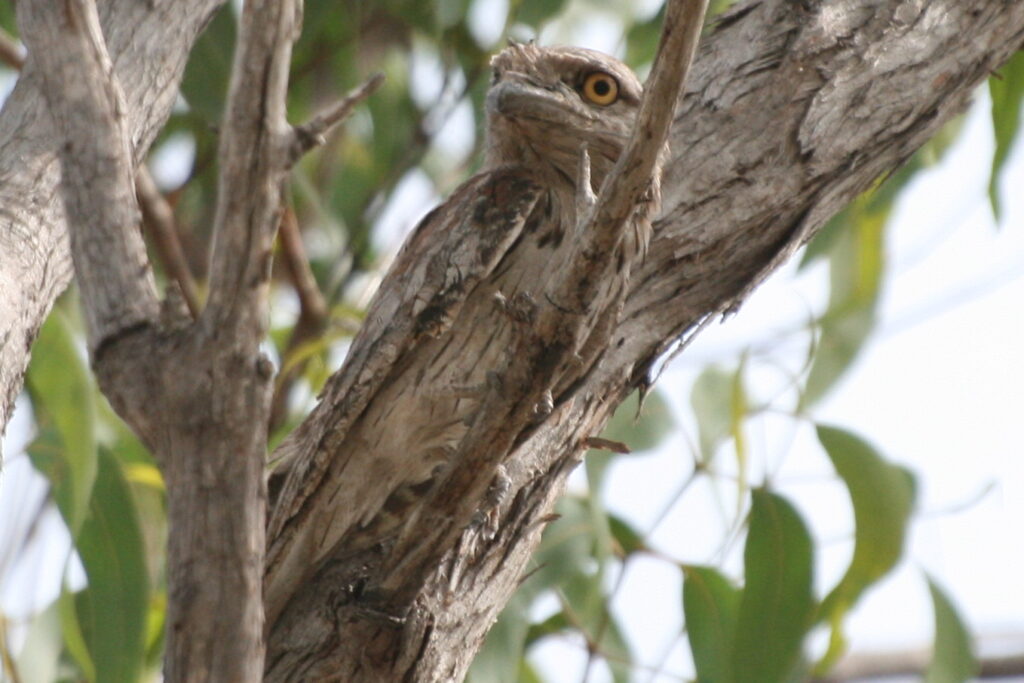
Why a tawny frogmouth isn’t an owl
San Diego Zoo Wildlife Alliance describes the tawny frogmouth as an “owl-like bird” with large, forward-facing eyes, and notes that frogmouths even have frayed edges on their wing feathers for quiet flight, “similar to that of an owl.” Under the disguise, they are built differently:
- Feet: the Australian Museum says frogmouth feet are weak and “lack the curved talons of owls.”
- Bill: very wide, triangular and hooked, with whisker-like bristles around it. The inside of the mouth is yellow to bright green.
- Hunting: the San Diego Zoo Wildlife Alliance fact sheet says frogmouths handle prey with the bill only, not the feet.
- Family: frogmouths are grouped with the nightjars, the family that includes nighthawks and whip-poor-wills, per Lincoln Park Zoo and San Diego Zoo Wildlife Alliance.
- Tongue: long, thin and forked at the tip, according to both zoos.
Color varies. The Australian Museum describes most birds as silver-gray, streaked and mottled with black and rufous, with a second, russet-red form. Birds in southeastern Australia are larger than birds in the north.
The “I’m a branch” pose
The pose that fills so many photos is camouflage. When a tawny frogmouth feels watched in daylight, it stretches its head and body into a straight line, flattens its feathers, closes its eyes and freezes, so it looks like part of the tree, according to the San Diego Zoo Wildlife Alliance fact sheet. San Diego Zoo and the Virginia Zoo call this “stumping.” Lincoln Park Zoo says the birds sit with their beaks pointed skyward to resemble a branch.
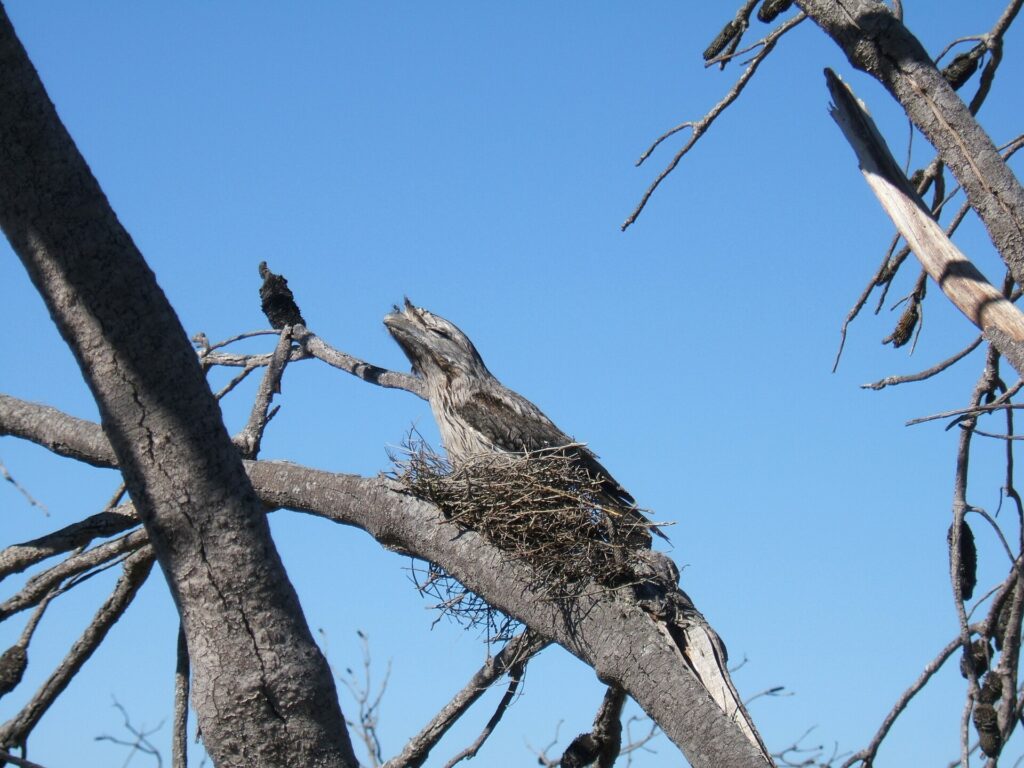
If the disguise fails, the bird switches to bluffing. The same fact sheet lists raised feathers to look bigger, a stare, bill snapping and growling, and a wide-open, brightly colored mouth as a threat display. The Australian Museum adds a loud hiss. If that sounds familiar, the potoo is another night bird that hides by posing as a branch.
What does a tawny frogmouth eat?
Mostly bugs. The Australian Museum says the bulk of the diet is nocturnal insects, worms, slugs and snails, with small mammals, reptiles, frogs and birds also taken. San Diego Zoo Wildlife Alliance lists cockroaches, beetles, moths, scorpions, spiders and centipedes among the common prey.
Frogmouths are sit-and-wait hunters. They watch from a perch, then drop to the ground to grab prey, and they catch some moths in midair. That moth-chasing has a cost: the Australian Museum says many are hit by cars while chasing insects lit up by headlights. For comparison, see what owls eat.
Why the tawny frogmouth went viral
Frogmouths have a face that photographs as permanently unimpressed. Live Science reported in May 2021 that a 2004 article in Nature Australia had called the frogmouth “the world’s most unfortunate-looking bird.” Then researchers writing in the journal i-Perception looked at more than 27,000 bird photos from nine popular Instagram bird accounts. Frogmouths appeared in only 65 of them, but those photos earned more likes than expected for their audience, more than any other bird, so the study called the frogmouth the “most Instagrammable bird,” Live Science reported.
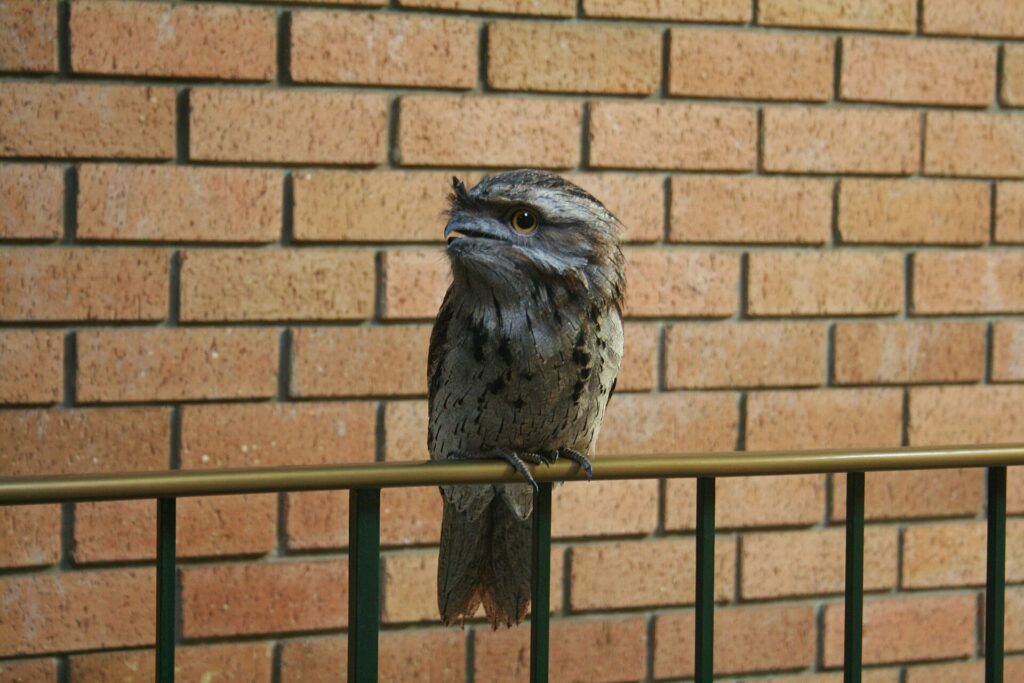
It also lives close to people. Lincoln Park Zoo says frogmouths remain motionless during the day, and the San Diego Zoo Wildlife Alliance fact sheet lists urban parks and large gardens among their habitats and says they often nest in backyards in Australia.
Where tawny frogmouths live
Tawny frogmouths are found throughout Australia, including Tasmania. The Australian Museum says they use almost every habitat except dense rainforest and treeless desert, including heath, forest, woodland, and urban and rural areas. San Diego Zoo Wildlife Alliance says a pair or family group holds a small territory all year.
They are not in trouble overall. The IUCN lists the species as Least Concern with a stable population, according to San Diego Zoo Wildlife Alliance, which also notes declines in some local areas. Threats it lists include tree clearing, cars, pesticides used on snails, cockroaches and rodents, and predators such as feral cats and foxes.
Nesting and family life
- Pairs: the Saint Louis Zoo and San Diego Zoo say pairs mate for life and often reuse the same nest site.
- Nest: a loose platform of sticks on a horizontal fork in a tree (Australian Museum).
- Season and eggs: August to December in Australia, usually 2 to 3 eggs (Australian Museum).
- Who sits: both parents incubate; the male sits during the day (Australian Museum).
- Timing: eggs hatch after about 28 to 32 days, and young leave the nest at about 27 to 32 days (San Diego Zoo Wildlife Alliance fact sheet).
Can you see a tawny frogmouth in the US?
Not in the wild: the species lives only in Australia. But the San Diego Zoo Wildlife Alliance fact sheet says frogmouths are common in zoos, and the Saint Louis Zoo says it takes part in a Species Survival Plan, a cooperative breeding program among zoos. These US zoos describe tawny frogmouths on their own animal pages (read Nov. 25, 2026):
- Saint Louis Zoo (St. Louis, Missouri): in the Bird House on Historic Hill.
- Lincoln Park Zoo (Chicago): in the McCormick Bird House.
- Virginia Zoo (Norfolk, Virginia): its page names its frogmouths, including a female named Maggie that hatched in March 2025.
- Columbus Zoo and Aquarium (Ohio): listed in its Australia and the Islands region.
- San Diego Zoo (California): its animal page describes the diet it feeds its frogmouths.
Animals move between zoos and are sometimes off view, so check with the zoo before you go. Lincoln Park Zoo notes that its animals can choose to spend time out of public view. Closer to home, the owls in our chart are the night birds you can find in the wild. The eastern screech-owl is patterned to give it excellent camouflage against tree bark, per Cornell’s All About Birds.
Tawny frogmouth FAQ
What does a tawny frogmouth sound like? A soft, deep, repeated “oom-oom-oom,” per the Australian Museum. San Diego Zoo adds a hiss when threatened and a bee-like buzz when startled. For US night sounds, see night birds that sound like squeaky toys.
How long do tawny frogmouths live? Wild lifespan isn’t well known. The San Diego Zoo Wildlife Alliance fact sheet cites a median life expectancy in zoos of about 21 years for males and 15 for females.
Can you keep a tawny frogmouth as a pet? The species is protected as a native bird under Australian law, per San Diego Zoo Wildlife Alliance. The Saint Louis Zoo says its frogmouths are part of a cooperative Species Survival Plan.
Do frogmouths sleep with one eye open? They can keep one eye at least partly open while asleep, and they can move their eyes independently, according to the San Diego Zoo Wildlife Alliance fact sheet.
Bottom line
The tawny frogmouth is an Australian nightjar relative, not an owl: weak feet, no talons, a giant bug-catching mouth and a convincing branch disguise. It went viral for its face, and the only place to see one in the US is a zoo such as the Saint Louis Zoo or Lincoln Park Zoo. For more internet-famous birds, meet the shoebill, the fluffy shima enaga and the skinny-looking wet owl. To name the birds in your own yard, print our free backyard bird ID chart by color.