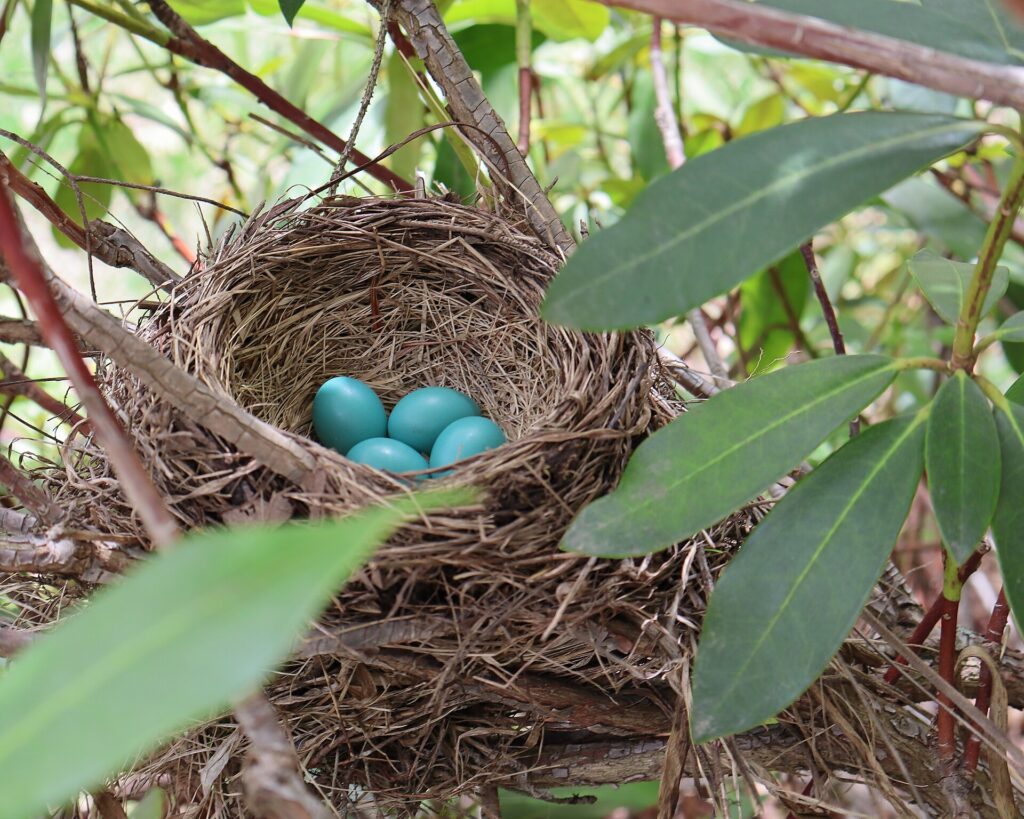
If you found a sky-blue egg in a nest in your yard, it’s most likely from an American robin, the bird that gave us the color “robin’s egg blue.” But robins aren’t the only ones. Eastern bluebirds, gray catbirds, wood thrushes, starlings and several other backyard birds also lay blue or blue-green eggs, and the size, shade, speckles and nest location will tell you which. Here’s how to identify a blue egg, why some eggs are blue at all, and what to do (and not do) if you find one.
The short version
- Plain sky blue, about an inch long, in a mud-lined cup nest: American robin.
- Pale blue, smaller, in a nest box or tree cavity: eastern bluebird.
- Deep turquoise-green, unmarked, in a thick shrub: gray catbird.
- Bright blue like a robin’s but smaller, in the woods: wood thrush.
- Pale blue with dark spots or scrawls: house finch, chipping sparrow, red-winged blackbird, common grackle or blue jay.
- Found one on the ground? Leave it. It’s almost never viable, and native birds’ eggs are protected by federal law.
Plain blue eggs (no spots)
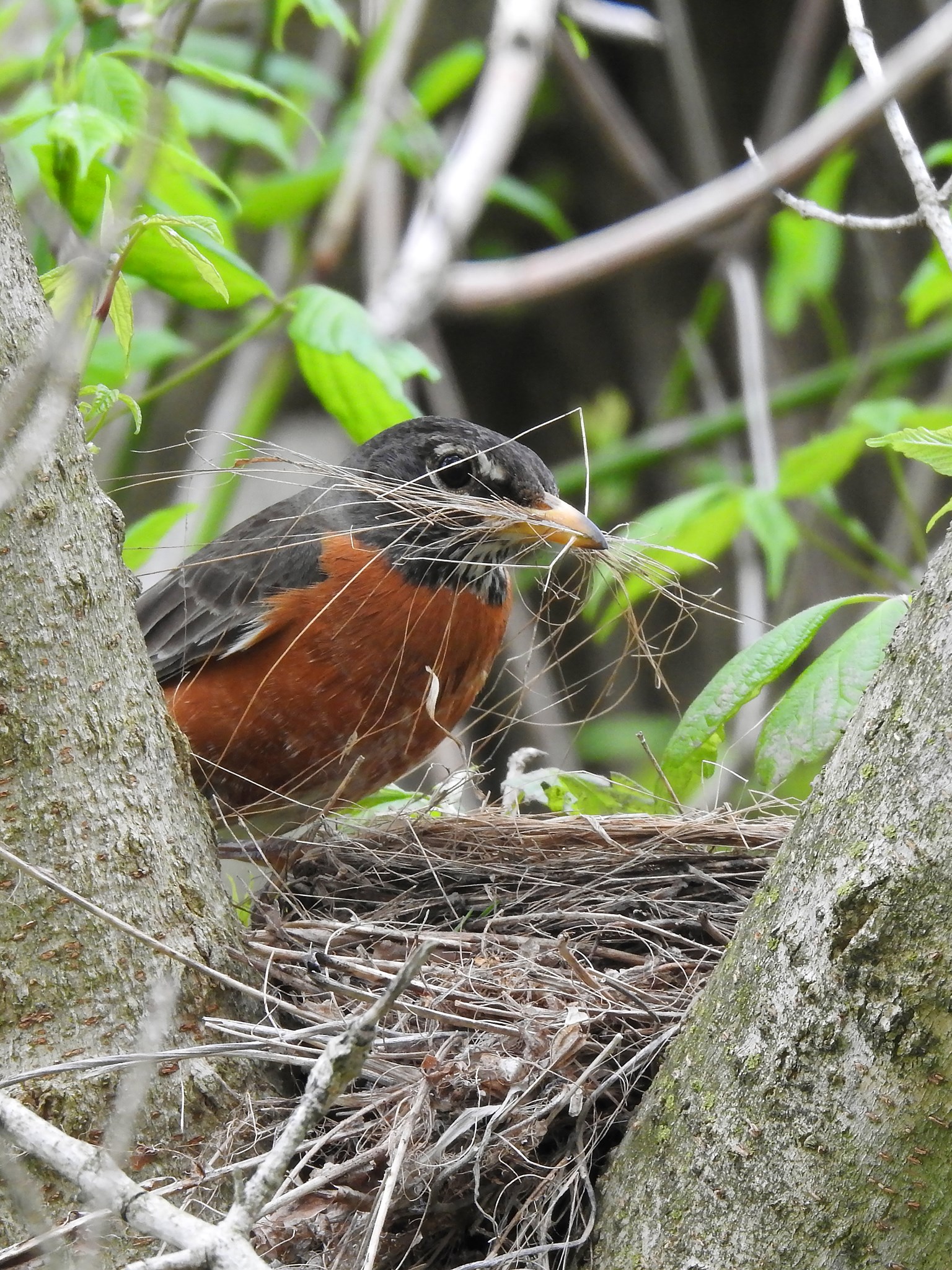
American robin. The classic blue egg: smooth, unmarked, a clear sky blue, and about an inch long. Robins lay three to five eggs in a sturdy cup of grass and twigs plastered inside with mud, usually on a branch fork, a ledge, a gutter, a porch light or a wreath on your front door. They often raise two or three broods a summer, so a new clutch can appear from April into July.
Eastern bluebird. Pale, powder-blue eggs, a bit smaller than a robin’s, usually four or five to a clutch. Bluebirds nest in cavities, so you’ll find them in a nest box or an old woodpecker hole, laid in a neat cup of fine grass or pine needles. A small share of bluebirds lay pure white eggs instead, so a white clutch in a bluebird box isn’t necessarily a different species. Western and mountain bluebirds lay similar pale blue eggs.
Gray catbird. A deep, glossy turquoise or blue-green, noticeably greener and darker than a robin’s egg and a little smaller. Catbirds hide their nests low in dense shrubs, thickets and vine tangles, so you usually find them while pruning.
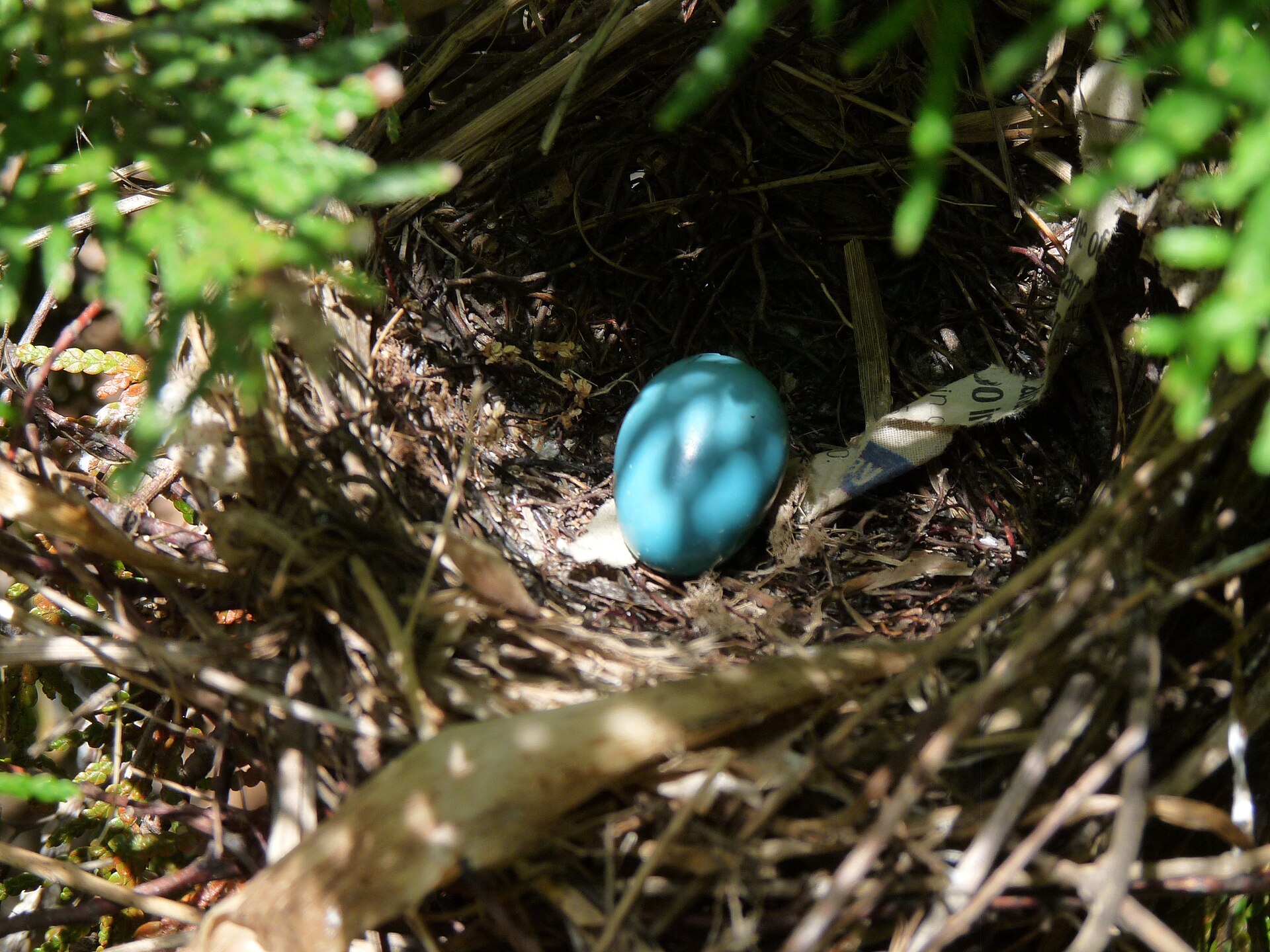
Wood thrush. A bright, robin-like blue in a smaller egg. Wood thrushes nest in eastern forests and wooded suburbs, often in a sapling or shrub, and often work a bit of white paper or plastic into the nest.
European starling. Pale blue to greenish-white and unmarked, laid in cavities: dryer vents, gaps under eaves, nest boxes and holes in trees. Starlings are non-native and aggressive about taking bluebird and woodpecker cavities.
Blue eggs with spots or markings
House finch. Small, pale bluish-white eggs with fine black or lavender specks, mostly at the large end. House finches nest almost anywhere: hanging baskets, wreaths, porch lights, ivy and evergreens.
Chipping sparrow. Tiny pale blue eggs with dark spots and scrawls, usually ringed around the large end, in a small, flimsy cup of grass often lined with hair, low in a shrub or small conifer.
Red-winged blackbird and common grackle. Both lay pale blue-green eggs heavily marked with dark brown or black blotches and squiggly lines. Red-wings nest in cattails and marsh edges. Grackles nest in dense evergreens, often in small colonies. (More on grackles in what grackles eat.)
Blue jay. Blue-green, olive or buff eggs with brown spots, in a bulky twig nest high in a tree. Despite the name, jay eggs are rarely a clean blue.
Bigger blue eggs
If the egg is much larger than a robin’s, think bigger birds. Great blue herons lay pale blue-green eggs in stick nests high in treetop colonies, and several egrets lay similar pale blue eggs. Among poultry, Araucana, Ameraucana and Cream Legbar chickens are famous for laying blue eggs, so a large blue egg on a farm or in a backyard flock is almost certainly a hen’s.
Why are some bird eggs blue?
The color comes from a pigment called biliverdin, which the female deposits into the shell as it forms. Nobody knows for certain why some species evolved blue eggs. Leading ideas are that the pigment helps shield the embryo from strong sunlight in open cup nests, and that a richer blue may signal a healthy female, encouraging the male to help feed the chicks. Brown speckles come from a second pigment, protoporphyrin, and may help strengthen the shell or camouflage the egg.
Found a blue egg? What to do
- On the ground: leave it. Eggs usually end up on the ground because a predator knocked them out, the parent removed an infertile egg, or a cowbird tossed it. It almost never survives, and you can’t put it back safely or hatch it at home.
- In a nest: enjoy it from a distance. Check no more than once every few days, don’t linger, and keep pets and kids back. Parents return quickly once you leave.
- Don’t collect it: the eggs and nests of native birds, including robins, bluebirds and catbirds, are protected under the federal Migratory Bird Treaty Act. Starlings and house sparrows are the exceptions.
- Nest in a bad spot? Wait it out. Robins go from egg to fledgling in about four weeks. Then clean up the empty nest and block the spot before next spring.
Want to host bluebirds and their blue eggs on purpose? A properly sized nest box in open grass is the way to start. See our guide to bluebird feeders for what to feed them once they arrive, and our bird-friendly garden guide for the shrubs catbirds and robins like to nest in.
Bottom line
A plain sky-blue egg in a mud-lined cup is a robin’s. Pale blue in a nest box is a bluebird’s. Deep turquoise in a thick shrub is a catbird’s. Pale blue with dark specks points to a house finch or chipping sparrow. And whichever it is, the best thing you can do is look, take a photo, and leave it where it is.