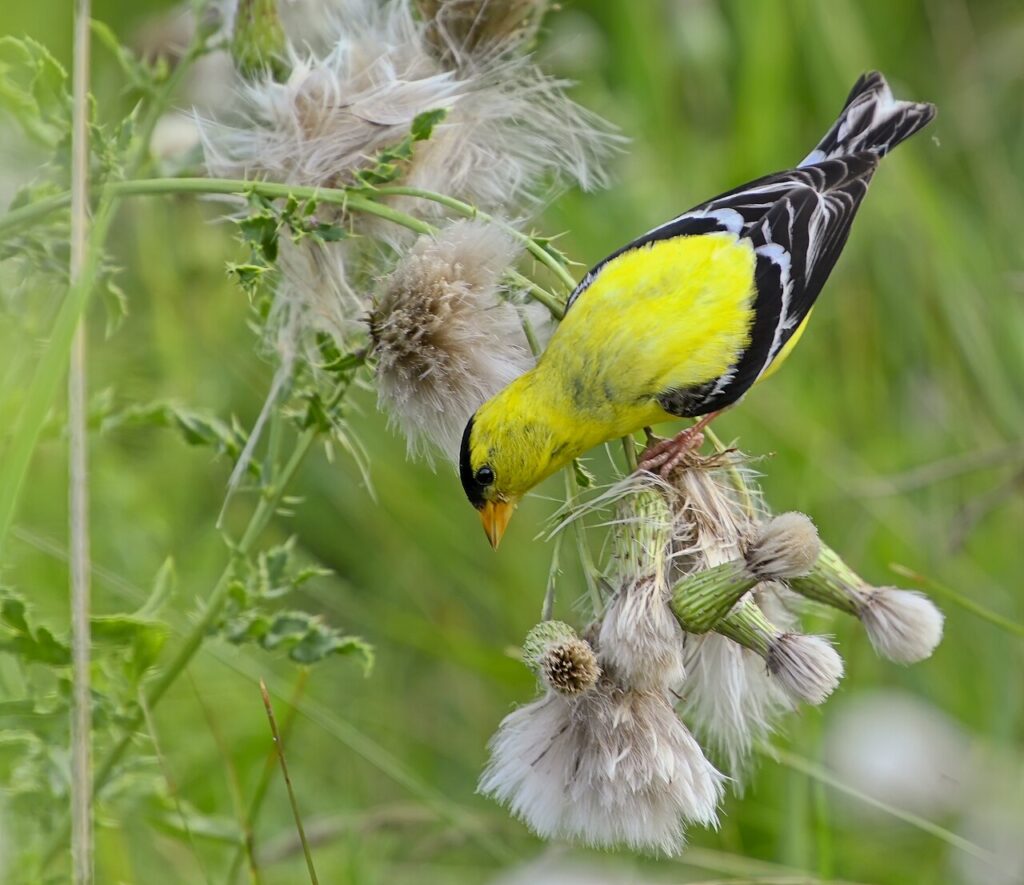
Saw a yellow bird with black wings at your feeder or in the yard? In most of the United States, it is an American goldfinch. It is common, it comes to feeders all year, and in spring and summer the male is bright yellow with black wings and a black cap. But seven other birds can fit the same description, depending on where you live and the time of year. This guide shows how to tell them apart, using the Cornell Lab of Ornithology and Audubon field guides.
The short version
- Small, at a seed feeder, anywhere in the U.S.: American goldfinch.
- Small, out West or in Texas, with an all-black cap: lesser goldfinch.
- Cardinal-sized, with a huge pale bill, in winter: evening grosbeak.
- Yellow body, orange-red head, in western woods in summer: western tanager.
- Greenish-yellow with dark wings, in eastern woods: a female or fall scarlet tanager.
- Slim, long-tailed, at a hummingbird feeder in the Southwest: hooded oriole or Scott’s oriole.
- Yellow with a fully black head, in South Texas: Audubon’s oriole.
Quick ID table
| Bird | Length | Best clue | Where and when |
|---|---|---|---|
| American goldfinch | 4.3–5.1 in | Black cap on the forehead only; white marks on black wings; short cone-shaped bill | Most of the U.S.; at feeders all year |
| Lesser goldfinch | 3.5–4.3 in | Glossy all-black cap; white patch on the wing; back black or green | The West and Texas; most common in California and Texas |
| Evening grosbeak | 6.3–7.1 in | Very thick pale bill; yellow eyebrow; big white wing patch | Irregular winter visitor, West and Northeast |
| Western tanager | 6.3–7.5 in | Orange-red head; one yellow and one white wingbar | Western woods in summer |
| Scarlet tanager (female, fall male) | 6.3–6.7 in | Olive-yellow; plain dark wings; thick rounded bill | Eastern forests in summer; also in migration |
| Hooded oriole | 7.1–7.9 in | Black bib up around the eye; long tail; slightly curved bill | Southwest, about March to August |
| Scott’s oriole | 9.1 in | Black head, back and breast; lemon-yellow belly | Desert Southwest, spring and summer |
| Audubon’s oriole | 7.5–9.4 in | Whole head black; yellow back | South Texas only, all year |
1. American goldfinch: the most likely answer
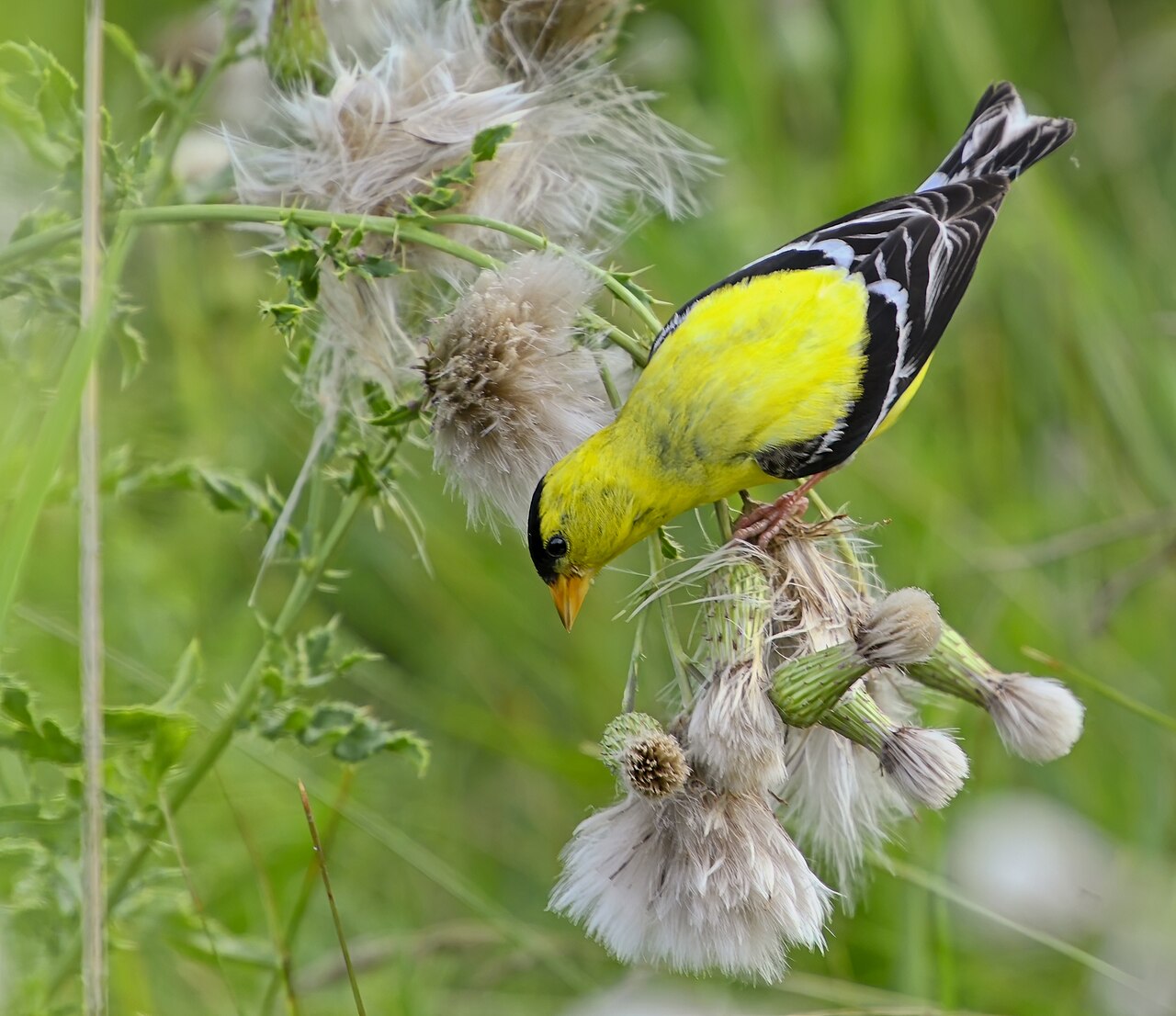
The Cornell Lab describes the breeding male as bright yellow with a black forehead, black wings with white markings, and white patches above and below the tail. It is a small finch, 4.3 to 5.1 inches long, with a short, cone-shaped bill and a short, notched tail. The female is a duller yellow below and olive above, with no black on the forehead.
In winter the same birds look very different. Cornell says they turn a drab, unstreaked brown with blackish wings and two pale wingbars, because goldfinches molt their body feathers twice a year, in late winter and late summer. So a “yellow bird with black wings” in June and a “brown bird with black wings” in January can be the same goldfinch.
- Where: through most of North America except deep forest. In winter they move south to areas where the average January low is no colder than about 0°F, according to Cornell.
- At feeders: common all year, most of all in winter. They eat mainly sunflower seed and nyjer, at hanging, hopper and platform feeders, and on the ground below.
- Late nesters: Cornell says they wait until June or July to nest, when milkweed and thistle give them fiber and seed. Audubon puts most nesting in July and August.
- State bird: Cornell notes that the American goldfinch is the state bird of Iowa, New Jersey and Washington.
Want more of them? Our guide to attracting goldfinches with sunflower hearts covers food and feeders, and how goldfinches nest explains that late summer timing. Related: American goldfinch meaning.
2. Lesser goldfinch: the western look-alike
If you live in the West or in Texas, check the cap. The male lesser goldfinch has a glossy black cap that covers the whole top of the head, while the American goldfinch’s black is only on the forehead. Cornell says that all-black cap is the way to pick it out of a mixed flock. Its back is black or dull green (green mostly on the West Coast and west of the Rockies), and it shows a white patch on the wing and big white corners on a black tail.
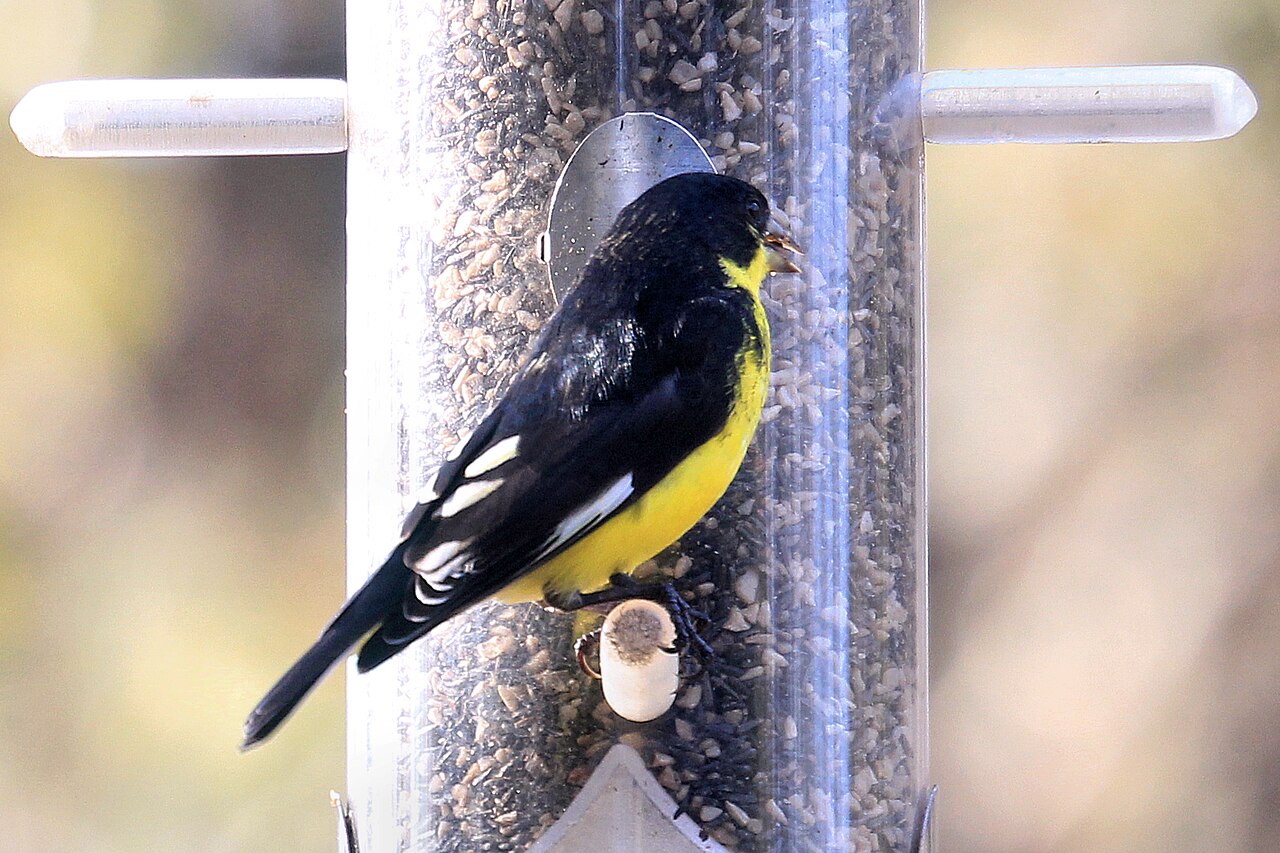
- Size: 3.5 to 4.3 inches, a touch smaller than an American goldfinch.
- Females: olive above and dull yellow below. Cornell says the small white rectangle on the edge of the folded wing separates them from female American goldfinches.
- Where: the western U.S., most common in California and Texas, and fairly common in suburbs.
- At feeders: comes readily, especially for nyjer and other small seeds.
3. Evening grosbeak: big bill, winter surprise
The evening grosbeak is a much bigger bird, about the size of a cardinal at 6.3 to 7.1 inches. The male is yellow and black with a dark head, a bright yellow eyebrow, a large white patch on the wing and a very thick, cone-shaped bill that is pale ivory in winter. The female is mostly gray, with white and black wings.
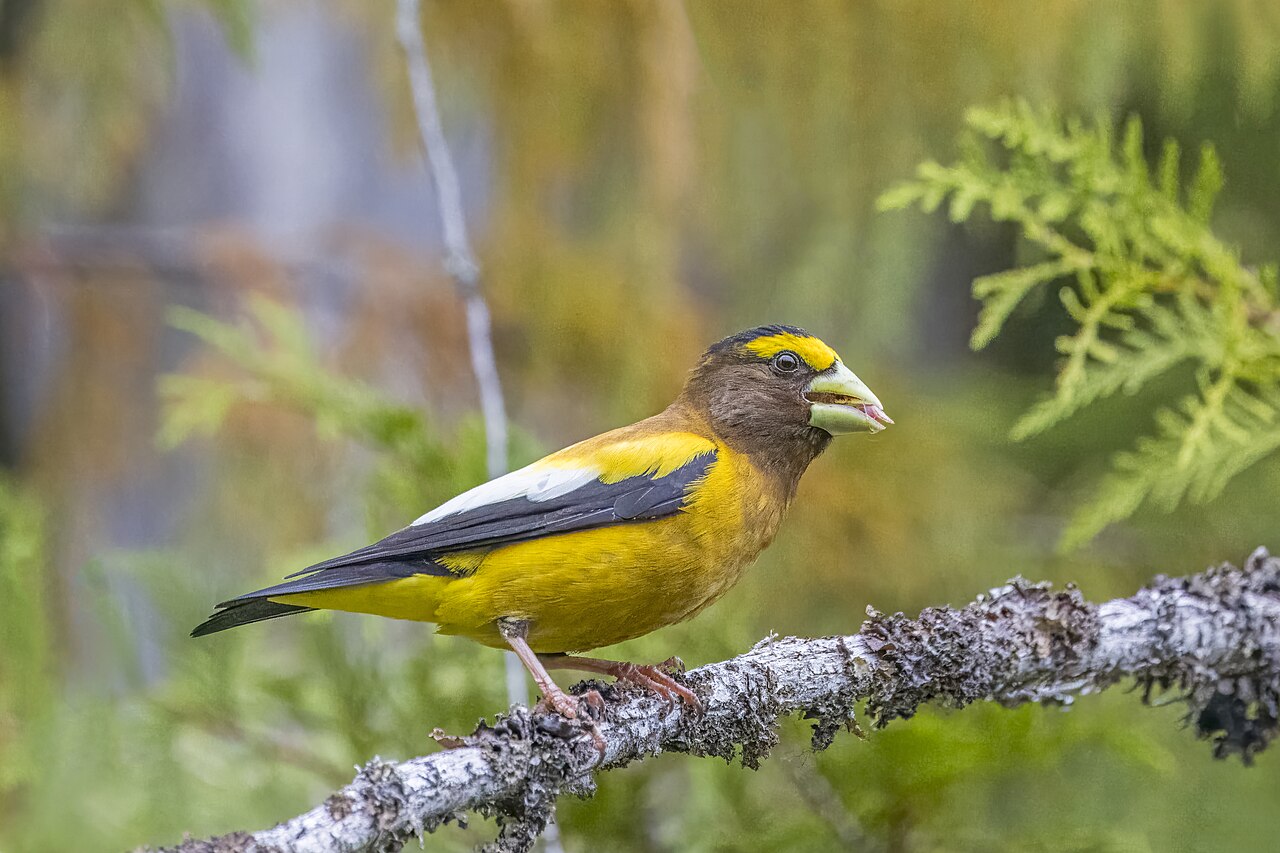
Cornell calls it an irregular winter visitor to the western and northeastern U.S., and notes that the species is declining, especially in the East. When they do show up, they favor sunflower seed on platform feeders rather than tube feeders. If you see them, it may be part of a bigger movement of northern finches; see our page on the winter finch irruption.
4. Western tanager: yellow with an orange-red head
The male western tanager has a yellow body, an orange-red head and a black back, wings and tail, with two bold wingbars: the upper one yellow, the lower one white. He is 6.3 to 7.5 inches long. The female is yellow-green with darker wings and two wingbars.
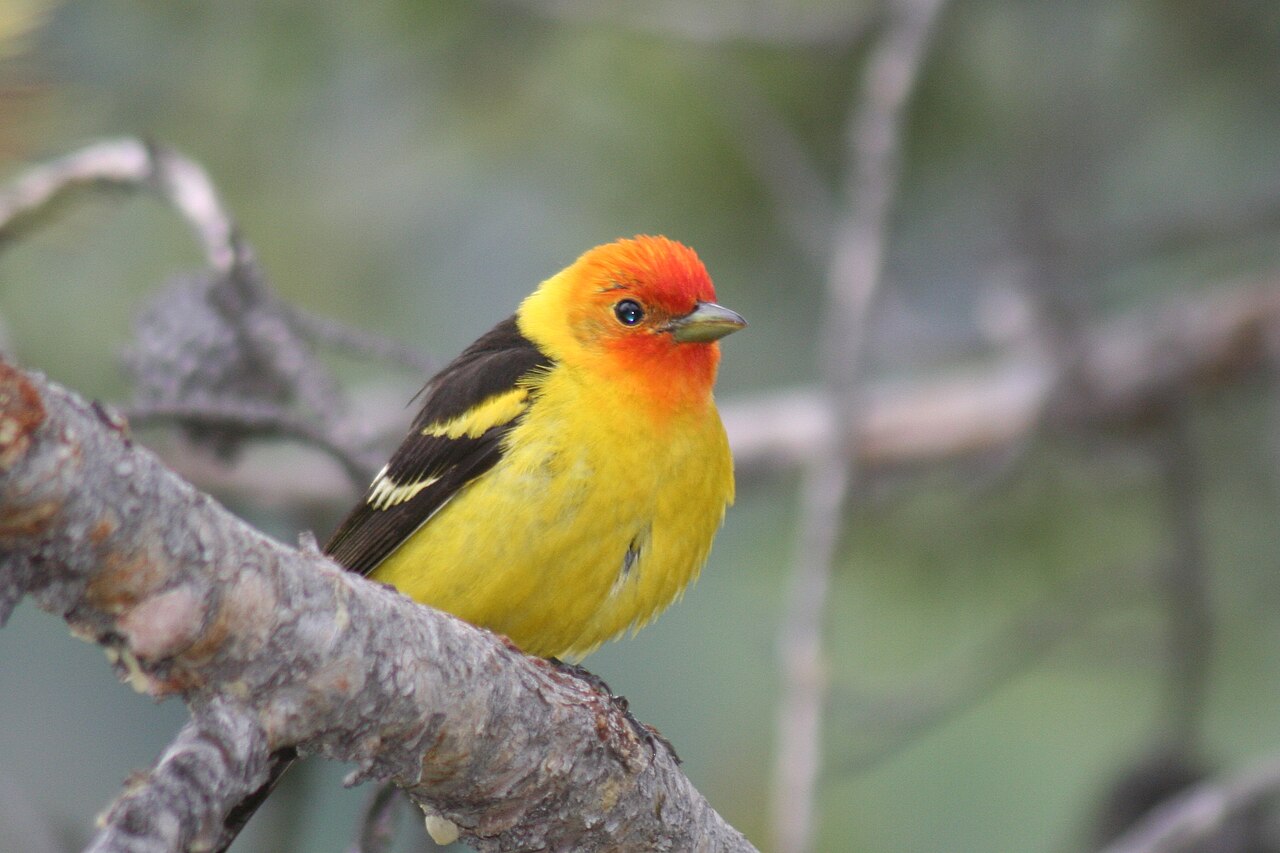
Western tanagers spend the summer in open woods across the West, especially conifer forests, and winter in Mexico and Central America, according to Cornell. In migration they can turn up in almost any wooded area. They eat mainly insects and some small fruit and do not usually eat seed, but Cornell says they may take cut oranges, other fresh fruit or dried fruit, and moving water or a birdbath can draw them in.
5. Scarlet tanager (female and fall male): the eastern woods bird
The breeding male scarlet tanager is red, so he is not the bird you saw. But the Cornell Lab says females and young birds are olive-yellow with darker olive wings and tail. After nesting, the adult male molts into a similar yellow-green coat but keeps his black wings and tail, which makes him a true “yellow bird with black wings” for a few weeks in late summer and fall.
Scarlet tanagers are 6.3 to 6.7 inches long with a thick, rounded bill. They summer in large eastern forests and migrate to northern South America in fall. In migration they also use shrubby areas and backyards, where they eat berries such as blackberry, raspberry, serviceberry and mulberry. We did not find a source saying they visit feeders.
6. Hooded oriole: the palm tree oriole of the Southwest
The male hooded oriole ranges from yellow to flame-orange, with a black throat that reaches up around the eye, black wings and tail, and a white wingbar. Cornell notes that birds in the southwestern U.S. tend to be yellower and birds in South Texas more orange. It is slim, 7.1 to 7.9 inches long, with a long tail and a slightly curved bill. The female is olive-yellow with thin white wingbars.
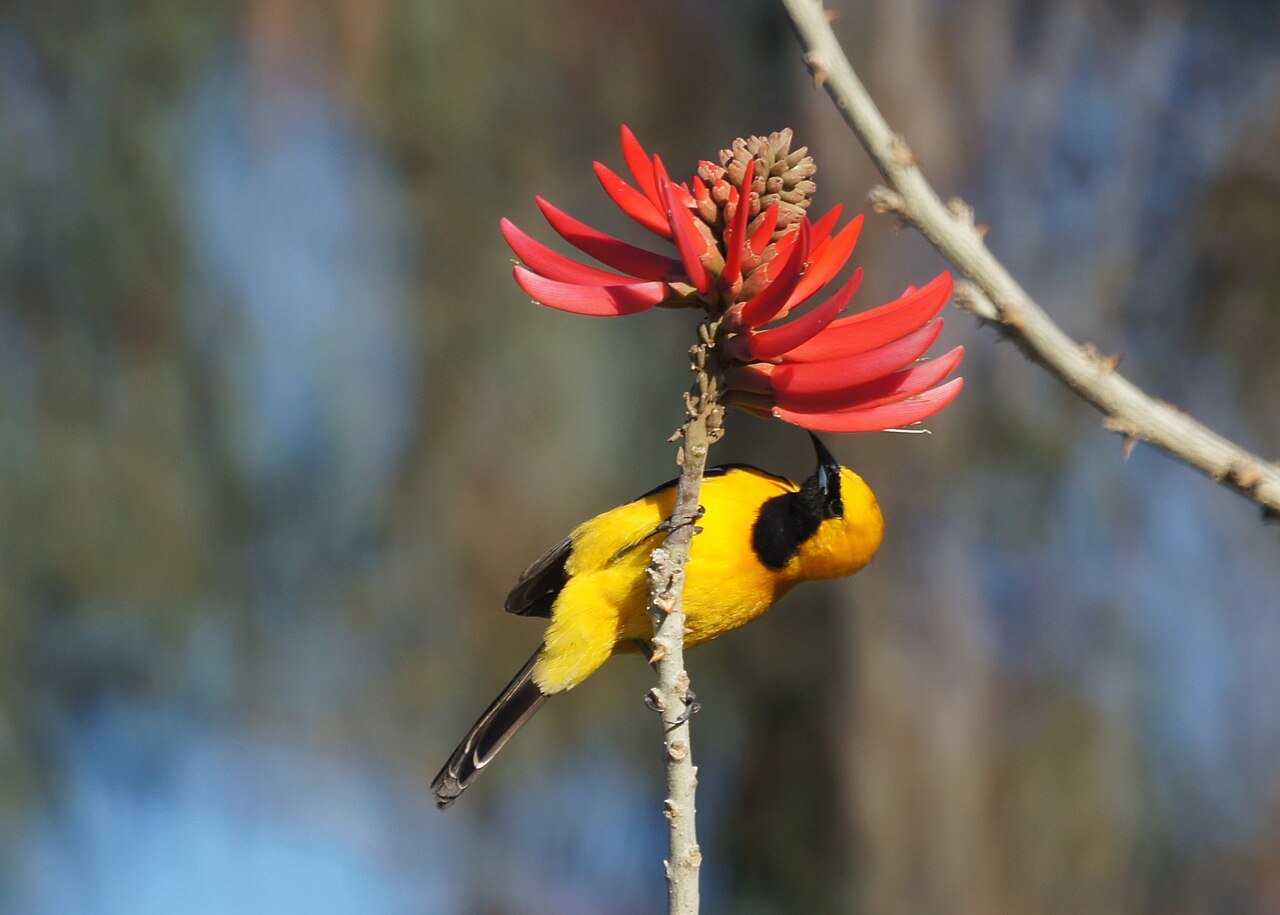
Hooded orioles live in open woods with cottonwoods, sycamores and especially palm trees, and in suburbs. Cornell says they usually arrive in March and leave in August, and that they visit hummingbird feeders and come to halved oranges and jelly. A few stay through the winter, especially where sugar-water feeders are kept up, according to Audubon.
7. Scott’s oriole: the yucca bird of the desert
The male Scott’s oriole is lemon-yellow below with a velvety black head, back and breast, white wingbars and a yellow shoulder. At about 9.1 inches it is one of the largest birds on this list, with a long, straight, pointed bill. The female is a duller yellow and olive.
Look for it on yucca-covered desert slopes, in pinyon-juniper and oak foothills and among Joshua trees in the arid Southwest. Cornell says it is closely tied to yuccas. It eats insects, nectar and some fruit, and Audubon says it takes sugar water from feeders. Audubon puts its arrival in March or April and its departure mostly in July and August.
8. Audubon’s oriole: South Texas only
The Audubon’s oriole has an entirely black head and throat, a yellow body and back, and black wings and tail. Males and females look nearly alike. In the U.S. it lives only in South Texas, mainly in brush along the Rio Grande, and stays all year. Cornell says it comes to yards with thick cover or fruiting shrubs, eats sunflower seed at feeders and may visit hummingbird feeders.
Not quite a match: Lawrence’s goldfinch
In California and the Desert Southwest, people sometimes describe the Lawrence’s goldfinch as yellow and black. Cornell describes the male as mostly gray with a black face and yellow on the breast and wings, so it is really a gray bird with yellow wing patches. It wanders widely and sometimes visits feeders with nyjer.
Three questions that solve most sightings
- How big was it? Sparrow-sized points to a goldfinch. Cardinal-sized or bigger points to a grosbeak, tanager or oriole.
- What was the bill like? Short and cone-shaped means a finch or grosbeak. Long and pointed means an oriole.
- Where and when? East or West, summer or winter, rules out most of the list. Outside the Southwest and South Texas, orioles drop out; outside the West, so do western tanagers and lesser goldfinches.
Still not sure? Try our free backyard bird ID chart by color, or see our guide to the little gray bird with yellow if your bird was more gray than yellow.
FAQ
What is the small yellow bird with black wings at my feeder?
In most of the U.S., an American goldfinch. In the West and Texas, check whether the black cap covers the whole crown; if it does, it is a lesser goldfinch.
Why did my yellow goldfinches turn brown?
American goldfinches molt twice a year. In late summer they trade their bright yellow for a plain brown winter coat, and they turn yellow again in late winter and spring, according to the Cornell Lab.
What does it mean to see a yellow bird?
Many people see yellow birds as a sign of joy or good news. That is folklore, not science, and it belongs in its own article. This page is about identifying the bird itself.
Bottom line
A yellow bird with black wings is usually an American goldfinch, especially at a seed feeder. In the West, check for the lesser goldfinch’s full black cap. A bigger bird with a huge pale bill in winter is an evening grosbeak; a yellow bird with an orange-red head in western woods is a western tanager; and a slim, long-tailed yellow-and-black bird at a hummingbird feeder in the Southwest is likely an oriole. Size, bill shape and where you live will answer it almost every time.