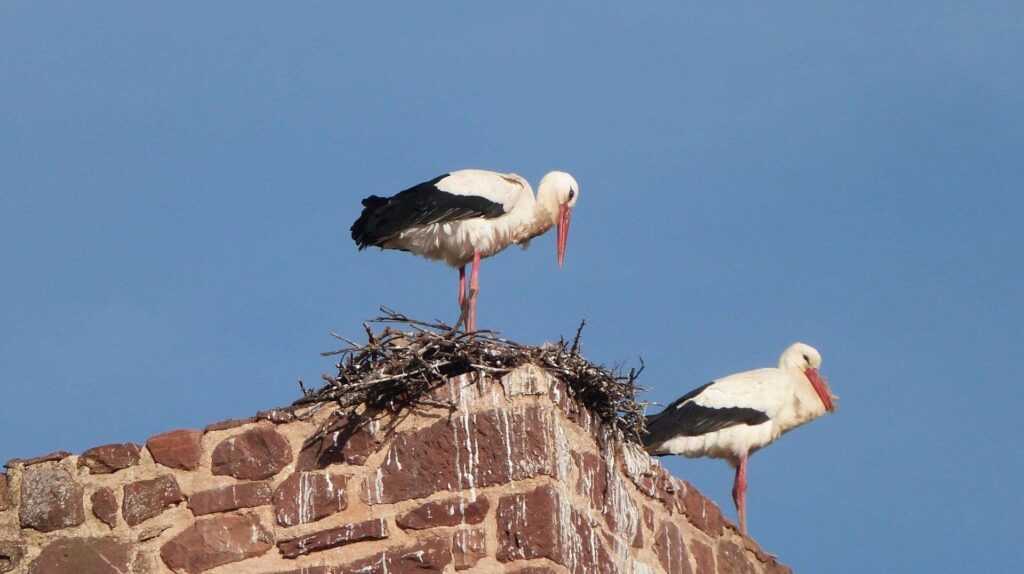
The bird that brings babies is the white stork (Ciconia ciconia), a tall, red-billed wading bird that nests on rooftops and chimneys across Europe. The legend grew out of Northern European folklore, got a huge boost from an 1839 Hans Christian Andersen fairy tale, and became the standard way for Victorian parents to dodge the facts of life. Storks don’t deliver babies, but the real bird is more interesting than the myth, and if you live in Florida or the Southeast, you can see its American cousin, the Wood Stork, in a roadside ditch.
Why do storks bring babies? Where the legend comes from
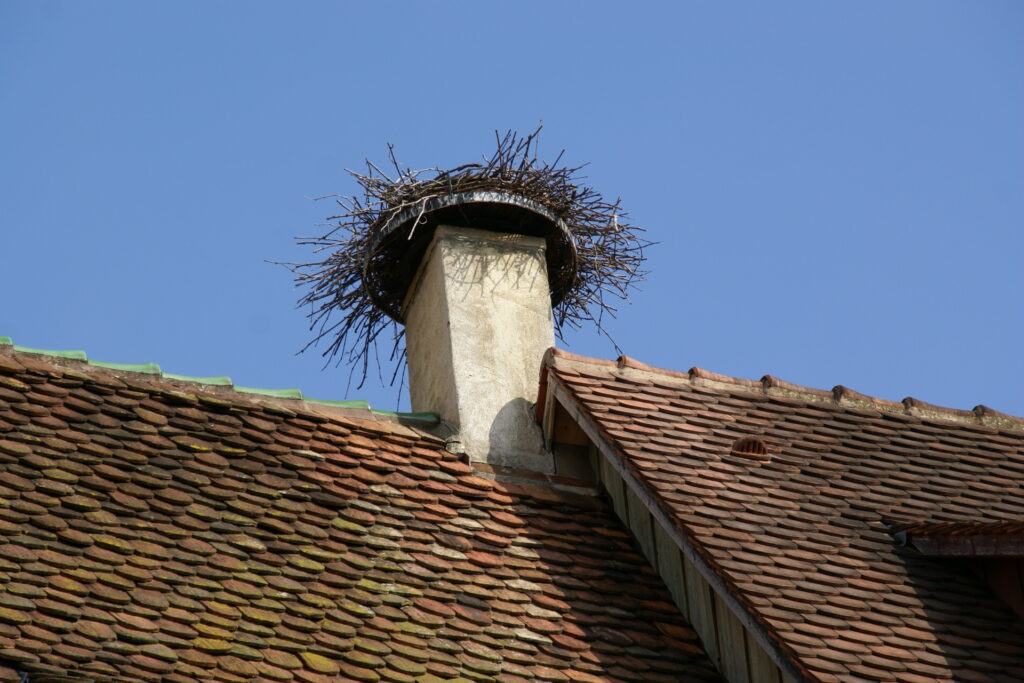
The stork-and-baby story is strongest in Germany, the Netherlands, Poland, and Scandinavia, and it starts with where the bird lives. White storks build enormous stick nests on top of houses, barns, and church towers, and people watched those pairs feed and guard their chicks all summer.
Timing did the rest. In much of Northern Europe, weddings clustered around midsummer. Nine months later, in early spring, babies arrived at the same moment the storks returned from Africa. Rachel Warren Chadd, co-author of Birds: Myth, Lore and Legend, notes the birds are “big and white,” tied to purity in the popular mind, with huge nests close to where people live.
German folklore filled in the details. Storks were said to fetch the souls of unborn children from marshes and ponds, and kids who wanted a sibling sang to the birds and left out sweets. A rooftop nest also meant good luck. That belief is still alive in Poland, where roughly a quarter of the world’s white storks spend the summer and homeowners bolt metal platforms to roofs and utility poles to invite a pair to nest. If bird symbolism interests you, we’ve also covered what a white pigeon symbolizes.
Hans Christian Andersen’s “The Storks” and the Victorians
The legend went global in 1839, when Andersen published a short tale called “The Storks” (Storkene in Danish). A stork family nests on the roof of a village house. Local boys sing a cruel song threatening the chicks. The mother stork calms her young by describing the pond where, in M. R. James’s translation, “all the human children lie till the stork comes.”
The ending is darker than the greeting-card version. The storks reward one kind boy, Peter, with two babies for his family and punish the ringleader with a dead child. Strange as it reads today, the story cemented the image of a stork flying in with a bundle, and Victorian parents found that image useful. It answered “where do babies come from?” without discussing anything uncomfortable. That’s why the stork shows up on baby-shower cards in America, even though the bird has never lived here.
The real bird: white stork facts
The white stork stands about 3 feet tall with a wingspan of roughly 5 to 6.5 feet. It’s white with black flight feathers, a long red bill, and long red legs. Unlike most storks, it spends much of its time on dry ground, hunting frogs, insects, voles, and small reptiles in fields and shallow water.
White storks breed across Europe and winter in Africa south of the Sahara. Because they soar on thermals, which don’t form over open water, they avoid crossing the Mediterranean and funnel over land through two narrow gaps, the Strait of Gibraltar in the west and the Bosporus in the east. BirdLife International reports gliding speeds up to 110 km/h, about 68 mph.
The nests are legendary in their own right. Pairs return to the same nest and partner every year, and later pairs keep building after the original owners die. Adam Zbyryt of the University of Bialystok, who weighed 145 nests, found some stand 2 to 3 meters tall and weigh over a ton. BirdNote reports one European nest site was used continuously from 1549 to 1930.
White storks are nearly voiceless. They greet their mates by rapidly clattering the bill, a sound amplified by a throat pouch that Britain’s Wildwood Trust says sounds “like a machine gun.” The species is listed as Least Concern, with a global population BirdLife estimates at roughly 700,000 birds.
Do storks really deliver babies? The famous statistics lesson
Here’s the part statistics professors love. In 2000, Robert Matthews of Aston University published a two-page paper in Teaching Statistics titled “Storks Deliver Babies (p = 0.008).” He compared breeding stork pairs with human births across 17 European countries and found a real, statistically significant correlation (r = 0.62, p = 0.008).
The catch is obvious once you see it. Bigger countries have more land, so they have more storks and more people, which means more births. Land area is the hidden variable driving both numbers. Matthews called the link “causally nonsensical” and used it to show that a small p-value doesn’t prove your hypothesis. The example now turns up in statistics textbooks and college lectures as the standard illustration of correlation versus causation.
Is there a stork in the United States? Meet the Wood Stork
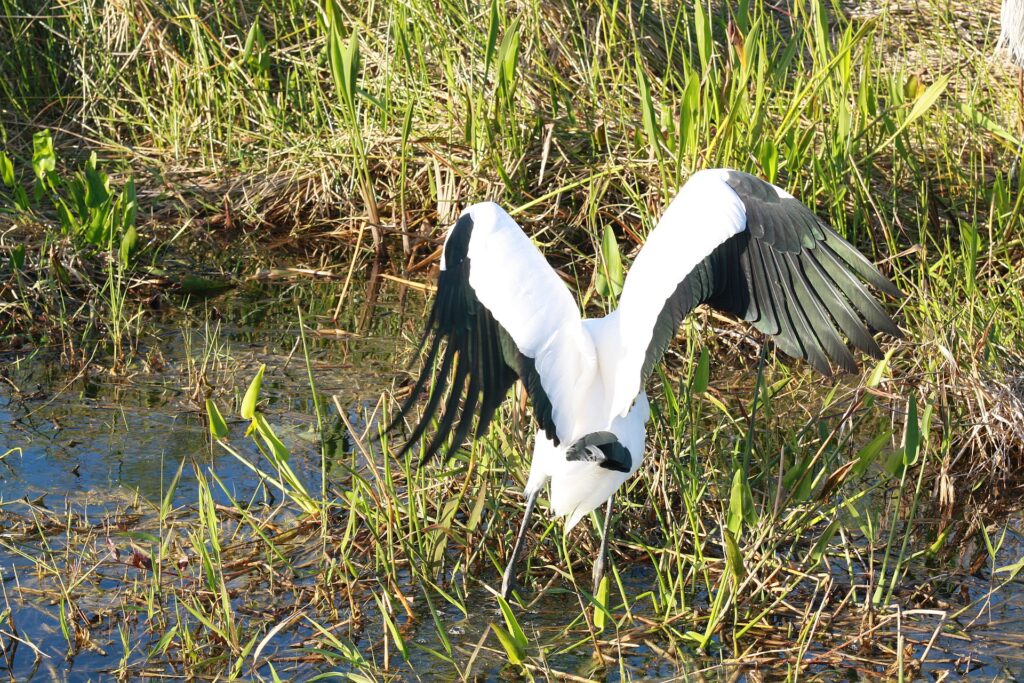
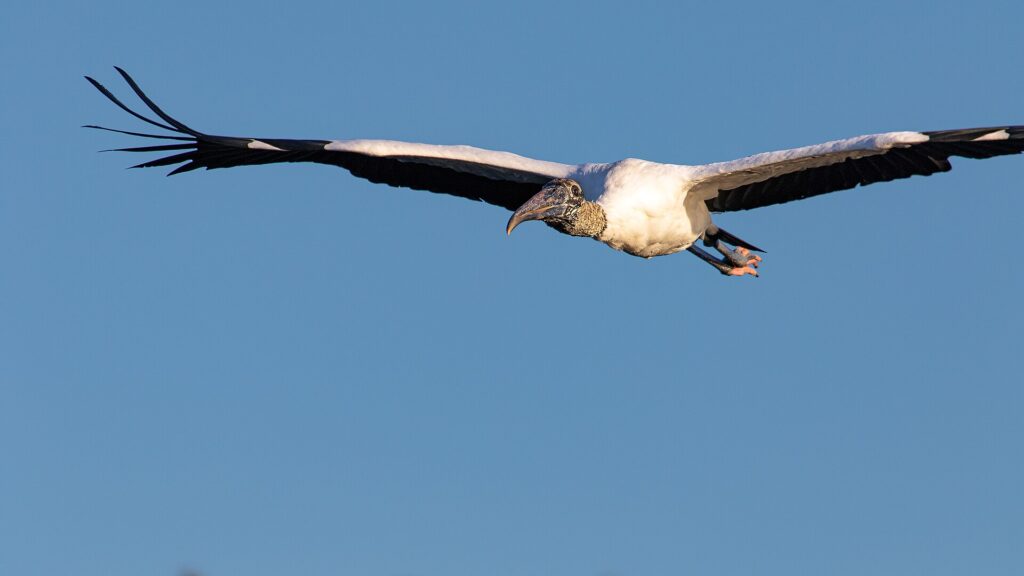
The white stork is not a North American bird. What we have is the Wood Stork (Mycteria americana), which Audubon calls “our only native stork in North America.” It’s mostly white with black flight feathers and tail, but with a bare, scaly, dark gray head and a thick black bill that curves down at the tip. Juveniles have a dusky feathered head and a yellowish bill.
According to the Cornell Lab of Ornithology, Wood Storks measure 33.5 to 45.3 inches long with a wingspan of 59 to 69 inches and weigh 4.5 to 5.8 pounds. They walk slowly through water no deeper than 10 to 12 inches with the bill partly open, feeling for fish. When a fish touches the bill, it snaps shut in about 25 milliseconds, a reflex the National Park Service calls the fastest known among vertebrates.
Wood Storks nest in colonies of 100 to 500 nests in trees standing over water, mainly cypress swamps and mangroves. In South Florida, nesting runs from late November to March, timed to the dry season, when falling water levels trap fish in shrinking pools. A pair needs about 440 pounds of fish to raise a brood, and if water rises at the wrong time, the fish scatter and the storks abandon their nests.
That dependence on natural water cycles nearly wiped them out. Everglades drainage cut the South Florida population from 5,000 to 15,000 nesting pairs in the 1930s to fewer than 500 pairs by 1995. The U.S. Fish and Wildlife Service listed the Wood Stork as endangered in 1984, when about 5,000 pairs remained across the Southeast, and downlisted it to threatened in 2014.
The comeback is now official. On February 9, 2026, the Service removed the U.S. population from the federal endangered and threatened list, effective March 9, 2026, citing 10,000 to 14,000 nesting pairs at roughly 100 colonies across the coastal plains of Florida, Georgia, the Carolinas, Alabama, and Mississippi. Service Director Brian Nesvik called it “a real conservation success thanks to a lot of hard work.” A 10-year monitoring plan follows delisting.
| Feature | White Stork (Ciconia ciconia) | Wood Stork (Mycteria americana) |
|---|---|---|
| Size | Stands about 3 ft 3 in (100 cm) tall | 33.5–45.3 in long; stands just over 3 ft tall |
| Wingspan | Roughly 5–6.5 ft (1.5–2 m) | 59–69 in (about 5–5.75 ft) |
| Head and bill | Feathered white head, long red bill | Bare gray scaly head, thick black bill |
| Range | Breeds across Europe and parts of Asia; winters in Africa south of the Sahara | Southeastern U.S. coastal plain (FL, GA, SC, NC, AL, MS) south through Mexico and South America |
| Nest site | Rooftops, chimneys, pylons, trees | Trees over standing water in swamps |
| Status | Least Concern (IUCN) | Removed from U.S. endangered/threatened list in 2026 after recovery |
| Voice | Bill clattering, almost no calls | Hisses; otherwise silent |
Where to see Wood Storks in Florida
Florida readers don’t need a special trip. Wood Storks feed in flooded farm fields, roadside ditches, ponds, and shallow marshes, especially where the water is dropping. Look for a big white bird with a dark bald head, walking slowly with its face in the water. Overhead, the black flight feathers along the back edge of each wing separate it from an all-white Great Egret.
For a more dependable look, Audubon’s Corkscrew Swamp Sanctuary outside Naples protects the largest remaining old-growth bald cypress forest in the world and is home to Wood Storks. Everglades National Park and coastal Georgia and the Carolinas also hold colonies. The best months are the dry season, roughly November through March.
Wood Storks are an easy win for young birders because they’re huge, slow, and unmistakable. See our tips for getting kids interested in birdwatching, our backyard bird ID chart by color, and, for more kid-friendly trivia, which birds lay blue eggs.
Frequently asked questions
Do storks actually bring babies?
No. The legend comes from storks returning to Northern Europe each spring around the time babies conceived at midsummer were born, plus the birds’ habit of nesting on people’s roofs. Andersen’s 1839 fairy tale turned the folk belief into a story everyone knew.
Why is a stork a sign of good luck?
In Germany, Poland, and the Netherlands, a pair nesting on your roof was taken as a blessing on the household. Storks are loyal to their nest and partner and come back every spring, which made them a natural symbol of family and renewal.
Is the Wood Stork still endangered?
Not anymore. It was listed as endangered in 1984, downgraded to threatened in 2014, and removed from the federal list in 2026 after the population more than doubled. The Fish and Wildlife Service will monitor it for 10 more years.
Bottom line
The bird that brings babies is the white stork, a European species whose rooftop nests, spring return, and starring role in an Andersen fairy tale turned a folk belief into a worldwide symbol. It has never lived in North America. The stork Americans can actually see is the Wood Stork, a bald-headed swamp bird that just came off the endangered species list, and in Florida it’s often as close as the nearest ditch.