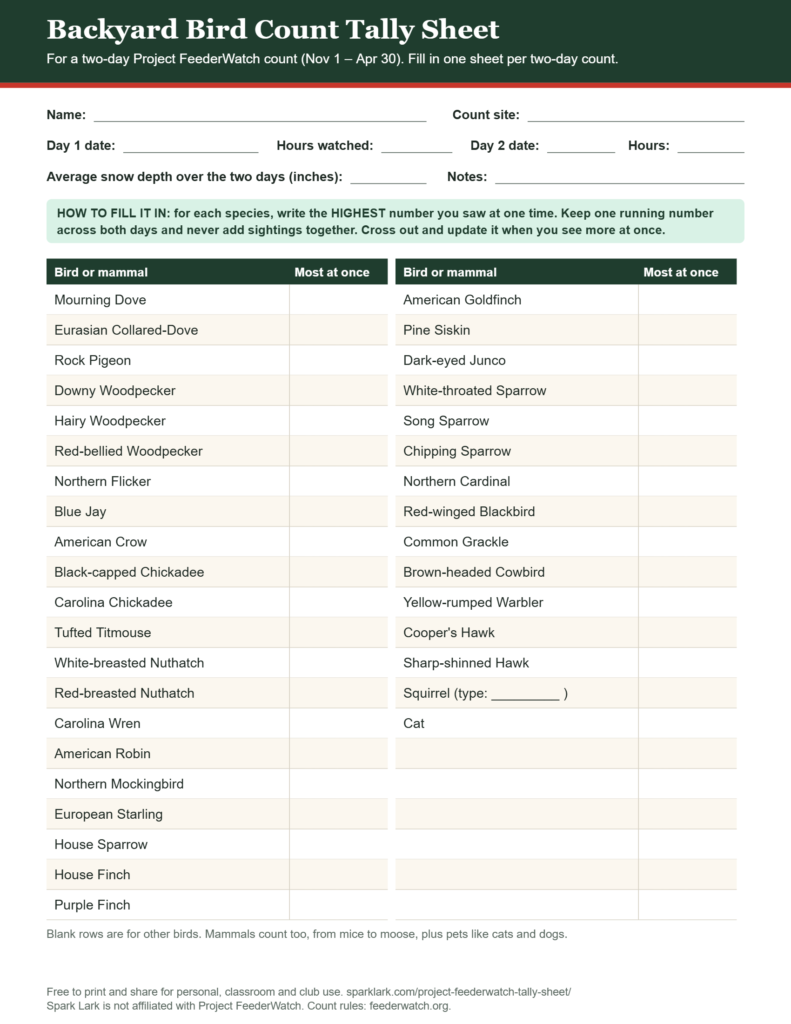
Project FeederWatch starts November 1, and this free printable makes your first count easy. It’s a two-page tally sheet: page one lists 36 common feeder birds and mammals with a column for the most you saw at once, and page two explains the count rules in plain English. Print one for each two-day count, fill it in at the window, then type the numbers into FeederWatch. No signup needed to download it.
What is Project FeederWatch?
Project FeederWatch is a winter bird count that anyone can join from home. It is operated by the Cornell Lab of Ornithology and Birds Canada. Participants count the birds at their feeders on days they choose and send the counts to FeederWatch.
- Season: November 1 through April 30.
- Cost: FeederWatch charges U.S. residents an annual participation fee, which it says pays for the website, database, data analysis and participant support. Canadians take part by donating any amount to Birds Canada. Check feederwatch.org for the current amount.
- Where: Your own yard, porch or balcony. Feeders are not required.
- How you report: Online in the Your Data section of the FeederWatch site, or in the FeederWatch app.
Spark Lark is not part of FeederWatch. We made this sheet because a paper tally by the window is the easiest way to keep track during a count, and FeederWatch’s own rules fit on one page.
How a FeederWatch count works
- Pick a count site. FeederWatch asks you to “choose a portion of your yard that is easy to monitor, preferably an area that is visible from one vantage point.” Most sites are about the size of two tennis courts, but one can be as small as a single feeder. The site should include something you maintain that draws birds, such as feeders, water or plantings.
- Choose two days in a row. “Count days always come in pairs.” FeederWatch recommends no more than one pair a week and at least five days without counting between pairs. There’s no minimum number of counts, so even a single count is fine.
- Watch as much or as little as you like. Ten minutes over coffee counts. So does an all-day stakeout.
- Record the most at once. This is the key rule. For each species, write down the largest number you saw at the same moment during the two days. In FeederWatch’s words: “Keep one running tally across both days. This way you won’t count the same bird twice.”
- Skip fly-overs. Birds that only fly over your site, such as geese or cranes passing high overhead, aren’t counted.
- Note your effort and snow. Record the dates, roughly how long you watched, and the average snow depth. You don’t need temperature, rain or wind.
- Send it in. Enter your counts on the FeederWatch website or app.
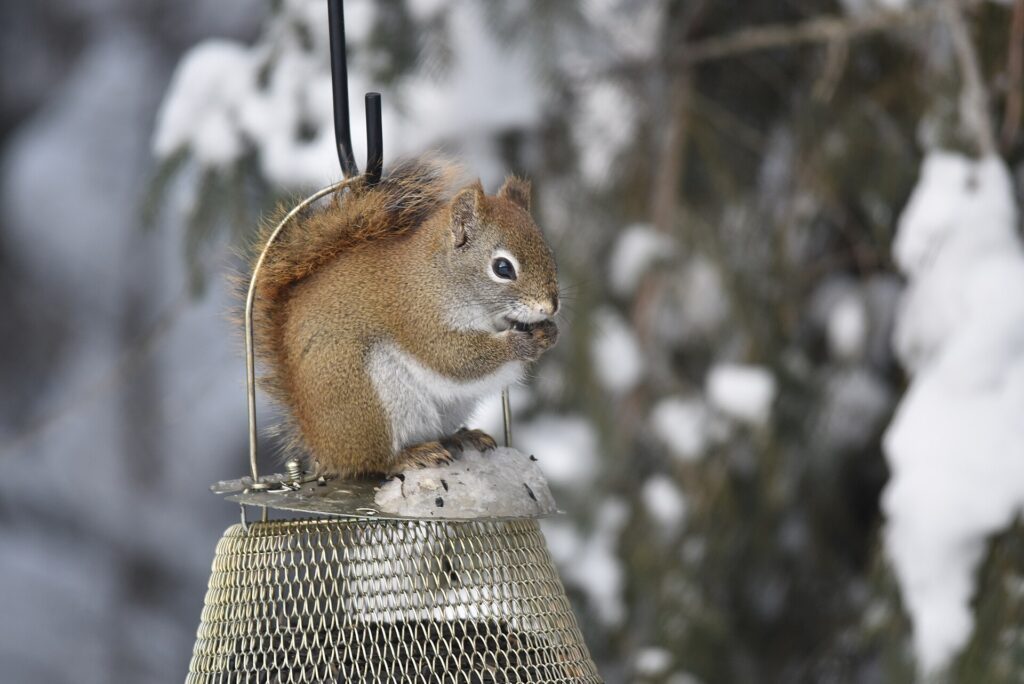
Mammals count too. FeederWatch lets you report wild mammals “ranging in size from mouse to moose,” plus pets like cats and dogs, so the sheet has rows for squirrels and cats.
Why “most at once” and not a running total?
Say you see 3 cardinals in the morning and 2 in the afternoon. A running total says 5, but it might have been the same 3 birds twice. The highest number you saw together, 3, is the one number you know is real. That’s why the sheet has a single “Most at once” column and why you cross out and update it rather than adding.
What’s on the tally sheet
- Name, count site and dates, plus space for hours watched and snow depth.
- 36 common North American feeder birds and mammals, from mourning dove and downy woodpecker to dark-eyed junco and Cooper’s hawk.
- Six blank rows for anything else that shows up.
- A one-page summary of the count rules on page 2.
The list leans toward birds found across much of the U.S. and Canada, so you’ll skip some rows depending on where you live. If a bird isn’t on the list, write it in a blank row.
Tips for your first count
- Learn the regulars first. Our free backyard bird ID chart by color covers 48 common birds and prints on two pages.
- Only count what you can name. FeederWatch asks for “every species you can identify.” If you’re unsure, leave it off.
- Clean and fill feeders before count days. Our guide to cleaning a bird feeder walks through it, and what to feed birds in winter covers seed choices.
- Make it a family job. One person watches, one keeps the sheet. More ideas in how to get kids interested in birdwatching.
- Keep your sheets. A stack of tally sheets is your own record of the winter. Pair it with our backyard bird life list.
Why winter counts matter
The big U.S. bird survey, the USGS Breeding Bird Survey, counts birds along roadsides in June. It misses birds that only visit in winter, and it isn’t a feeder count. FeederWatch fills that gap with winter counts from yards. To see what the June survey shows for one state, read our breakdown of Florida bird population trends since 1966.
For teachers, scout leaders and bird clubs
The tally sheet is free to print and share for personal, classroom and club use, including handing it out at Audubon chapter events. A link back to this page is appreciated.
FAQ
When does Project FeederWatch start?
November 1. The season runs through April 30.
Is Project FeederWatch free?
Not in the U.S. FeederWatch charges an annual participation fee for U.S. residents. Canadians take part by donating to Birds Canada. This tally sheet is free either way.
Do I need a bird feeder to take part?
No. FeederWatch says you can count without feeders if your site has something you maintain that attracts birds, such as water or plantings.
How often should I count?
As often as one pair of days a week, with at least five days off between counts. There’s no minimum, so count as often as you can.
Do I have to use this sheet?
No. You can keep track any way you like, including in the FeederWatch app. The sheet is just an easy paper option for the window sill.