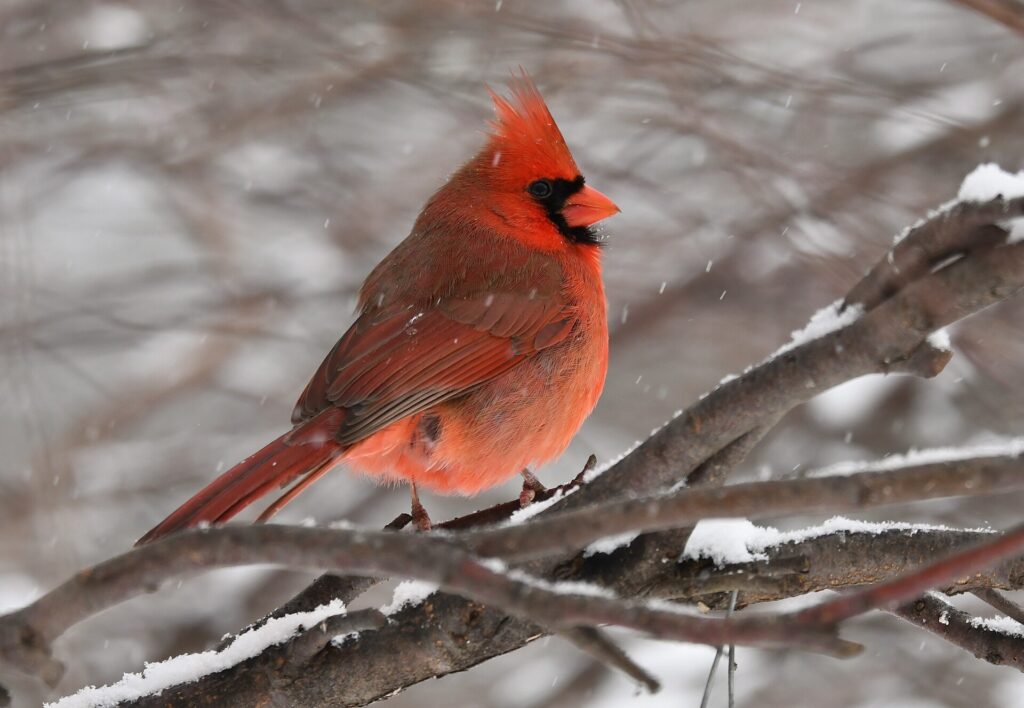
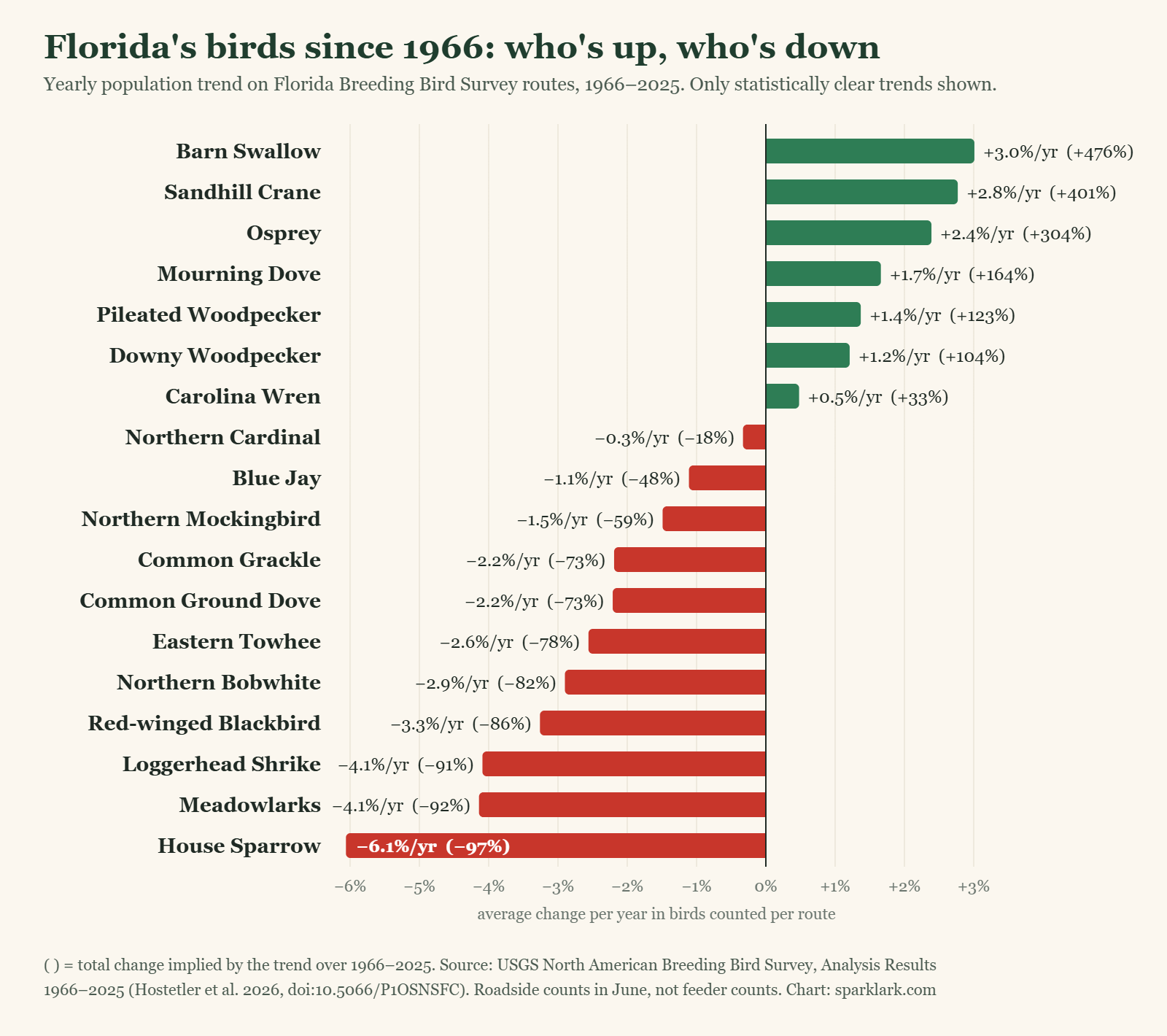
Florida’s backyard birds have changed a lot since 1966. Mourning doves, downy woodpeckers and Carolina wrens are more common on Florida’s survey routes than they were then. Northern mockingbirds, blue jays and even northern cardinals are less common, and the house sparrow has almost vanished from the counts. Those numbers come from the U.S. Geological Survey’s North American Breeding Bird Survey, the longest-running count of breeding birds on the continent. Below are the Florida results from its newest release, covering 1966 to 2025, put in plain English.
The short version
- Biggest drop: House sparrow, down about 6% a year, roughly 97% fewer per route than in 1966.
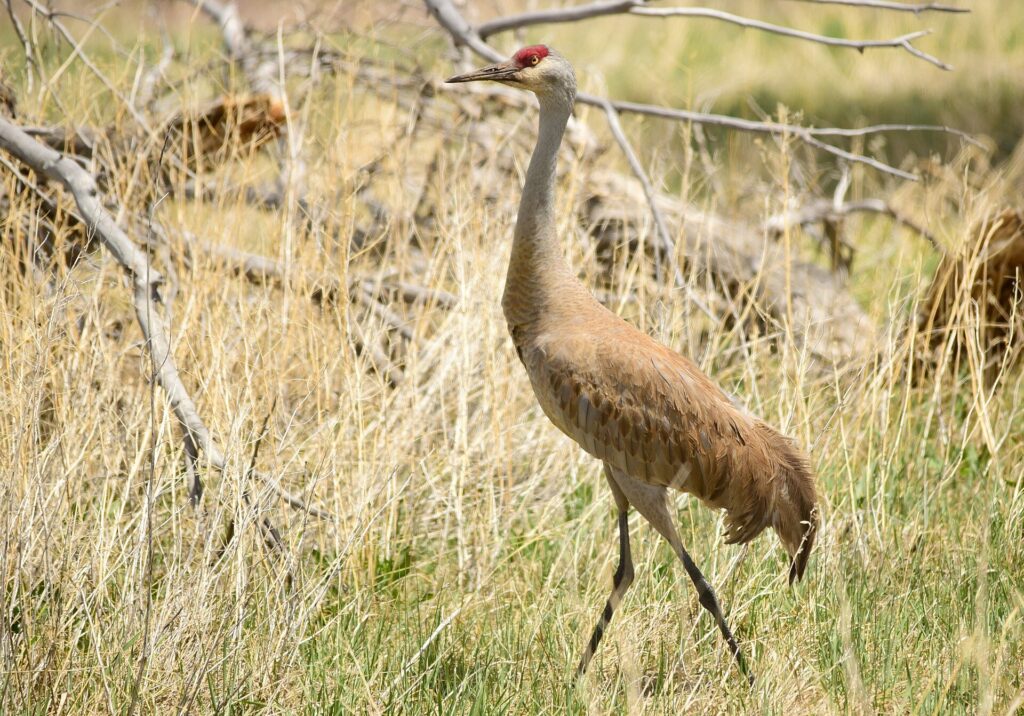
- Biggest gains: Barn swallow, sandhill crane and osprey, each up 2.4% to 3% a year.
- Backyard winners: Mourning dove, downy woodpecker, pileated woodpecker and Carolina wren.
- Backyard losers: Northern mockingbird (Florida’s state bird), blue jay, common grackle, eastern towhee and, by a small but statistically clear amount, northern cardinal.
- Open-country birds are hit hardest: Meadowlarks, northern bobwhite and loggerhead shrike are all down 80% to 92%.
Where these numbers come from
The Breeding Bird Survey is coordinated in the U.S. by the USGS. Each route is a fixed roadside course of about 24.5 miles with 50 stops spaced about half a mile apart. At every stop a volunteer skilled in bird identification does a 3-minute bird count. The survey runs once a year in the breeding season, mostly in June, starting half an hour before sunrise. About 3,000 routes are run across North America each year.
Every year USGS scientists turn those counts into a trend for each species in each state: the average yearly percentage change in birds per route, with a range of uncertainty around it. We used the Florida rows of the 2026 release, The North American Breeding Bird Survey, Analysis Results 1966–2025 (Hostetler, Sauer, Hines, Ziolkowski, Lutmerding and Skalos). The data are public domain.
Two things to keep in mind. These are June roadside counts, not winter feeder counts, so they track the birds that breed in Florida. Birds that only winter here are not part of it. And a trend tells you how much a bird changed, not why.
Florida’s backyard birds: who’s up, who’s down
This table covers the birds most Floridians see at feeders or in the yard. “Clearly up” or “clearly down” means the trend’s 95% credible range sits entirely on one side of zero. “No clear change” means the data can’t rule out a flat line. We only list birds the USGS rates as having enough data (at least 14 routes and no data warning).
| Bird | Trend per year | Change since 1966* | Verdict |
|---|---|---|---|
| Downy Woodpecker | +1.2% | +104% | Clearly up |
| Pileated Woodpecker | +1.4% | +123% | Clearly up |
| Mourning Dove | +1.7% | +164% | Clearly up |
| Carolina Wren | +0.5% | +33% | Clearly up |
| Red-bellied Woodpecker | 0.0% | about the same | No clear change |
| Tufted Titmouse | +0.2% | +16% | No clear change |
| Eastern Bluebird | +0.3% | +17% | No clear change |
| Carolina Chickadee | −0.3% | −17% | No clear change |
| Brown Thrasher | −0.3% | −15% | No clear change |
| Northern Cardinal | −0.3% | −18% | Clearly down |
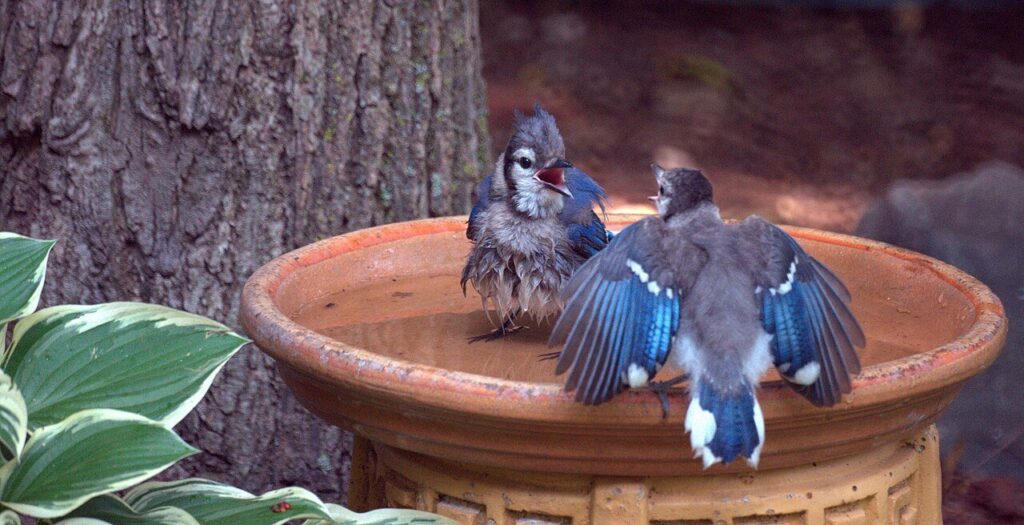
| Blue Jay | −1.1% | −48% | Clearly down |
| Northern Mockingbird | −1.5% | −59% | Clearly down |
| European Starling | −1.6% | −62% | Clearly down |
| Common Grackle | −2.2% | −73% | Clearly down |
| Common Ground Dove | −2.2% | −73% | Clearly down |
| Eastern Towhee | −2.6% | −78% | Clearly down |
| Red-winged Blackbird | −3.3% | −86% | Clearly down |
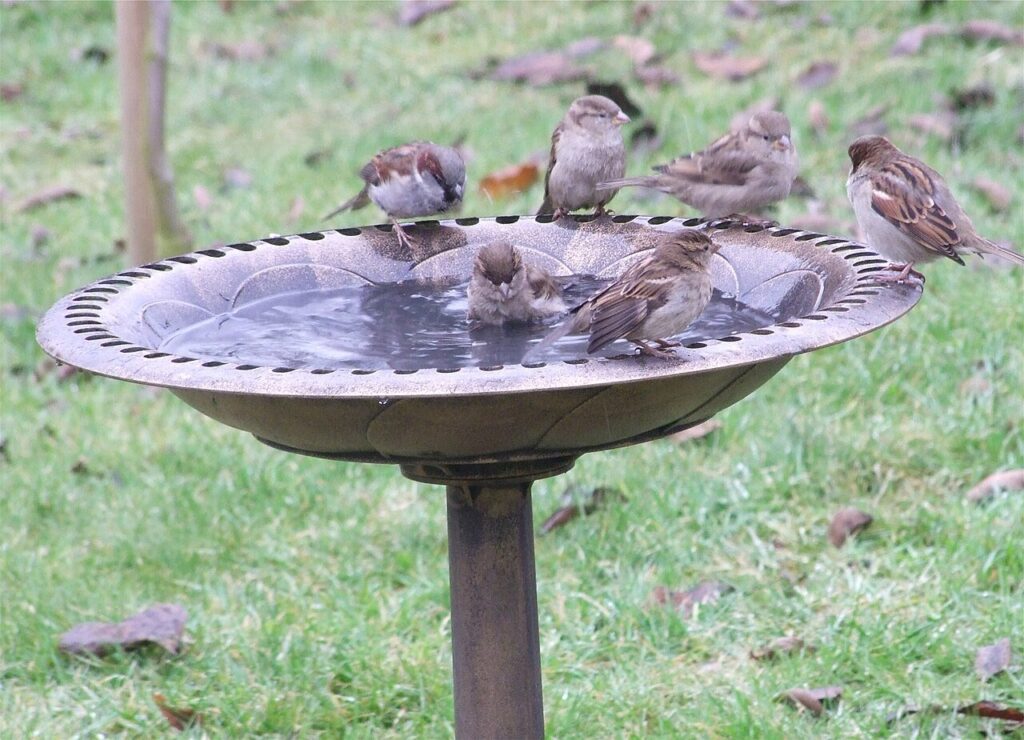
| House Sparrow | −6.1% | −97% | Clearly down |
*Change since 1966 is our calculation: the yearly trend compounded over the 59 years from 1966 to 2025. Treat it as a rough size of the change, not an exact count.
The surprise: cardinals and mockingbirds
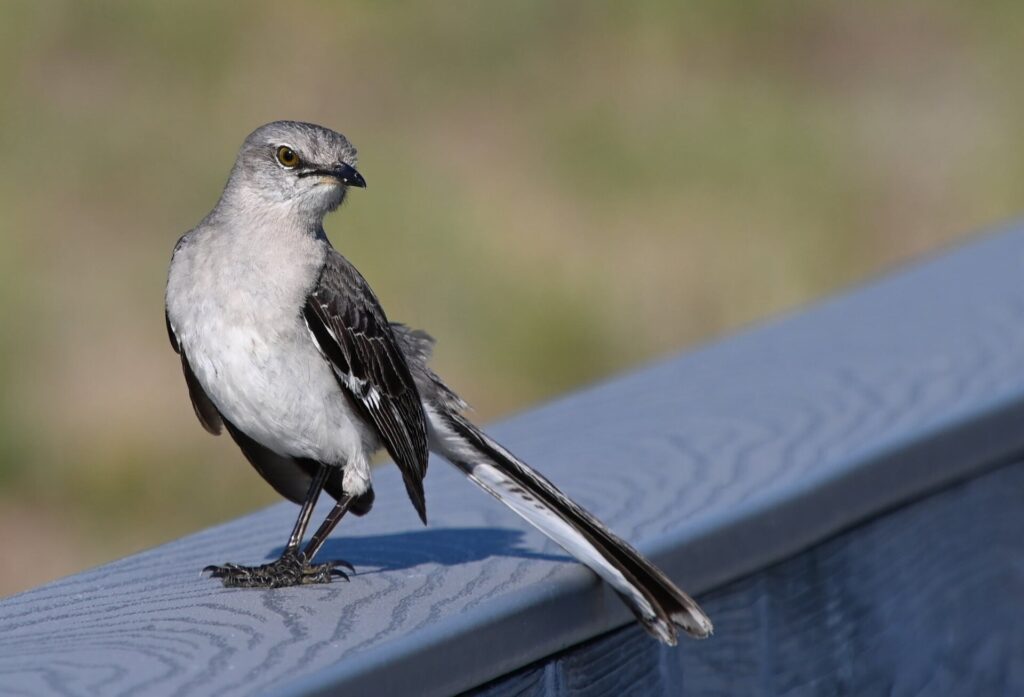
The northern cardinal is still one of Florida’s most-counted birds. Only four species average more per route: white ibis, western cattle-egret, laughing gull and boat-tailed grackle. But its trend is down 0.3% a year, about 18% fewer since 1966. That’s small, but the range doesn’t touch zero, so it isn’t noise. The northern mockingbird, the state bird, is down 1.5% a year, or about 59%. Both are still common. They’re just less common than they were.
If cardinals are your favorite feeder bird, our guide to feeders cardinals actually use covers the platform and hopper styles they prefer.
The winners: doves and woodpeckers
Mourning doves are up 1.7% a year, about 2.6 times as many per route as in 1966. Downy woodpeckers have roughly doubled, and pileated woodpeckers are up about 120%. Carolina wrens show a smaller but clear rise of 0.5% a year.
The steepest declines in Florida
Among all Florida birds with a clear trend, these fell fastest from 1966 to 2025. The survey found 31 species with a clear decline and 10 with a clear increase.
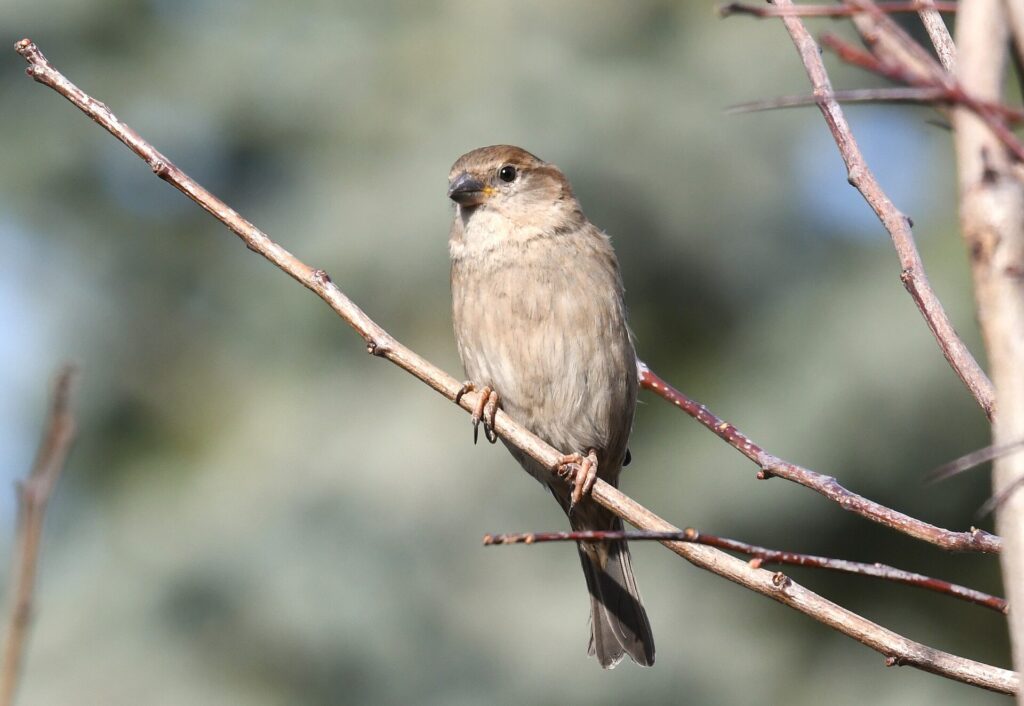
- House sparrow: −6.1% a year (about −97%). This non-native bird is now scarce on Florida routes.
- Least tern: −5.4% a year (about −96%).
- Common nighthawk: −4.2% a year (about −92%).
- Meadowlarks: −4.1% a year (about −92%).
- Loggerhead shrike: −4.1% a year (about −91%).
- Red-winged blackbird: −3.3% a year (about −86%).
- Northern bobwhite: −2.9% a year (about −82%).
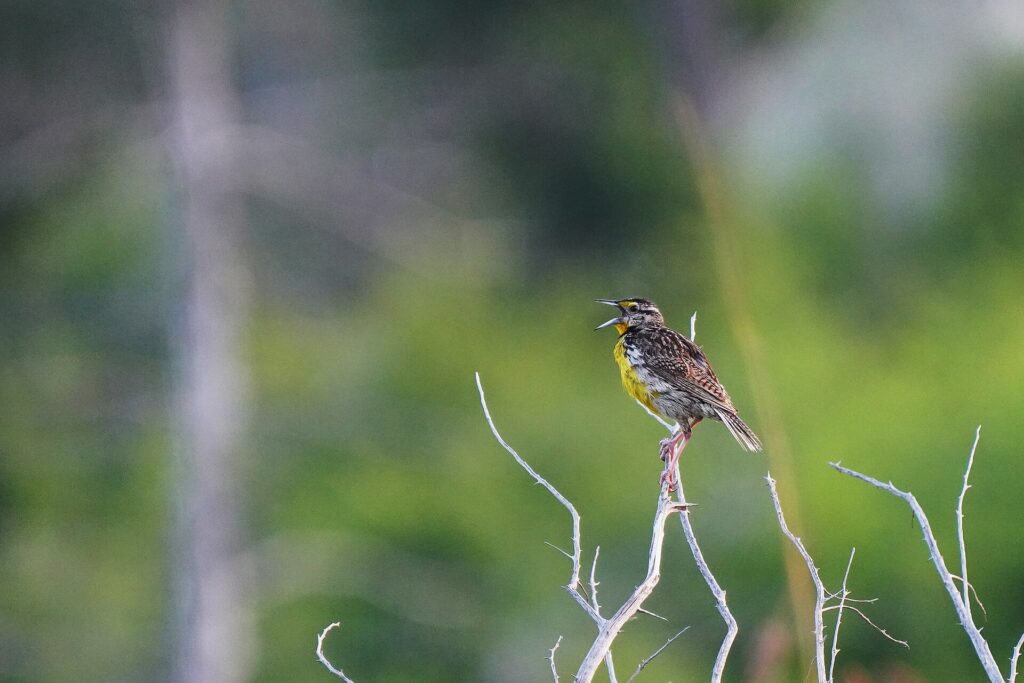
Notice how many of these are birds of open ground: pasture, prairie and roadside fields. Meadowlarks, bobwhite and loggerhead shrikes all live there. The same pattern shows up across North America: the Cornell Lab of Ornithology reports that North American bird populations have dropped nearly 30% since 1970, almost 3 billion birds, and that grassland birds declined 53% (Cornell Lab, Bring Birds Back).
The biggest gains in Florida
- Barn swallow: +3.0% a year.
- Sandhill crane: +2.8% a year, about five times as many per route as in 1966.
- Osprey: +2.4% a year, about four times as many.
- Mourning dove: +1.7% a year.
- Brown-headed cowbird: +1.5% a year.
- Pileated woodpecker: +1.4% a year.
- Downy woodpecker: +1.2% a year.
The 15 most-counted birds on Florida routes
This is the USGS index of birds per route, so it favors birds you see from a road in June. That’s why ibises, egrets and gulls top the list. The first true backyard songbird is the northern cardinal at number five.
| # | Bird | Birds per route |
|---|---|---|
| 1 | White Ibis | 258 |
| 2 | Western Cattle-Egret | 228 |
| 3 | Laughing Gull | 107 |
| 4 | Boat-tailed Grackle | 86 |
| 5 | Northern Cardinal | 54 |
| 6 | Mourning Dove | 42 |
| 7 | Northern Mockingbird | 41 |
| 8 | Carolina Wren | 30 |
| 9 | American Crow | 22 |
| 10 | Red-bellied Woodpecker | 22 |
| 11 | Eastern Towhee | 21 |
| 12 | Black Vulture | 20 |
| 13 | Common Grackle | 18 |
| 14 | Blue Jay | 16 |
| 15 | Fish Crow | 16 |
What you can do from your own yard
- Count your feeder birds this winter. Project FeederWatch, run by the Cornell Lab and Birds Canada, starts November 1. Your counts add winter data that the June roadside survey can’t collect. Our free FeederWatch tally sheet makes it easy.
- Keep feeders clean. Our step-by-step guide shows how to clean a bird feeder.
- Learn who’s visiting. Our free backyard bird ID chart by color covers 48 common U.S. backyard birds.
- Plan for winter visitors. See winter backyard birds by region for the species that arrive after this survey’s June counts.
How we built this page
- Source file: BBS_Core_Trends_1966-2025.csv from the USGS ScienceBase release (doi:10.5066/P1OSNSFC), Florida rows only (142 species).
- “Clearly up/down” uses the USGS significance field: the 95% credible interval excludes zero.
- We kept only species with no USGS credibility warning (65 of 142), so thin-data birds are left out.
- Change since 1966 = (1 + yearly trend) to the 59th power, minus 1. It’s an estimate built from the trend, not a separate count.
- Birds per route = the USGS relative abundance index. Species with an important data deficiency were left out of the top-15 list.
FAQ
Are cardinals declining in Florida?
Slightly. The USGS trend for Florida is −0.33% a year from 1966 to 2025, with a 95% range of −0.59% to −0.07%. That works out to roughly 18% fewer per route. Cardinals are still among the most common birds in the state.
Which Florida birds are increasing?
Barn swallows, sandhill cranes and ospreys rose fastest. Among yard birds, mourning doves, downy and pileated woodpeckers and Carolina wrens all show clear increases.
Why are house sparrows disappearing from Florida counts?
The survey measures the drop, about 6% a year, but it doesn’t give causes. We haven’t found a Florida-specific study that explains it, so we won’t guess.
Does this survey count birds at feeders?
No. It counts birds along roadside routes in June. For winter feeder data, Project FeederWatch is the main program, and anyone can join.