A winter finch irruption is a year when northern seed-eaters such as evening grosbeaks, pine siskins, redpolls and crossbills fly far south into the United States because the cone and seed crops they depend on have failed. This winter (2026–27) is shaping up as a big one in the West and the Plains: the Finch Research Network has issued an “extreme irruption alert” for evening grosbeaks across the central and western U.S., and red crossbills, pine siskins and Cassin’s finches are moving too. In the East the outlook is more mixed, with pine siskins and red crossbills the birds most likely to show up. Our chart below sums up the outlook for 11 species, region by region.
The 2026–27 winter finch outlook at a glance
We built this chart from the two forecasts the Finch Research Network (FiRN) published this fall: Tyler Hoar’s Winter Finch Forecast 2026–2027 (Sept. 25, 2026), which covers eastern Canada, the Great Lakes and the northeastern U.S., and Caleb Centanni and Matt Young’s Irruption Alert for central and western areas (Oct. 16, 2026), which covers the Mississippi River west to the Pacific. Each cell is our plain-English summary of what the forecasters wrote for that bird and region. Tap or click the chart to open the full-size version.
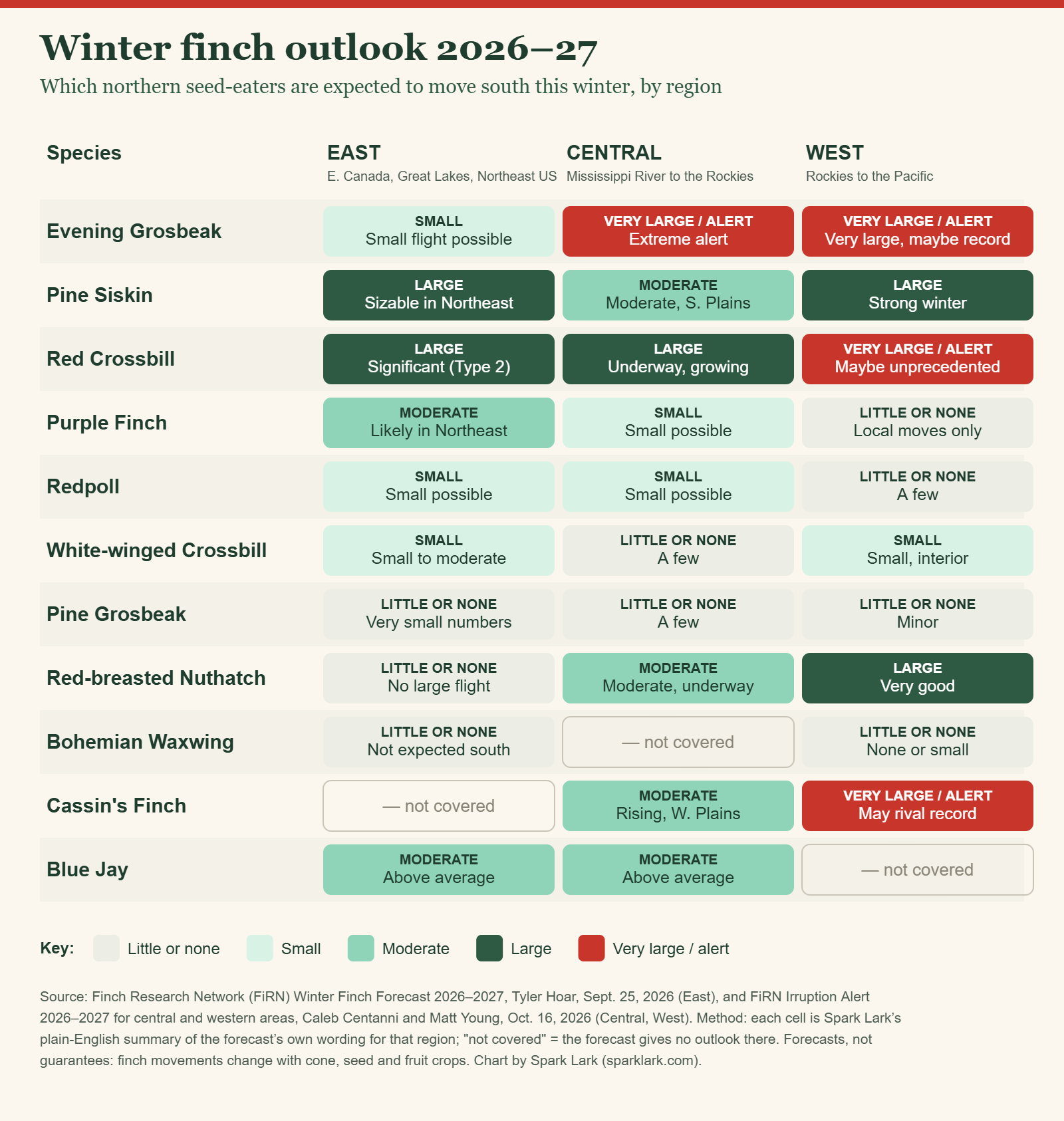
Source and method: Finch Research Network, Winter Finch Forecast 2026–2027 (Tyler Hoar, posted Sept. 25, 2026) and Winter Finch Forecast Irruption Alert 2026–2027, Central and Western Areas (Caleb Centanni and Matt Young, posted Oct. 16, 2026), both read Nov. 6, 2026. Levels (little or none, small, moderate, large, very large/alert) are Spark Lark’s summary of each forecast’s own wording; “not covered” means that forecast gives no outlook for the bird in that region. The western forecast calls itself a pilot, and parts of it experimental.
The short version:
- West and Plains: the year’s headline. Evening grosbeaks, red crossbills, Cassin’s finches and red-breasted nuthatches are already moving, some in numbers the forecasters call possibly unprecedented.
- East: watch for pine siskins (a sizable flight into the Northeast) and red crossbills. Evening grosbeaks are possible in small numbers in southern New York, Pennsylvania and Massachusetts.
- Probably not this year: big flights of redpolls, pine grosbeaks or Bohemian waxwings. Good fruit and seed crops up north should hold most of them there.
What is a winter finch irruption?
Most backyard birds either stay put all winter or migrate on a fairly fixed schedule. A handful of northern seed-eaters don’t. They follow food. Redpolls, for example, move south because of a “temporary scarcity of food in the North, not by cold,” according to the Audubon field guide, and they likely travel only as far as they must to find it. Cornell Lab’s All About Birds says pine siskins can be “abundant one winter and gone the next” over much of the continent.
The food is mostly tree seed: spruce, pine, hemlock, cedar, tamarack and birch, plus fruit such as mountain-ash and crabapple. Trees don’t produce the same crop every year, so in some years a whole region runs short. If that happens after a good nesting season, there are more birds and less food, and many of them head south. Hoar’s forecast notes that spruce budworm outbreaks from Ontario eastward have supplied extra food to several finch species. All About Birds explained during last winter’s flight that a budworm boom likely produced large broods, and more young birds plus bare trees is the mix that sends them south.
That is why these birds can be at your feeder one winter and absent the next. It is also why forecasters study cone and seed crops, not the weather, to guess what’s coming.
Why this winter is different: the western pine cone failure
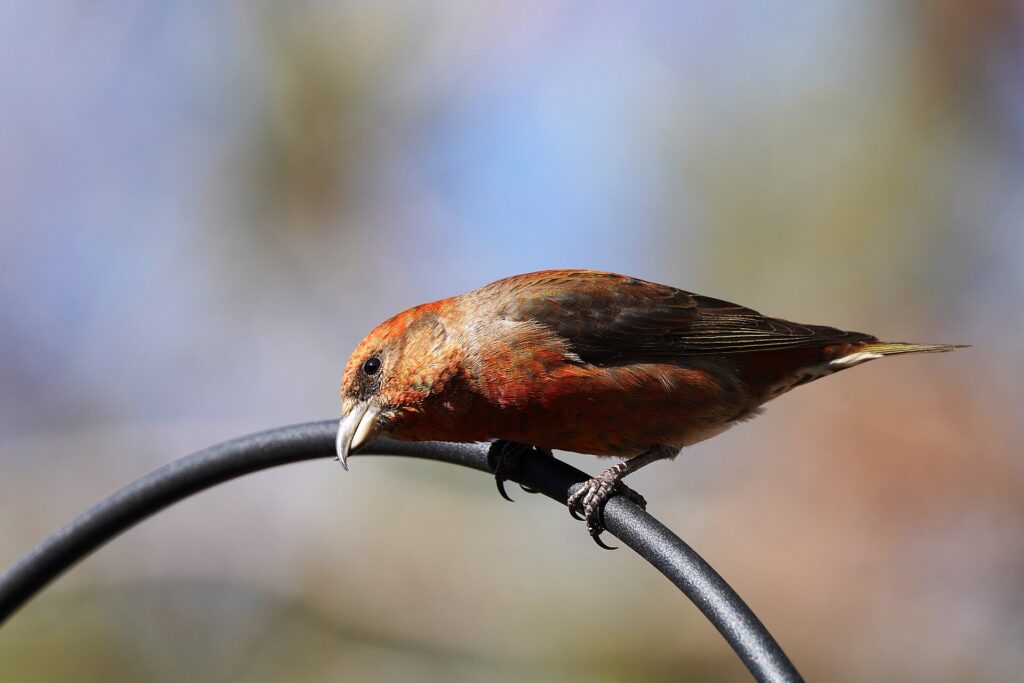
Both FiRN forecasts point to the same trigger. Centanni and Young report a “widespread significant cone crop failure” on limber, whitebark, pinyon and ponderosa pines across the interior mountain West, with spotty Douglas fir and western hemlock crops. Hoar’s eastern forecast says that failure pushed red crossbills of the call type known as Type 2 eastward.
Meanwhile, the spruce crop is reasonably good from northern British Columbia to Alaska and good in parts of the eastern boreal forest, while the central boreal (western Manitoba to Alberta) is mostly poor, per the forecasts. Hoar describes the eastern crops as mostly good, with very good eastern white pine and northern white cedar. That patchwork is why the outlook looks so different depending on where you live.
It is not only finches. The western alert reports Clark’s nutcrackers reaching Wisconsin and Minnesota, which the authors call unusually early, and pinyon jays reaching the California coast for the first time in over two decades. Hawk Ridge counted more than 13,000 blue jays on Sept. 16, according to the same alert.
Region by region: what to watch for this winter
East: eastern Canada, the Great Lakes and the Northeast
Hoar expects a sizable pine siskin irruption in the northeastern U.S., fed by very good white cedar and white pine crops, with a small to moderate flight to the Southeast also possible. One twist: he expects siskins to stay in the forests more than at feeders. Red crossbills should be widespread, with the call type known as Type 12 dominating in the Northeast and Type 2 in the western Great Lakes early in the winter.
Evening grosbeaks are “quite possible” in small numbers in southern New York, Pennsylvania and Massachusetts; Hoar notes irruptions in four of the last six years. Purple finches should move into eastern Canada, the Great Lakes and the Northeast, but any flight to the Mid-Atlantic and South is expected to be a late, small one at best. White-winged crossbills may make a small to moderate push. Blue jays should have an above-average flight.
What probably won’t happen in the East: a big redpoll flight (birch seed is mixed but good in parts of Quebec and the Maritimes), a pine grosbeak or Bohemian waxwing flight (a robust mountain-ash crop should hold them north), or a big red-breasted nuthatch flight to the Southeast like last year’s. Hoar adds a fair warning: last year’s expected redpoll invasion never materialized, and redpolls have become harder to predict.
Central: the Mississippi River to the Rockies
This is where the evening grosbeak alert is loudest. Centanni and Young list an “extreme irruption alert,” with reports spanning the Plains from the Dakotas to Texas. Red crossbills (Type 2) are already irrupting and expected to spread across the Plains. Pine siskins carry an irruption alert too, with a moderate flight into the southern Plains forecast: stronger than in 2024 and 2025, weaker than 2020.
Also on the list: a moderate red-breasted nuthatch irruption already underway, rising numbers of Cassin’s finches on the western Plains, a possible small purple finch flight (birds already reported in central Oklahoma), and above-average blue jay movements. Redpolls and pine grosbeaks are expected only in small numbers, in the northern Plains and Minnesota.
West: the Rockies to the Pacific
The western outlook is the most dramatic. The authors expect a “very large or unprecedented” evening grosbeak irruption, with numbers that may be unprecedented on the California coast, in Oregon’s Willamette Valley and in the northern Great Basin. Red crossbills have already spread into the Willamette Valley, Vancouver Island and Southern California, and may reach unprecedented levels around Puget Sound and Vancouver Island.
Pine siskins are already in the lowlands at well above average numbers, and the authors expect a strong winter in western valleys and the interior West. Cassin’s finches are shifting south, with high numbers from Southern California to West Texas, and the authors say westward movements may rival the largest in eBird’s history. A very good red-breasted nuthatch irruption is expected. Redpolls, pine grosbeaks and Bohemian waxwings look quiet.
How to identify the irruptive finches
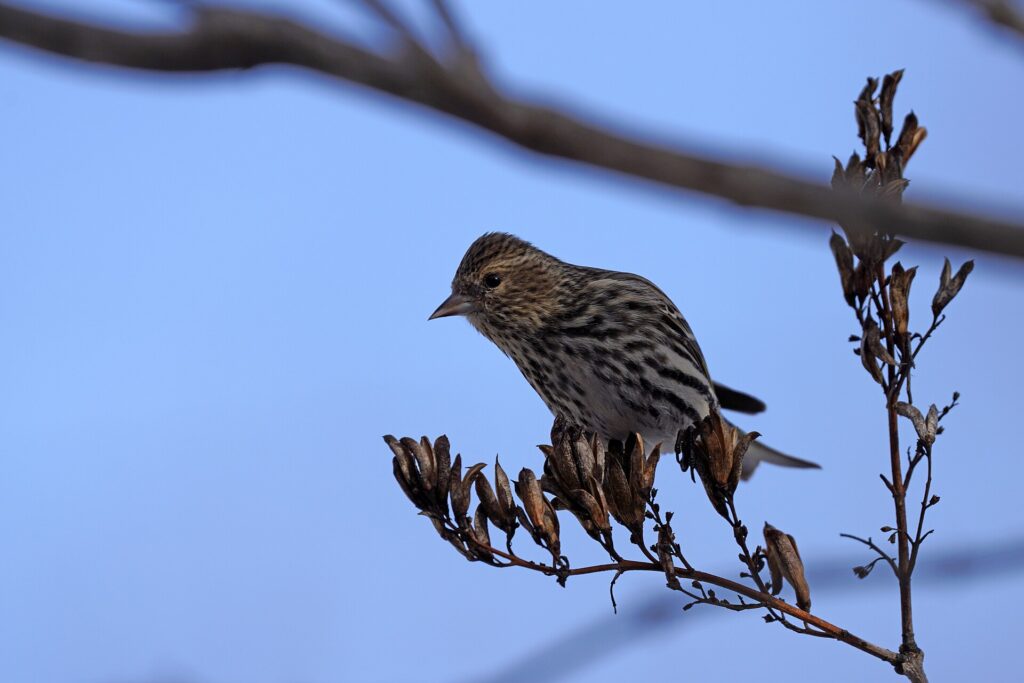
Several of these birds look like everyday feeder birds at a glance. Pine siskins pass for female goldfinches or house finches; purple finches pass for house finches. Sizes and field marks below are from Cornell Lab’s All About Birds and the Audubon field guide.
| Bird | Length | Look for | What brings it in |
|---|---|---|---|
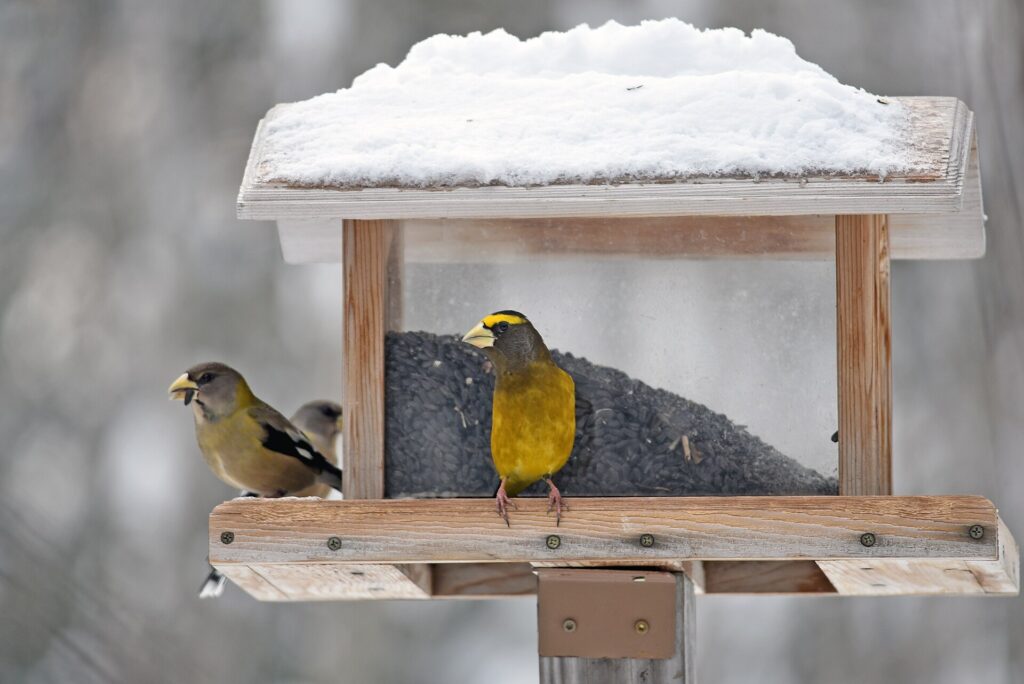
| Evening Grosbeak | 6.3–7.1 in | Male: yellow body, dusky head, bold yellow eyebrow, huge pale bill. Female: gray with golden tints. | Black-oil sunflower on a platform feeder |
| Pine Siskin | 4.3–5.5 in | Heavily streaked brown; thin, pointed bill; yellow flashes in the wings when it flies. | Nyjer, hulled sunflower, millet |
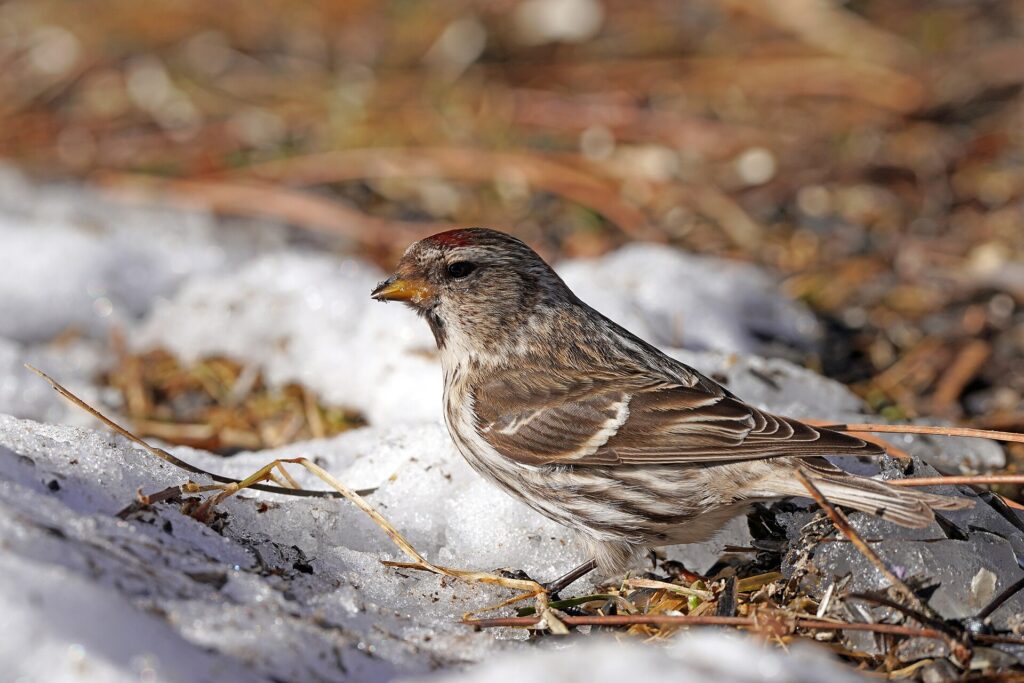
| Redpoll | 4.5–5.5 in | Small and streaky with a red forehead and black chin; many males have a pink wash on the chest. | Visits feeders in winter, often tame |
| Red Crossbill | 5.5–6.7 in | Bill tips cross. Most males dull brick-red with darker wings; females dull yellow. | Conifer cones; rarely at feeders |
| Purple Finch | 4.7–6.3 in | Male looks like a sparrow dipped in raspberry juice; cleaner-looking than a house finch. | Black-oil sunflower |
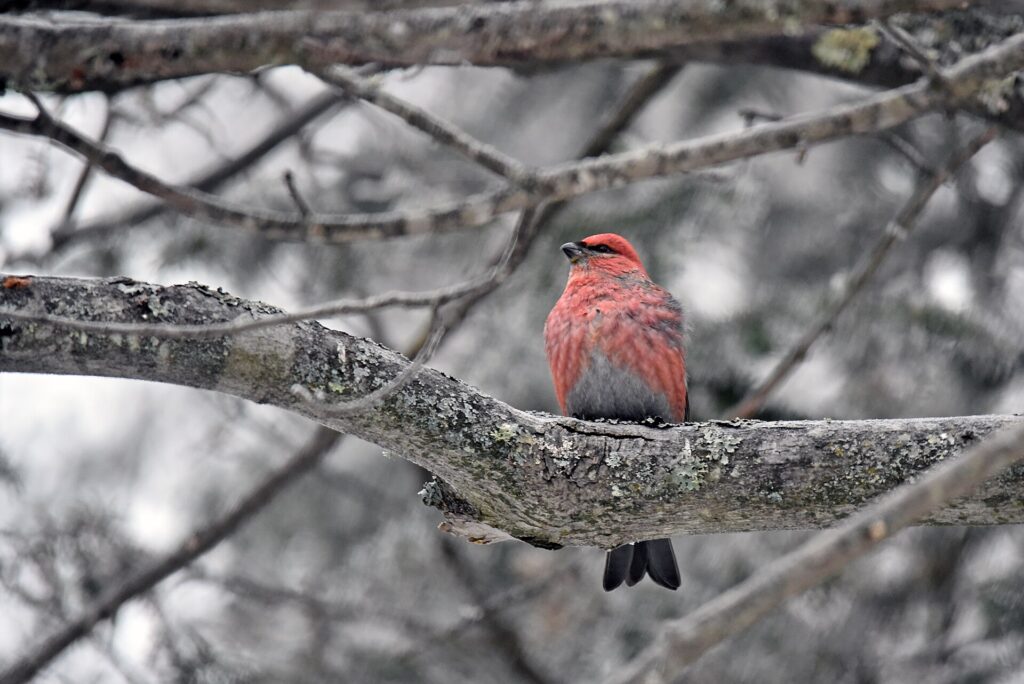
| Pine Grosbeak | 7.9–9.8 in | Big and plump with a stubby bill. Male rosy red and gray with two white wing bars; female gray with yellow or orange head. | Crabapple and mountain-ash fruit |
Sources: All About Birds ID pages for Evening Grosbeak, Pine Siskin, Redpoll, Purple Finch and Pine Grosbeak, and overviews for Evening Grosbeak, Pine Siskin and Purple Finch; Audubon field guide pages for Red Crossbill and Common Redpoll. All read Nov. 6, 2026. Redpolls: Common and Hoary redpolls were combined into one species, the Redpoll, in 2024, per All About Birds.
A few tips that help in the yard:
- Siskin vs. goldfinch: look for heavy brown streaks and a thin, sharp bill. All About Birds calls the siskin an “exceptionally streaky, small-billed finch.” Our guide to little gray birds with yellow on them covers the look-alikes.
- Evening grosbeak: about cardinal-sized but stockier, with a bill that looks too big for the bird. They travel in flocks, so if you see one, look for more.
- Crossbill: look for the crossed bill tips. Audubon says crossbills forage in flocks, clambering over cones in evergreens, and are “very attracted to salt.”
- Redpoll: the red forehead and black chin are the giveaway. Audubon calls redpolls “remarkably tame” at feeders in winter.
How to bring irruptive finches to your feeder
You can’t make an irruption happen, but you can be ready if one passes through. The foods that work are the ones these birds already eat in the wild:
- Evening grosbeaks: black-oil sunflower seed on a platform feeder. All About Birds says platform feeders work better than tube feeders for these large birds that travel in flocks. See our platform feeder guide.
- Pine siskins: nyjer (thistle), hulled sunflower and millet, per All About Birds. Redpolls also visit feeders in winter, Audubon notes. Our tube feeder guide includes nyjer and mesh finch feeders.
- Purple finches: black-oil sunflower, their favorite according to All About Birds. Our bird seed guide explains the different seed types.
- Pine grosbeaks and waxwings: fruiting trees such as crabapple and mountain-ash do more than any feeder.
Keep in mind that the 2026–27 eastern forecast expects pine siskins to stick to the woods more than feeders, and red crossbills rarely use feeders at all. If your feeders stay quiet, our checklist on why birds aren’t coming to your feeder covers the usual reasons.
Keep feeders clean: siskins and salmonella
Irruption years bring dense flocks, and dense flocks at feeders can spread disease. In January 2021, during an irruption year, Sacramento Audubon reported sluggish and dead pine siskins in California, with salmonella thought to pass from bird to bird at feeders. Portland Audubon’s advice, as quoted there, was to take feeders down for 14 days if you see sick birds, so the flock spreads out.
Cornell Lab’s All About Birds recommends cleaning seed feeders about once every two weeks, more often in heavy use or wet weather and when salmonella is reported nearby or you’ve seen sick birds. It suggests a solution of no more than 1 part bleach to 9 parts water, with a 10-minute soak and a scrub. Our step-by-step guide on how to clean a bird feeder walks through it.
How to report what you see
Irruptions are tracked by people watching their own yards. If finches show up, count them. Project FeederWatch runs through the winter, and our free Project FeederWatch tally sheet (no signup) makes it easy to keep track. The FiRN alert also asks birders to report irruptive movements on eBird and to FiRN, and to send recordings of red crossbills and evening grosbeaks so their call types can be identified.
FAQ
Is 2026–27 a big winter finch year?
In the West and on the Plains, yes, according to the Finch Research Network: evening grosbeaks, red crossbills, pine siskins, Cassin’s finches and red-breasted nuthatches are all on alert. In the East it looks moderate, led by pine siskins and red crossbills.
Will evening grosbeaks come to my feeder?
Your best odds are in the central and western U.S. this winter. In the East, the forecast calls a small flight into southern New York, Pennsylvania and Massachusetts “quite possible.” All About Birds calls the species declining and increasingly uncommon in the East, so any visit is worth noting.
Why do winter finches irrupt?
Food. When cone, seed and fruit crops fail in the northern forests, these birds move south to find more. For redpolls, Audubon says the moves are triggered by food scarcity “not by cold.”
Who makes the winter finch forecast?
The Finch Research Network publishes it each fall. The eastern forecast is by Tyler Hoar, and this year’s central and western alert is by Caleb Centanni and Matt Young. All About Birds notes the forecast has been published since 1999.
What other birds can I expect this winter?
Most of your winter feeder birds are regulars, not irruptive. See winter backyard birds by region, and use our free backyard bird ID chart by color to name newcomers. To learn how small finches get through freezing nights, read how birds survive the winter.
Bottom line
The 2026–27 winter finch irruption is centered in the West and on the Plains, where a failed pine cone crop has evening grosbeaks, red crossbills, pine siskins and Cassin’s finches on the move. In the East, pine siskins and red crossbills are the birds to watch, and a few evening grosbeaks are possible. Put out black-oil sunflower on a platform feeder and nyjer in a finch feeder, keep feeders clean, and count what you see. If the forecasts are right, this could be the winter a new finch lands in your yard.