Hummingbirds don’t care whether a plant is native, fashionable, or rare. They care whether it has tubular flowers, whether the nectar is worth the trip, and whether it blooms when they’re around. The plants below meet all three tests and share one more trait that matters from Texas to the Carolinas to California: once they’re established, they shrug off heat and weeks without rain. Here are the ten that earn their space, with the regions and zones where each one works, and the one thing you need besides plants.

Why drought-tolerant matters for hummingbirds specifically
A hummingbird burns through its body weight in nectar every day, so what it needs from a garden is not one spectacular plant but a steady supply from April to October. Thirsty annuals give up in the first heat wave, right when the birds need them most and when a water-restricted homeowner is least able to keep them going. Deep-rooted perennials and shrubs keep flowering through August with a soak every week or two, and many of them bloom harder when they’re a little stressed. The plants below are chosen for that: long bloom, low water, and flowers shaped for a hummingbird’s bill.
The ten plants
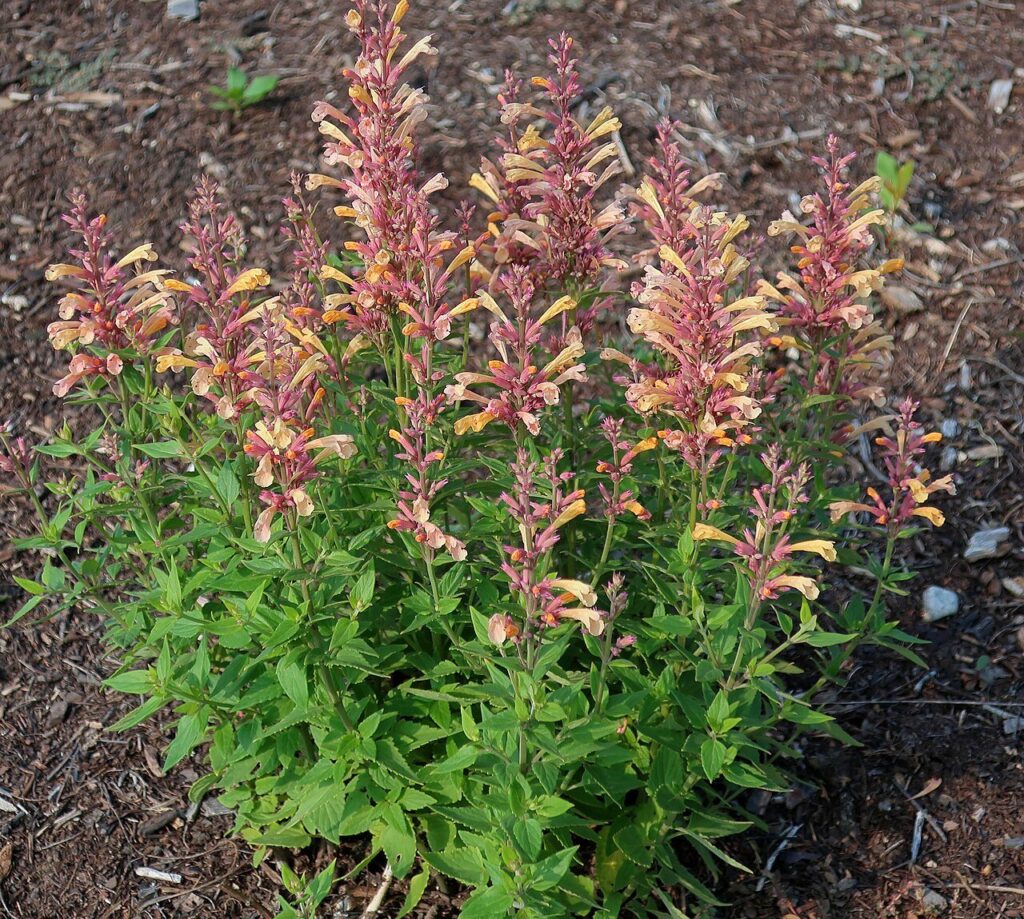
1. Agastache (hummingbird mint)
If you plant one thing from this list, plant this. Tall spikes of tubular flowers in orange, coral, pink, or purple from June until frost, a licorice-mint scent that deer avoid, and a habit of blooming harder the less you water it. Cultivars like ‘Kudos Coral’, ‘Blue Fortune’, and the orange Agastache rupestris are hardy in zones 5 to 9; in the Southeast give it sharp drainage or it rots in a wet winter. Two feet tall, full sun.
2. Salvia (sage)
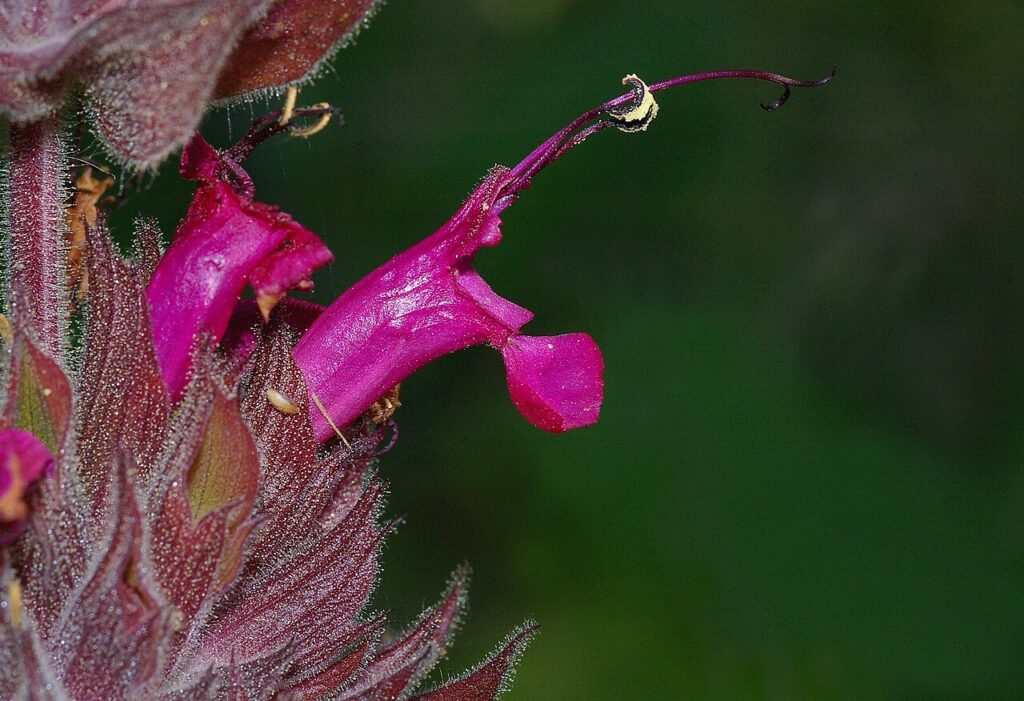
The biggest genus on the list and the most reliable. For the Southeast and Gulf Coast, Salvia greggii (autumn sage, zones 7–10) and ‘Black and Blue’ (S. guaranitica, zones 7–10, root-hardy to 6) bloom from spring to frost. For the West, hummingbird sage (S. spathacea) and Cleveland sage are California natives that want no summer water at all. For the North, S. nemorosa ‘May Night’ is hardy to zone 4 and gets a second bloom if you shear it in July. Red and blue salvias draw the most hummingbird traffic.
3. Penstemon (beardtongue)
Native across the whole country with a species for every region: firecracker penstemon (P. eatonii) and scarlet bugler (P. centranthifolius) in the Southwest and California, P. digitalis ‘Husker Red’ in the Midwest and Northeast (zone 3), pineleaf penstemon in the mountains. Red and orange species are hummingbird magnets; the white and lavender ones feed bees instead. Needs lean soil and excellent drainage; rich, wet beds kill it.
4. Trumpet vine (Campsis radicans)
The single most productive hummingbird flower in the eastern U.S., and a plant that will eat your fence, your shed, and your neighbor’s gutters if you let it. Zones 4–9, native from Pennsylvania to Texas, completely indifferent to drought once its roots are down. Plant it against a sturdy structure at the edge of the property, cut it back hard every spring, and never near the house. Blooms July through September, exactly the gap most gardens have.
5. Lantana
A shrub in zones 8–11 and an annual everywhere else, and worth growing as an annual: it flowers from the day you plant it until frost, in heat that flattens everything else, with no water past the first month. Hummingbirds and butterflies both work the flower clusters all day. In Florida and the Gulf states plant only sterile cultivars (‘New Gold’, ‘Miss Huff’) because the wild type is invasive there.
6. Bee balm (Monarda)
The northern and eastern answer to salvia: a native perennial hardy to zone 3 with shaggy red, pink, or purple heads that hummingbirds visit constantly in July. Standard bee balm wants moisture, but Monarda fistulosa (wild bergamot) and the ‘Jacob Cline’ cultivar handle dry summers once established. Give it air circulation to limit mildew.
7. Red yucca (Hesperaloe parviflora)
For Texas, Arizona, New Mexico, Nevada, and inland California, this is the workhorse: a grassy evergreen clump that sends up five-foot wands of coral-pink tubular flowers from May to October on zero irrigation. Zones 5–11, deer-proof, and a favorite of black-chinned and Anna’s hummingbirds. Slow to start; buy the biggest plant you can.
8. Cardinal flower (Lobelia cardinalis)
The exception on this list: it wants moist soil. It’s here because no plant in North America attracts hummingbirds more reliably, and because a rain garden, a downspout outlet, or the low corner where the hose drains will grow it on no extra water. Native to almost every state, zones 3–9, scarlet spikes in August when little else is red.
9. Baja fairy duster (Calliandra californica)
Southwest only (zones 9–11), and there it’s unbeatable: a three-foot shrub covered in red powder-puff flowers most of the year, on rainfall alone, that Anna’s and Costa’s hummingbirds guard like a feeder. In Phoenix and Tucson it blooms in January.
10. Coral honeysuckle (Lonicera sempervirens)
The well-behaved native vine for people who read the trumpet vine entry and got nervous. Zones 4–9, eastern half of the country, red-orange tubular flowers from April into fall, evergreen in the South, and it stays where you put it. Ruby-throats find it the week it opens. Not the invasive Japanese honeysuckle; check the Latin name.
Region quick pick
| Region | Start with these three |
|---|---|
| Northeast / Upper Midwest (zones 3–6) | Bee balm, penstemon ‘Husker Red’, agastache ‘Blue Fortune’ |
| Mid-Atlantic / Southeast (zones 7–8) | Salvia ‘Black and Blue’, coral honeysuckle, agastache |
| Florida / Gulf Coast (zones 9–10) | Sterile lantana, salvia greggii, firebush (a bonus native) |
| Texas / Southern Plains | Red yucca, salvia greggii, trumpet vine |
| Southwest desert | Red yucca, Baja fairy duster, firecracker penstemon |
| California | Hummingbird sage, Cleveland sage, scarlet bugler penstemon |
| Pacific Northwest | Agastache, penstemon, coral honeysuckle |
Planting so they actually survive a drought
Drought-tolerant means tolerant once established, and establishment takes one full growing season. Plant in fall where winters are mild and in spring where they’re not, water deeply once a week the first summer, then back off to every two or three weeks. Skip the fertilizer; these plants flower better lean. Mulch two inches deep with bark or gravel (gravel for the western natives, which rot under bark), keep the mulch off the crown, and plant in groups of three or more of the same thing so a hummingbird can work a patch instead of a single stem. Never spray insecticide near them; hummingbirds eat as many small insects as they do nectar, and a poisoned garden is an empty one.
Two honorable mentions
Rocky Mountain bee plant (Cleome serrulata) is a Western native annual that hummingbirds work hard in July and August, when a lot of perennials have quit. It is tall, pink, self-seeds freely, and asks for nothing but sun and poor soil, which is why it shows up along Colorado roadsides. Sow it directly in spring anywhere in zones 3 to 10; it does not transplant well.
Whatever is native to your county. The ten above are safe bets nationwide, but the plants hummingbirds evolved with in your area will always outdraw them, and native nurseries usually sell them cheaper. The Audubon native plant database (search by zip code) is the fastest way to build that list.
The one thing to buy besides plants
A feeder bridges the gaps: the two weeks in spring before anything blooms, the August lull, and the drought year when even these plants slow down. A saucer-style feeder with a built-in ant moat is the one to get: no leaking, no bees (the ports are too deep), easy to scrub, and the two-pack is a cheap way to start. Fill it with one part plain white sugar to four parts water, no dye, and change it every two to three days in heat. See our guides to keeping bees off hummingbird feeders and why hummingbirds fight at feeders.
Where to buy the plants
Not Amazon. Seed packets sold there are mostly annual salvia species and mislabeled mixes, and mail-order live plants arrive stressed. Buy from a local independent nursery or a regional native-plant nursery; they stock the species that survive your county’s summers, in the sizes that establish fastest. Fall plant sales at native plant societies and botanical gardens are the best deal going.
Related: The best hummingbird feeders · How to create a bird-friendly garden · The ultimate bird bath guide · Winter backyard birds by region