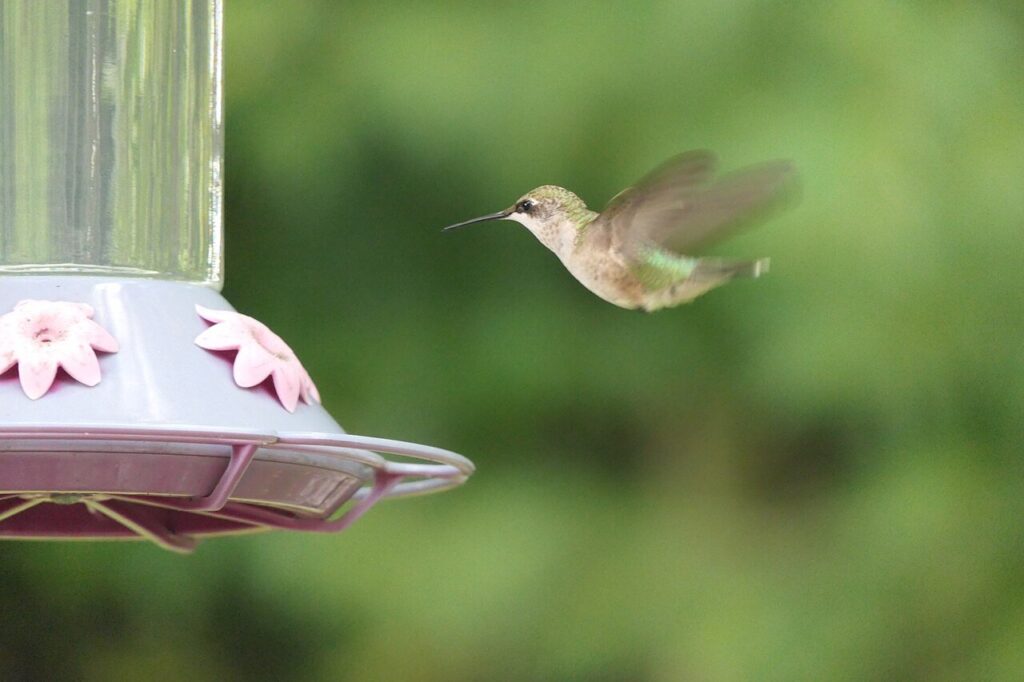
There are two kinds of hummingbird feeders, and once you know the difference, the choice mostly makes itself. Bottle feeders hold the nectar in a reservoir above the ports; they hold more, they look like the feeders in the catalogs, and they drip. Saucer feeders hold the nectar in a dish below the ports; they hold less, they don’t drip, and bees can’t reach the nectar. Nearly every problem people have with hummingbird feeders, bees, ants, leaking, mold, comes from the bottle design. So this list leans saucer, with the two bottle feeders that earn their place and one feeder with a camera in it.
We compared these on the things that matter after the first week: whether it leaks, how hard it is to clean (you’ll be doing it twice a week in July), whether it holds up outdoors for more than one season, and what the ports do about bees.
Spark Lark is reader-supported. As an Amazon Associate we earn from qualifying purchases made through links on this page, at no extra cost to you.
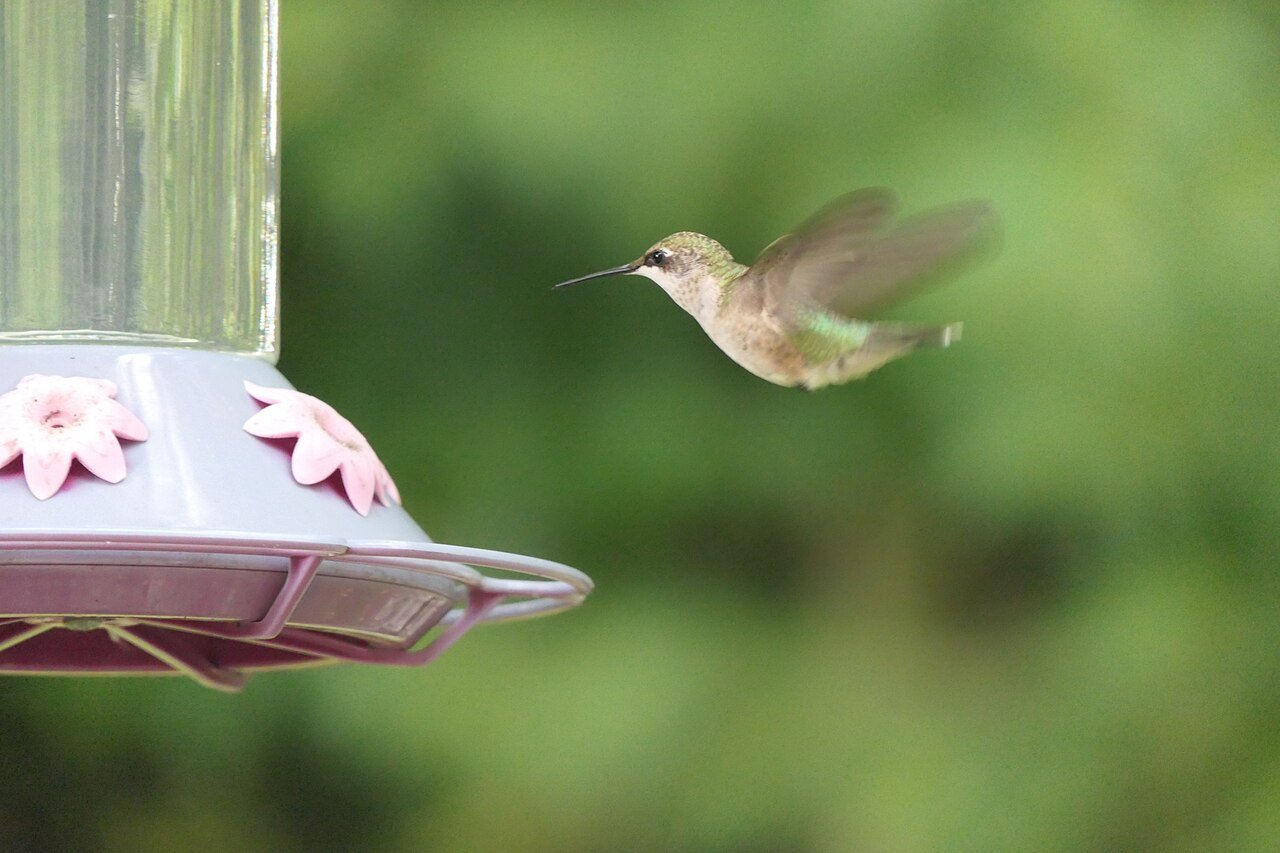
The short version
- Best overall: Aspects HummZinger HighView. The saucer feeder everyone else copies, made in the USA, lifetime guarantee.
- Best value: the 16-oz saucer with 8 replacement flowers. built-in ant moat, and it comes apart flat.
- Best bottle feeder: First Nature 16-oz, 10 ports. Wide mouth, no tiny parts, built-in ant moat, made in the USA.
- For a big flock: First Nature 32-oz. If you’re in Texas, Arizona or the Southwest and refilling daily, this.
- Best glass: More Birds Red Jewel. For the person who wants a feeder that looks like something.
- For the window: Perky-Pet window feeder. Hummingbirds two inches from the glass.
- With a camera: Netvue Birdfy Hummee. Slow-motion clips of every visit, solar-powered.
- Buy with any of them: ant moats and a port-brush set.
Saucer or bottle: the only decision that matters
In a bottle feeder, nectar sits in an inverted reservoir and is held in the ports by vacuum. When the sun warms the air in the bottle, it expands and pushes nectar out; that’s the drip, and the drip is what feeds bees, wasps and ants, and what leaves a sticky ring on the deck. Bottle feeders also have more parts, more seams for mold, and ports at the bottom where the nectar is warmest. Their advantage is capacity, and that only matters if you have the kind of hummingbird traffic that empties 16 ounces a day, which mostly means the Southwest.
In a saucer feeder, nectar sits in an open dish under a lid with ports in it. Nothing can drip because nothing is under pressure. A hummingbird’s tongue reaches the inch down to the nectar; a bee’s doesn’t. The lid lifts off, the dish rinses in five seconds, and there are no seams. The trade-off is that saucers hold 8 to 16 ounces, so a busy yard refills every two or three days. In summer heat you should be changing nectar that often anyway. For most of the country, a saucer is simply the better feeder, and our bees and wasps guide is mostly the story of people switching to one.
The feeders
1. Aspects HummZinger HighView — best overall
12 oz saucer · 4 ports · built-in ant moat · made in USA, lifetime guarantee
The HummZinger is the feeder serious hummingbird people own, and the reason is the polycarbonate: it doesn’t yellow, crack or cloud after three summers in the sun the way cheap feeders do. The raised perch ring (“HighView”) lets the birds sit while they drink and gives you an unobstructed look at them, the ant moat is built into the hanger, the lid lifts straight off for cleaning, and Aspects guarantees it for life. Twelve ounces is plenty for a yard with a few birds. If you’re buying one feeder to keep for a decade, this is it. The 8-oz Mini is the same feeder for a small yard or a second station.
Downside: it’s twice the price of the feeder below and it doesn’t look like much. If capacity matters, the 16-oz Excel is the bigger version.
2. 16-oz saucer with 8 replacement flowers — best value
16 oz saucer · 5 ports · ant moat
The saucer feeder we recommend to most people: red lid, clear dish, five ports with removable flower inserts (eight spares in the box, because they do get lost), a built-in moat, and a wide dish that fits a hand for scrubbing. It’s the same design as the HummZinger in cheaper plastic, which means it’ll fade and possibly crack in year three instead of never. At its price, replace it then. Comes with a hanging hook and an S-hook.
Downside: the plastic. Keep it out of direct afternoon sun if you can, both for the feeder and because nectar spoils faster in it. The two-pack of 16-oz saucers is even cheaper per feeder if you want two stations, which cuts down on the fighting.
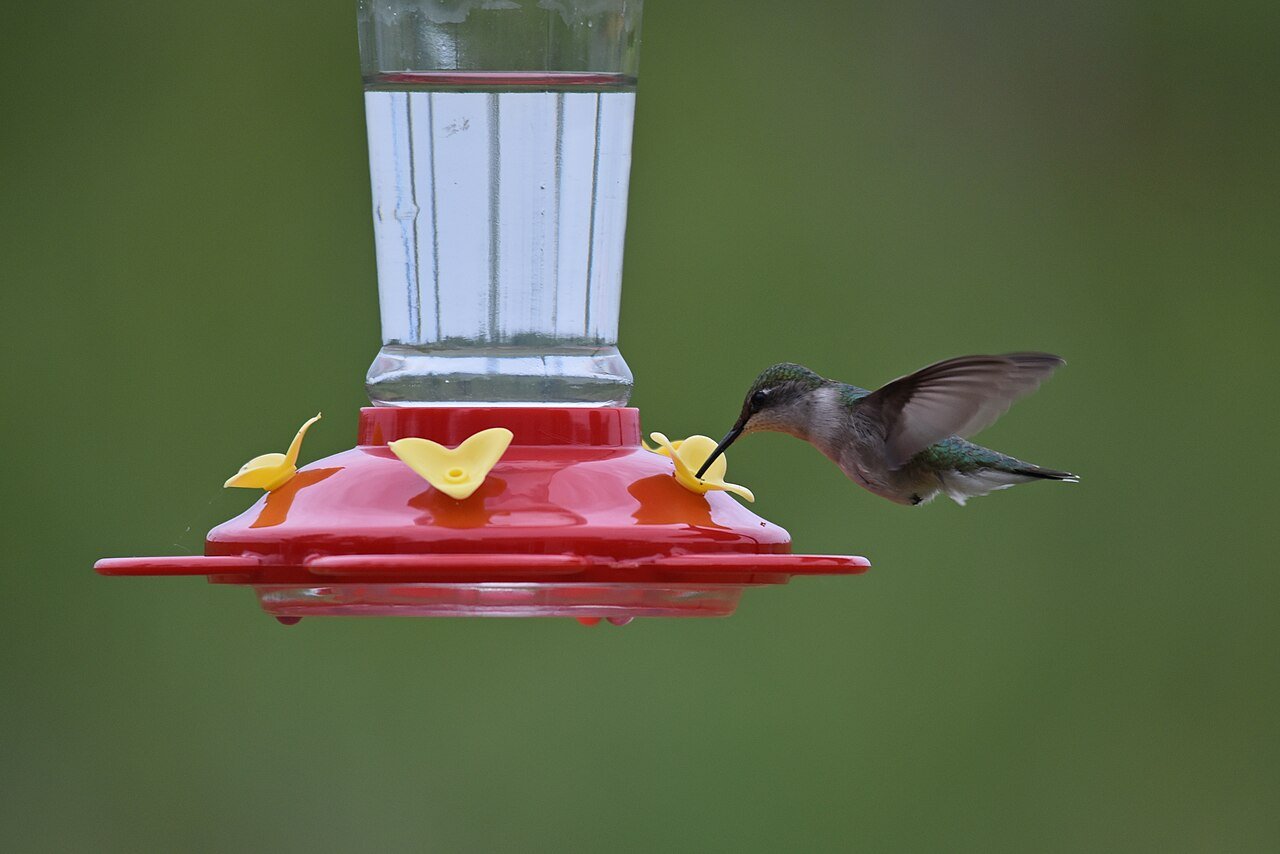
3. First Nature 16-oz, 10 ports — best bottle feeder
16 oz bottle · 10 ports
If you want a bottle feeder, buy this one. The reason it works where other bottle feeders don’t is the design: a wide-mouth reservoir you can get a brush into, a two-piece base with no hidden channels, ten ports so a flock can feed without a fight, and a sealing ring that actually seals. The base has a built-in ant moat, and it’s cheap enough to run two or three. Hang it in shade to cut the dripping.
Downside: it’s a bottle, so it drips a little, and the red base is a magnet for bees in August. Add bee guards, or switch to a saucer when the wasps show up.
4. First Nature 32-oz wide-mouth — for a big flock
32 oz bottle
The same feeder at twice the size, for the yards that need it: southeast Arizona, the Texas Hill Country, coastal California, anywhere with a dozen birds at a time or a fall migration that drains a quart a day. In a yard with three ruby-throats, 32 ounces will spoil before it’s drunk, so this is for volume only.
Downside: heavy when full, and the bigger air space means more expansion and more dripping. Hang it from a solid hook.
5. More Birds Red Jewel — best glass feeder
20 oz glass bottle · 5 ports
Glass doesn’t yellow, doesn’t hold odors and doesn’t scratch, and the Red Jewel is the glass bottle feeder that gets the mechanics right: a metal base with five ports and perches, a bottle that unscrews for cleaning, and a hanger that doesn’t tip. It’s the feeder for a porch you look at, and the one to give as a gift. Twenty ounces is on the large side; fill it half full in a quiet yard.
Downside: glass breaks when it blows down, and the metal base ports are harder to brush than plastic. Still a bottle, so still hang it in shade.
6. Perky-Pet window feeder — for the window
8 oz · 3 ports · suction cups
A small bottle feeder on suction cups that sticks to the glass. Hummingbirds get used to it within days, and the result is a bird at arm’s length while you drink your coffee, which is the whole point of feeding hummingbirds. Clean the glass with alcohol first and the cups hold all season. Good for apartments, offices, and anyone who can’t get outside.
Downside: 8 ounces and three ports, so it’s a second feeder, not the main one. Bottle-style, so expect a little drip on the sill.
7. Netvue Birdfy Hummee — with a camera
saucer-style with 1080p camera · solar · AI species ID
A saucer feeder with a camera in the middle and a solar panel on top. It triggers on each visit, records a clip, and, because hummingbirds move faster than any feeder camera can follow, slows it down so you can actually see the bird. The AI tells the species apart, which matters in the West where you might have four. Same lifetime-free identification as the other Birdfy products, no subscription. It’s the same idea as the smart seed feeders we compared here, for a bird that seed feeders never see.
Downside: it is expensive for a feeder, it has a short track record, and it needs sun for the panel and Wi-Fi at the feeder. Buy it for the second season, once the birds are reliable.
Side by side
| Feeder | Type | Capacity | Ports | Bee-resistant | Ant moat |
|---|---|---|---|---|---|
| HummZinger HighView | Saucer | 12 oz | 4 | Yes | Built in |
| Saucer w/ 8 flowers | Saucer | 16 oz | 5 | Yes | Built in |
| First Nature 16 oz | Bottle | 16 oz | 10 | Add guards | Built in |
| First Nature 32 oz | Bottle | 32 oz | 10 | Add guards | Add-on |
| More Birds Red Jewel | Glass bottle | 20 oz | 5 | Partly | Add-on |
| Perky-Pet window | Bottle | 8 oz | 3 | No | No |
| Birdfy Hummee | Saucer + camera | — | 4 | Yes | Built in |
Nectar, cleaning, and where to hang it
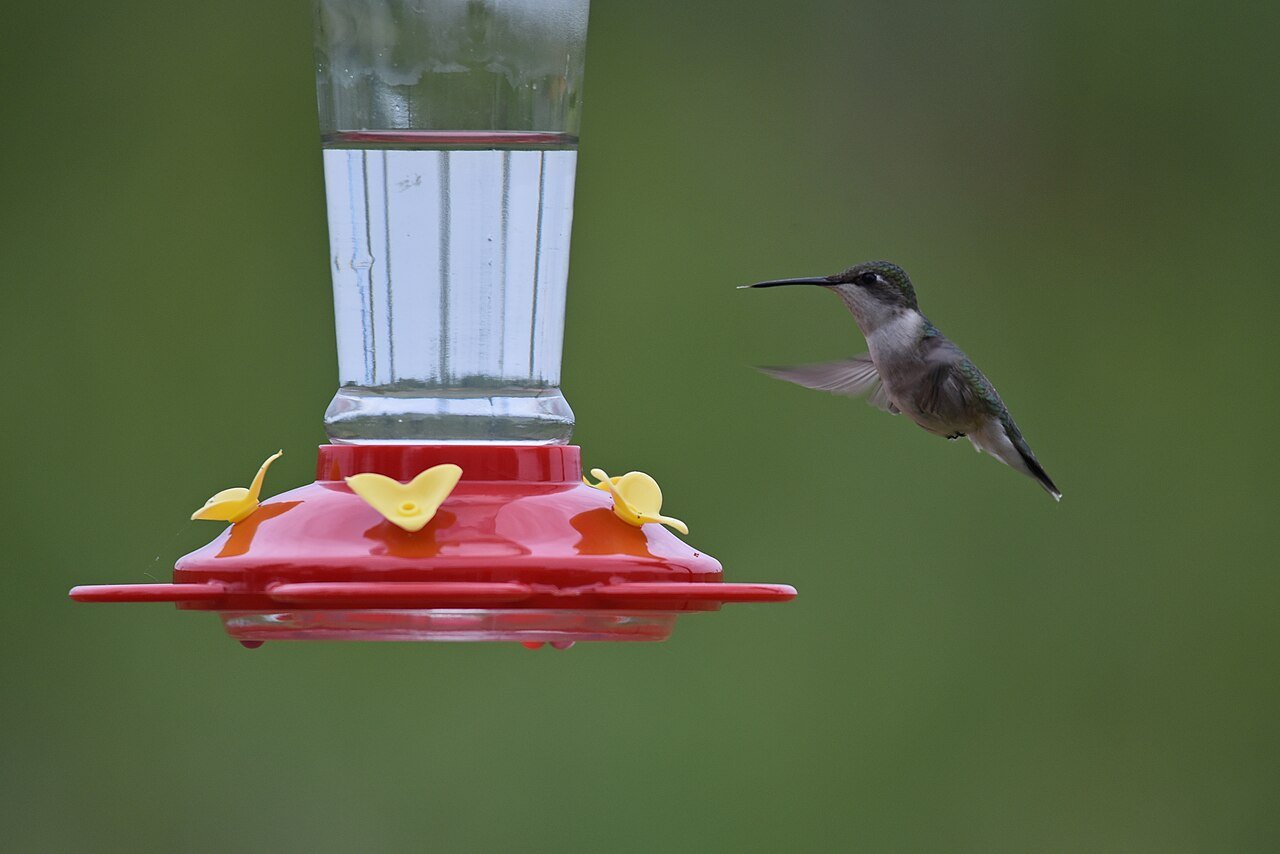
Nectar: one part plain white sugar to four parts water, boiled or not, no dye. Red dye does nothing for the birds and there’s reason to think it hurts them; the feeder is red, and that’s enough. Store extra in the fridge for a week. The Perky-Pet nectar powder is just sugar with a scoop if you’d rather not measure.
Cleaning: every two days when highs are over 90°F, every three to four days in the 80s, weekly in cool weather. Cloudy nectar or black spots mean it’s fermented or molded, and fermented nectar can kill a hummingbird. Hot water and a port brush; a splash of vinegar for mold. No soap residue.
Placement: in shade for at least the afternoon, near flowers or a shrub the birds can perch in, and out of sight of any other hummingbird feeder, because one bird will claim a feeder and chase everyone off it. Two feeders around a corner from each other hold twice the birds. Put the first one up in early April in the South, late April in the middle of the country, and early May in the North, and leave it up two weeks after you see the last bird in fall; the stragglers need it most.
Plant something too. A feeder gets the birds to stop; flowers get them to stay and nest. Our drought-tolerant hummingbird plants guide has ten that bloom through the heat.
When fall comes, don’t pull the feeder the day your regulars disappear. Our guide to when to take down hummingbird feeders gives the timing by region.
In fall, the question becomes when to take down hummingbird feeders, and if your feeder is a battleground, why hummingbirds fight at feeders explains the fix.
Bottom line
Buy a saucer. The HummZinger if you want to buy once, the saucer if you’d rather have two. If you’re set on a bottle, the First Nature is the one, in shade, with bee guards. Add an ant moat and a brush to the order and you’re done shopping for a decade.
Related: The best bird cameras · Keeping bees and wasps off hummingbird feeders · Drought-tolerant hummingbird plants by region · The best oriole feeders · When hummingbirds leave, state by state