There are three types of true cardinals, all in the genus Cardinalis: the Northern Cardinal, the Pyrrhuloxia (often called the desert cardinal), and the Vermilion Cardinal. Only the first two live in the United States. The Northern Cardinal is the red bird most Americans see at feeders, the Pyrrhuloxia is a gray-and-red cousin of the desert Southwest, and the Vermilion Cardinal lives in dry scrub in Venezuela and Colombia.
Plenty of other red birds get called cardinals, too. Below, you’ll find how to identify each species, which look-alikes cause the most confusion, and what’s going on with the yellow, white, and “half-and-half” cardinals that show up in the news.
How to identify a Northern Cardinal (male, female, and juvenile)
The Northern Cardinal is a large, long-tailed songbird with a pointed crest and a short, very thick bill. The Cornell Lab lists it at 8.3 to 9.1 inches long, a little smaller than an American Robin. It often perches with a hunched posture and its tail pointing straight down.
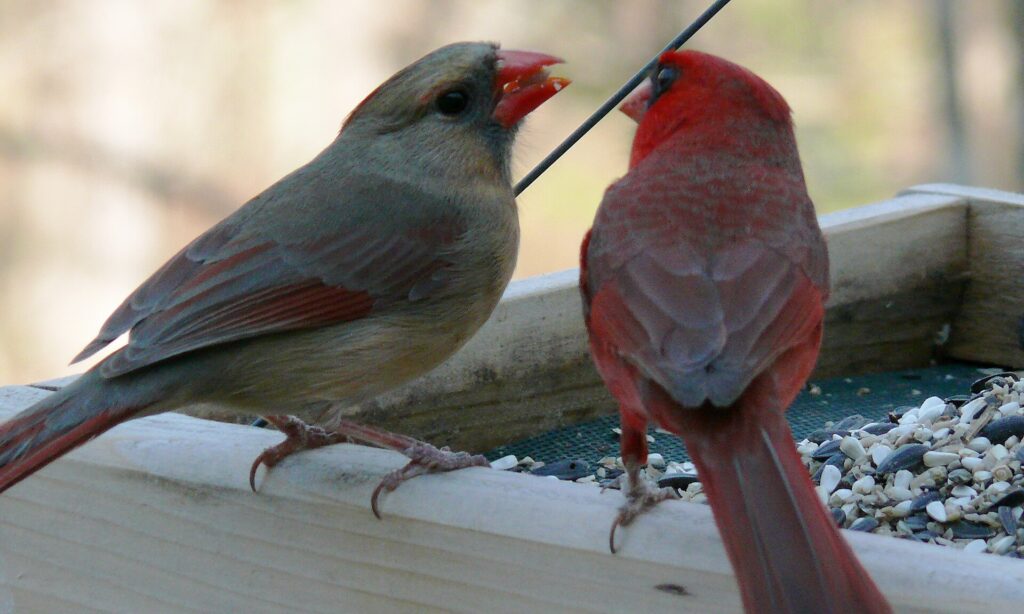
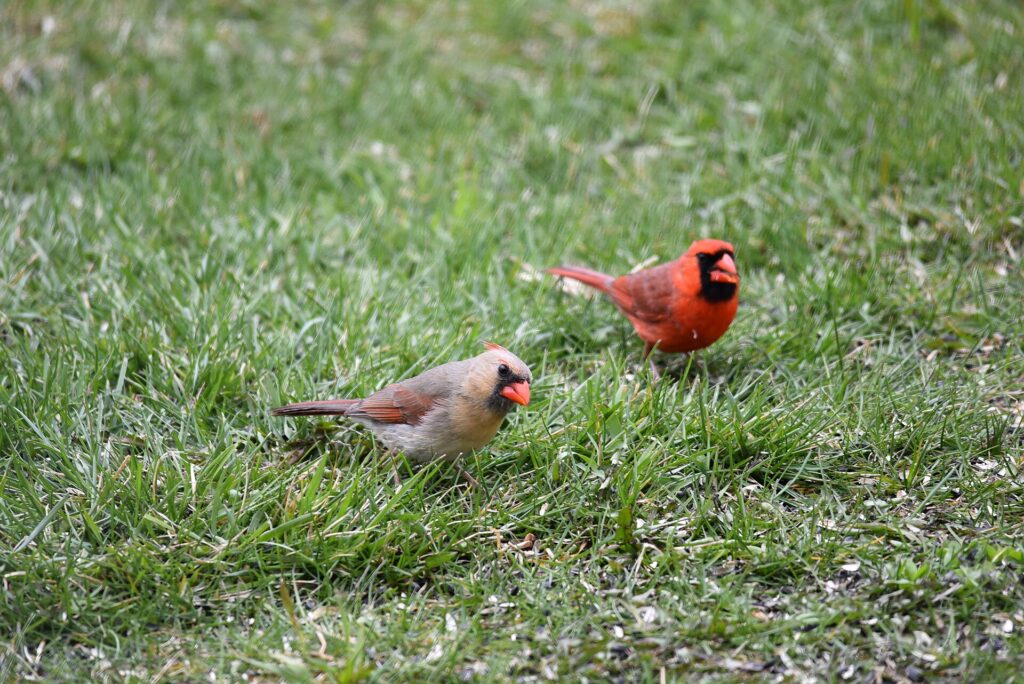
- Adult male: Red from crest to tail, with a black mask around a reddish bill.
- Adult female: Soft tan-brown with warm red tones in the crest, wings, and tail. She has the same black face and a red-orange bill.
- Juvenile: Looks like the female but has a gray to black bill instead of an orange one. That dark bill is the quickest way to spot a young bird.
The crest goes up when a cardinal is agitated, according to the Cornell Lab, so a bird with its crest flattened can look oddly round-headed. Cardinals don’t molt into a duller winter plumage, which is why a male stays bright red against the snow.
Where do Northern Cardinals live?
Northern Cardinals are year-round residents across the eastern and central United States. Audubon notes the species has been pushing its range north for decades and now reaches southeastern Canada. It’s mostly absent west of the Great Plains, though it’s locally common in the desert Southwest.
Cardinals like dense shrubs: woodland edges, thickets, hedgerows, parks, and backyards. They feed low, often on or near the ground and often in pairs. In fall and winter they can gather in flocks of a dozen to more than 50 birds. At feeders, Cornell says they strongly prefer black oil sunflower seed. If you want to attract them, our guide to the best bird feeders for cardinals covers the setups they use most, and our bird seed guide explains which mixes are worth buying.
Seven states claim the Northern Cardinal as their state bird: Illinois, Indiana, Kentucky, North Carolina, Ohio, Virginia, and West Virginia.
What does a cardinal’s song sound like?
Both sexes sing a loud string of clear, whistled notes. People often put words to it like “cheer, cheer, cheer” or “birdie, birdie, birdie,” and Audubon adds “what-cheer” and “purty-purty-purty.” The call is a sharp, metallic chip. The Cornell Lab notes the female often sings from the nest. For tips on learning songs like this one, see how to identify birds by their songs and calls.
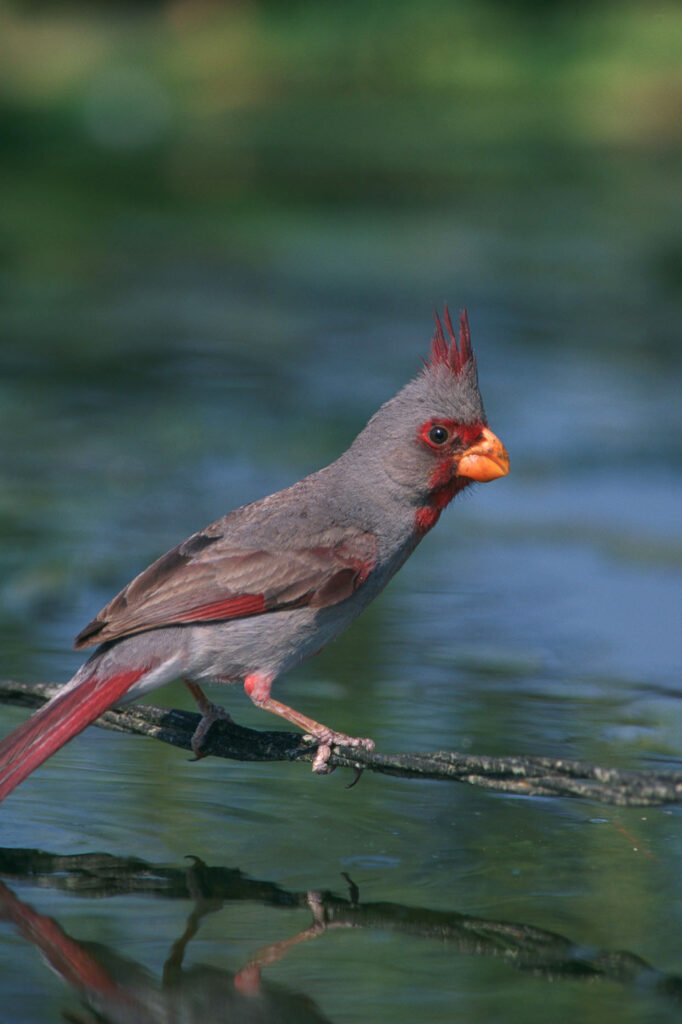
Pyrrhuloxia: the desert cardinal of the Southwest
The Pyrrhuloxia is the Northern Cardinal’s closest relative in the US. It’s about the same size (roughly 8.3 inches) but built for the desert, living in desert scrub, dry grassland, and mesquite across the American Southwest, including Texas, and northern Mexico.
The male is a crisp gray bird with a red face, a red crest, a red stripe down the breast, and a reddish tail. The female is a buffy gray with less red. Both have a stubby yellow bill with a curved upper edge that Cornell calls parrotlike, plus a taller, more elegant crest than a Northern Cardinal’s.
Its song is a string of whistles much like a cardinal’s, but Audubon describes it as thinner and shorter. Unlike Northern Cardinals, Pyrrhuloxias are fairly social and nomadic outside the breeding season. Cornell reports winter foraging flocks as large as 1,000 birds, and flocks often wander away from their nesting areas. They’ll come to backyard seed, especially sunflower, and prefer to eat on the ground.
Vermilion Cardinal: the cardinal you won’t see in the US
The third species, the Vermilion Cardinal, lives only in arid lowlands of northern Venezuela and far northeastern Colombia. It favors semi-arid scrub with cactus and thorny shrubs, according to eBird and other references.
The male is scarlet all over with a tall, spiky crest and a heavy gray bill. The female is brown with a gray head and red on the crest and tail. It’s listed as Least Concern. If a “vermilion cardinal” shows up in a US backyard photo, it’s almost certainly a Northern Cardinal or one of the look-alikes below.
Birds that look like cardinals
The Cornell Lab lists Summer Tanager, Scarlet Tanager, Pyrrhuloxia, and Phainopepla as species people confuse with Northern Cardinals. The House Finch is another frequent mix-up at feeders. The fastest check: no other red bird in the US has the cardinal’s combination of a tall crest, black face, and thick red bill.
Summer Tanager
The male Summer Tanager is entirely red, which is why it gets mistaken for a cardinal. Look closer and you’ll see it’s smaller (about 6.7 inches), has no black face, and has a pale bill. Any crest is slight and often not visible. Females are yellow-green, not tan. It’s a migrant that spends winter as far south as South America, and it specializes in catching bees and wasps.
Scarlet Tanager
A breeding male Scarlet Tanager is bright red with jet-black wings and tail, a pattern no cardinal shows. It has no crest and is slightly smaller than a Northern Cardinal. Females are olive-yellow. Scarlet Tanagers stay high in eastern forests during summer and head to northern South America for winter, so they rarely come to feeders.
House Finch
Male House Finches have rosy red on the face and upper breast, which can read as “small cardinal” at a glance. But they’re only about 5 to 5.5 inches long, have no crest, and show brown streaks on the back, belly, and sides. Females are plain gray-brown with blurry streaks. Cornell notes a male’s color depends on diet and can range from yellow to bright red. Our backyard bird ID chart by color puts these red birds side by side.
Northern Cardinal vs. Pyrrhuloxia and look-alikes, side by side
Where the two cardinals overlap in the Southwest, the bill is the giveaway: red on a Northern Cardinal, yellow on a Pyrrhuloxia. Overall color helps too, since a male Pyrrhuloxia is mostly gray with red accents rather than red all over.
| Bird | Length | Crest | Bill | Male color | Female color | Where in the US |
|---|---|---|---|---|---|---|
| Northern Cardinal | 8.3–9.1 in | Yes, prominent | Thick, red-orange (dark on juveniles) | All red, black face | Tan-brown, red tinges, black face | Eastern and central US, parts of Southwest; year-round |
| Pyrrhuloxia | About 8.3 in | Yes, tall | Stubby, yellow | Gray with red face, crest, breast stripe | Buffy gray, less red | Desert Southwest and Texas; year-round, wanders in winter |
| Summer Tanager | About 6.7 in | Slight or none | Pale, thick | All red, no black face | Yellow-green | Summer visitor |
| Scarlet Tanager | 6.3–6.7 in | No | Pale, thick | Red with black wings and tail | Olive-yellow | Eastern forests in summer |
| House Finch | 5.1–5.5 in | No | Conical | Red face and breast, brown streaks | Gray-brown, streaky | Common in towns, backyards, and farms |
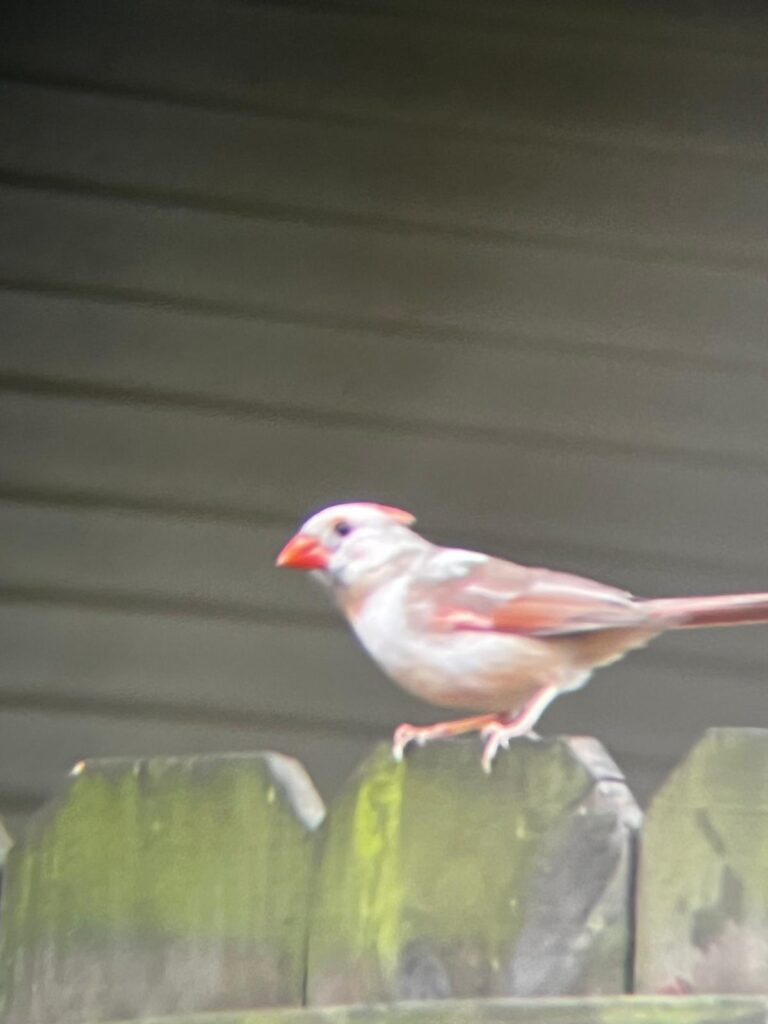
Yellow cardinals, white cardinals, and half-male half-female cardinals
These are all Northern Cardinals with unusual coloring, not separate species. Each one has a different cause.
Yellow cardinals (xanthochroism)
Cardinals get their red from carotenoid pigments in their food. Researchers at Washington University and colleagues identified a gene, CYP2J19, that lets birds convert yellow carotenoids into red ones. When yellow or orange replaces a bird’s normal red, it’s called xanthochroism. Auburn University ornithologist Geoffrey Hill told Audubon a well-known yellow male from Alabaster, Alabama, most likely had a mutation that leaves its food pigments yellow instead of red. Audubon’s Geoff LeBaron noted that poor diet or stress could also play a role.
White and patchy cardinals (leucism)
Project FeederWatch defines leucism as a problem with how pigment is laid down in feathers, which can leave a bird pale all over or with irregular white patches. True albinism is different: albino birds can’t make melanin and have pink eyes. A white-splotched cardinal with dark eyes is leucistic, not albino.
Half-red, half-brown cardinals (bilateral gynandromorphs)
In 2019, a cardinal in Erie, Pennsylvania, made headlines for being split down the middle: bright red on one side, female brown on the other. National Geographic explained this as bilateral gynandromorphy, where one half of the body is genetically male and the other half female. Cornell Lab researcher Daniel Hooper told the magazine these birds are uncommon, but they’re easiest to notice in species like cardinals where males and females look very different.
Frequently asked questions
Are female cardinals red?
Not mostly. Female Northern Cardinals are tan-brown with reddish tones in the crest, wings, and tail and a red-orange bill.
Do cardinals migrate?
No. Northern Cardinals and Pyrrhuloxias stay put year-round, though Pyrrhuloxia flocks may wander in winter. That makes cardinals a staple on any list of winter backyard birds.
Is a blue jay a type of cardinal?
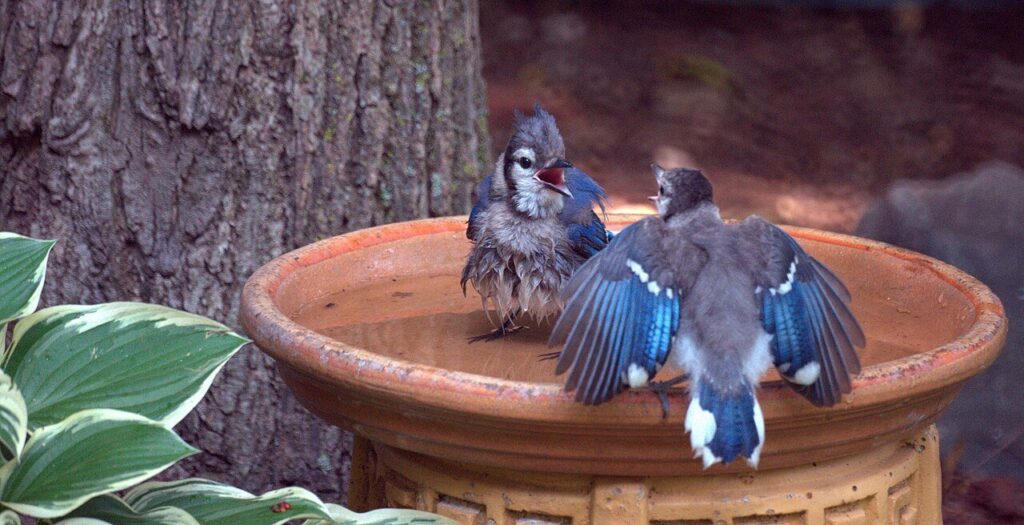
No. The three true cardinals are the Northern Cardinal, Pyrrhuloxia, and Vermilion Cardinal. Blue Jays are not in the genus Cardinalis.
How long do cardinals live?
The oldest Northern Cardinal on record, per the Cornell Lab, was a Pennsylvania female at least 15 years and 9 months old.
Bottom line
There are three cardinal species, and two live in the US: the red Northern Cardinal across most of the East and the gray-and-red Pyrrhuloxia in the desert Southwest. If a red bird has no crest, no black face, or black wings, it’s a tanager or a House Finch, not a cardinal. Yellow, white, and half-and-half cardinals are rare Northern Cardinals, not new species.