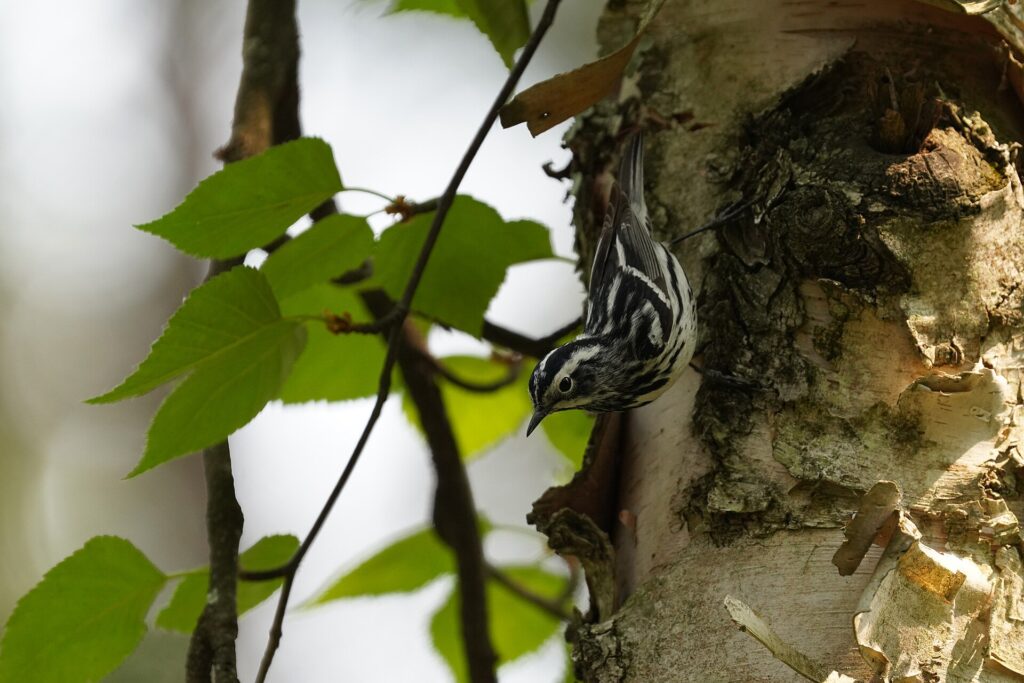
Most black and white birds in an American backyard are one of a handful of species: a downy or hairy woodpecker on the suet, a chickadee or white-breasted nuthatch at the seed feeder, or, in spring and fall, a striped black-and-white warbler creeping along a tree trunk. Out on fences and wires it may be an eastern kingbird or a loggerhead shrike; in the West, a long-tailed black-billed magpie. On ponds and marshes, think bufflehead, black-necked stilt or American avocet. Below is our size chart of 16 black and white birds, then how to tell each one apart.
If your bird is mostly black with white patches on its wings, see our guide to black birds with white wings, which covers towhees, the red-headed woodpecker and lark buntings. This page is for birds that read as black and white.
The short version
- Tiny, black cap and bib, white cheeks, gray back, at the feeder: chickadee (black-capped or Carolina).
- Small, striped black and white all over, creeping on bark: black-and-white warbler.
- Black cap, white face and belly, blue-gray back, moving at odd angles on a trunk: white-breasted nuthatch.
- Checkered black-and-white woodpecker with a white stripe down the back: downy (small, tiny bill) or hairy (bigger, long bill).
- Black-and-white woodpecker with a red forehead and a long white wing stripe: yellow-bellied sapsucker.
- Black and white with a red chevron on the chest: male rose-breasted grosbeak.
- Dark above, white below, white tip on the tail, sitting on a wire: eastern kingbird.
- Gray, black and white with a black mask, on a fence post: loggerhead shrike.
- Big, very long tail, white wing patches, in the West: black-billed magpie.
- Small black-and-white duck with a white patch on the back of its head: male bufflehead.
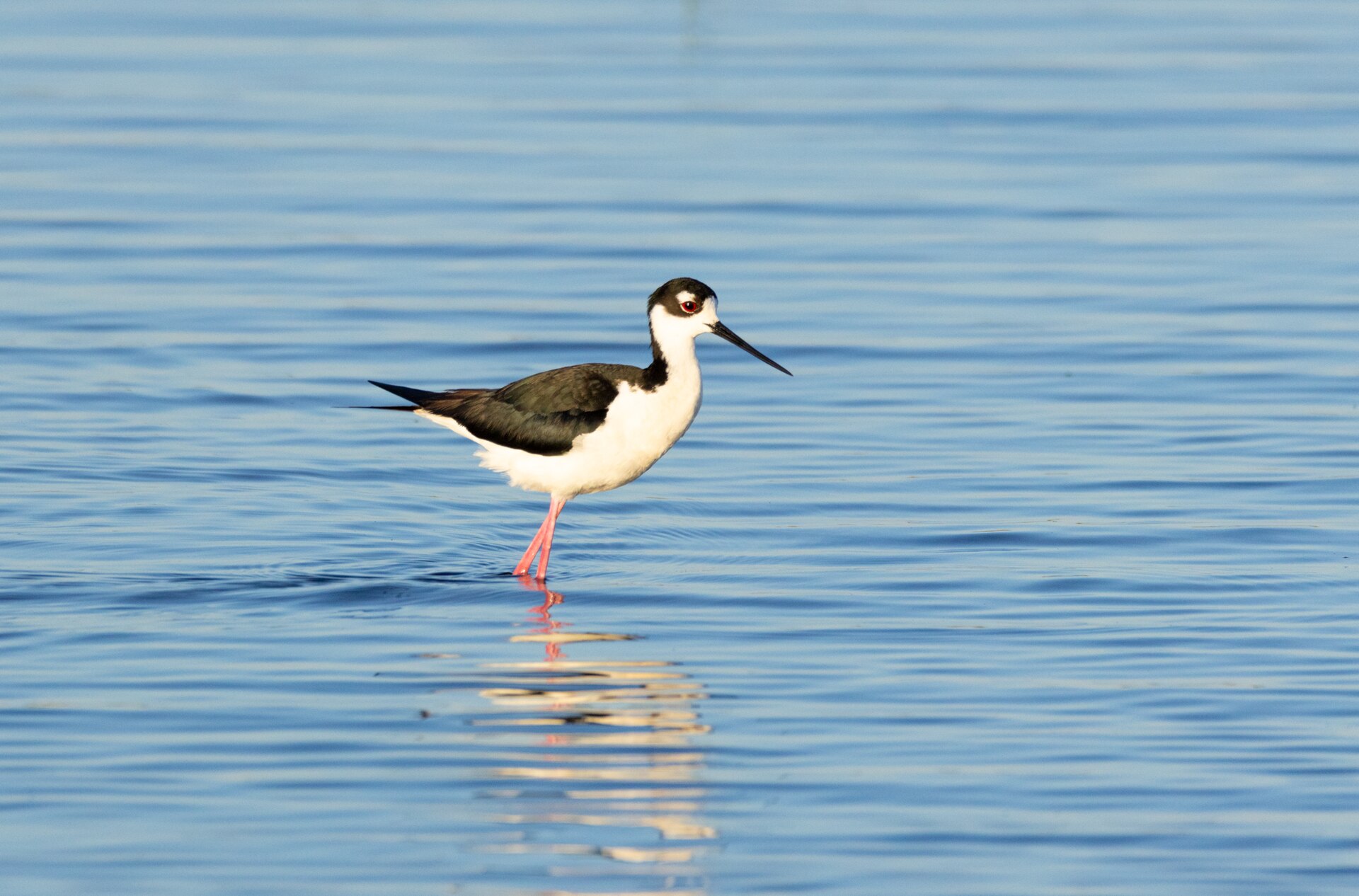
- Black above, white below, long pink legs, in shallow water: black-necked stilt.
Black and white birds by size (chart)
Size is the fastest way to narrow it down. Our chart lines up 16 black and white birds by body length, using the lengths the Cornell Lab of Ornithology lists on its All About Birds identification pages. Green bars are birds of feeders and yard trees, red bars are birds of open country and perches, and blue bars are water birds.
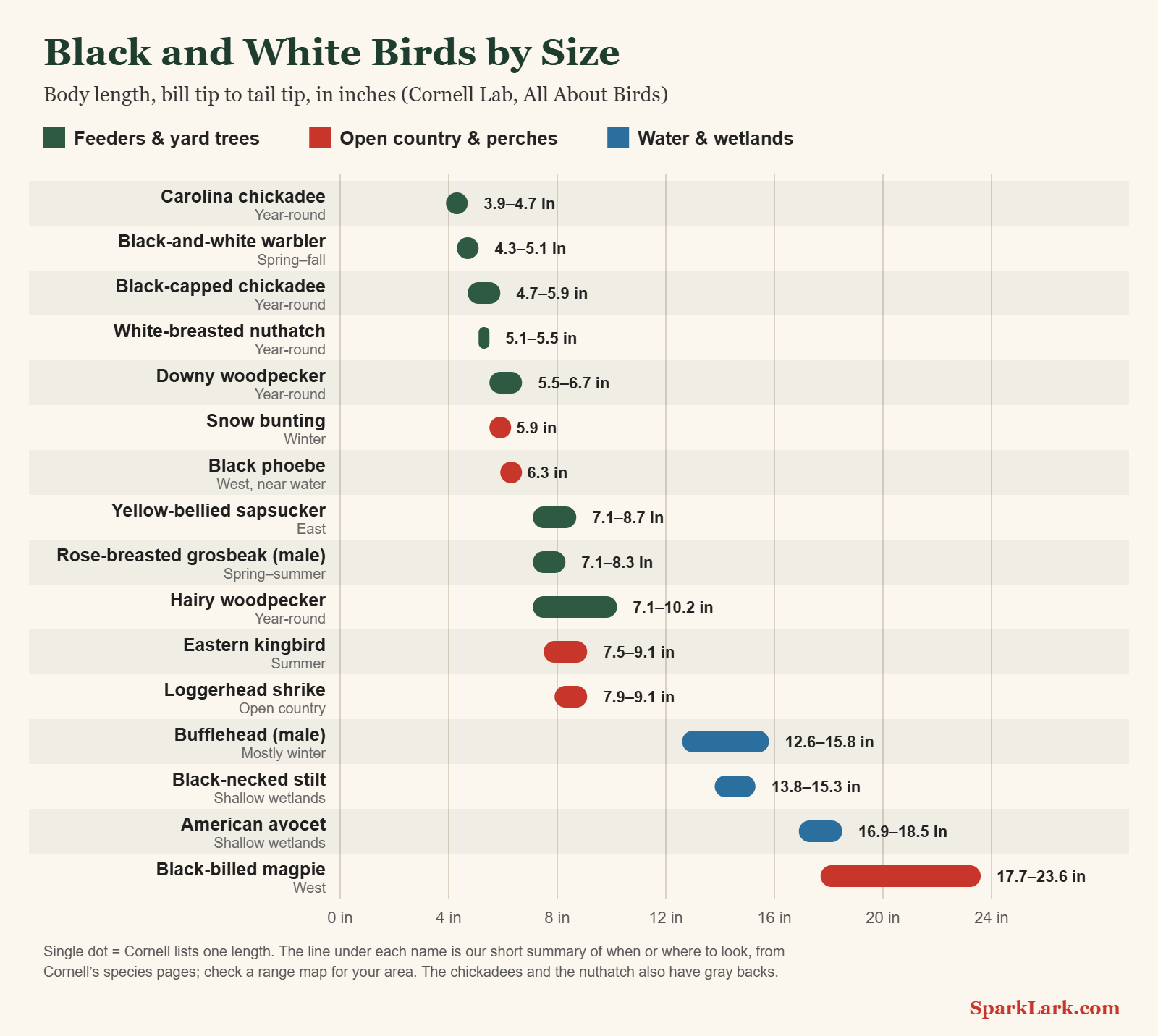
A rough guide: chickadee-sized (under 6 inches) means a chickadee, nuthatch, black-and-white warbler or downy woodpecker. Seven to 10 inches means a hairy woodpecker, sapsucker, grosbeak, kingbird or shrike. Anything over a foot long is one of the water birds or a magpie.
At feeders and in yard trees
Black-capped and Carolina chickadees
Both chickadees have a black cap and bib separated by white cheeks, with a soft gray back. The Carolina chickadee is the smaller of the two at 3.9 to 4.7 inches; the black-capped runs 4.7 to 5.9 inches, and its gray wing feathers are edged with white, according to Cornell’s identification page. The two species hybridize where their ranges meet, so some birds can’t be told apart by sight. Black-capped chickadees are easy to see at feeders, Cornell notes, though they seldom stay: they grab one seed and fly off to eat it somewhere else.
Black-and-white warbler
This is the only bird on the list that is striped black and white from head to tail. Cornell describes it as boldly striped, with two wide white wing bars; males are more heavily streaked than females. It creeps along trunks and big branches much like a nuthatch, probing bark for insects. Cornell calls it one of the earliest-arriving migrant warblers in spring. Look for it in deciduous and mixed woods and, on migration, in almost any woodlot.
White-breasted nuthatch
A common feeder bird with a black (or gray) cap, a frosty white face and belly, and a gray-blue back. The lower belly and the feathers under the tail are often chestnut. Nuthatches move quickly along trunks and big branches at odd angles. Their name comes from wedging large nuts and acorns into bark and hammering them open. Cornell lists them as resident, so the pair in your yard is likely there all year.
Downy woodpecker
A familiar little woodpecker at backyard feeders, including suet. Downies are checkered black and white, with a striped head and a broad white stripe down the middle of the back; males have a small red patch on the back of the head. At 5.5 to 6.7 inches, they’re barely bigger than the chickadees they often travel with in winter. Tip from Cornell: the outer tail feathers are usually white with a few black spots.
Hairy woodpecker
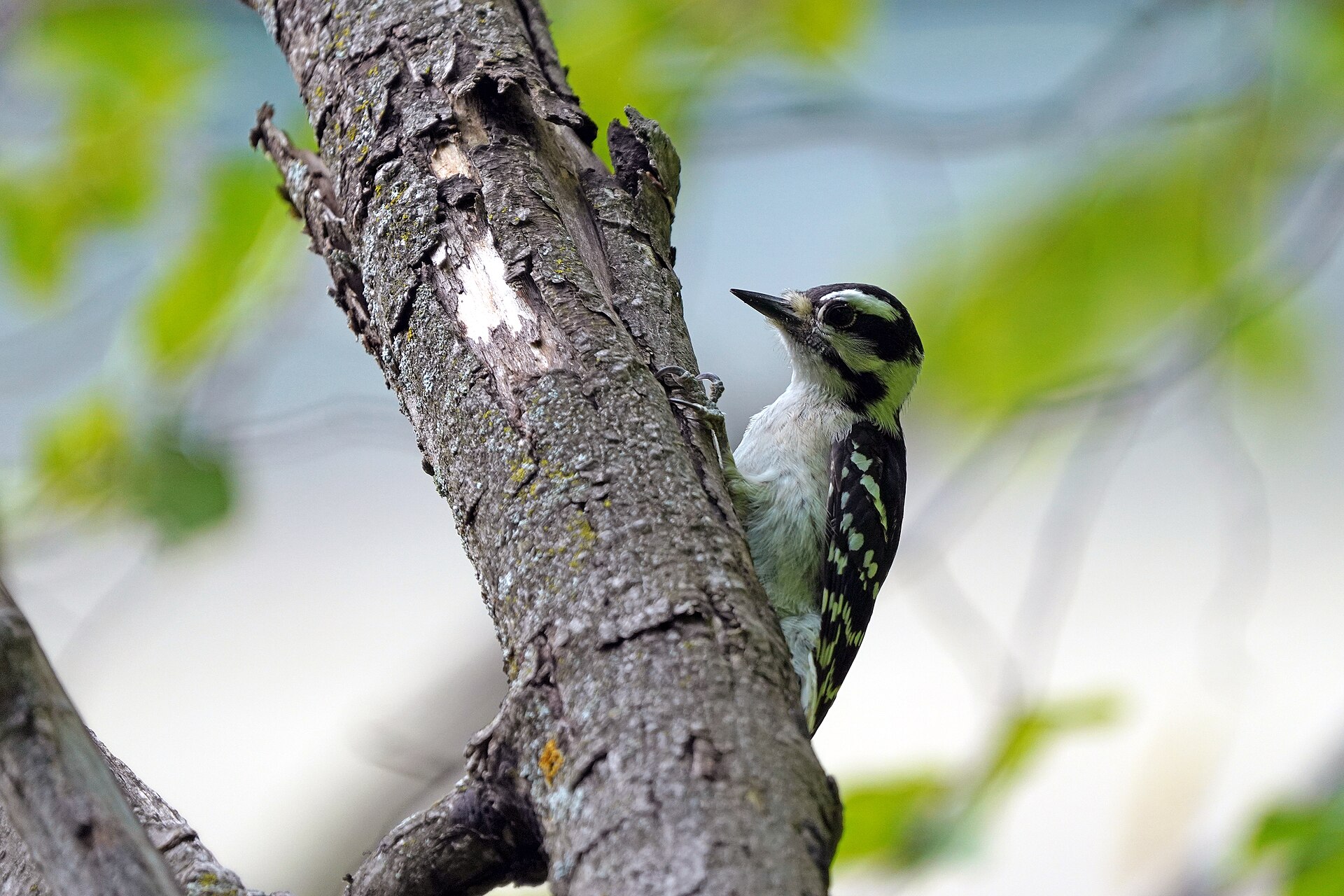
A larger copy of the downy, 7.1 to 10.2 inches long, with the same checkered wings, white back stripe and (on males) red head patch. The surest difference is the bill: Cornell says the hairy’s is much longer than the downy’s almost thorn-like bill. Hairies also spend more time on trunks and main branches, while downies use smaller branches and even weed stems. More on telling them apart below.
Yellow-bellied sapsucker
A black-and-white woodpecker with a boldly striped face, a red forehead and a long white stripe along the folded wing; males also have a red throat. The belly is white or yellowish. In the East, rows of small, neat holes in tree bark are the sapsucker’s work: it drinks the sap that leaks out and eats insects caught in it. Cornell notes it occasionally visits feeders for suet.
Rose-breasted grosbeak (male)
The male is black and white with a bright red chevron running from his black throat down the middle of his chest. Females look completely different: brown and heavily streaked, with a bold whitish stripe over the eye. Rose-breasted grosbeaks nest in eastern forests, and Cornell describes the male as an exclamation mark at your bird feeder. Listen for the song, which Cornell compares to “an American Robin in an unusually good mood.”
Downy vs. hairy woodpecker: how to tell
These two cause more confusion than any other black and white birds, because the patterns are nearly the same. Check three things:
- Bill length. The hairy’s bill is long; the downy’s is tiny and thorn-like.
- Size. Downy 5.5–6.7 inches. Hairy 7.1–10.2 inches.
- Outer tail feathers. On a downy they’re usually white with a few black spots.
Both species visit suet; see when to put out suet and our guide to attracting woodpeckers.
In open country, on wires and fence posts
Eastern kingbird
Blackish above and white below, with a darker black head and a black tail with a clean white tip. Kingbirds perch in the open on treetops, wires and fences, and fly out to catch insects. They’re known for chasing much bigger birds, including crows and hawks, out of their territory. They nest in yards, fields and pastures in summer and spend the winter in South America.
Loggerhead shrike
Cornell calls it “a songbird with a raptor’s habits.” It’s gray, black and white, with a wide black mask, black wings with white flashes and a black tail with white corners. Shrikes hunt insects, lizards, small birds and small mammals from utility poles and fence posts in open country. They’re still easy to find in the South but have become rare in the Northeast and upper Midwest; Cornell lists the species as a Common Bird in Steep Decline.
Black phoebe
A small western flycatcher with a sooty black head, chest and back and a crisp white belly. In the U.S., Cornell says, you’ll almost always find it near water: streams, rivers, lakes, the Pacific coast, even cattle tanks. It sits low and pumps its tail constantly, and it builds a mud nest against walls, bridges and culverts.
Black-billed magpie
The biggest bird on our chart, 17.7 to 23.6 inches, and much of that is tail. Magpies are black and white with blue-green shine on the wings and tail, white patches in the outer wing and two white stripes on the back. They’re common in towns, fields and along streams in the West and often sit right on top of trees and fence posts.
Snow bunting
Snow buntings breed in the high Arctic. In winter they spread across Canada and the United States in flocks, sometimes by the hundreds; look in crop stubble and along lakeshores. In flight they always show white inner wings with black tips. Breeding males are sharp white with a black back, but in winter males have rusty patches on the crown, cheek and shoulder. Cornell lists them as a Common Bird in Steep Decline.
On ponds, lakes and marshes
Bufflehead
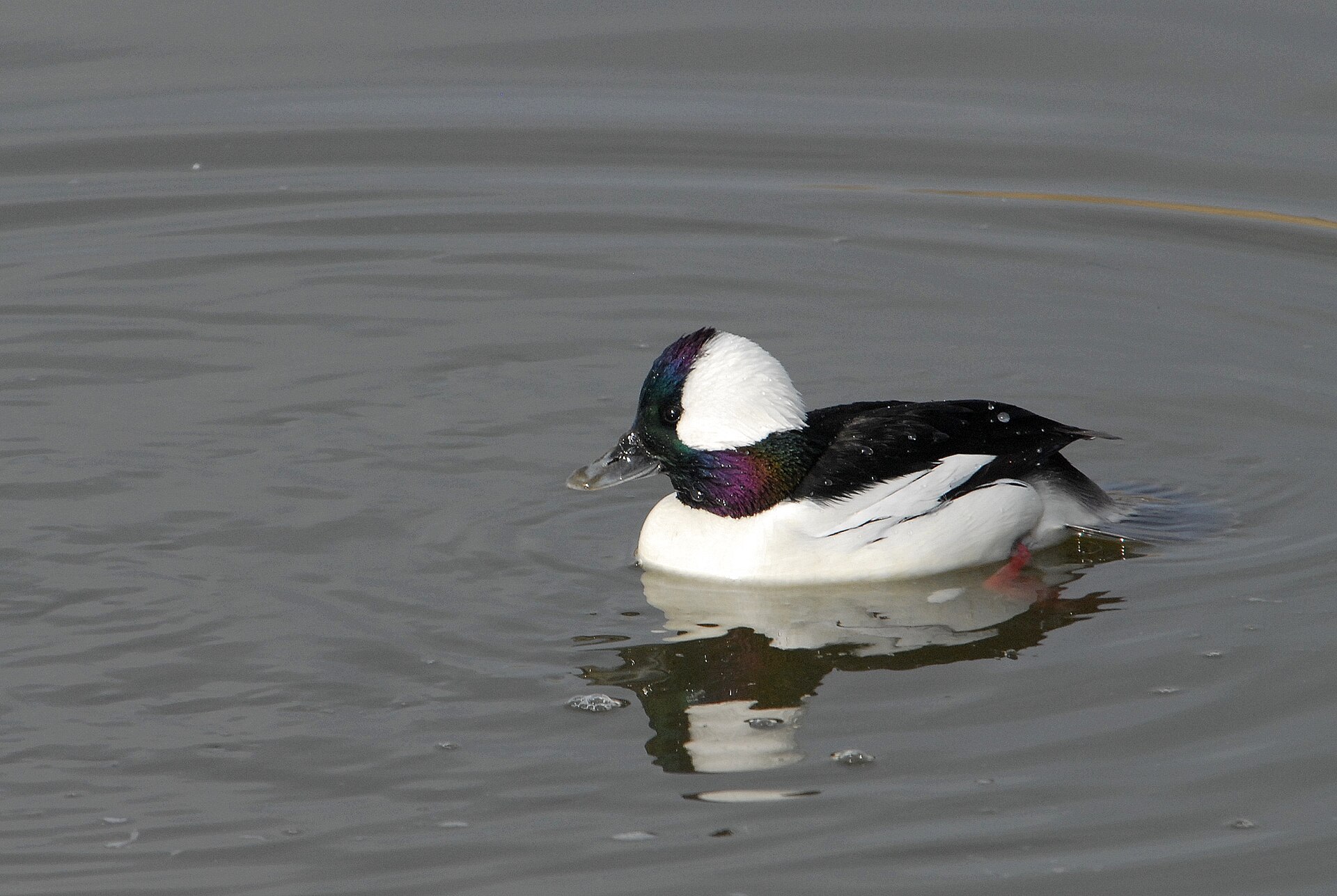
A tiny diving duck. The adult male has a white body, a black back and a dark head with a big white patch wrapping around the back. Females are gray-brown with an oval white cheek patch. Buffleheads spend winter on sheltered coastal coves and on inland ponds and lakes in the southern part of the continent, and they spend about half their foraging time underwater, so watch the spot where one disappears. They nest almost entirely in old northern flicker holes.
Black-necked stilt
Black above, white below, with white around the eye, a thin black bill and very long rosy-pink legs. Relative to body size, Cornell says, only flamingos have longer legs. Stilts wade in shallow fresh and salt water, including flooded fields and sewage ponds, and call loudly when disturbed.
American avocet
A tall wader with a black-and-white back and wings and a long, thin, upturned bill that it sweeps from side to side through the water. In breeding season the head and neck are rusty; after breeding they turn grayish white, so a winter avocet is a mix of gray-white, black and white.
Quick ID table
| Bird | Length (in) | Look for | Where |
|---|---|---|---|
| Carolina chickadee | 3.9–4.7 | Black cap and bib, white cheeks, gray back | Feeders, trees |
| Black-and-white warbler | 4.3–5.1 | Striped all over, creeps on bark | Woods, yard trees |
| Black-capped chickadee | 4.7–5.9 | Like Carolina; white edges on wing feathers | Feeders, trees |
| White-breasted nuthatch | 5.1–5.5 | Black cap, white face, blue-gray back | Feeders, trunks |
| Downy woodpecker | 5.5–6.7 | Checkered; tiny bill | Suet, small branches |
| Snow bunting | 5.9 | White wings with black tips in flight | Fields, shores (winter) |
| Black phoebe | 6.3 | Sooty black, white belly, pumps tail | Near water (West) |
| Yellow-bellied sapsucker | 7.1–8.7 | Red forehead, long white wing stripe | Trees with sap holes |
| Rose-breasted grosbeak | 7.1–8.3 | Male: red chevron on chest | Feeders, forest edges |
| Hairy woodpecker | 7.1–10.2 | Checkered; long bill | Suet, trunks |
| Eastern kingbird | 7.5–9.1 | White tip on black tail | Wires, fields (summer) |
| Loggerhead shrike | 7.9–9.1 | Black mask, gray back | Fence posts, open country |
| Bufflehead | 12.6–15.8 | Male: white patch behind head | Ponds, bays |
| Black-necked stilt | 13.8–15.3 | Very long pink legs | Shallow wetlands |
| American avocet | 16.9–18.5 | Upturned bill | Shallow wetlands |
| Black-billed magpie | 17.7–23.6 | Very long tail, white wing patches | Towns, fields (West) |
Not quite black and white?
- Mostly black with white patches on the wings: see black birds with white wings.
- Small and gray with a black cap: see small gray bird with a black cap.
- Slate gray above, white belly, white outer tail feathers: probably a dark-eyed junco.
- Still stuck? Try our printable bird ID chart by color, or a free app like Merlin (see the best bird identification apps).
FAQ
What is the small black and white bird at my feeder?
Usually a chickadee, a white-breasted nuthatch or a downy woodpecker. A chickadee has a black bib under its chin; a nuthatch has a white face and creeps along the trunk; a downy is checkered and clings to suet.
What is the big black and white bird with a long tail?
In the West, a black-billed magpie. Elsewhere, a black-and-white bird on a wire is more likely an eastern kingbird (white tip on the tail) or a loggerhead shrike (black mask), both much smaller.
What black and white bird climbs on tree trunks?
Woodpeckers (downy, hairy, sapsucker), the white-breasted nuthatch and the black-and-white warbler all forage on bark. The warbler is the only one striped from head to tail.
What is the small black and white duck?
Most often a male bufflehead: white body, black back and a white patch on the back of a dark head. Females are gray-brown with a white cheek spot.
Bottom line
Start with size and place. Small and at the feeder: chickadee, nuthatch or downy woodpecker. Bigger and on the suet or tree bark: hairy woodpecker or sapsucker. On a wire or fence: kingbird or shrike. On the water: bufflehead, stilt or avocet. In the West, the long-tailed one is a magpie. Check the bill on any black-and-white woodpecker, and you’ll have most of these sorted in seconds.
Sources: Cornell Lab of Ornithology, All About Birds species pages (identification, overview and range text) for each bird above, read November 23, 2026.