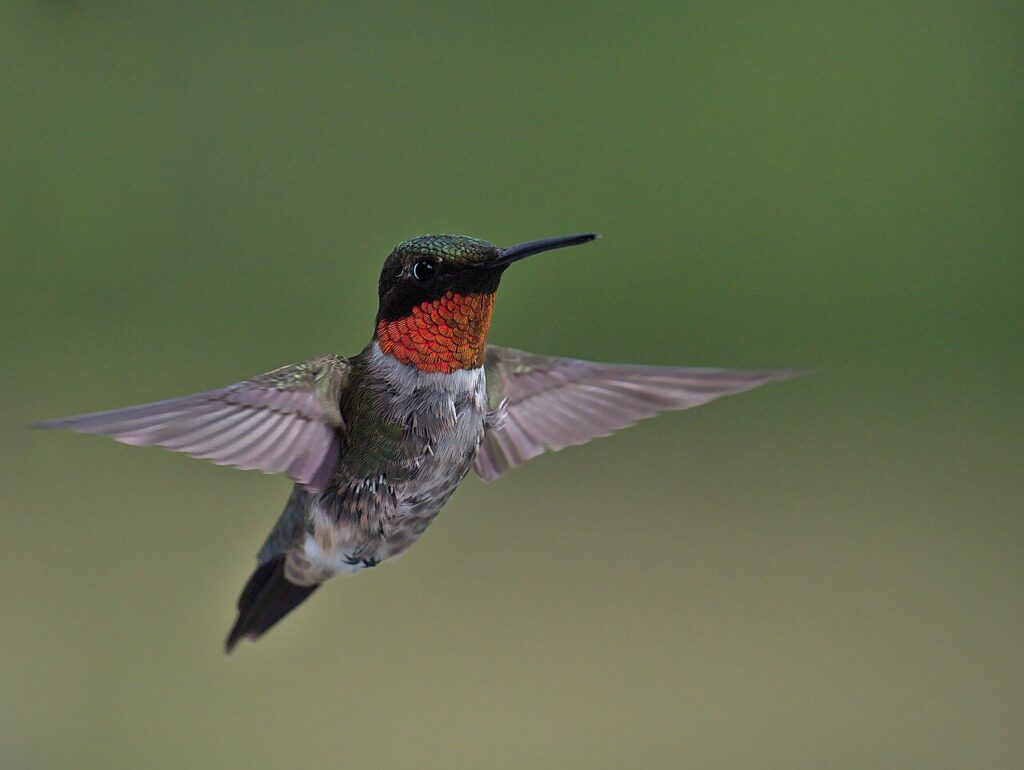
Why do hummingbirds hover in your face? The honest answer is that no one has studied that exact moment. We looked through the Cornell Lab of Ornithology, Audubon, the Smithsonian and the U.S. Fish and Wildlife Service and did not find a study that explains it. What those sources do show is a bird that learns colors fast, remembers exactly where food was, and is bold enough to fly right up to something much bigger than itself. Put those together and most close visits make sense. Below is what is known, what is only a guess, and what to do when it happens to you.
The short version
- Color: Hummingbirds learn which colors lead to nectar, and red and orange get their attention from far away. A red hat or shirt may be worth a look.
- Memory: They remember where food was, down to the spot. Cornell notes rufous hummingbirds checking where a feeder hung the year before.
- Display: A male Anna’s hummingbird begins his dive display by hovering in front of his target, and Cornell says the target can be a person.
- Boldness: Hummingbirds are famously feisty, but the chasing and jabbing that experts describe is aimed at other hummingbirds.
- Not proven: That the bird is “curious about you,” knows your face, or is asking you to refill the feeder. Those ideas are common online, but we could not find them in a scientific or agency source.
It may be checking a color it has learned to trust
Hummingbird flowers are often red or orange, and the Smithsonian’s National Zoo describes those colors as a long-distance sign to a fast-flying bird. That is why most feeders have red parts, as the Cornell Lab points out.
The pull toward red is not fixed, though. Audubon reports that research shows the preference is learned, and Cornell says black-chinned hummingbirds are drawn less to red itself than to the colors of flowers that fed them recently. In other words, a hummingbird is testing anything that looks like its last good meal.
Could that include your clothes? One biologist thought so. Jeff Mitton of the University of Colorado Boulder wrote in 2009 about a female hummingbird that hovered two feet from his face, and he guessed she was sizing up his red ball cap. That is one scientist’s reading of one encounter, not a study. It is still the best-informed explanation we found.
It remembers where the food was
Hummingbird memory is one of the best-studied parts of this story. In a 2006 study in the journal Current Biology, researchers working with wild rufous hummingbirds refilled some artificial flowers every 10 minutes and others every 20. The birds kept track of both the place and the timing of eight different flowers. A 2012 study in Animal Cognition found that wild hummingbirds could return to a rewarded spot after a single visit, using the landmarks around it.
That memory lasts. The Cornell Lab says rufous hummingbirds have been seen checking the place where a feeder hung the previous year, even after it was moved. So if a hummingbird hovers in an odd spot on your porch, or near the door where the feeder used to be, it may simply be looking for food where it found food before. You happen to be standing there.
On the West Coast, it may be a display
One hover is described in the scientific record, and it belongs to the male Anna’s hummingbird. According to the Cornell Lab, he starts his dive display by hovering 6 to 13 feet in front of his target, which can be another hummingbird or a person. The display ends with a loud squeak within about a foot and a half of the target. If you live along the Pacific Coast and a hummingbird hovers in front of you and then dives past with a sharp squeak, that may be what you are seeing.
Hummingbirds are bold by nature
Hummingbirds do not act like tiny birds. Cornell says ruby-throated hummingbirds can become quite bold around homes, feeding at hanging plants and feeders on a porch. It calls the rufous one of the feistiest hummingbirds in North America, and it describes male ruby-throats defending flowers and feeders with chases and dogfights. A male broad-tailed hummingbird was once recorded making more than 40 chases in an hour to guard a feeder.
All of that aggression is described as aimed at other hummingbirds. We did not find a scientific or agency source saying that hummingbirds treat people as rivals. A bird that will take on a much larger hummingbird is, however, not likely to be scared off by a person sitting quietly near its feeder.
How a hummingbird hangs in the air
The hover itself is rare in nature. The Smithsonian says hummingbirds are the only animals with backbones that can hover for a sustained time. It also says hummingbirds and swifts can stroke with power on both the downbeat and the upbeat of the wing. A 2005 study in the journal Nature measured the split: about 75 percent of the lift comes from the downstroke and 25 percent from the upstroke.
- Wingbeats: A ruby-throated hummingbird beats its wings about 53 times a second, according to the Cornell Lab. A broad-tailed hummingbird hovers at about 50 beats a second.
- Control: Cornell says a ruby-throat can hang motionless in midair and shift up, down, sideways and backward with fine control.
- Heart rate: The Smithsonian puts a ruby-throat’s heart at about 225 beats a minute at rest and more than 1,200 a minute in flight.
That is the reason a hummingbird can stop a couple of feet from your nose and hold perfectly still. For this bird, hovering in place to look at something is easy.
What it sees when it looks at you
A hummingbird sees more colors than you do. Birds have a fourth type of color cone in the eye that picks up ultraviolet light. In a 2020 study in PNAS, a Princeton-led team working with wild broad-tailed hummingbirds in Colorado showed that the birds could tell apart colors that mix ultraviolet with visible light, such as ultraviolet plus green. People cannot see those colors at all. The same team noted how quickly the birds learned to link a color with a reward.
Do hummingbirds recognize people?
Many people who feed hummingbirds are sure the birds know them. It may be true, but it has not been shown. We did not find a published study testing whether hummingbirds recognize individual people.
A story that is often repeated online as “UCLA research” is really a 2016 UCLA Newsroom feature about Melanie Barboni, a geochemist who kept feeders outside her office window and drew more than 200 hummingbirds. She said the birds came to know her. That is one person’s experience with her own birds. It was not a study.
What is proven is narrower: hummingbirds remember places and timing very well. A bird that returns to your porch every morning may know the porch, not you.
Which hummingbird was it?
| Where you live | Most likely bird | What Cornell says |
|---|---|---|
| East of the Mississippi | Ruby-throated hummingbird | The only hummingbird that breeds in eastern North America |
| Pacific Coast | Anna’s hummingbird | Among the most common hummingbirds on the coast; they don’t migrate much |
| West, on migration | Rufous hummingbird | Spring in California, summer in the Pacific Northwest and Alaska, fall in the Rockies |
| Much of the West | Black-chinned hummingbird | Widespread from deserts to mountain forests |
| Mountain West | Broad-tailed hummingbird | High mountain meadows, breeding up to 10,500 feet |
Not sure when yours will head south? See our state-by-state guide to when hummingbirds leave.
What to do when a hummingbird hovers near you
- Enjoy it and let it leave. There is no official advice for this moment, so we suggest the simple thing: don’t swat at it or reach for it.
- Don’t try to catch or hold it. Hummingbirds are protected under the federal Migratory Bird Treaty Act, which prohibits capturing protected birds without a permit.
- Check the feeder. The Smithsonian’s recipe is 1 part white sugar to 4 parts water, with no red dye and no honey. It advises changing the nectar every other day and cleaning the feeder each time.
- Spread feeders out. Cornell says four small one-port feeders placed around your home will hold more hummingbirds than one large feeder. Hummingbirds are often very territorial around feeding sites.
For more, read our guides to the best hummingbird feeders, how to clean a bird feeder and when to take down hummingbird feeders.
FAQ
Why do hummingbirds fly up to your face and stare?
No study has answered this directly. The best-supported explanations are that the bird is checking a color it links with food, or looking for food in a spot where it has fed before. On the West Coast, a male Anna’s hummingbird may be starting a display.
Will a hummingbird hurt you?
In the Cornell, Audubon, Smithsonian and U.S. Fish and Wildlife Service pages we read, we found no reports of hummingbirds injuring people. The beak jabs that Cornell describes happen between hummingbirds fighting over food.
Are hummingbirds really attracted to red?
Yes, but Audubon reports that the preference is learned. Hummingbirds follow whatever colors have paid off with nectar. That is also why you don’t need red dye in the feeder: the red parts on the feeder are enough.
Does a hummingbird hovering near you mean something?
Many cultures have stories about hummingbirds, and some people take a close visit as a sign. Those are beliefs, and there is no scientific evidence for them. We cover the old stories in hummingbird meaning and folklore.
Bottom line
Why do hummingbirds hover in your face? Science has not tested it directly. The best evidence points to a bird that learns colors quickly, remembers exactly where it found food, and is bold enough to inspect something many times its size. A red hat, a spot where a feeder once hung, or a male Anna’s display can each explain a close visit. Whether the bird knows you personally is still an open question. Either way, stay relaxed, keep the feeder clean, and let the bird go on its way.