When people search for hummingbird meaning, they usually want to know what the old stories say about this tiny bird, and whether a hummingbird showing up means something. The honest answer: hummingbirds carry a lot of meaning in the Americas, the only part of the world where they live. Aztec tradition tied them to a war god and to the souls of fallen warriors, a Cherokee story makes a hummingbird the hero who brings back tobacco, and early Jamaicans called their hummingbird the “God-bird.” Those beliefs are folklore and cultural history, and there is no scientific evidence that birds carry signs or messages. What is real is a bird so small and so fast that it’s easy to see why people built stories around it. Below we cover the beliefs, the biology behind each one, and a chart we built from federal survey data showing which U.S. hummingbirds are increasing and which are in trouble.
The short version
- Aztec beliefs: The war god Huitzilopochtli’s name is usually translated as “hummingbird of the south” or “hummingbird on the left,” and warriors who died in battle, along with women who died in childbirth, were said to return as hummingbirds.
- Cherokee story: In a tale recorded by James Mooney around 1900, the hummingbird succeeds where bigger animals failed and brings tobacco back to the people.
- Caribbean belief: Jamaica’s national bird, the doctor bird, was called the “God-bird” by the island’s early Arawak people, who believed it carried the souls of the dead.
- Modern meaning: Today many people say a hummingbird visit means a loved one is near. We could not trace that belief to older sources, and there is no evidence for it.
- The trend: On U.S. Breeding Bird Survey routes, ruby-throated and Anna’s hummingbirds have increased since the 1960s, while rufous, Allen’s and broad-tailed hummingbirds have dropped sharply.
Are hummingbirds increasing or declining? Our chart
Before the stories, the numbers. We pulled every hummingbird row from the U.S. Geological Survey’s newest North American Breeding Bird Survey results, which run from the 1960s to 2025, and charted how each species has changed across the United States. The survey’s data are released into the public domain, so anyone can check the math.
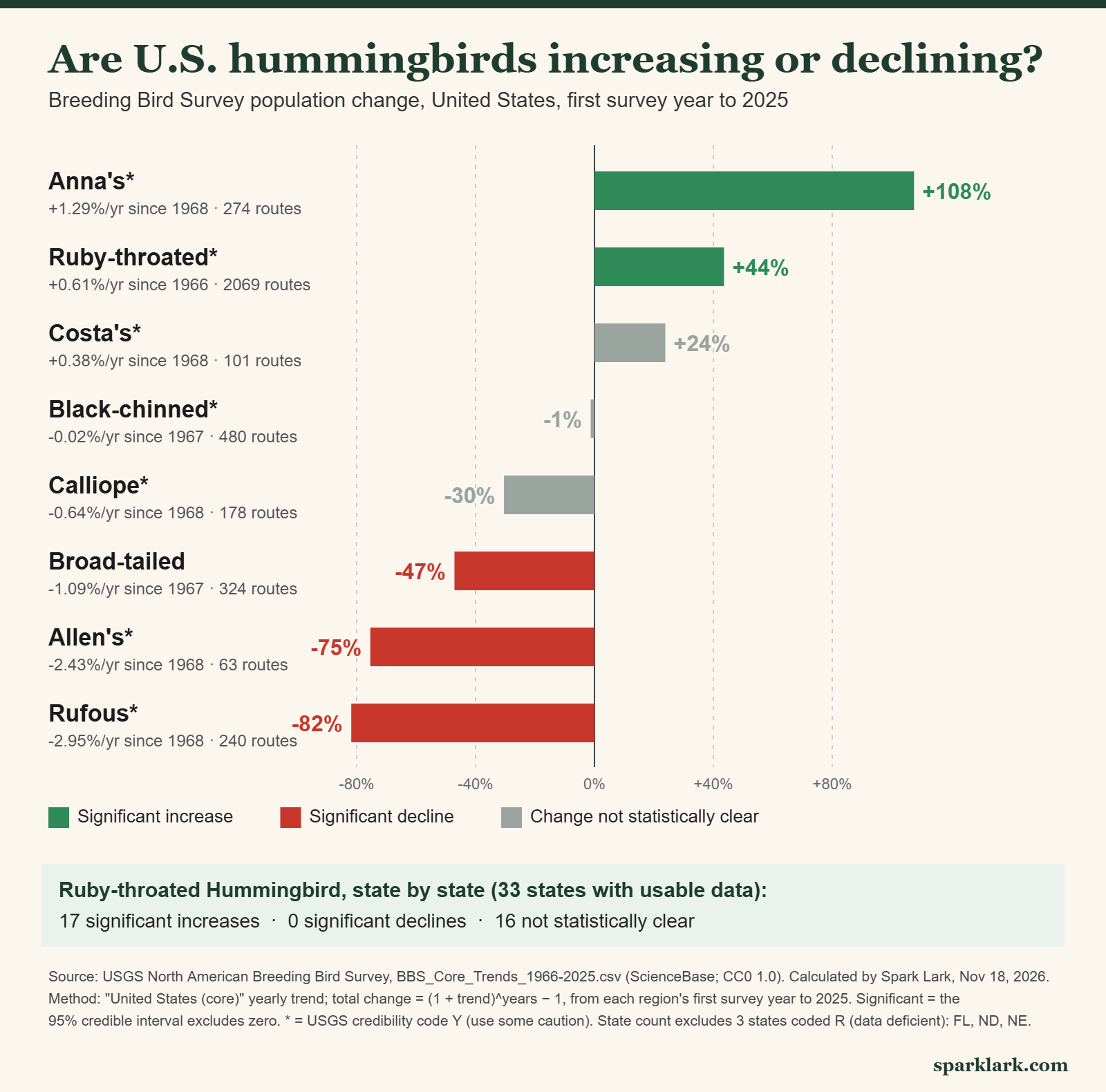
The picture splits by species. The two hummingbirds most people see at feeders, the ruby-throated in the East and Anna’s on the Pacific Coast, are both up. The ruby-throated has gained about 0.6% a year since 1966, roughly 44% overall, and in the 33 states with usable data, 17 show a significant increase and none show a significant decline. Anna’s has roughly doubled. The Cornell Lab of Ornithology notes that in the first half of the 20th century Anna’s bred only in southern California and northern Baja California, and that planted, flowering trees let it spread.
Three western species are going the other way. The rufous hummingbird is down about 82% on U.S. routes since 1968, Allen’s about 75% and the broad-tailed about 47%. Black-chinned, Costa’s and calliope hummingbirds show no clear trend either way.
| Species | Trend per year | Change to 2025 | Result |
|---|---|---|---|
| Anna’s (since 1968) | +1.29% | +108% | Significant increase |
| Ruby-throated (since 1966) | +0.62% | +44% | Significant increase |
| Costa’s (since 1968) | +0.38% | +24% | No clear trend |
| Black-chinned (since 1967) | −0.02% | −1% | No clear trend |
| Calliope (since 1968) | −0.64% | −30% | No clear trend |
| Broad-tailed (since 1967) | −1.09% | −47% | Significant decline |
| Allen’s (since 1968) | −2.43% | −75% | Significant decline |
| Rufous (since 1968) | −2.95% | −82% | Significant decline |
How we did it: “United States (core)” rows from the USGS 1966–2025 trend file; total change = (1 + yearly trend) raised to the number of years, minus 1. USGS flags every species above except the broad-tailed with a “use some caution” credibility code, so treat the exact percentages as estimates and the direction as the main point.
Hummingbirds in Aztec belief
The best-known hummingbird beliefs come from the Aztecs. According to World History Encyclopedia (Jordy Samuels, Oct. 2025), the name of Huitzilopochtli, the Aztec war and sun god, is usually translated as “hummingbird of the south” or “hummingbird on the left.” The same article explains that warriors who died in battle, people who were sacrificed and women who died in childbirth were among the “luckiest dead,” and that only they could return to the world as hummingbirds.
Hummingbirds also mattered as material. Aztec featherworkers prized their shimmering feathers, which the article ranks second in rarity only to those of the resplendent quetzal, and used them in featherwork; the article describes a later image of Saint John the Evangelist made largely of hummingbird feathers.
The real biology: why a hummingbird seems to die and come back
World History Encyclopedia points to a passage in the Florentine Codex describing a bird that sticks its beak into a tree and “awakens” when it thunders for rain. That story likely grew out of something hummingbirds really do: torpor. On cold nights or when food runs short, a hummingbird can drop its heart rate and body temperature until it looks lifeless, then warm back up. A 2020 study of Andean hummingbirds, reported by Smithsonian Magazine, found heart rates falling from about 1,200 beats a minute during the day to as low as 40 at night, and one species letting its body cool to about 38°F. To someone watching without that knowledge, a bird that “dies” and returns would look a lot like a soul coming back.
The Cherokee story of the hummingbird and the tobacco
In “How They Brought Back the Tobacco”, one of the stories James Mooney collected in Myths of the Cherokee (published 1900), the people have lost their tobacco and larger animals try and fail to get it back. The hummingbird volunteers, darts to the tobacco, snatches off the top with its leaves and seeds, and brings it home, where tobacco smoke revives an old woman. In another version Mooney recorded, a young man disguises himself in a hummingbird skin so he can slip in unseen.
The real biology: a bird built for speed and precision
The story picks the right hero. The Cornell Lab says the ruby-throated hummingbird beats its wings about 53 times a second and can fly full out, stop instantly, hover, and move up, down, sideways and backward. It weighs only 0.1 to 0.2 ounces, yet males fight hard over flowers and feeders. A small, fast bird that wins where big animals fail is a fair description of a real hummingbird. (More on that temper in our guide to why hummingbirds fight.)
Jamaica’s doctor bird: the “God-bird”
Jamaica’s national bird is a hummingbird, the streamertail or doctor bird, found nowhere else in the world. A short history from the Institute of Jamaica says the island’s early Arawak people believed the bird had magical powers, called it the “God-bird,” and thought it was the reincarnation of dead souls. The same source says many people in rural Jamaica still believe killing a doctor bird brings bad luck. Nobody knows for sure where the name “doctor bird” came from; one idea is that its black crest and long tail streamers resemble the clothing doctors wore centuries ago, another that it comes from the way the bird pierces flowers with its bill to feed.
Hummingbirds and European fashion
Europeans had no hummingbirds at home. The Cornell Lab notes that Christopher Columbus wrote about them and that some early observers wondered whether they were part insect, calling them “flybirds.” Later the feathers became fashionable in Europe. Around the turn of the 20th century, Smithsonian Magazine reports, milliners were selling earrings made from the heads and beaks of hummingbirds, and it took the 1918 Migratory Bird Treaty Act to end the hunting of birds like egrets, swans, eagles and hummingbirds.
What does it mean when a hummingbird visits you?
This is the belief most people are actually asking about. Many people today say that a hummingbird visit means a loved one who has died is near, or that the bird brings joy and good luck. We could not find this belief in the older folklore collections we read, so it appears to be mostly modern. There is no scientific evidence that a hummingbird carries a message. If the idea brings you comfort, that comfort is real, and a hummingbird at the window is a lovely thing to notice.
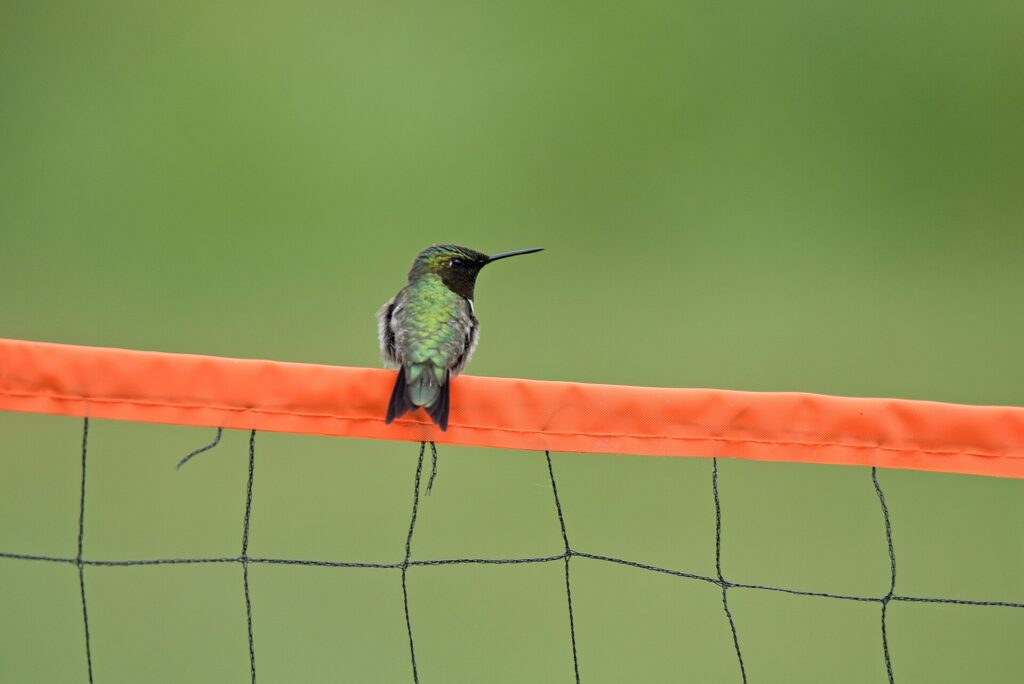
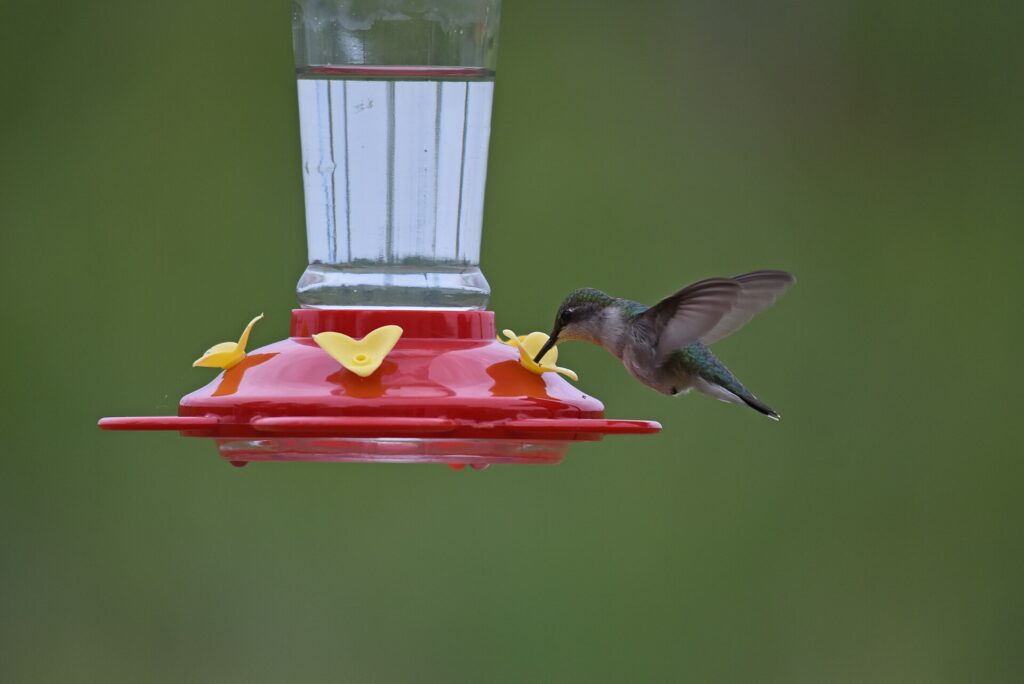
The biology explains why the visits feel so personal. The Cornell Lab says ruby-throated hummingbirds are common in suburbs and towns and can become quite bold, feeding at hanging plants and feeders on porches and next to windows. They favor red and orange flowers, and like many birds they see colors humans can’t, including ultraviolet. So a hummingbird that hovers at your red shirt or your window may simply be checking a bright color for nectar. That is our reading of its habits, not a tested explanation.
Why the same hummingbird seems to come back every year
It may really be the same bird. Ruby-throated hummingbirds can live for years; the oldest known one was a female at least 9 years, 2 months old, recaptured in West Virginia in 2014. The Cornell Lab also notes that rufous hummingbirds have an excellent memory for places, and some have been seen checking the spot where a feeder hung the year before, even after it was moved.
Folklore vs. biology at a glance
| Belief | Where it comes from | The real biology |
|---|---|---|
| Fallen warriors return as hummingbirds | Aztec tradition | Hummingbirds can enter torpor and look lifeless, then revive |
| The hummingbird brings back tobacco | Cherokee story, recorded by Mooney (1900) | About 53 wingbeats a second; hovers and flies backward |
| The “God-bird” carries souls of the dead | Arawak belief in Jamaica | The streamertail lives only in Jamaica |
| A visit means a loved one is near | Modern, widely shared online | Bold birds drawn to red and orange flowers |
| Hummingbirds are jewels to wear | European and American fashion | The 1918 Migratory Bird Treaty Act ended the hunting |
How to bring hummingbirds closer
If you want more hummingbird visits to enjoy, the Cornell Lab’s advice is simple: put up a hummingbird feeder or plant tubular flowers. Mix about one-quarter cup of table sugar per cup of water, skip the red dye, and change the water before it turns cloudy, since sugar water ferments quickly in hot weather. Keep feeders away from spots where cats can wait, and away from windows birds might hit.
- Choosing a feeder: see our guide to the best hummingbird feeders.
- Planting: our list of heat-loving, drought-tolerant hummingbird plants.
- Timing: when hummingbirds leave, state by state, and when to take down hummingbird feeders.
FAQ
What do hummingbirds symbolize?
It depends on the culture. In Aztec tradition they were linked to the war god Huitzilopochtli and to honored dead warriors; in a Cherokee story the hummingbird is a small hero; early Jamaicans saw the doctor bird as a “God-bird.” Today many people treat hummingbirds as a symbol of joy or of a loved one. These are beliefs, not facts about the birds.
Is it good luck to see a hummingbird?
Some traditions say so, and rural Jamaican belief holds that killing a doctor bird brings bad luck. There is no evidence that seeing a hummingbird changes your luck. It does usually mean there are flowers or a feeder nearby.
Why did a hummingbird hover in front of my face?
Hummingbirds favor red and orange flowers and can become bold around people, so a hovering bird may be checking you, or something bright you are wearing, for nectar. Nobody can say for sure what an individual bird is doing.
Are hummingbirds endangered?
The ruby-throated hummingbird is rated a species of low concern, and its numbers have grown. The rufous hummingbird is different: the 2025 State of the Birds report, cited by the Cornell Lab, lists it as an “Orange Alert” species that has lost more than half its population in 50 years.
Bottom line
Hummingbird meaning depends on who is telling the story. To the Aztecs a hummingbird could be a returning warrior, to the Cherokee it was the quick little hero who brought back tobacco, and to early Jamaicans it was the “God-bird.” The modern idea that a hummingbird visit means a loved one is near is a comforting belief, not something science supports. The birds behind all of these stories are tiny, fast, bold and surprisingly long-lived, and while the familiar ruby-throated and Anna’s hummingbirds are doing well, several western species are in steep decline. For more bird beliefs and the science behind them, read what it means when you see a cardinal, blue jay meaning and folklore and what a white pigeon symbolizes.