Spark Lark is reader-supported. As an Amazon Associate we earn from qualifying purchases, at no extra cost to you. How we choose products.
The best high-end binoculars for birding are full-size 8x models with a wide field of view, close focus and enough eye relief for glasses. On the makers’ published specs, the Swarovski NL Pure 8×42 has the widest view of the six pairs below (477 feet at 1,000 yards). The Zeiss SFL 8×40 is the lightest at 22.6 ounces, and the Vortex Razor UHD 8×42 focuses closest, at 4.5 feet. If you’re buying a once-in-a-lifetime pair, or a gift for a birder who already has a starter pair, these are the ones to compare.
We compared the specs from each maker’s own pages and charted them side by side below. We did not use these binoculars ourselves; this guide is built from published specs and independent birding advice.
The short version
- Widest view: Swarovski NL Pure 8×42, 477 ft at 1,000 yd.
- Lightest: Zeiss SFL 8×40, 22.6 oz.
- Lightest full-size 42 mm pair here: Nikon Monarch HG 8×42, 23.5 oz, with a 435-ft view.
- Closest focus and an unconditional warranty: Vortex Razor UHD 8×42, 4.5 ft.
- Most eye relief for eyeglass wearers: Leica Noctivid 8×42, 19 mm.
- Steadiest view at 10x: Canon 10×42 L IS WP, with built-in image stabilization (but heavy, and it runs on AA batteries).
Side by side: the specs that matter for birding
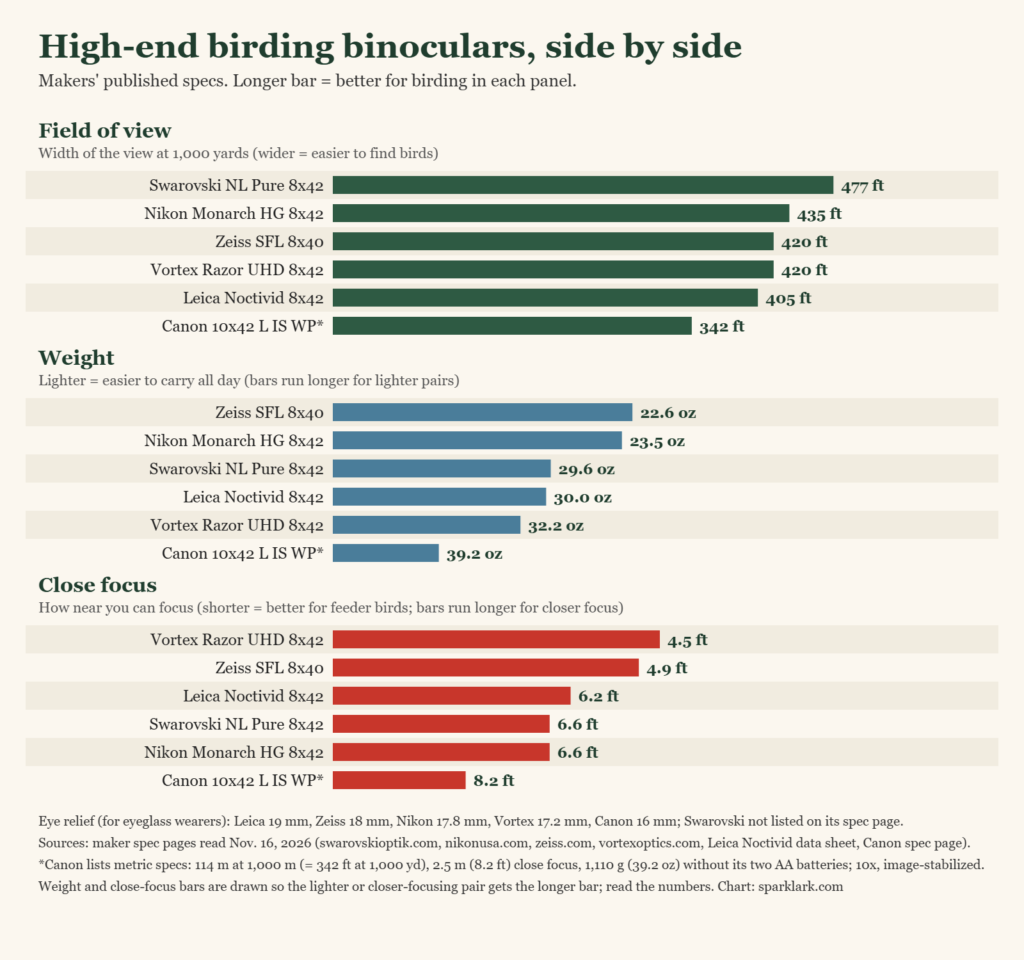
Source and method: specs read Nov. 16, 2026 from Swarovski, Nikon, Zeiss, Vortex, Leica and Canon. Canon publishes metric figures only; we converted 114 m at 1,000 m to 342 ft at 1,000 yd, 2.5 m to 8.2 ft and 1,110 g to 39.2 oz (without batteries).
A few things jump out. The Swarovski’s view is the widest by a clear margin. The two lightest pairs, Zeiss and Nikon, are 6 to 9 ounces lighter than the Swarovski, Leica and Vortex, which you will notice on an all-day walk. And the Canon gives up width of view and adds weight in exchange for a stabilized 10x image.

How to choose high-end birding binoculars
- 8x or 10x. In Audubon‘s guide, Wayne Mones recommends 8x or lower because higher power magnifies hand shake and narrows the field of view. The RSPB calls 8x or 10x “the best compromise between power and practicality,” with 10x for open country and water and 8x for woods and poor light. Five of our six picks are 8x.
- Field of view. A wider view makes birds easier to find and follow. Mones suggests at least 6.5 degrees, which he equates to about 341 feet at 1,000 yards. All six pairs here meet that.
- Close focus. If you watch feeder birds, butterflies or birds in a nearby shrub, shorter close focus matters. The RSPB flags it for close subjects.
- Eye relief. If you wear glasses, you need enough eye relief to see the whole view with the eyecups twisted down. Mones says birding binoculars typically run 15 to 20 mm.
- Weight. Mones says objective lenses over 42 mm are too heavy for most people to carry all day. All six picks are 40 to 42 mm.
- Waterproofing. Mones recommends waterproof, nitrogen-purged binoculars for anything beyond entry level. Every pair here is sealed against water.
The 6 best high-end binoculars for birding
1. Swarovski NL Pure 8×42: widest view
Swarovski Optik · 8×42 · field of view 477 ft at 1,000 yd · close focus 6.6 ft · 29.6 oz (840 g) · 6.2 in long · submersible to 13 ft
The NL Pure has the widest field of view of any pair in this guide by a wide margin; Swarovski says the 8×42 has “the largest field of view” in its NL Pure line. A view that wide makes it easier to pick up a warbler moving through leaves or to stay on a hawk in flight. Swarovski credits its SWAROVISION optics for color fidelity. Top-tier premium cost.
Downside: Swarovski’s U.S. spec page doesn’t list eye relief, so eyeglass wearers should check the fit in person. At 29.6 oz it is 6 to 7 ounces heavier than the Zeiss and Nikon.
2. Zeiss SFL 8×40: lightest
Zeiss · 8×40 · field of view 420 ft at 1,000 yd · close focus 4.9 ft · eye relief 18 mm · 22.6 oz (640 g) · 5.7 in long
The SFL is the lightest pair here, and Zeiss pitches the line as “Ultra-light and Compact.” It still has a wide 420-ft view and focuses down to 4.9 feet, close enough for feeder birds on the deck. Zeiss also highlights its “Intuitive SmartFocus Concept.” A good choice for long walks, travel, or anyone who finds full-size binoculars tiring. Premium cost.
Downside: 40 mm objectives are slightly smaller than the 42 mm on most of the others. Zeiss lists water resistance as “400 mbar” rather than a depth rating, so it’s harder to compare with the others’ figures.
3. Nikon Monarch HG 8×42: lightest full-size pair
Nikon · 8×42 · field of view 435 ft at 1,000 yd (8.3°) · close focus 6.6 ft · eye relief 17.8 mm · 23.5 oz · 5.7 in long · waterproof/fogproof
The Monarch HG pairs a 42 mm objective with a weight of just 23.5 ounces, the lightest of the 42 mm pairs here, and its 435-ft view is second only to the Swarovski. Nikon highlights a magnesium-alloy body and a phase-correction prism coating for “resolution and contrast.” Premium cost.
Downside: Its 6.6-ft close focus is longer than the Zeiss and Vortex, which matters if you watch birds at a feeder a few feet away.
4. Vortex Razor UHD 8×42: closest focus, best warranty
Vortex · 8×42 · field of view 420 ft at 1,000 yd · close focus 4.5 ft · eye relief 17.2 mm · 32.2 oz · gas purged and O-ring sealed · VIP warranty
The Razor UHD focuses down to 4.5 feet, the closest of the six. Vortex’s VIP warranty is described on its page as “unlimited. unconditional. lifetime,” which is a real comfort on a pair this costly. Vortex highlights its UHD optical system and XR Plus anti-reflective coatings on all air-to-glass surfaces. Premium cost.
Downside: At 32.2 oz it is the heaviest of the 8x42s here, about 9 ounces more than the Nikon.
5. Leica Noctivid 8×42: most eye relief
Leica · 8×42 · field of view 405 ft at 1,000 yd (135 m at 1,000 m) · close focus about 6.2 ft · eye relief 19 mm · about 30 oz (853 g) · waterproof to 16.5 ft
The Noctivid has the longest eye relief of the pairs that publish it, 19 mm, which makes it the first one to try if you bird in glasses. Leica also rates it waterproof to 16.5 feet, the deepest rating here. Leica points to its P40 phase-correcting prism coating and its HighLux System. Top-tier premium cost.
Downside: Its 405-ft view is the narrowest of the 8x pairs here, and at about 30 oz it’s one of the heavier ones.
6. Canon 10×42 L IS WP: steadiest 10x view
Canon · 10×42 · field of view 6.5° (342 ft at 1,000 yd) · close focus 8.2 ft (2.5 m) · eye relief 16 mm · 39.2 oz (1,110 g) without batteries · image stabilizer · 2 AA batteries · water resistance JIS level 7
This is the pick for someone who wants 10x power without the shake. Press a button and Canon’s Vari-Angle Prism stabilizer, with two gyro sensors, steadies the image, which helps with distant shorebirds, raptors and ducks on open water. Its 6.5-degree view meets the minimum Mones recommends. Premium cost.
Downside: It’s the heaviest pair here by far, and Canon rates battery life at about 2.5 hours at 77°F but only about 10 minutes at 14°F with alkaline batteries, a real limit for winter birding. Mones advises against image-stabilized binoculars for most birders because they are heavy and give up field of view.
Comparison table
| Pick | Power | Field of view (ft at 1,000 yd) | Close focus | Eye relief | Weight | Best for |
|---|---|---|---|---|---|---|
| Swarovski NL Pure | 8×42 | 477 | 6.6 ft | Not listed | 29.6 oz | Widest view |
| Zeiss SFL | 8×40 | 420 | 4.9 ft | 18 mm | 22.6 oz | Lightest to carry |
| Nikon Monarch HG | 8×42 | 435 | 6.6 ft | 17.8 mm | 23.5 oz | Light full-size pair |
| Vortex Razor UHD | 8×42 | 420 | 4.5 ft | 17.2 mm | 32.2 oz | Close focus, warranty |
| Leica Noctivid | 8×42 | 405 | 6.2 ft | 19 mm | 30 oz | Eyeglass wearers |
| Canon 10×42 L IS WP | 10×42 | 342 | 8.2 ft | 16 mm | 39.2 oz | Steady 10x, open country |
Tips before you buy
- Try the fit if you can. Audubon’s guide suggests checking that you can “see the full field of view while wearing your glasses” and comfortably reach the focus knob.
- Buying as a gift? An 8x pair is the safer choice for most birders, given Audubon’s and the RSPB’s advice. If you’re shopping for a gift, our gifts for bird lovers list has other ideas.
- Check the seller. On a pair this costly, look at who sells and ships the item on the Amazon listing, and check the maker’s warranty terms before you buy.
- Not ready to spend this much? Our guides to the best binoculars for birding under $500 and under $200 cover strong pairs at lower cost.
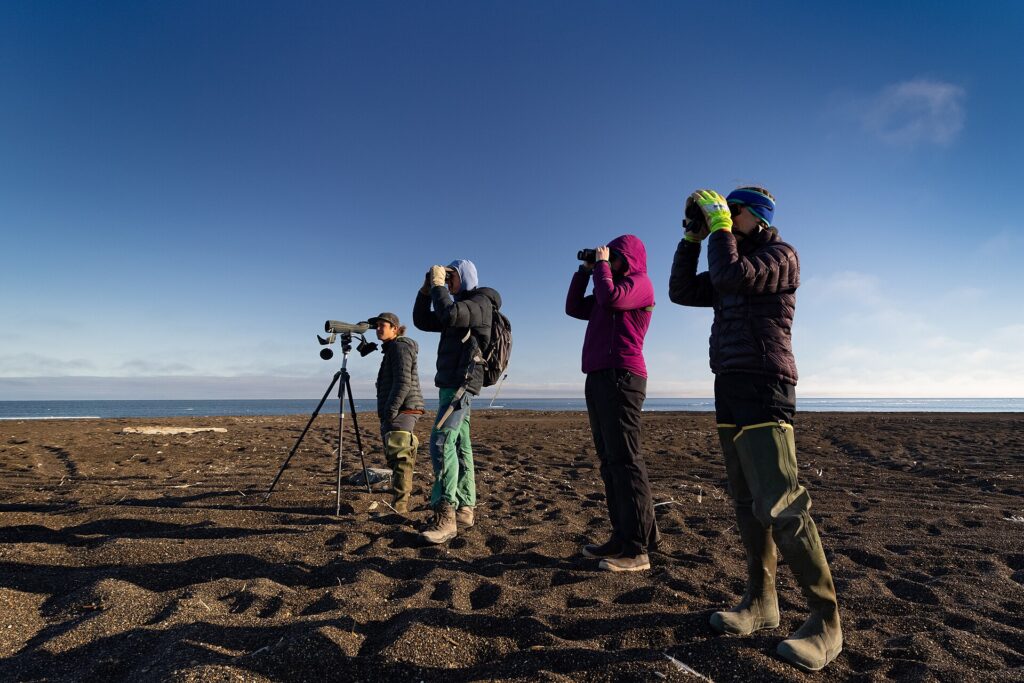
If you watch a lot of distant water birds, a spotting scope is worth considering alongside your binoculars. And once your new binoculars are around your neck, our free backyard bird ID chart (free printable, no signup) is a handy companion.
Bottom line
For most birders who want the best, the Swarovski NL Pure 8×42 has the widest view in this group. If weight matters most, the Zeiss SFL 8×40 or Nikon Monarch HG 8×42 are 6 to 9 ounces lighter than the heaviest 8x pairs. Choose the Vortex Razor UHD for close focus and its warranty, the Leica Noctivid if you bird in glasses, and the Canon 10×42 L IS only if you want stabilized 10x and can live with the weight and batteries.