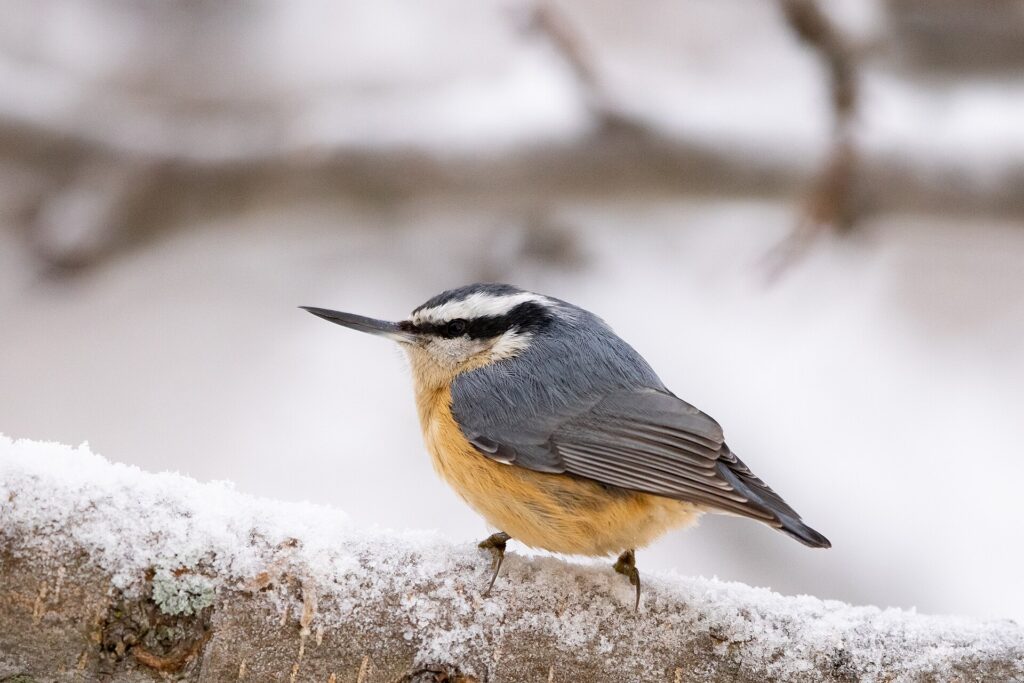
A gray bird with an orange belly is most often an American robin: gray-brown on top, warm orange below. If the bird is tiny, clings to bark or a suet feeder, and has a black-and-white striped head, it’s a red-breasted nuthatch. A soft orange breast with blue in the wings and tail points to a female bluebird. If the orange is only a peachy wash along the sides, under a pointed gray crest, you’re looking at a tufted titmouse. Out West, check two more: Say’s phoebe in open, dry country, and the varied thrush in winter yards near the Pacific Coast. And if the rust is only under the tail, it’s a gray catbird or a white-breasted nuthatch.
The short version
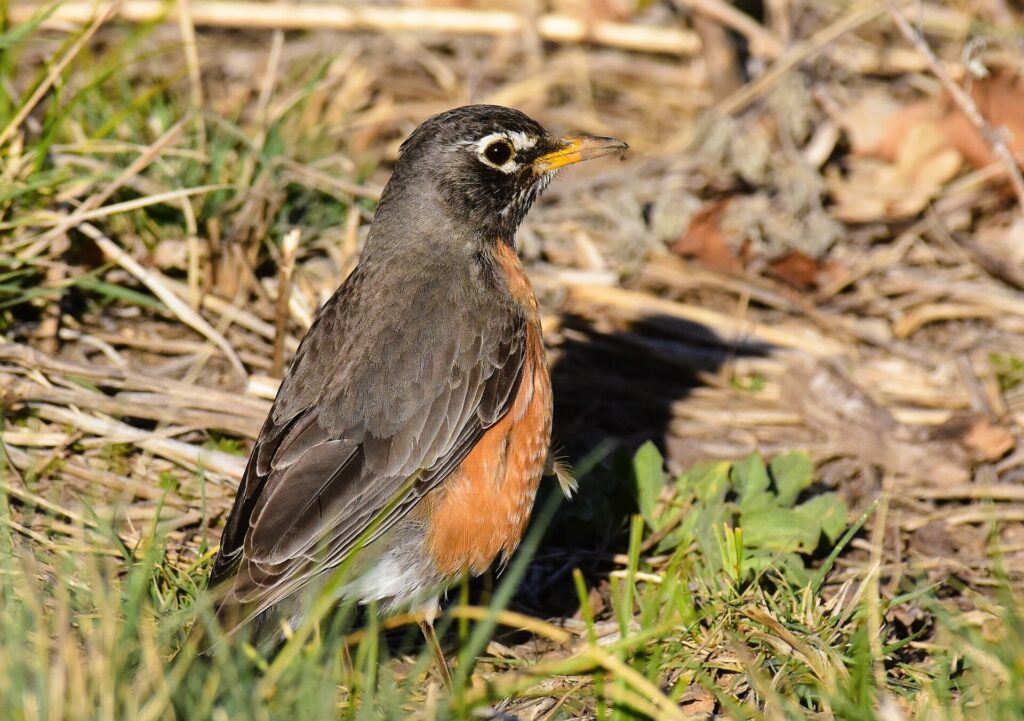
- Robin-sized, orange from throat to belly, dark head, yellow bill, on the lawn: American robin.
- Smaller, round-headed, grayish back, blue wings and tail, orange-brown breast: a female eastern or western bluebird.
- Tiny, short-tailed, rusty underparts, black-and-white striped head, climbing bark: red-breasted nuthatch.
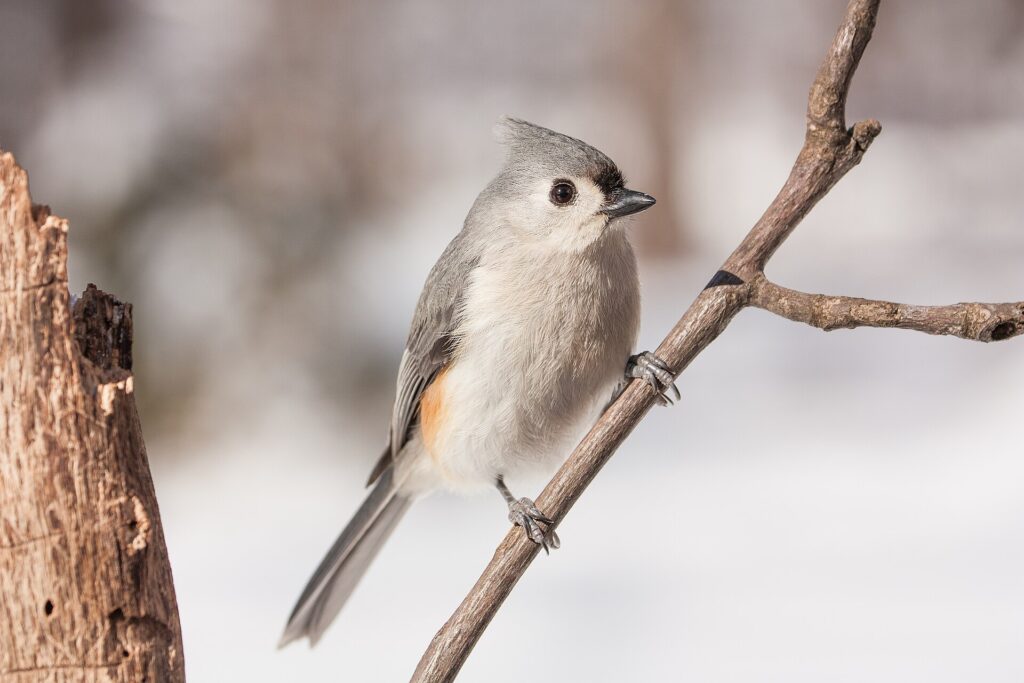
- Gray crest, white front, peach-orange only on the sides: tufted titmouse.
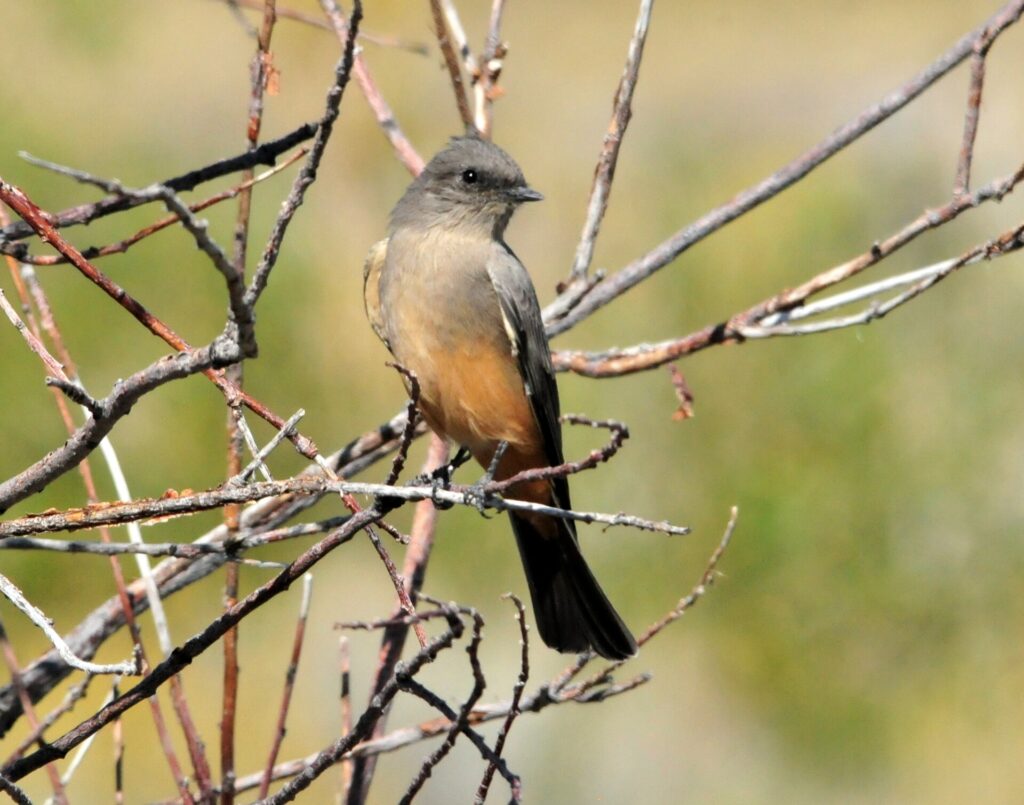
- Slim, brownish gray with a cinnamon belly, pumping its tail on a fence in dry, open country: Say’s phoebe.
- Orange and gray with a dark band across the breast and an orange eyebrow, out West in winter: varied thrush.
American robin: the most likely answer
Cornell Lab’s All About Birds describes robins as “gray-brown birds with warm orange underparts and dark heads.” They’re fairly large songbirds with a round body, long legs and a fairly long tail. Females have paler heads that contrast less with the gray back, so a female can look like a plain gray bird with an orange front. A white patch on the lower belly and under the tail can stand out when the bird flies.
Cornell says they bound across lawns or stand upright, and when they land they habitually flick the tail down several times. They’re common across the continent, in yards, parks, gardens and golf courses.
Robins don’t all leave in fall. Cornell notes that many spend the whole winter in their breeding range, but you’re less likely to see them because they spend more time roosting in trees and less time in your yard. In fall and winter they form large flocks, eat a lot of fruit and gather in trees to roost; Cornell says some winter roosts include a quarter-million birds.
Female eastern and western bluebirds: orange breast, blue in the wings
Male bluebirds are obviously blue. The females are the ones that read as gray. Cornell describes the female eastern bluebird as “grayish above with bluish wings and tail, and a subdued orange-brown breast.” The female western bluebird is “gray-buff with a pale orange wash on the breast,” with blue tints in the wings and tail.
Shape helps separate a bluebird from a robin. Cornell calls the eastern bluebird a small thrush with a big, rounded head, a large eye, a plump body and fairly short tail and legs, while the robin is a fairly large songbird. Bluebirds perch upright on wires, posts and low branches in open country, then drop to the ground to grab insects. In fall and winter they also perch in fruiting trees.
Eastern bluebirds occur across eastern North America. Western bluebirds live in the open parklands of the American West, including backyards, farmland and burned areas, and they usually feed in flocks outside the nesting season. Neither one comes to seed feeders much: Cornell says eastern bluebirds don’t often visit feeders unless you offer mealworms, and Project FeederWatch calls mealworms “one of the only food items that reliably attract bluebirds.” Our guide to bluebird feeders covers mealworm feeders.
Red-breasted nuthatch: tiny, rusty below, climbs in every direction
Cornell describes the red-breasted nuthatch as small and compact with a long, pointed bill, very short tail and almost no neck. It’s blue-gray above with a black cap and a black stripe through the eye, separated by a white stripe over the eye, and the underparts are rich rusty-cinnamon. Females have “grayer caps and paler rusty underparts,” per Cornell.
Watch how it moves. Red-breasted nuthatches creep up, down and sideways on trunks and branches without caring which way is up, and Cornell says this species often comes to bird feeders. Listen too: Cornell says their calls “sound like tiny tin horns being honked in the treetops.”
They’re mainly birds of coniferous woods and mountains, though in the Northeast they also use oak, maple, birch and other hardwood forests. Some years they show up far outside that range. Cornell says they move south in large numbers when cone crops fail, on a roughly two-year cycle, and in some years they reach as far as the Gulf Coast. Its cousin, the white-breasted nuthatch, has a white face and front; we compare the two in small gray bird with a black cap.
Tufted titmouse: orange only along the sides
Cornell describes it as silvery gray above and white below, with “a rusty or peach-colored wash down the flanks.” The pointed crest and a black patch just above the bill make it easy to confirm.
Tufted titmice live in most eastern woodlands below about 2,000 feet and don’t migrate. They’re common at feeders and in backyards, parks and orchards, often traveling with chickadees, nuthatches and woodpeckers. If your gray bird has a crest, our guide to the small gray bird with a crest covers the titmouse and its western look-alikes.
Say’s phoebe: cinnamon belly in open, dry country
Cornell describes Say’s phoebes as “pale brownish gray above with a cinnamon belly,” plus a gray breast and a blackish tail. It’s a slender, long-tailed flycatcher that looks large-headed for its size, and males and females look alike.
The behavior clue is the tail: like other phoebes, it often wags or pumps its tail while perched. It sits around eye level on exposed twigs and jumps up to snatch flying insects, so look for it on a fence, a shrub top or a building edge rather than at a seed feeder.
Habitat narrows it down. Say’s phoebes live in open country, sagebrush, badlands, dry foothills, canyons and desert edges, and Cornell says “they avoid forests.” Birds in the Southwest stay year-round. Those that nest in Alaska, Canada and the northern U.S. head south for the winter to the southwestern states or Mexico.
Varied thrush: burnt orange and gray in western winter yards
Cornell describes the male as dark blue-gray on the back and “rich burnt-orange below with a sooty-black breastband,” with an orange line over the eye and orange bars on blackish wings. Females have the same pattern in paler gray-brown. It’s a stocky, round-headed bird with long legs, so at a glance it can pass for a robin until you notice the breastband and the orange eyebrow.
Varied thrushes nest in dark, damp evergreen forests along the Pacific Coast, and they’re common in the Cascades and northern Rockies. In winter many move into parks, gardens and backyards, often south of their nesting range, and Cornell says they’ll eat seed from ground feeders. Elsewhere they’re “rare but regular winter visitors to the Upper Midwest and Northeast.”
Rust only under the tail or on the sides
Some gray birds have just a small rusty patch.
- Gray catbird: Cornell says catbirds look entirely slaty gray until you notice a small black cap, a blackish tail and “a rich rufous-brown patch under the tail.” They stay low in tangles and shrubs.
- White-breasted nuthatch: gray-blue back, white face and front, and per Cornell, “The lower belly and under the tail are often chestnut.” Like other nuthatches, it often turns sideways and upside down on trunks.
- Dark-eyed junco (western forms): the Oregon form of western North America has a dark hood and rufous flanks, and the pink-sided form around the Rocky Mountains has a slate-gray head and pinkish-brown sides. Both have a pink bill. More in our dark-eyed junco guide.
Side by side
| Bird | Where the orange is | Other clues | Where to look |
|---|---|---|---|
| American robin | Throat to belly, warm orange | Gray-brown back, dark head, yellow bill, white under the tail | Lawns and fruiting trees, across the U.S. |
| Female eastern bluebird | Breast, orange-brown | Grayish back, blue wings and tail, big round head | Wires and posts in open country, eastern U.S. |
| Female western bluebird | Breast, pale orange wash | Gray-buff, blue tints in wings and tail | Open woodland, farmland and yards, the West |
| Red-breasted nuthatch | Rusty-cinnamon underparts | Tiny, blue-gray, black-and-white striped head, very short tail | Conifers and feeders; farther south in irruption years |
| Tufted titmouse | Peach wash on the flanks only | Gray crest, black spot above the bill, white front | Eastern woodlands, backyards and feeders |
| Say’s phoebe | Cinnamon belly, gray breast | Brownish-gray, blackish tail that pumps | Open, dry country; year-round in the Southwest |
| Varied thrush | Burnt-orange throat and belly | Dark breastband, orange eyebrow and wing bars | Pacific Coast and northern Rockies; ground feeders in winter |
| Gray catbird | Rufous patch under the tail | All slate gray, small black cap, long black tail | Dense shrubs and tangles |
| White-breasted nuthatch | Chestnut under the tail | White face and front, black or gray cap | Tree trunks and large branches |
Four questions that narrow it down
- Where exactly is the orange? The whole front points to a robin, a varied thrush or a red-breasted nuthatch. A breast wash that fades into a pale belly fits a female bluebird. Orange on the sides only is a titmouse or a western junco, and a patch under the tail is a catbird or a white-breasted nuthatch.
- What shape is it? A big, round-bodied bird on long legs is a robin or a varied thrush. A small, compact bird with a very short tail is a nuthatch.
- What is it doing? Bounding across a lawn is classic robin. Dropping from a wire to the ground is a bluebird. Creeping on bark is a nuthatch, and pumping its tail on a fence is a phoebe.
- Where are you? In the East, start with the robin, eastern bluebird, titmouse and red-breasted nuthatch. In the West, add the western bluebird, Say’s phoebe, varied thrush and Oregon junco.
For birds of every color in one place, our printable backyard bird ID chart by color groups the common feeder birds so you can match what you saw.
What they eat at feeders in winter
Project FeederWatch says chickadees, titmice, wrens and nuthatches “relish” mealworms, and that smaller birds like chickadees, nuthatches and titmice do well with shelled peanuts. It calls suet “a good choice for attracting insect-eating birds”; our suet feeder guide covers the main styles.
Robins, bluebirds and catbirds are fruit eaters. FeederWatch lists all three among the birds likely to eat fruit and suggests grapes and raisins without preservatives. Varied thrushes eat seed from ground feeders, and Cornell says planting native fruiting shrubs is another good way to draw them in. For a full rundown of winter foods, see what to feed birds in winter.
Common questions
What bird looks like a robin but is smaller? Usually a female eastern or western bluebird: grayish above with an orange-brown or pale orange breast, but with blue in the wings and tail and a rounder head.
Is a robin gray or brown? Both. Cornell calls it gray-brown above, and females have paler heads, so many look grayer than people expect.
What small gray bird has a rusty belly and a black stripe through the eye? The red-breasted nuthatch. Look for the white stripe above the black eye line and the very short tail.
What gray bird with an orange belly lives in the desert? Most likely a Say’s phoebe. It favors open, dry country, stays year-round in the Southwest and pumps its tail when perched.
Do robins stay north all winter? Many do. Cornell says many robins spend the whole winter in their breeding range, but they spend more time in trees and less time in yards, so they’re harder to spot.
Still stuck on a gray bird? Try 18 common gray birds and how to tell them apart.
Bottom line
A gray bird with an orange belly is a robin most of the time, especially if it’s on the lawn or in a berry tree. Smaller with blue in the wings means a female bluebird. Tiny, climbing bark and rusty underneath is a red-breasted nuthatch, and orange only along the sides of a crested bird is a tufted titmouse. Out West, add Say’s phoebe in dry, open country and the varied thrush in winter. Note where the orange sits, how big the bird is and what it’s doing, and you’ll have your answer in seconds.