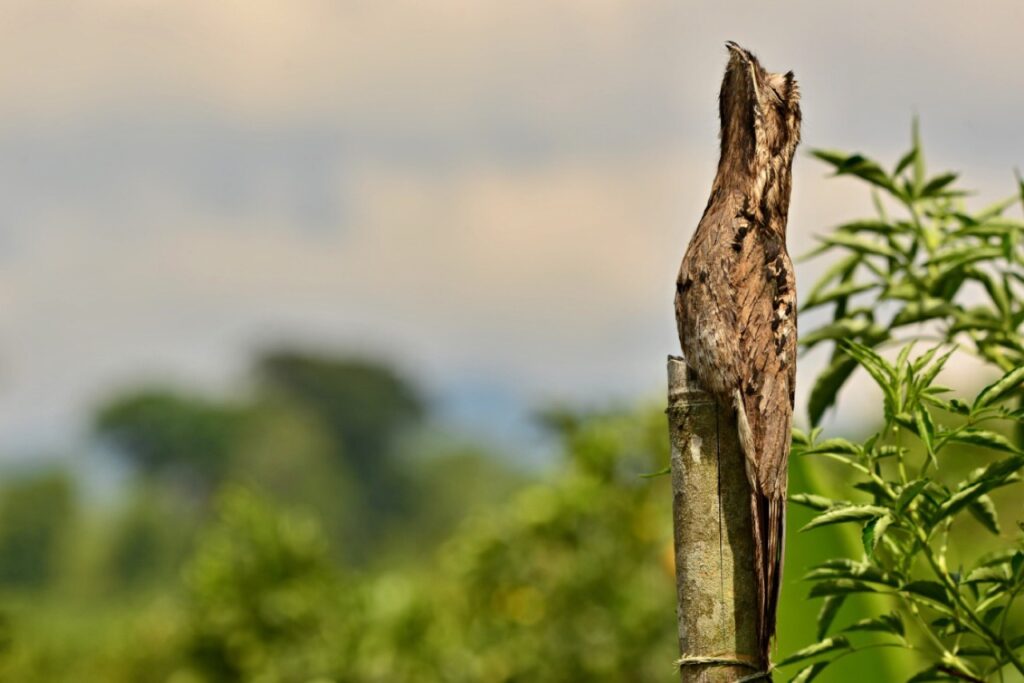
A potoo is a big-eyed night bird from tropical America that spends its days pretending to be a broken branch. It sits bolt upright on a stump or post, points its bill at the sky, closes its eyes and simply doesn’t move, and its gray-brown, bark-patterned feathers do the rest. At night the same bird opens a huge mouth and snaps moths and other flying insects out of the air. That combination, a stick by day and a goggle-eyed cartoon face when it looks at a camera, is why potoos keep going viral. Here’s what they are, how big they get, why they look the way they do, and whether you can see one in the United States.
The short version
- What it is: one of seven species of potoo, a family of nocturnal birds found from Mexico and the Caribbean through Central and South America. They are related to nightjars, not owls.
- Why it looks like a branch: by day a potoo freezes on an exposed perch with its head up and eyes shut, and its mottled feathers match the wood.
- Why it looks so strange up close: very large eyes and a wide mouth that stays mostly hidden until it opens.
- How big: from under 10 inches (rufous potoo) to nearly two feet (great potoo), per American Bird Conservancy.
- Can you see one in the US? Not in the wild. The closest wild potoos live in Mexico. The nearest look-alikes in the US are nightjars like the common nighthawk and whip-poor-will.
How big is a potoo?
Potoos look enormous in viral photos because the camera is usually close and the bird is all eyes and fluff. To put real numbers on it, we charted the published body lengths of two potoos next to night birds that live in the US, using Animal Diversity Web for the great potoo, the University of the West Indies’ animal guide for the common potoo, and the Cornell Lab of Ornithology’s All About Birds for the US species.
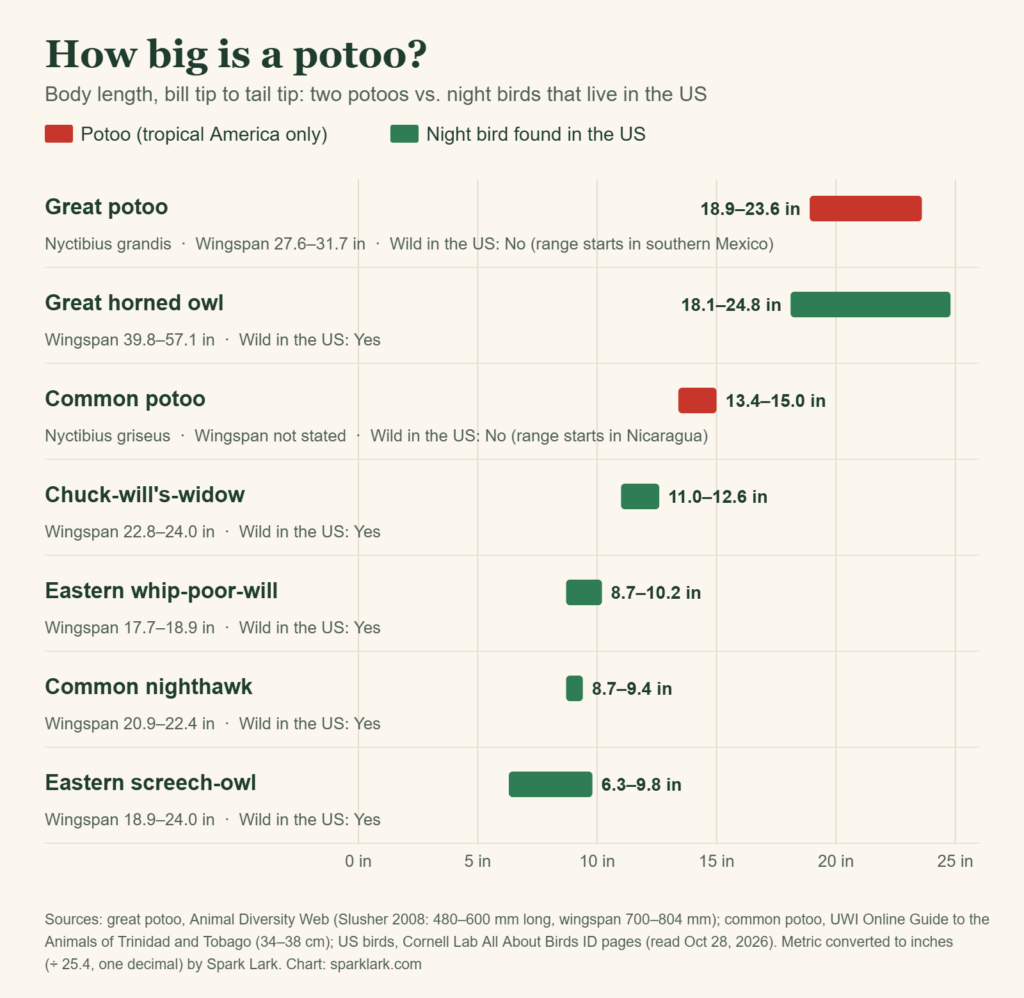
Source and method: great potoo length 480–600 mm and wingspan 700–804 mm (Animal Diversity Web, Slusher 2008); common potoo length 34–38 cm (UWI Online Guide to the Animals of Trinidad and Tobago); US birds from Cornell Lab All About Birds ID pages, read Oct 28, 2026. Metric values converted to inches (÷ 25.4, one decimal) by Spark Lark. No wingspan was given for the common potoo in the source we read.
The takeaway: a great potoo is about as long as a great horned owl, though its wings are far shorter, so in person it’s a big bird. A common potoo is a little longer than a chuck-will’s-widow, one of the US nightjars. And the smallest potoo, the rufous potoo, is under 10 inches, close to the size of an eastern whip-poor-will.
What is a potoo, exactly?
Potoos make up their own small family, Nyctibiidae, with two genera and seven living species. American Bird Conservancy lists them as the great, long-tailed, common, northern, Andean, white-winged and rufous potoos. They live in tropical forests and savannas from Mexico and the Caribbean south through Central and South America, and fossils show the family once lived in Europe too.
Big eyes, night habits and bark-colored feathers make it easy to mistake a potoo for an owl, but it isn’t one. Their closest relatives are the nightjars, the family that includes the common nighthawk and the whip-poor-will. American Bird Conservancy describes a potoo as “little more than a flying mouth and eyes.”
The common potoo lives in the lowlands of southern Central America and northern and central South America, from Nicaragua south to Argentina and Uruguay, according to the Cornell Lab’s Neotropical Birds account. It uses forest edges, open woodland, tall second growth, plantations and clearings, locally up to about 5,900 feet (1,800 m).
Why does a potoo look like a branch?
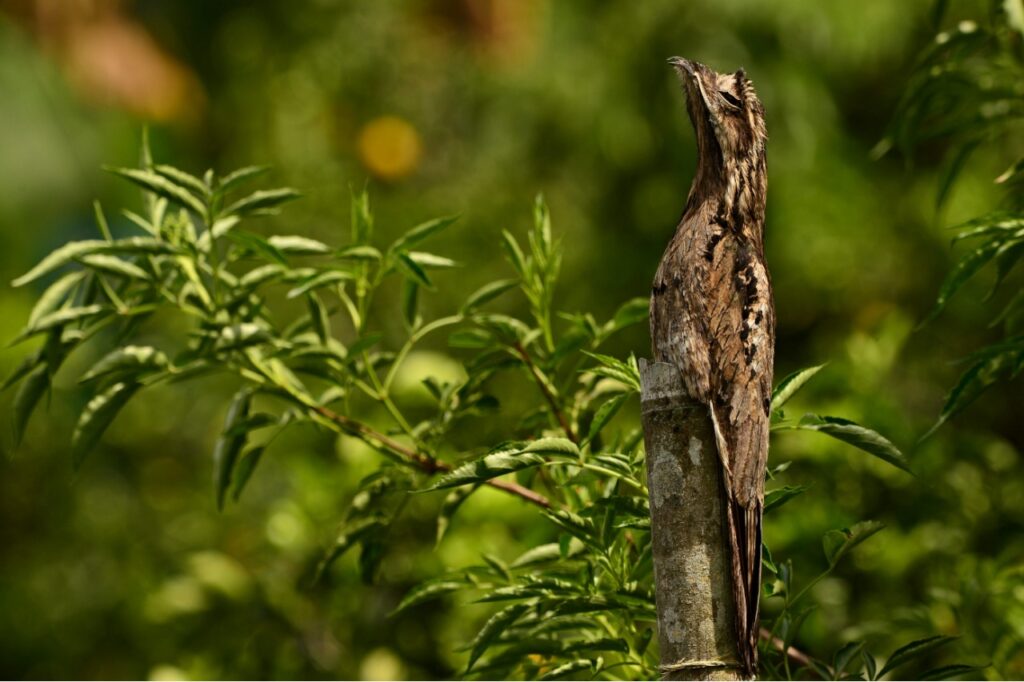
Camouflage is the potoo’s whole defense. By day it sits motionless on a snag, a broken branch or a fence post, where its gray, brown and black mottling matches the wood. According to the Neotropical Birds account, a relaxed potoo sits shorter and stouter with its bill forward. When it senses it is being watched, it slowly stretches its body, flattens its feathers and raises its head, with no other visible movement, until it reads as the end of a broken limb.
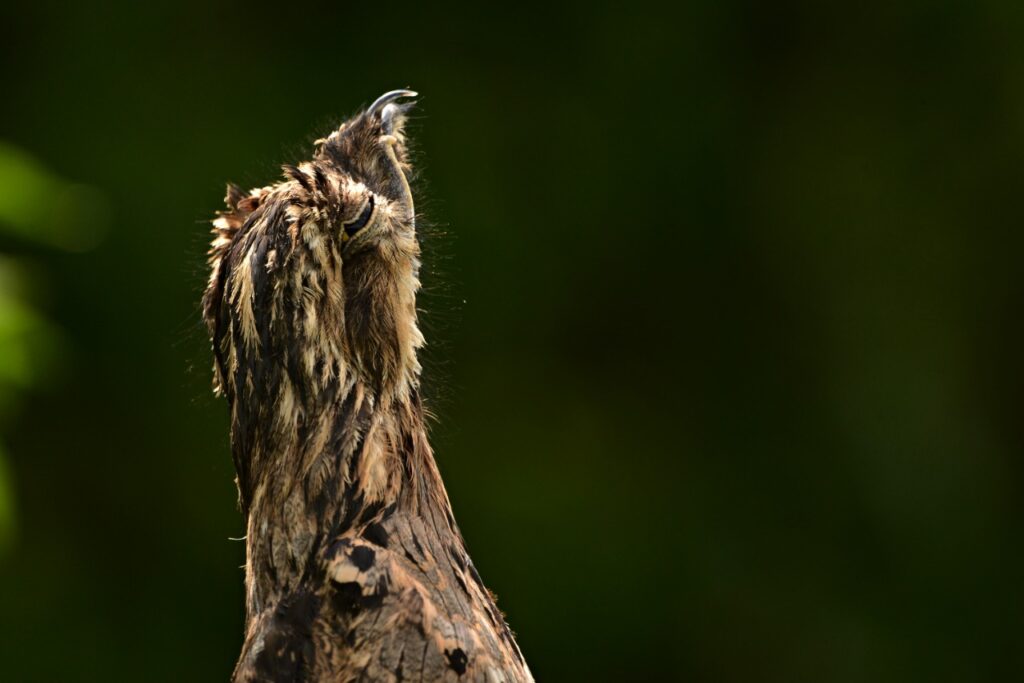
A potoo may use the same daytime roost for months at a time, per the Neotropical Birds account, which is part of why so many potoo photos are taken in broad daylight.
The eyelid trick. Shutting the eyes hides the potoo’s biggest giveaway, but it doesn’t leave the bird blind. American Bird Conservancy and Tetrapod Zoology author Darren Naish both describe small slits or notches in the eyelids that let a potoo keep track of what’s around it with its eyes closed.
Why potoos went viral
Potoos have been an internet staple for more than a decade. Writing on his Tetrapod Zoology blog in 2019, Darren Naish traced the craze to Imgur memes around 2014 and, above all, to a set of photos of a great potoo on a fence that spread widely in 2015. Those pictures, apparently taken in Venezuela in 2013, were reused in a made-up story about a “dinosaur owl” brought back from ancient DNA, and some viewers insisted the bird was an alien or a stuffed specimen. It was just a potoo looking at the camera.
The fame keeps renewing itself. In March 2024, Good Good Good reported that a family’s video of a potoo, posted to TikTok, reached about 5 million views overnight, under the nickname “ghost bird.” The appeal is the contrast: in one frame the bird is a stick, and in the next it opens its eyes and turns into a wide-eyed, wide-mouthed puppet.
That huge mouth: what potoos eat
Potoos hunt at night from open perches. A potoo scans with frequent head movements until it spots a large insect, flies out to grab it in the air, and often returns to the same perch, according to the Neotropical Birds account. The University of the West Indies’ guide lists ants, termites, moths, grasshoppers and crickets in the common potoo’s diet. American Bird Conservancy notes that potoos occasionally take bats and small birds, and that the great potoo is the species known for it.
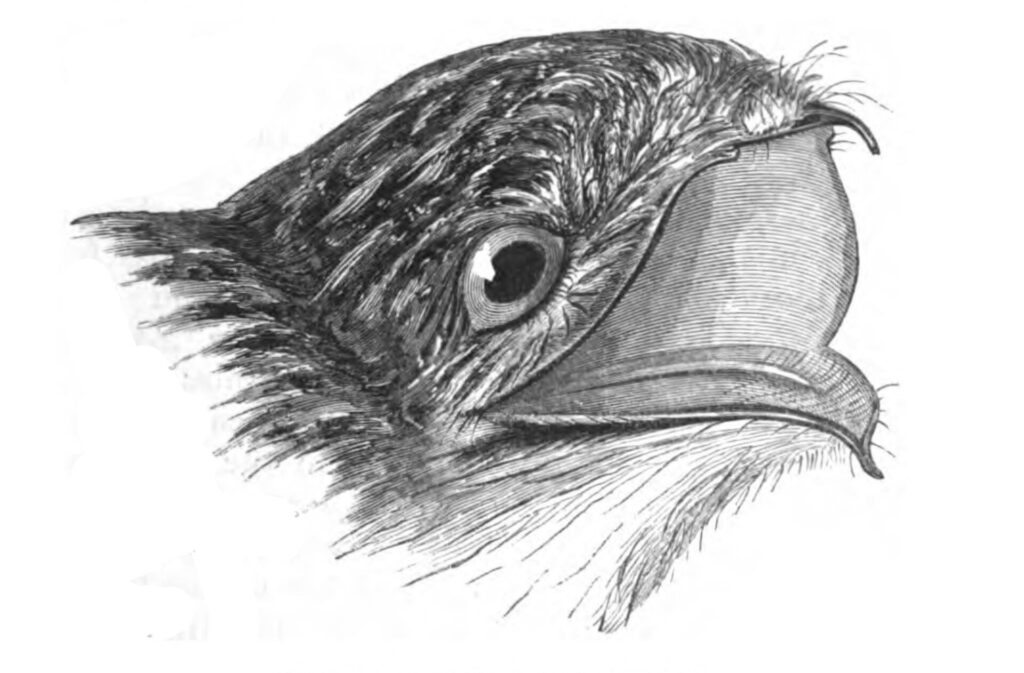
The mouth is the part you rarely see. Naish points out that the wide gape is almost entirely hidden when the bill is closed, which is why a resting potoo looks like it has a tiny beak, and why the open-mouthed photos are so startling.
What does a potoo sound like?
Each potoo species has its own call, and several are famous for sounding eerie in the dark. A few, as described by the sources we read:
- Common potoo: a haunting, descending song, often about eight notes that start loud and fade, heard most on moonlit nights. Its mournful sound earned it the nickname “poor-me-one.”
- Great potoo: a deep, reverberating roar; Animal Diversity Web describes a frog-like “baaaao” and an eerier “whoap.”
- Northern potoo: a gruff, guttural “kwaaaaaa-kwa, kwa.”
If you like night sounds you can hear closer to home, see our guide to night birds that sound like squeaky toys and how to identify birds by their songs and calls.
No nest, one egg on a branch
Potoos don’t build nests. The common potoo lays a single white, flecked egg in a small dip on a sloping branch, usually about 10 to 65 feet (3 to 20 m) up, or sometimes on top of a stump. Both parents incubate, and in some reports the male takes the daytime shift. The egg hatches after about 30 to 33 days, and the young bird leaves at roughly 40 to 47 days, according to the Neotropical Birds account.
The chick has its own disguise. A 2014 AAAS piece notes that fuzzy white potoo chicks, frozen in place, look like clumps of tree fungus.
Can you see a potoo in the US?
In the wild: no. No potoo species lives in the United States. The closest is the northern potoo, whose range reaches north to southern Sinaloa on Mexico’s Pacific side and southern Tamaulipas on the Gulf side, plus Cuba, Jamaica and Hispaniola, per the Neotropical Birds account. The great potoo ranges from southern Mexico to Bolivia. None of the range descriptions we read mention a US record.
In zoos: we could not confirm, from any zoo’s own website, a US zoo currently showing a potoo. If you want to see one, check the bird or nocturnal-animal lists of large zoos and aquariums with tropical exhibits, or call ahead before you go.
The US look-alikes: you don’t need to leave the country to see the same trick. The common nighthawk, a nightjar and the potoo’s relative, roosts motionless on a tree branch, fence post or the ground during the day and is very difficult to see, according to All About Birds. And the eastern screech-owl, a true owl, has bark-patterned feathers that give it excellent camouflage against a tree trunk. A good pair of binoculars helps; see our binocular picks for birding.
Are potoos endangered?
Not at the moment. American Bird Conservancy says none of the seven potoo species is considered threatened, but all seven are declining, partly from habitat loss as tropical forests are cleared.
Potoo FAQ
Is a potoo an owl? No. Potoos are their own family, related to nightjars such as the nighthawk and whip-poor-will. They share the owl’s night hours and big eyes, not its ancestry. (Curious about the real owls? See what owls eat.)
Why do potoos close their eyes? Open eyes are the easiest thing for a predator to spot. Slits in the eyelids let a potoo keep watch while its eyes look shut.
How big is the biggest potoo? The great potoo, at about 19 to 24 inches long with a wingspan of roughly 28 to 32 inches (Animal Diversity Web).
Are potoos dangerous? No. They eat insects and occasionally bats or small birds, and Good Good Good notes they pose no risk to people.
Where do potoos live? Mexico, the Caribbean, and Central and South America, in tropical forests, forest edges and savannas.
Bottom line
The potoo is a real bird with a real survival plan: freeze, point your bill at the sky, close your eyes and become a branch, then come out at night as a big-mouthed insect hunter. You can’t find one wild in the US, but its relative the common nighthawk pulls off a similar disappearing act on branches and fence posts here. For more internet-famous birds, see why a wet owl looks so skinny and meet the fluffy shima enaga. And if you want to catch your own backyard birds on video, start with our guide to the best bird cameras.